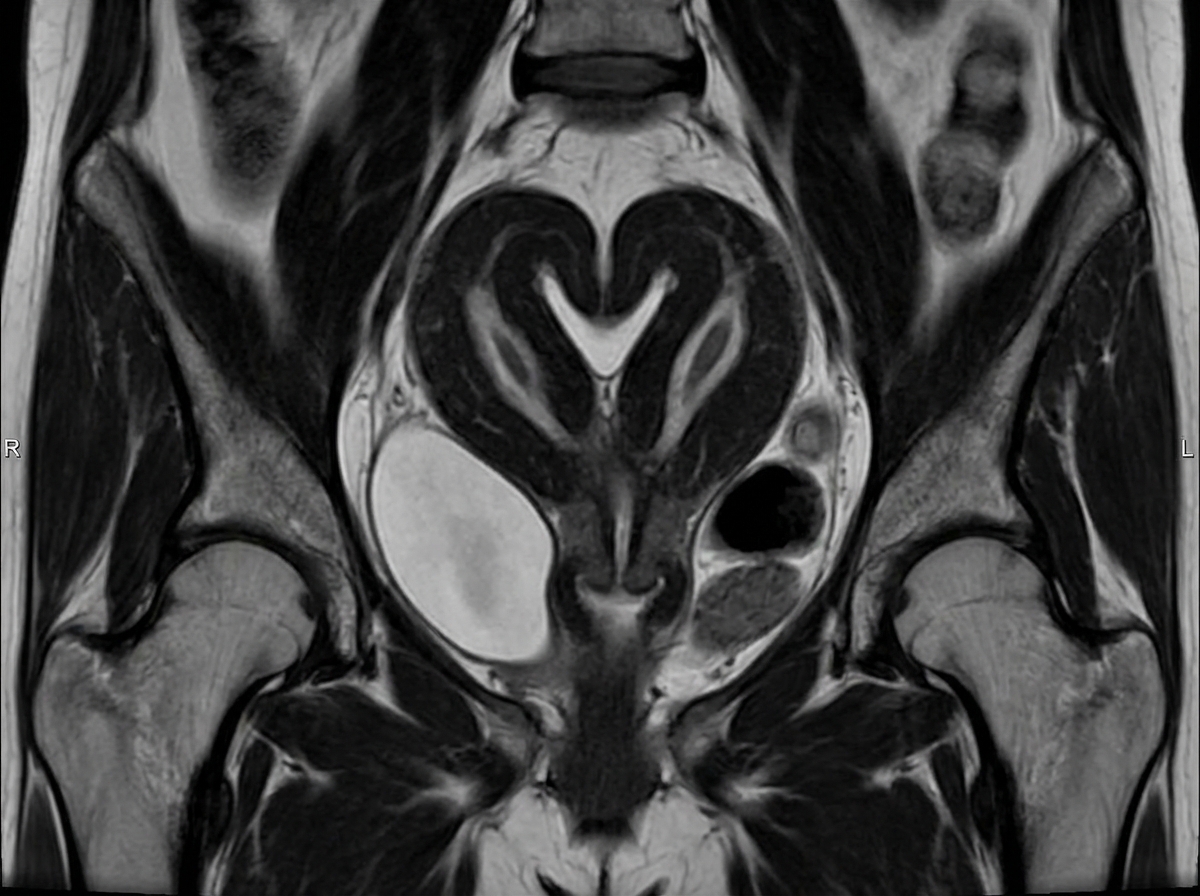
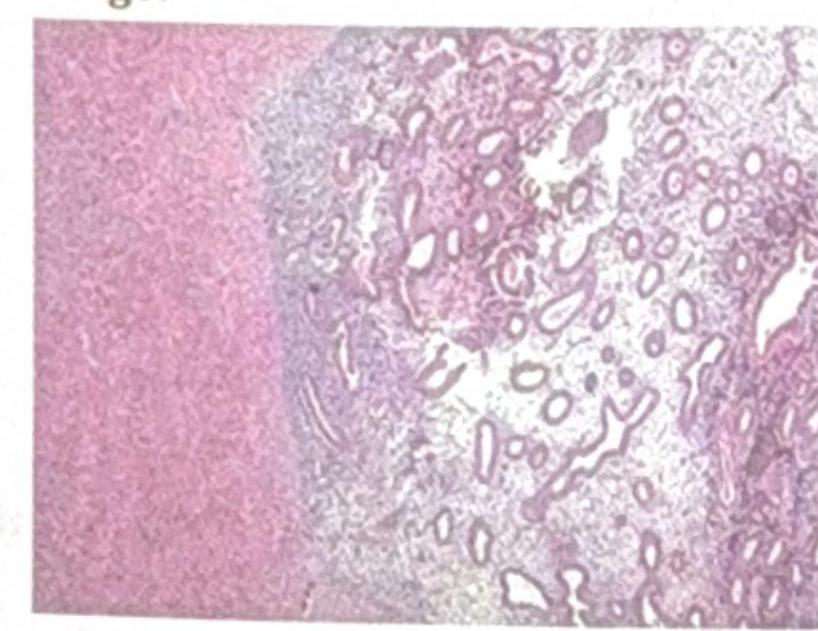
OB/GYN
7 questionsA 45-year-old woman presents with a history of cervical erosion and spotting for the past 2 months. What is the next best step?
A GSP4 woman comes for routine sonography for the first time. She has four daughters and expresses a desire for a boy this time, asking for sex determination. To abide by ethical guidelines, what should you do?
A young woman presents with prolapse, and a mesh is being placed. Where is this mesh typically fixed to?
Which of the following is a tumor marker associated with ovarian solid-cystic masses?
A 32-year-old woman presents with a new 2 cm black nodular mass near her episiotomy scar. She reports that the mass is painful and tends to increase in size during menstruation. What is the most likely diagnosis?
A teenage girl presents with a history of amenorrhea. Local examination is shown in the image. What karyotype analysis would you consider for further evaluation?

A female presents with postcoital bleeding. Which of the following is the most appropriate investigation?
NEET-PG 2024 - OB/GYN NEET-PG Practice Questions and MCQs
Question 91: A 45-year-old woman presents with a history of cervical erosion and spotting for the past 2 months. What is the next best step?
- A. LBC + HPV (Correct Answer)
- B. Pap smear + HSV
- C. Pap smear + HBV
- D. LBC + HSV
Explanation: ***LBC + HPV*** - Cervical erosion and spotting are concerning for **cervical intraepithelial neoplasia (CIN)** or **cervical cancer**, making **Liquid-Based Cytology (LBC)** the appropriate screening method. - **Human Papillomavirus (HPV) testing** is crucial as persistent high-risk HPV infection is the primary cause of cervical cancer and helps in risk stratification and management. *Pap smear + HSV* - A **routine Pap smear** (conventional cytology) is less sensitive than LBC for detecting abnormal cervical cells and is generally being phased out by LBC. - **Herpes Simplex Virus (HSV)** causes genital herpes and is not directly associated with cervical cancer, thus testing for it in this context is not the most appropriate immediate next step. *Pap smear + HBV* - As mentioned, a **routine Pap smear** is not the preferred method for cervical cancer screening compared to LBC. - **Hepatitis B Virus (HBV)** causes liver disease and is entirely unrelated to cervical pathology; therefore, testing for it would be irrelevant to the patient's symptoms. *LBC + HSV* - While **LBC** is the correct advanced cytology method, adding **HSV testing** is not indicated as HSV does not cause cervical cancer or intraepithelial lesions that present with cervical erosion and spotting. - Focus should be on identifying potential malignancy or pre-malignant changes with HPV co-testing, not sexually transmitted infections unrelated to cancer risk.
Question 92: A GSP4 woman comes for routine sonography for the first time. She has four daughters and expresses a desire for a boy this time, asking for sex determination. To abide by ethical guidelines, what should you do?
- A. Check routine ANC and sex for developmental abnormalities and do not reveal gender to the patient (Correct Answer)
- B. Check routine ANC and sex for developmental abnormalities and do reveal gender to the patient
- C. Do reveal gender if a girl
- D. Check only routine ANC, do not check sex
Explanation: ***Check routine ANC and sex for developmental abnormalities and do not reveal gender to the patient*** - It is **illegal** and **unethical** to reveal the sex of the fetus in many countries, including India, to prevent **sex-selective abortions**. - The primary purpose of a routine antenatal ultrasound is to assess fetal **health** and **developmental abnormalities**, not to determine sex for parental preference. *Check routine ANC and sex for developmental abnormalities and do reveal gender to the patient* - Revealing the gender to the patient directly facilitates **sex-selective abortion**, which is medically unethical and illegal due to the potential for harm to the fetus and society. - This practice would violate the **Pre-Conception and Pre-Natal Diagnostic Techniques (PCPNDT) Act** in India, which prohibits gender determination. *Do reveal gender if a girl* - Revealing the gender, regardless of whether it is a boy or a girl, can lead to **gender-biased selective abortions**, particularly in cultures with a strong preference for male offspring. - This action undermines the ethical principles of **non-maleficence** and **justice** by potentially facilitating harm based on gender preference. *Check only routine ANC, do not check sex* - While the primary focus is routine antenatal care, avoiding the assessment of fetal sex entirely could lead to **missing potential developmental abnormalities** that might be identifiable through observation of external genitalia. - A thorough ultrasound examination routinely includes a visual check of fetal anatomy, which can incidentally reveal gender, but this information should not be shared with the parents for selection purposes.
Question 93: A young woman presents with prolapse, and a mesh is being placed. Where is this mesh typically fixed to?
- A. Ischial spine
- B. Ischial tuberosity
- C. Sacral promontory (Correct Answer)
- D. Pubic symphysis
Explanation: ***Sacral promontory*** - In **sacrocolpopexy**, a common surgical procedure for vaginal prolapse, a mesh is attached from the vaginal apex to the **anterior longitudinal ligament** overlying the **sacral promontory**. - This anatomical landmark provides a strong, stable point of fixation to support the vagina and prevent recurrence of prolapse. *Ischial spine* - The **ischial spine** is a common landmark for identifying the **pudendal nerve** and for performing a **pudendal nerve block**, not for mesh fixation in prolapse repair. - It is also relevant in measuring the **interspinous diameter** of the pelvis during childbirth, but not for surgical mesh attachment in this context. *Ischial tuberosity* - The **ischial tuberosity** is the bony prominence on which one sits and is an attachment point for various muscles of the **thigh** and **pelvic floor**. - It is not used as a primary fixation point for mesh in vaginal prolapse repair due to its position and lack of direct support for the vaginal apex. *Pubic symphysis* - The **pubic symphysis** is a cartilaginous joint connecting the two **pubic bones** in the anterior pelvis. - While part of the pelvic framework, it does not provide the appropriate superior posterior support needed for **vaginal apex suspension** in prolapse surgery.
Question 94: Which of the following is a tumor marker associated with ovarian solid-cystic masses?
- A. CEA
- B. HCG
- C. HER2/neu
- D. AFP (Correct Answer)
Explanation: ***AFP (Alpha-fetoprotein)*** - **AFP** is a reliable tumor marker for differentiating **germ cell tumors**, especially **yolk sac tumors**, which often present as an ovarian solid-cystic mass. - Elevated **AFP** levels help in diagnosis, monitoring treatment response, and detecting recurrence of these specific ovarian malignancies. *CEA (Carcinoembryonic antigen)* - **CEA** is primarily associated with **gastrointestinal cancers**, such as colorectal cancer, and is less specific for ovarian masses. - While it can be elevated in some mucinous ovarian carcinomas, it's not the most specific marker for a general solid-cystic ovarian mass. *HCG (Human chorionic gonadotropin)* - **HCG** is a key marker for **gestational trophoblastic disease** and some **germ cell tumors**, such as choriocarcinoma. - It is not typically elevated in most common solid-cystic ovarian masses, especially those of epithelial origin. *HER2/neu (Human Epidermal growth factor Receptor 2)* - **HER2/neu** is primarily associated with **breast cancer** and some gastric cancers, playing a role in targeted therapy. - It is not a standard tumor marker for the general evaluation or diagnosis of ovarian solid-cystic masses.
Question 95: A 32-year-old woman presents with a new 2 cm black nodular mass near her episiotomy scar. She reports that the mass is painful and tends to increase in size during menstruation. What is the most likely diagnosis?
- A. Melanoma
- B. Foreign body granuloma
- C. Inclusion cyst
- D. Endometriosis (Correct Answer)
Explanation: ***Endometriosis*** - The location near an **episiotomy scar**, the **painful black nodular mass**, and its tendency to **increase in size during menstruation** are highly characteristic of an **episiotomy scar endometriosis**, also known as cutaneous endometriosis. - This condition involves the presence of **endometrial tissue** outside the uterus, which responds to hormonal fluctuations, explaining the cyclical pain and size changes. *Melanoma* - While a **black nodular mass** could suggest melanoma, the key differentiating factor here is the **cyclical pain and growth with menstruation**, which is not typical for melanoma. - Melanoma is a **malignant tumor** of melanocytes and usually presents with irregular borders, asymmetry, and color variation, without a direct correlation to the menstrual cycle. *Foreign body granuloma* - A **foreign body granuloma** is an inflammatory reaction to non-degradable foreign material, which could be seen at a surgical site like an episiotomy. - However, this condition typically doesn't exhibit the **cyclical pain and growth with menstruation** that is a hallmark of endometriosis. *Inclusion cyst* - An **inclusion cyst** is a benign cyst that develops when epithelial cells become trapped under the skin surface after trauma or surgery. - While it can occur at an episiotomy site, it is usually a **slow-growing mass** that is typically painless (unless infected) and does not fluctuate in size or pain with the menstrual cycle.
Question 96: A teenage girl presents with a history of amenorrhea. Local examination is shown in the image. What karyotype analysis would you consider for further evaluation?
- A. 46 XY
- B. 46 XX
- C. 45 XO (Correct Answer)
- D. 47 XXY
- E. 47 XXX
Explanation: ***45 XO*** - The image shows a **webbed neck** and **short stature** (suggested by the overall body proportions typically associated with Ullrich-Turner Syndrome), alongside primary amenorrhea, which are classic features of **Turner Syndrome**. - **Turner Syndrome** is a chromosomal disorder characterized by the absence of all or part of one X chromosome in females, resulting in a **45, XO karyotype**. *46 XY* - This karyotype indicates a **phenotypic male** with normal male chromosomal constitution. - Individuals with this karyotype would not typically present with **primary amenorrhea** as they do not have a uterus. *46 XX* - This is the **normal female karyotype**, and while a female with this karyotype could experience amenorrhea (e.g., due to Asherman's syndrome or PCOS), the physical features associated with the image (like webbed neck) are not consistent. - This option does not explain the **physical stigmata** often seen in genetic causes of primary amenorrhea, such as in Turner syndrome. *47 XXY* - This karyotype is characteristic of **Klinefelter Syndrome**, which affects males and is associated with hypogonadism and gynecomastia. - It would not be found in a female patient presenting with **amenorrhea** and the physical features shown in the image. *47 XXX* - This karyotype represents **Triple X Syndrome** (Trisomy X), which affects females and typically presents with **normal female appearance** and often normal fertility. - While some individuals may have menstrual irregularities, the **distinctive physical features** shown in the image (webbed neck, short stature) are not characteristic of Triple X syndrome, which usually lacks specific dysmorphic features.
Question 97: A female presents with postcoital bleeding. Which of the following is the most appropriate investigation?
- A. Pap smear, HCV DNA, electrophoresis
- B. Liquid-based cytology, cervical biopsy
- C. Cervical biopsy, HBV DNA
- D. Pap smear, HPV DNA testing (Correct Answer)
Explanation: **Pap smear, HPV DNA testing** - **Postcoital bleeding** is a classic symptom of **cervical cancer**, which can be identified by a **Pap smear** to detect abnormal cervical cells. - **HPV DNA testing** is essential as persistent infection with high-risk human papillomavirus (HPV) genotypes is the primary cause of cervical cancer. *Pap smear, HCV DNA, electrophoresis* - While a **Pap smear** is appropriate for cervical cytology, **HCV DNA testing** is for Hepatitis C virus infection and is not routinely indicated for postcoital bleeding. - **Electrophoresis** is used to analyze proteins (e.g., hemoglobinopathies) and has no direct role in evaluating postcoital bleeding or cervical pathology. *Liquid-based cytology, cervical biopsy* - **Liquid-based cytology** is a method of preparing a Pap smear, but it's not a standalone investigation. - A **cervical biopsy** is a more invasive procedure done *after* initial screening (like Pap smear with HPV testing) suggests abnormalities, not as a primary first-line investigation for postcoital bleeding unless there are visible lesions. *Cervical biopsy, HBV DNA* - A **cervical biopsy** is typically performed following an abnormal **Pap smear** or colposcopy findings, not as the initial diagnostic step for postcoital bleeding. - **HBV DNA testing** is for Hepatitis B virus infection and is irrelevant to the workup of postcoital bleeding.
Orthopaedics
2 questionsThe image shows a pediatric fracture involving the growth plate. Which classification system and stage best describes this fracture?

Identify the implant shown in the image:

NEET-PG 2024 - Orthopaedics NEET-PG Practice Questions and MCQs
Question 91: The image shows a pediatric fracture involving the growth plate. Which classification system and stage best describes this fracture?
- A. Gartland 3
- B. Salter Harris 3 (Correct Answer)
- C. Gartland 2
- D. Salter Harris 2
Explanation: ***Salter Harris 3*** - The image shows a **fracture extending from the epiphyseal surface down through the growth plate (physis) and exiting through the epiphysis** into the joint. This configuration is characteristic of a Salter-Harris type III fracture. - Salter-Harris Type III fractures disrupt the **articular cartilage** and can have a poorer prognosis due to potential joint incongruity and growth disturbance if not properly reduced. *Gartland 3* - The **Gartland classification** is specifically used for **supracondylar fractures of the humerus** in children, which is a different type of fracture involving the distal humerus metaphysis, not typically the growth plate itself in this manner. - Gartland type 3 refers to a **completely displaced supracondylar fracture** with no cortical contact, involving the metaphysis proximal to the growth plate. *Gartland 2* - **Gartland type 2** describes a **displaced supracondylar fracture** with an intact posterior cortex, also referring to a fracture of the distal humerus metaphysis, not a trans-growth plate fracture. - This classification is not applicable to the image which clearly depicts a fracture involving the epiphysis and physis. *Salter Harris 2* - A **Salter-Harris type II fracture** involves the **physis and extends into the metaphysis**, creating a triangular fragment known as the "Thurston Holland sign." - In the provided image, the fracture line clearly extends into the **epiphysis**, not just the metaphysis, distinguishing it from a Salter-Harris type II.
Question 92: Identify the implant shown in the image:
- A. Dynamic hip screw (Correct Answer)
- B. Cannulated hip screw
- C. Condylar hip screw
- D. Intramedullary nail
Explanation: ***Dynamic hip screw*** - The image shows a **lag screw** inserted into the femoral neck and head, which slides within a **side plate** attached to the femoral shaft with cortical screws. - This construct allows for controlled **dynamic collapse** and impaction at the fracture site, promoting healing and providing stable fixation for **extracapsular hip fractures**. *Cannulated hip screw* - Cannulated screws are typically used in a **parallel configuration** or as a single large screw for hip fractures, particularly **femoral neck fractures**. - They do not feature a **side plate** that extends down the femoral shaft for additional fixation. *Condylar hip screw* - A condylar hip screw (DCS) is used for **distal femur fractures**, often extending into the **condyles**. - It involves a different angulation and design compared to the proximal femoral implant seen, which is fixed to the femoral shaft. *Intramedullary nail* - An intramedullary nail is inserted into the **medullary canal** of the bone, running through its center. - While some hip nails (e.g., trochanteric nails) have a cephalic screw component, they primarily stabilize the shaft from within, unlike the **extracortical side plate** seen here.
Surgery
1 questionsTubectomy is typically performed on which part of the fallopian tube and why?
NEET-PG 2024 - Surgery NEET-PG Practice Questions and MCQs
Question 91: Tubectomy is typically performed on which part of the fallopian tube and why?
- A. Ampulla - uniform thickness of muscle
- B. Ampulla - widest
- C. Isthmus - uniform thickness of muscle
- D. Isthmus - narrowest (Correct Answer)
Explanation: ***Isthmus - narrowest*** - The **isthmus** is preferred for tubectomy because its **narrowest diameter** and thick muscular wall make it easier to ligate and minimize recanalization. - Its narrow lumen also reduces the chances of spontaneous rejoining and pregnancy, ensuring a more effective and permanent sterilization. *Ampulla - uniform thickness of muscle* - The **ampulla** is a wider, more distensible part of the fallopian tube, making it **less suitable for ligation** due to a higher risk of recanalization. - While tubular muscle thickness is a factor, the **ampulla's larger lumen** makes it less ideal for effective and permanent occlusion compared to the isthmus. *Ampulla - widest* - The **ampulla's wider diameter** increases the technical difficulty of creating a secure and permanent occlusion, as ligating a broad segment is less effective. - A wider lumen makes **spontaneous recanalization** more likely, compromising the contraceptive efficacy of the procedure. *Isthmus - uniform thickness of muscle* - While the isthmus does have a relatively **uniform and thick muscular wall**, it is the **narrowness of the lumen** that is the primary reason for its selection in tubectomy. - The consistency of its muscle is a contributing factor to its robustness, but the **small caliber** is key to preventing recanalization.