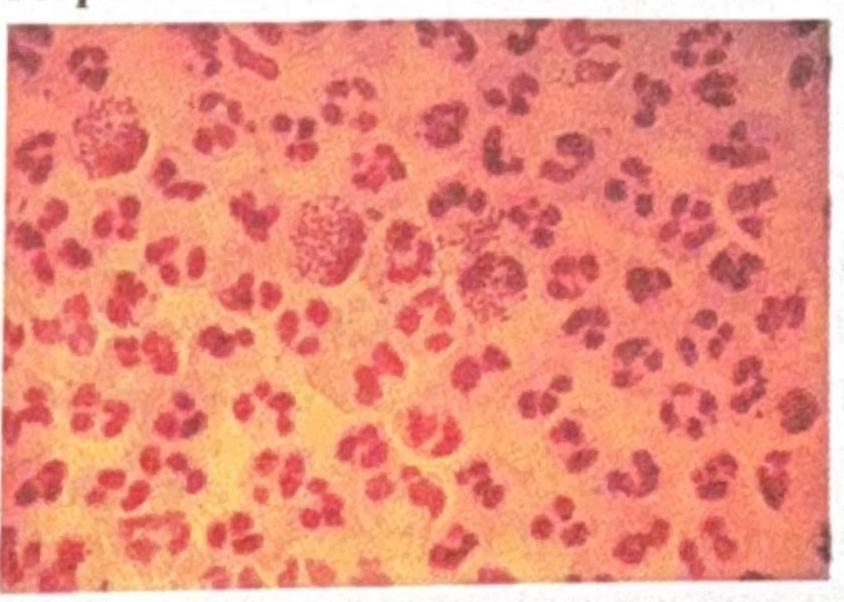
A farmer presents with a subcutaneous wound on his foot with discharge. Microscopy of a white granule from the wound shows Gram-positive filamentous rods. What is the most likely organism?
Q12
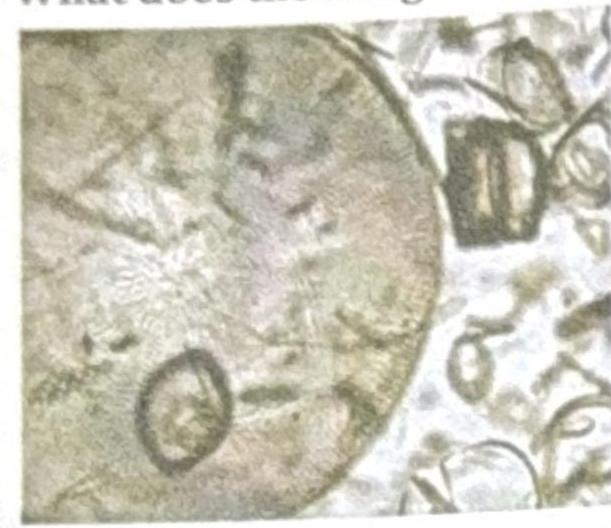
The image shows microscopic organisms. What is the most appropriate description of these organisms?
Q13
A 27-year-old patient presents with motheaten alopecia, moist perianal lesions, and an asymptomatic macular rash. What is the most likely causative organism?
Q14
A patient presents with sinus tracts on the foot, and a smear reveals filamentous organisms.
Q15
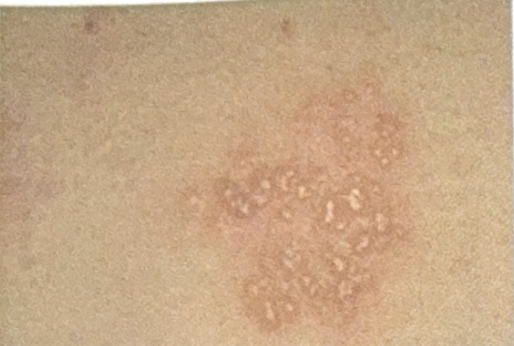
A patient presents with genital grouped vesicles, as shown in the image. What is the most likely causative organism?
NEET-PG 2024 - Microbiology NEET-PG Practice Questions and MCQs
Question 11: A farmer presents with a subcutaneous wound on his foot with discharge. Microscopy of a white granule from the wound shows Gram-positive filamentous rods. What is the most likely organism?
A. Staphylococcus aureus
B. Histoplasma
C. Nocardia (Correct Answer)
D. Sporothrix
Explanation: ***Nocardia***
- The presence of **white granules** in the discharge, along with **Gram-positive, filamentous rods**, is highly characteristic of *Nocardia* infection, often forming **sulfur granules** (though not always yellow).
- *Nocardia* is a common soil bacterium, making it a likely pathogen in a **farmer with a subcutaneous wound** related to environmental exposure.
*Staphylococcus aureus*
- While *Staphylococcus aureus* can cause skin infections and abscesses, it presents as **Gram-positive cocci in clusters**, not filamentous rods.
- It does not typically form **granules** in the discharge in the same manner as *Nocardia*.
*Histoplasma*
- *Histoplasma* is a **dimorphic fungus** that causes systemic infections, often acquired by inhaling spores.
- It would appear as **yeast forms** in tissue or cultures, not Gram-positive filamentous rods, and is not typically associated with subcutaneous wounds forming granules.
*Sporothrix*
- *Sporothrix schenckii* causes **sporotrichosis**, characterized by a **subcutaneous nodule** that progresses along lymphatic channels.
- It is a **dimorphic fungus** (yeast in tissue, mold in culture) and would not appear as Gram-positive filamentous rods on microscopy.
Question 12: The image shows microscopic organisms. What is the most appropriate description of these organisms?
A. Wall contains silica and chlorophyll
B. Present only in bone marrow
C. Bacteria (Correct Answer)
D. Not resistant to acid
Explanation: ***Unicellular bacteria***
- The image depicts **bacteria**, which are by definition unicellular prokaryotic microorganisms
- Bacteria exhibit varied morphologies (cocci, bacilli, spirilla) which can be visualized under microscopy
- This is the most appropriate description among the given options for microscopic bacterial forms
*Wall contains silica and chlorophyll*
- Silica cell walls are characteristic of **diatoms** (photosynthetic protists), not bacteria
- Bacteria have peptidoglycan cell walls, not silica
- While some bacteria contain pigments, they do not contain chlorophyll in the same form as eukaryotic organisms
*Present only in bone marrow*
- This statement is anatomically incorrect for bacteria
- Bacteria are ubiquitous and can be found in virtually all environments
- Bone marrow primarily contains hematopoietic cells, not bacteria in normal conditions
*Not resistant to acid*
- This is not a defining characteristic that can be determined from microscopic appearance alone
- Many bacteria (e.g., *Mycobacterium tuberculosis*) are **acid-fast** and highly resistant to acid
- Acid resistance varies among different bacterial species and requires specific staining (Ziehl-Neelsen) to determine
Question 13: A 27-year-old patient presents with motheaten alopecia, moist perianal lesions, and an asymptomatic macular rash. What is the most likely causative organism?
A. Haemophilus
B. Klebsiella
C. Treponema (Correct Answer)
D. Herpes Simplex
Explanation: ***Treponema***
- The constellation of **motheaten alopecia**, **moist perianal lesions** (condyloma lata), and an **asymptomatic macular rash** is highly characteristic of **secondary syphilis**, caused by *Treponema pallidum*.
- **Condyloma lata** are highly infectious, raised plaques found in moist areas, and the rash can affect palms and soles.
*Haemophilus*
- *Haemophilus influenzae* is primarily associated with **respiratory infections** (e.g., otitis media, epiglottitis, pneumonia) and sometimes meningitis.
- It does not cause the specific dermatological manifestations described in the patient.
*Klebsiella*
- *Klebsiella pneumoniae* is a common cause of **nosocomial infections**, particularly **pneumonia** (often with currant jelly sputum), **UTIs**, and wound infections.
- It is not associated with skin conditions like alopecia or maculopapular rashes typical of syphilis.
*Herpes Simplex*
- Herpes Simplex Virus (HSV) causes **vesicular or ulcerative lesions**, commonly known as cold sores or genital herpes.
- It does not cause motheaten alopecia, moist perianal plaques (condyloma lata), or an asymptomatic macular rash in the same manner as syphilis.
Question 14: A patient presents with sinus tracts on the foot, and a smear reveals filamentous organisms.
A. Sporothrix
B. Nocardia (Correct Answer)
C. Dermatophytes
D. Candida
Explanation: ***Correct: Nocardia***
- **Nocardia species** cause **actinomycetoma**, a chronic infection characterized by **sinus tracts** discharging purulent material with sulfur granules
- Smear shows **branching filamentous organisms** that are gram-positive and partially acid-fast
- Classic presentation: sinus tracts on foot with filamentous organisms on direct microscopy
- Key features: aerobic actinomycetes, branching at acute angles (45°)
*Incorrect: Sporothrix*
- Causes **sporotrichosis** (lymphocutaneous nodules along lymphatics), not sinus tracts
- **Dimorphic fungus** diagnosed primarily by culture, not direct smear
- Clinical presentation: nodular lesions following trauma (rose gardener's disease)
- Does not show filamentous organisms on direct smear
*Incorrect: Dermatophytes*
- Cause **superficial infections** of skin, hair, and nails (tinea pedis, ringworm)
- Do not form **deep sinus tracts** or involve subcutaneous tissue
- Microscopy shows septate hyphae in skin scrapings, not in discharge from sinus tracts
- Clinical presentation completely different from actinomycetoma
*Incorrect: Candida*
- **Yeast** causing mucocutaneous infections (thrush, vaginitis) or systemic candidiasis
- Does not cause **sinus tracts** on the foot
- Microscopy reveals **budding yeasts and pseudohyphae**, not true branching filaments
- Not associated with actinomycetoma-type presentations
Question 15: A patient presents with genital grouped vesicles, as shown in the image. What is the most likely causative organism?
A. Herpes simplex virus (Correct Answer)
B. Haemophilus
C. Klebsiella
D. Treponema
Explanation: ***Herpes***
- The image shows **grouped vesicles** on an erythematous base, which is the classic presentation of **genital herpes** caused by the **Herpes simplex virus (HSV)**.
- These lesions are typically painful and can recur, indicating a viral etiology.
*Haemophilus*
- *Haemophilus ducreyi* causes **chancroid**, which presents as **painful genital ulcers** with ragged borders and often associated with inguinal lymphadenopathy.
- It does not present as grouped vesicles.
*Klebsiella*
- *Klebsiella granulomatis* causes **donovanosis (granuloma inguinale)**, characterized by progressive, **painless ulcerative lesions** that are highly vascular and bleed easily.
- This organism does not cause vesicular lesions.
*Treponema*
- *Treponema pallidum* causes **syphilis**, which in its primary stage presents as a **painless chancre** (a solitary ulcer) or in secondary stage as a diffuse rash.
- It does not cause grouped vesicles.