What is the most common cause of death in idiopathic pulmonary fibrosis (IPF)?
A patient presents with large sweaty hands, macroglossia, and frontal bossing. What is the best test for confirmation of the diagnosis?
A 45-year-old patient presents with hypertension, hematuria, and flank pain. An MRI scan is performed, and the image provided shows multiple cystic lesions in both kidneys. What is the most likely diagnosis?

An endoscopic image shows the following finding. What is the most likely diagnosis?

A 40-year-old farmer presents with fever, calf tenderness, conjunctival suffusion, retro-orbital pain, and hypokalemia. What is the diagnosis?
Which of the following antibodies is associated with Celiac disease?
Which of the following is typically observed in the investigation results for a patient with iron deficiency anemia (IDA)?
An adult female presents with pallor and fatigue. Blood investigations show low hemoglobin ( Hb ), low serum iron, low ferritin, low transferrin saturation, and increased total iron-binding capacity (TIBC). What is the likely diagnosis?
A 32-year-old female presents with a 2-month history of progressive, painless swelling in the left side of her neck. She also reports low-grade fever, night sweats, and unintentional weight loss. Physical examination reveals a firm, non-tender, immobile mass in the left cervical region, and multiple smaller lymph nodes in the supraclavicular area. Chest X-ray shows mediastinal widening, and a lymph node biopsy confirms the presence of Reed-Sternberg cells. What is the most appropriate management for this patient?
A patient presents with itchy skin lesions with blistering along with gastrointestinal issues. Which of the following is the most specific serological test for this condition?
NEET-PG 2024 - Internal Medicine NEET-PG Practice Questions and MCQs
Question 11: What is the most common cause of death in idiopathic pulmonary fibrosis (IPF)?
- A. Respiratory failure (Correct Answer)
- B. Pulmonary edema
- C. Cancer
- D. Pulmonary arterial hypertension (PAH)
- E. Acute exacerbation of IPF
Explanation: ***Respiratory failure*** - **Progressive fibrosis** of the lung tissue in idiopathic pulmonary fibrosis (IPF) directly impairs gas exchange, leading to **hypoxemia** and hypercapnia. - This deterioration ultimately culminates in **respiratory failure**, which is the primary cause of mortality in most IPF patients. *Pulmonary edema* - While pulmonary edema can occur in systemic conditions, it is not the **primary or most common cause of death** specifically in IPF. - IPF is characterized by **fibrotic remodeling**, not primarily fluid overload in the alveoli. *Cancer* - Patients with IPF have an **increased risk of lung cancer**, but it is not the most common cause of death compared to respiratory failure. - The development of cancer is a **complication**, not the direct mechanism by which most IPF patients succumb to the disease. *Pulmonary arterial hypertension (PAH)* - PAH can be a significant complication of IPF, contributing to increased morbidity and mortality, but it is typically a **secondary contributor to death**, often by worsening respiratory mechanics. - Its presence usually **compounds respiratory failure**, rather than being the standalone, most common cause of death. *Acute exacerbation of IPF* - Acute exacerbations represent episodes of **rapid clinical deterioration** with worsening dyspnea and hypoxemia, often idiopathic or triggered by infections. - While they are a **significant cause of mortality** (accounting for a substantial proportion of IPF deaths), the underlying mechanism still relates to respiratory failure, making chronic progressive respiratory failure the most common overall cause of death.
Question 12: A patient presents with large sweaty hands, macroglossia, and frontal bossing. What is the best test for confirmation of the diagnosis?
- A. GHRH levels
- B. IGF-1 (Correct Answer)
- C. IGF-2
- D. GH levels after glucose suppression
- E. Random GH level
Explanation: ***IGF-1*** - Elevated **IGF-1 (Insulin-like Growth Factor 1)** is the most reliable screening test for acromegaly, reflecting integrated GH secretion over time. - The clinical signs of **large sweaty hands**, **macroglossia**, and **frontal bossing** are classic symptoms of acromegaly, caused by excessive growth hormone (GH) production, which then stimulates IGF-1. *GHRH levels* - **Growth hormone-releasing hormone (GHRH)** levels are typically only measured when investigating ectopic GHRH production as a rare cause of acromegaly, which is not the primary diagnostic step. - While GHRH stimulates GH, its direct measurement is not the standard initial diagnostic test for suspected pituitary-driven acromegaly. *IGF-2* - **IGF-2 (Insulin-like Growth Factor 2)** plays a role in fetal growth and certain tumor-related syndromes, but it is not the primary mediator or diagnostic marker for acromegaly in adults. - IGF-1, not IGF-2, is the main growth factor responsible for the anabolic effects of growth hormone. *GH levels after glucose suppression* - Measuring **GH levels after glucose suppression** (oral glucose tolerance test with 75g glucose) is a confirmatory test for acromegaly, used when IGF-1 levels are equivocal or borderline. - In healthy individuals, glucose suppresses GH secretion to <1 ng/mL, but in acromegaly, GH levels remain elevated (failure to suppress), confirming autonomous GH hypersecretion. *Random GH level* - **Random GH levels** are unreliable for diagnosing acromegaly due to the pulsatile nature of GH secretion, with significant variation throughout the day. - A single normal GH level does not exclude acromegaly, and a single elevated level can occur in healthy individuals during normal secretory peaks, making it inadequate as a diagnostic test.
Question 13: A 45-year-old patient presents with hypertension, hematuria, and flank pain. An MRI scan is performed, and the image provided shows multiple cystic lesions in both kidneys. What is the most likely diagnosis?
- A. Renal cyst
- B. Renal tumor
- C. Autosomal Dominant Polycystic Kidney Disease (ADPKD) (Correct Answer)
- D. Chronic kidney disease with cystic degeneration
- E. Acquired cystic kidney disease
Explanation: ***Autosomal Dominant Polycystic Kidney Disease (ADPKD)*** - The presence of **hypertension, hematuria, and flank pain** in conjunction with an MRI showing **multiple bilateral renal cystic lesions** is highly characteristic of ADPKD. - ADPKD is a genetic disorder leading to the gradual enlargement of **cysts in both kidneys**, often accompanied by complications such as pain, bleeding into cysts, and eventually **renal failure**. *Renal cyst* - A **simple renal cyst** is typically a solitary, benign lesion and would not explain the **hypertension, hematuria, or multiple bilateral cysts** seen on imaging. - While common, a simple cyst usually causes no symptoms unless it becomes very large or ruptures. *Renal tumor* - A renal tumor, such as **renal cell carcinoma**, typically presents as a **solid mass** or a complex cystic mass, not multiple simple cysts bilaterally. - While it can cause hematuria, flank pain, and hypertension, the imaging description of **multiple cystic lesions in both kidneys** points away from a single tumor. *Chronic kidney disease with cystic degeneration* - While **chronic kidney disease (CKD)** can sometimes be associated with acquired renal cysts, especially in patients on dialysis, these cysts are typically **smaller, fewer in number**, and develop over a longer course than what is implied here. - This condition does not typically present with the extensive, bilateral cystic burden seen in ADPKD as the primary pathology. *Acquired cystic kidney disease* - **Acquired cystic kidney disease (ACKD)** typically develops in patients with **end-stage renal disease**, particularly those on **long-term dialysis**. - While it can present with bilateral renal cysts, it usually occurs in the context of **pre-existing chronic kidney disease**, and the patient would have a known history of renal dysfunction. - The clinical presentation here, with a 45-year-old presenting acutely with hypertension, hematuria, and flank pain without mention of dialysis or CKD history, favors **ADPKD** over ACKD.
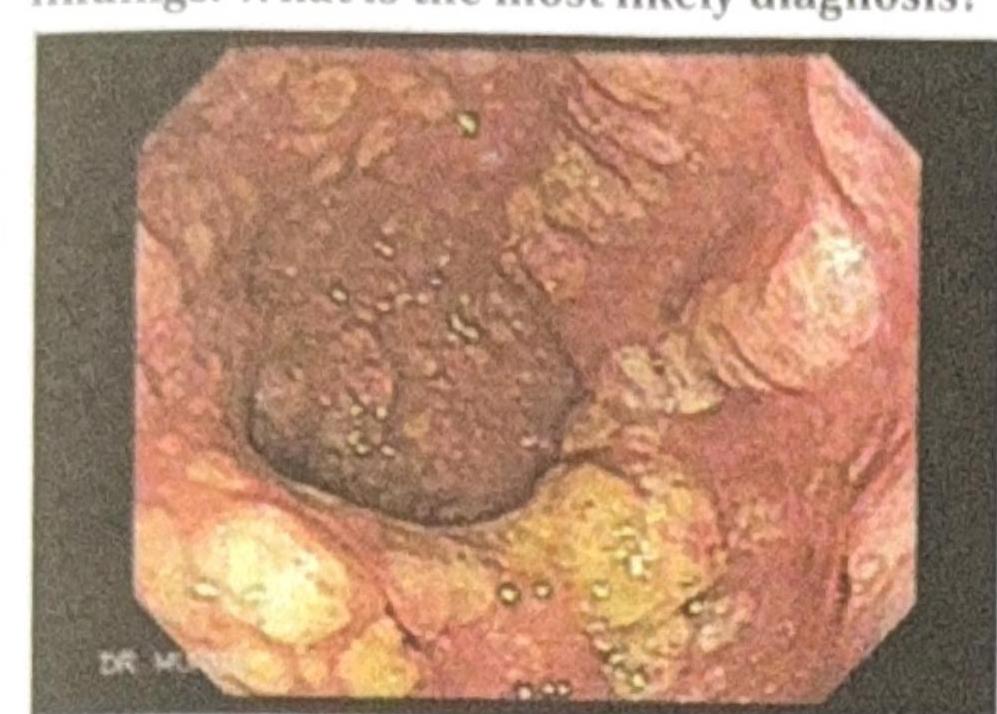
Question 14: An endoscopic image shows the following finding. What is the most likely diagnosis?
- A. Barrett's esophagus (Correct Answer)
- B. Esophageal varices
- C. Gastric erosion
- D. Chronic GERD
- E. Esophageal candidiasis
Explanation: ***Barrett's esophagus*** - The endoscopic image shows a **change in the mucosal lining** from the pale, smooth squamous epithelium (typical of the esophagus) to a red, velvety columnar epithelium, which is characteristic of **intestinal metaplasia** occurring in Barrett's esophagus. - This metaplastic change occurs as a complication of chronic gastroesophageal reflux disease (GERD) and is a **precursor to esophageal adenocarcinoma**. *Esophageal varices* - Esophageal varices appear as **dilated, tortuous veins** beneath the esophageal mucosa, often seen in patients with **portal hypertension**. - The image does not show these typical tortuous, bluish veins. *Gastric erosion* - Gastric erosions are **superficial breaks in the gastric mucosa**, typically appearing as reddish spots or streaks, often with overlying exudate. - The image depicts a change in mucosal type rather than superficial damage to the gastric lining. *Chronic GERD* - While chronic GERD is the underlying cause for Barrett's esophagus, the image shows the **consequence of GERD** (metaplasia), not the direct endoscopic signs of active GERD, such as **esophagitis** (inflammation, redness, erosions) in the squamous epithelium. - The distinct change in mucosal appearance to columnar epithelia is specific to Barrett's esophagus. *Esophageal candidiasis* - Esophageal candidiasis presents with **white plaques or pseudomembranes** overlying the esophageal mucosa, typically seen in immunocompromised patients. - The image shows a change in mucosal type (metaplasia) rather than infectious white plaques characteristic of candidiasis.
Question 15: A 40-year-old farmer presents with fever, calf tenderness, conjunctival suffusion, retro-orbital pain, and hypokalemia. What is the diagnosis?
- A. Malaria
- B. Dengue
- C. Leptospira (Correct Answer)
- D. Influenza
- E. Typhoid fever
Explanation: ***Leptospira*** - The combination of **fever**, **calf tenderness**, **conjunctival suffusion** (red eyes without purulent discharge), **retro-orbital pain**, and **hypokalemia** is highly suggestive of **leptospirosis**. - A farmer's occupation increases the risk of exposure to contaminated water or soil, which is a common transmission route for Leptospira. - **Calf tenderness** and **conjunctival suffusion** are particularly characteristic features. *Malaria* - Characterized by **cyclic fevers**, **chills**, and **sweats**, often with **splenomegaly** and **anemia**. - **Calf tenderness**, **conjunctival suffusion**, and **retro-orbital pain** are not typical primary symptoms of malaria. *Dengue* - Often presents with **high fever**, **severe headache** (especially retro-orbital), **muscle and joint pain** ("breakbone fever"), and **rash**. - **Conjunctival suffusion** and significant **calf tenderness** are not classic features, and hypokalemia is less common than with leptospirosis. *Influenza* - Acute respiratory illness with **fever**, **cough**, **sore throat**, **muscle aches**, and **fatigue**. - While muscle aches can occur, **calf tenderness**, **conjunctival suffusion**, and **hypokalemia** are not characteristic of influenza. *Typhoid fever* - Presents with **sustained fever**, **relative bradycardia**, **rose spots**, and **hepatosplenomegaly**. - **Conjunctival suffusion**, **calf tenderness**, and **retro-orbital pain** are not typical features of typhoid fever.
Question 16: Which of the following antibodies is associated with Celiac disease?
- A. Anti-TTG (Tissue Transglutaminase) (Correct Answer)
- B. ANCA (Anti-Neutrophil Cytoplasmic Antibodies)
- C. ASCA (Anti-Saccharomyces cerevisiae Antibodies)
- D. Anti-gliadin
- E. Anti-EMA (Endomysial Antibodies)
Explanation: ***Anti-TTG (Tissue Transglutaminase)*** - **Anti-TTG antibodies** (especially **IgA**) are the primary serological markers for celiac disease, demonstrating high sensitivity and specificity. - These antibodies target **tissue transglutaminase**, an enzyme involved in gluten deamidation, which triggers the autoimmune response in genetically predisposed individuals. - **Anti-TTG IgA** is the **preferred initial screening test** due to its superior diagnostic accuracy and cost-effectiveness. *ANCA (Anti-Neutrophil Cytoplasmic Antibodies)* - **ANCA** are associated with **vasculitis**, such as **Granulomatosis with Polyangiitis (Wegener's)** and **Microscopic Polyangiitis**. - They are not a diagnostic marker for celiac disease, which is an autoimmune enteropathy. *ASCA (Anti-Saccharomyces cerevisiae Antibodies)* - **ASCA** are commonly found in patients with **Crohn's disease**, particularly in those with ileal involvement. - While both celiac disease and Crohn's are gastrointestinal conditions, ASCA is not a marker for celiac. *Anti-gliadin* - **Anti-gliadin antibodies (AGA)** were historically used in celiac disease diagnosis but have **lower sensitivity and specificity** compared to anti-TTG and anti-endomysial antibodies. - Modern guidelines recommend using **anti-TTG IgA** as the primary screening tool due to its superior diagnostic accuracy. *Anti-EMA (Endomysial Antibodies)* - **Anti-EMA IgA** is highly specific for celiac disease (>95% specificity) and is often used as a **confirmatory test**. - However, **anti-TTG is preferred for initial screening** because anti-EMA testing is more expensive, operator-dependent (uses immunofluorescence), and less widely available. - Anti-EMA targets the same antigen as anti-TTG (tissue transglutaminase).
Question 17: Which of the following is typically observed in the investigation results for a patient with iron deficiency anemia (IDA)?
- A. Increased serum ferritin
- B. Decreased transferrin saturation (Correct Answer)
- C. Increased serum iron
- D. Normal total iron-binding capacity (TIBC)
- E. Increased mean corpuscular volume (MCV)
Explanation: ***Decreased transferrin saturation*** - In **iron deficiency anemia**, there is insufficient iron to bind to **transferrin**, leading to a reduction in the percentage of transferrin that is iron-bound. - This reflects the body's struggle to supply iron for erythropoiesis due to depleted iron stores. *Increased serum ferritin* - **Serum ferritin** is a key indicator of the body's iron stores; in **iron deficiency anemia**, these stores are depleted, leading to a *decreased* rather than increased serum ferritin level. - An increased serum ferritin is typically seen in conditions of **iron overload** or **inflammation**. *Increased serum iron* - **Serum iron** measures the iron circulating in the blood, and in **iron deficiency anemia**, iron levels are *low* due to inadequate intake or excessive loss. - An increased serum iron level would contradict the diagnosis of iron deficiency. *Normal total iron-binding capacity (TIBC)* - **Total iron-binding capacity (TIBC)** typically *increases* in iron deficiency anemia as the liver produces more transferrin in an attempt to capture any available iron. - A normal TIBC would not reflect the compensatory mechanisms seen in iron deficiency. *Increased mean corpuscular volume (MCV)* - **Iron deficiency anemia** is a **microcytic anemia**, characterized by *decreased* MCV due to inadequate hemoglobin synthesis within red blood cells. - An increased MCV is seen in **macrocytic anemias** such as vitamin B12 or folate deficiency, not in iron deficiency.
Question 18: An adult female presents with pallor and fatigue. Blood investigations show low hemoglobin ( Hb ), low serum iron, low ferritin, low transferrin saturation, and increased total iron-binding capacity (TIBC). What is the likely diagnosis?
- A. Iron Deficiency Anemia (IDA) (Correct Answer)
- B. Anemia of Chronic Disease
- C. Hemolytic Anemia
- D. Thalassemia
- E. Sideroblastic Anemia
Explanation: ***Iron Deficiency Anemia (IDA)*** - The unique constellation of **low hemoglobin**, **low serum iron**, **low ferritin**, **low transferrin saturation**, and **increased total iron-binding capacity (TIBC)** is the hallmark of Iron Deficiency Anemia. - **Ferritin** is a direct measure of iron stores, and its low level confirms depletion, while **increased TIBC** signifies the body's attempt to absorb more iron due to deficiency. *Anemia of Chronic Disease* - While also presenting with **low hemoglobin** and often **low serum iron**, Anemia of Chronic Disease is characterized by **normal or increased ferritin** (as ferritin is an acute phase reactant) and **decreased TIBC**. - There is a functional iron deficiency, but iron stores are typically adequate, and inflammation plays a central role. *Hemolytic Anemia* - Hemolytic anemia is characterized by the premature destruction of red blood cells, leading to **low hemoglobin** but typically **normal or elevated serum iron** and ferritin due to iron release from lysed red cells. - Key indicators, such as **elevated bilirubin**, **lactate dehydrogenase (LDH)**, and **reticulocytosis**, are absent in the given scenario. *Thalassemia* - Thalassemia is a genetic disorder causing defective hemoglobin synthesis, resulting in **microcytic hypochromic anemia** with **low hemoglobin**. - However, thalassemia typically presents with **normal to high serum iron** and ferritin levels, as iron absorption may be increased, and there's no primary iron deficiency. *Sideroblastic Anemia* - Sideroblastic anemia is characterized by defective heme synthesis with iron accumulation in mitochondria, forming characteristic ring sideroblasts on bone marrow examination. - Laboratory findings typically show **normal to increased serum iron**, **increased ferritin**, and **increased transferrin saturation**, distinguishing it from iron deficiency anemia.
Question 19: A 32-year-old female presents with a 2-month history of progressive, painless swelling in the left side of her neck. She also reports low-grade fever, night sweats, and unintentional weight loss. Physical examination reveals a firm, non-tender, immobile mass in the left cervical region, and multiple smaller lymph nodes in the supraclavicular area. Chest X-ray shows mediastinal widening, and a lymph node biopsy confirms the presence of Reed-Sternberg cells. What is the most appropriate management for this patient?
- A. NHL with a highly aggressive chemotherapy regimen
- B. Hodgkin Lymphoma with the ABVD regimen (Correct Answer)
- C. NHL with Rituximab
- D. Hodgkin Lymphoma with surgical excision only
- E. Hodgkin Lymphoma with radiation therapy only
Explanation: ***Hodgkin Lymphoma with the ABVD regimen*** - The presence of **Reed-Sternberg cells** in a lymph node biopsy, along with **painless lymphadenopathy**, **mediastinal widening**, and **B symptoms** (fever, night sweats, weight loss), is characteristic of **Hodgkin Lymphoma**. - **ABVD chemotherapy** (Adriamycin, Bleomycin, Vinblastine, Dacarbazine) is the standard frontline treatment regimen for Hodgkin Lymphoma, especially in advanced stages or with B symptoms. *NHL with a highly aggressive chemotherapy regimen* - This patient's symptoms and especially the presence of **Reed-Sternberg cells** are pathognomonic for **Hodgkin Lymphoma**, not Non-Hodgkin Lymphoma (NHL). - While some NHLs require aggressive chemotherapy, the specific findings in this case point away from an NHL diagnosis. *NHL with Rituximab* - **Rituximab** is a monoclonal antibody targeting the **CD20 antigen** found on B-cells and is primarily used in the treatment of **B-cell Non-Hodgkin Lymphomas**. - Since the diagnosis here is Hodgkin Lymphoma, characterized by Reed-Sternberg cells (which are atypical B cells that typically lack CD20), rituximab is not an appropriate primary treatment. *Hodgkin Lymphoma with surgical excision only* - **Hodgkin Lymphoma** is a systemic disease, as evidenced by mediastinal widening and B symptoms, indicating spread beyond a localized area. - **Surgical excision alone** is not curative for Hodgkin Lymphoma; systemic chemotherapy, often combined with radiation therapy, is essential for effective treatment. *Hodgkin Lymphoma with radiation therapy only* - While **radiation therapy** plays a role in Hodgkin Lymphoma treatment, it is typically used in **combination with chemotherapy** (combined modality therapy) or reserved for **early-stage, favorable-risk disease without B symptoms**. - This patient presents with **advanced disease** (mediastinal involvement, B symptoms, multiple lymph node regions), which requires **systemic chemotherapy** as the primary treatment modality. - Radiation alone would be inadequate for achieving optimal disease control and cure in this clinical scenario.
Question 20: A patient presents with itchy skin lesions with blistering along with gastrointestinal issues. Which of the following is the most specific serological test for this condition?
- A. Anti-TTG antibody
- B. Anti-nuclear antibody
- C. Anti-endomysial antibody (Correct Answer)
- D. IgA deposits at the dermoepidermal junction
- E. Anti-desmoglein antibody
Explanation: ***Anti-endomysial antibody*** - The combination of **itchy, blistering skin lesions** and **gastrointestinal issues** is highly suggestive of **Dermatitis Herpetiformis**, which is the cutaneous manifestation of **celiac disease**. - **Anti-endomysial antibody (EMA)**, particularly IgA, is highly specific (nearly 100%) for **celiac disease** and thus for Dermatitis Herpetiformis, especially when tested on primate esophagus. *Anti-TTG antibody* - **Anti-tissue transglutaminase (tTG) antibody** (IgA) is a sensitive and specific serological marker for **celiac disease** and is often the first-line test. - While highly indicative, **EMA** is generally considered to have slightly higher specificity than tTG for celiac disease, particularly in predicting intestinal villous atrophy. *Anti-nuclear antibody* - **Anti-nuclear antibodies (ANA)** are primarily associated with **systemic autoimmune diseases** like Systemic Lupus Erythematosus. - They are not specific for **celiac disease** or **Dermatitis Herpetiformis**. *Anti-desmoglein antibody* - **Anti-desmoglein antibodies** (anti-Dsg1 and anti-Dsg3) are specific for **pemphigus vulgaris** and **pemphigus foliaceus**, which are autoimmune blistering disorders. - While these conditions present with blistering, they typically lack the gastrointestinal symptoms and the specific pruritic, grouped vesicular pattern seen in **Dermatitis Herpetiformis**. - This is not the appropriate serological test for DH/celiac disease. *IgA deposits at the dermoepidermal junction* - The presence of **granular IgA deposits at the dermoepidermal junction** (dermal papillae) is the **gold standard for diagnosing Dermatitis Herpetiformis** through **direct immunofluorescence** of a skin biopsy. - However, this is a **histopathological finding**, not a serological test, and therefore does not fit the question's criteria for a "serological test."