Anatomy
1 questionsA patient presents with an anesthetic patch in areas of the face. Which of the following nerves is the most commonly involved in this condition?
NEET-PG 2022 - Anatomy NEET-PG Practice Questions and MCQs
Question 81: A patient presents with an anesthetic patch in areas of the face. Which of the following nerves is the most commonly involved in this condition?
- A. Facial nerve
- B. Abducens nerve
- C. Trigeminal nerve (Correct Answer)
- D. Optic nerve
Explanation: ***Trigeminal nerve*** - The **trigeminal nerve** (CN V) is responsible for **sensory innervation of the face, scalp, and mucous membranes** of the mouth and nose [1]. An anesthetic patch suggests a loss of sensation in these areas. - Involvement of the trigeminal nerve, particularly its branches (ophthalmic, maxillary, mandibular), would lead to **paresthesia, numbness, or anesthesia** in the corresponding dermatomes of the face. *Abducens nerve* - The **abducens nerve** (CN VI) primarily controls the **lateral rectus muscle**, responsible for **abduction of the eye**. - Dysfunction of this nerve would lead to **diplopia (double vision)** and an inability to move the eye laterally, not facial anesthesia. *Facial nerve* - The **facial nerve** (CN VII) is mainly responsible for **motor innervation of the muscles of facial expression** and taste from the anterior two-thirds of the tongue. - Damage to this nerve causes **facial weakness or paralysis** (e.g., Bell's palsy) and taste disturbances, not loss of sensation (anesthesia) in facial skin. *Optic nerve* - The **optic nerve** (CN II) is solely responsible for **vision**. - Damage to the optic nerve results in **visual field defects or blindness**, not sensory changes on the face.
Biochemistry
1 questionsWhat is the term for a single mutation in a nucleotide base pair that results in a termination codon?
NEET-PG 2022 - Biochemistry NEET-PG Practice Questions and MCQs
Question 81: What is the term for a single mutation in a nucleotide base pair that results in a termination codon?
- A. Missense mutation
- B. Nonsense mutation (Correct Answer)
- C. Termination mutation
- D. Silent mutation
Explanation: ***Nonsense mutation*** - A **nonsense mutation** occurs when a single nucleotide base pair change leads to the formation of a **premature stop codon**, which results in a truncated and often non-functional protein. - The term "nonsense" refers to the fact that the new codon signals an early termination of protein synthesis. *Missense mutation* - A **missense mutation** involves a single nucleotide change that results in a codon coding for a **different amino acid**, potentially altering protein function but not necessarily terminating it. - This type of mutation can have varying effects on protein function, from benign to severe, depending on the amino acid substitution. *Termination mutation* - While a nonsense mutation does result in **premature termination**, "termination mutation" is not the standard or most precise scientific term used to describe this specific type of genetic alteration. - The more accurate and widely accepted terminology is **nonsense mutation** for a change leading to a stop codon. *Silent mutation* - A **silent mutation** is a type of point mutation that changes a single nucleotide, but does not change the amino acid sequence of the protein due to the **degeneracy of the genetic code**. - These mutations have **no observable effect** on the organism's phenotype as the protein produced remains unchanged.
Community Medicine
1 questionsYou are working in a primary health center (PHC) situated in a high seismic zone. Which of the following actions should you take as part of preparedness for an emergency?
NEET-PG 2022 - Community Medicine NEET-PG Practice Questions and MCQs
Question 81: You are working in a primary health center (PHC) situated in a high seismic zone. Which of the following actions should you take as part of preparedness for an emergency?
- A. Ensure all financial and other resources are available for disaster preparedness.
- B. Increase public awareness through campaigns and loudspeakers.
- C. Follow instructions given over the phone or radio by higher officials.
- D. Conduct a simulation for the disaster and assess the response. (Correct Answer)
Explanation: ***Conduct a simulation for the disaster and assess the response.*** - **Simulation exercises** are crucial for testing the effectiveness of a disaster preparedness plan and identifying weaknesses in the response system. - This allows for refinement of protocols, training of personnel, and ensuring that all team members understand their roles during an actual emergency. *Ensure all financial and other resources are available for disaster preparedness.* - While important for effective disaster management, simply "ensuring" resources are available is not an action of preparedness, but rather an **enabling condition**. - This statement focuses on the availability of resources rather than a proactive step to prepare the PHC for an emergency. *Increase public awareness through campaigns and loudspeakers.* - **Public awareness campaigns** are vital for community preparedness, but this action is primarily for the general population and not a specific preparedness action for the PHC itself in terms of its operational readiness. - While a PHC might be involved in public awareness, its core preparedness involves internal actions to ensure its functionality during a disaster. *Follow instructions given over the phone or radio by higher officials.* - This describes a reaction during or immediately before a disaster, rather than a proactive **preparedness measure**. - Relying solely on real-time instructions from higher officials during an emergency without prior planning can lead to delays and inefficiencies.
Internal Medicine
1 questionsA patient with diabetes mellitus for the past 5 years presents with vomiting and abdominal pain. She is non-compliant with medication and appears dehydrated. Investigations revealed a blood sugar value of 500 mg/dl and the presence of ketone bodies. What is the next best step in management of this patient?
NEET-PG 2022 - Internal Medicine NEET-PG Practice Questions and MCQs
Question 81: A patient with diabetes mellitus for the past 5 years presents with vomiting and abdominal pain. She is non-compliant with medication and appears dehydrated. Investigations revealed a blood sugar value of 500 mg/dl and the presence of ketone bodies. What is the next best step in management of this patient?
- A. Intravenous fluids
- B. Intravenous insulin
- C. Intravenous fluids with regular insulin (Correct Answer)
- D. Intravenous fluids with long-acting insulin
Explanation: Detailed management of diabetic ketoacidosis (DKA) requires both fluid resuscitation and insulin therapy. ***Intravenous fluids with regular insulin*** - The patient presents with classic signs of **diabetic ketoacidosis (DKA)**: hyperglycemia (blood sugar 500 mg/dl), ketone bodies, dehydration, and a history of diabetes non-compliance [1]. - Initial management for DKA involves aggressive **intravenous fluid resuscitation** to correct dehydration and then **intravenous regular insulin** to lower blood glucose and resolve ketosis [2]. *Intravenous fluids with long-acting insulin* - While fluids are essential, **long-acting insulin** is not appropriate for the acute management of DKA because its slow onset of action makes it inefficient for rapidly correcting hyperglycemia and ketosis. - **Regular insulin** is preferred as it has a quicker onset and shorter duration, allowing for more precise titration in an acute setting [2]. *Intravenous fluids* - Although crucial for correcting **dehydration** and improving renal perfusion, fluids alone will not address the underlying **insulin deficiency** and **ketosis** that define DKA. - Without insulin, the body will continue to produce ketones, exacerbating acidosis [3]. *Intravenous insulin* - Giving intravenous insulin without prior or concomitant **fluid resuscitation** can be dangerous, as it can worsen **hypovolemia** and potentially lead to circulatory collapse by shifting glucose and potassium into cells. - It is critical to first restore **circulating volume** before initiating insulin therapy [2].
Microbiology
1 questionsA farmer presents you with a cauliflower-shaped mass on foot, which developed after a minor injury. Microscopy shows copper penny bodies. What is the most likely diagnosis?
NEET-PG 2022 - Microbiology NEET-PG Practice Questions and MCQs
Question 81: A farmer presents you with a cauliflower-shaped mass on foot, which developed after a minor injury. Microscopy shows copper penny bodies. What is the most likely diagnosis?
- A. Sporotrichosis
- B. Blastomycosis
- C. Chromoblastomycosis (Correct Answer)
- D. Phaeohyphomycosis
Explanation: **Chromoblastomycosis** - The characteristic "cauliflower-shaped" lesion on the foot following a minor injury, especially in a farmer (indicating outdoor exposure), is highly suggestive of chromoblastomycosis. - The presence of **copper penny bodies** (also known as **sclerotic** or **muriform cells**) on microscopy is **pathognomonic** for chromoblastomycosis. *Blastomycosis* - Blastomycosis typically presents with **granulomatous lesions** that can ulcerate but are rarely described as cauliflower-shaped. - Microscopic examination would reveal **broad-based budding yeast cells**, not copper penny bodies. *Sporotrichosis* - Sporotrichosis usually presents as **subcutaneous nodules** that can ulcerate and spread lymphatically, forming a chain of lesions. - Microscopy shows **cigar-shaped budding yeasts** within macrophages or neutrophils, which are distinct from copper penny bodies. *Phaeohyphomycosis* - Phaeohyphomycosis encompasses a broad group of infections by dematiaceous fungi that produce **dark-walled hyphae** or yeast-like cells in tissue. - While it can cause subcutaneous nodules or cysts, the presence of distinct copper penny bodies points away from phaeohyphomycosis as the primary diagnosis.
Pediatrics
2 questionsA male child presented with arthralgia and abdominal pain. On examination, there was palpable purpura over the lower limbs. There is a past history of upper respiratory tract infection prior to the onset of presenting symptoms. Which of the following is the treatment for this condition?
A child presents with recurrent chest infections and abdominal pain. There is a history of 1 blood transfusion in the past. On examination, he had icterus and mild splenomegaly. Electrophoresis shows increased HbA2, HbF, and S spike. What is the likely diagnosis?
NEET-PG 2022 - Pediatrics NEET-PG Practice Questions and MCQs
Question 81: A male child presented with arthralgia and abdominal pain. On examination, there was palpable purpura over the lower limbs. There is a past history of upper respiratory tract infection prior to the onset of presenting symptoms. Which of the following is the treatment for this condition?
- A. Azathioprine
- B. Methotrexate
- C. Cyclosporine
- D. Glucocorticoids (Correct Answer)
Explanation: ***Glucocorticoids*** - The constellation of **arthralgia**, **abdominal pain**, and **palpable purpura** following an **upper respiratory tract infection** in a child is highly suggestive of **Henoch-Schönlein purpura (HSP)**, now known as **IgA vasculitis**. - **Glucocorticoids** are indicated in HSP for severe symptoms like significant abdominal pain, gastrointestinal bleeding, or painful arthralgia, all of which this patient demonstrates. - While HSP often resolves spontaneously with supportive care, this patient's presentation with both arthralgia and abdominal pain warrants glucocorticoid therapy. *Azathioprine* - **Azathioprine** is an immunosuppressant typically used for conditions like rheumatoid arthritis, IBD, or organ transplant rejection. - It is not a first-line treatment for the acute management of **IgA vasculitis**, which typically responds to supportive care or short courses of steroids for severe symptoms. *Methotrexate* - **Methotrexate** is a disease-modifying antirheumatic drug (DMARD) used in conditions such as rheumatoid arthritis, psoriasis, and certain cancers. - It does not have a role in the acute treatment of uncomplicated **IgA vasculitis** based on the described symptoms. *Cyclosporine* - **Cyclosporine** is a potent immunosuppressant used in severe autoimmune conditions or to prevent organ rejection. - While it may be considered in very severe, refractory cases of **IgA vasculitis** with significant renal involvement, it is not the initial treatment for the symptoms presented.
Question 82: A child presents with recurrent chest infections and abdominal pain. There is a history of 1 blood transfusion in the past. On examination, he had icterus and mild splenomegaly. Electrophoresis shows increased HbA2, HbF, and S spike. What is the likely diagnosis?
- A. HbC disease
- B. Sickle cell disease
- C. Aplastic anemia
- D. Sickle Beta Thalassemia (Correct Answer)
Explanation: ***Sickle Beta Thalassemia*** - The combination of **sickle cell disease manifestations** (recurrent chest infections, abdominal pain, icterus, splenomegaly) with **electrophoresis showing increased HbA2, elevated HbF, and S spike** is diagnostic of **Sickle Beta Thalassemia**. - **Increased HbA2 (>3.5%)** is the key distinguishing feature that differentiates this from pure sickle cell disease. It indicates co-inheritance of a **beta-thalassemia gene** along with the **sickle cell gene**. - Clinical presentation is similar to sickle cell disease with **vaso-occlusive crises**, **acute chest syndrome**, hemolytic anemia, and organomegaly. - The severity depends on the type: S/β⁰-thalassemia (no HbA production) is clinically more severe and similar to SS disease, while S/β⁺-thalassemia (reduced HbA) tends to be milder. *Sickle cell disease* - Pure sickle cell disease (HbSS) presents with similar clinical features: recurrent chest infections, abdominal pain, hemolysis, and splenomegaly. - However, electrophoresis would show **normal or only slightly elevated HbA2 (2-3%)**, not the increased HbA2 mentioned in this case. - The presence of significantly increased HbA2 rules out pure sickle cell disease. *HbC disease* - Patients with HbC disease typically have **mild chronic hemolytic anemia** and **splenomegaly** but usually lack severe vaso-occlusive crises. - Electrophoresis would show primarily **HbC**, not an S spike. - The clinical picture is much milder than described in this case. *Aplastic anemia* - Characterized by **pancytopenia** due to bone marrow failure, leading to fatigue, infections, and bleeding tendency. - Does not involve hemolysis, icterus, or abnormal hemoglobin variants on electrophoresis. - The electrophoresis findings completely exclude this diagnosis.
Pharmacology
2 questionsA woman presenting with symptoms of urinary tract infection was prescribed a drug that causes tendon rupture and arthropathy. What is the mechanism of action of the drug?
A patient comes with a history of asthma and sinusitis. On looking into his medical records, you notice this has been attributed to Samter’s triad. Which drug should be avoided in this patient due to its potential to exacerbate respiratory symptoms?
NEET-PG 2022 - Pharmacology NEET-PG Practice Questions and MCQs
Question 81: A woman presenting with symptoms of urinary tract infection was prescribed a drug that causes tendon rupture and arthropathy. What is the mechanism of action of the drug?
- A. Ribosomal inhibition
- B. Cell wall synthesis
- C. Inhibition of folic acid synthesis
- D. DNA gyrase inhibition (Correct Answer)
Explanation: ***DNA gyrase inhibition*** - The description of a drug causing **tendon rupture** and **arthropathy** in the context of a urinary tract infection (UTI) suggests a **fluoroquinolone**. - Fluoroquinolones exert their bactericidal effect by inhibiting **bacterial DNA gyrase** (also known as topoisomerase II) and **topoisomerase IV**, thereby preventing DNA replication and repair. *Ribosomal inhibition* - This mechanism is characteristic of antibiotics like **aminoglycosides**, **tetracyclines**, and **macrolides**. - While some of these can treat UTIs, they are not typically associated with **tendon rupture** or **arthropathy** as major side effects. *Cell wall synthesis* - This is the mechanism of action for **beta-lactam antibiotics** (e.g., penicillins, cephalosporins) and **vancomycin**. - These drugs are common for UTIs but do not cause **tendon rupture** or **arthropathy**. *Inhibition of folic acid synthesis* - This mechanism is used by **sulfonamides** and **trimethoprim**, often combined as trimethoprim-sulfamethoxazole. - While effective for UTIs, these drugs are not known to cause **tendon rupture** or **arthropathy**.
Question 82: A patient comes with a history of asthma and sinusitis. On looking into his medical records, you notice this has been attributed to Samter’s triad. Which drug should be avoided in this patient due to its potential to exacerbate respiratory symptoms?
- A. Cotrimoxazole
- B. Co-amoxiclav
- C. Chloramphenicol
- D. Aspirin (Correct Answer)
Explanation: ***Aspirin (Correct Answer)*** - Samter's triad, or **aspirin-exacerbated respiratory disease (AERD)**, is characterized by **asthma**, **nasal polyps with chronic rhinosinusitis**, and a severe reaction to **aspirin** and other **NSAIDs**. - **Aspirin** inhibits COX-1, leading to an overproduction of **leukotrienes**, which causes bronchoconstriction and exacerbates respiratory symptoms in susceptible individuals. - This is the drug that **must be avoided** in patients with Samter's triad. *Cotrimoxazole (Incorrect)* - **Cotrimoxazole** (trimethoprim-sulfamethoxazole) is an antibiotic not directly involved in the cyclooxygenase pathway. - While allergic reactions can occur, it is **not specifically contraindicated** in Samter's triad. *Co-amoxiclav (Incorrect)* - **Co-amoxiclav** (amoxicillin/clavulanic acid) is a penicillin-class antibiotic, and its mechanism of action does not involve prostaglandin synthesis. - It does not pose a specific risk for exacerbating respiratory symptoms in patients with **Samter's triad**. *Chloramphenicol (Incorrect)* - **Chloramphenicol** is an antibiotic that inhibits bacterial protein synthesis and is not associated with the pathogenesis of Samter's triad. - It does not impact the **cyclooxygenase or lipoxygenase pathways** that are central to AERD.
Surgery
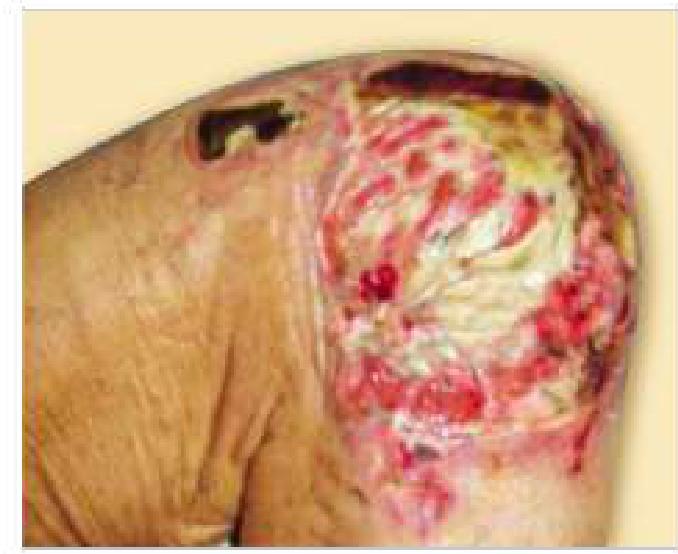
1 questionsThe image below shows a pressure sore. Which stage does this belong to?

NEET-PG 2022 - Surgery NEET-PG Practice Questions and MCQs
Question 81: The image below shows a pressure sore. Which stage does this belong to?
- A. Stage 1
- B. Stage 2
- C. Stage 3
- D. Stage 4 (Correct Answer)
Explanation: ***Stage 4*** - The image clearly shows **extensive tissue loss**, including exposed bone and muscle, indicating a **deep tissue injury**. - The presence of large areas of **dead tissue (eschar)**, undermining, and tunneling are characteristic features of a stage 4 pressure sore. *Stage 1* - This stage involves **intact skin** with non-blanchable redness, indicating only superficial damage. - There is no **break in the skin** or tissue loss in Stage 1 pressure sores. *Stage 2* - Characterized by **partial-thickness skin loss**, presenting as an open blister or shallow ulcer. - **No visible deeper tissue** such as fat, muscle, or bone is exposed in this stage. *Stage 3* - Involves **full-thickness skin loss** with visible subcutaneous fat, but bone, tendon, or muscle are not exposed. - While there may be **undermining or tunneling**, the deep structures are not yet visible as seen in the image.