Biochemistry
2 questionsWhich of the following statements is true regarding the telomerase theory of aging?
The electron transport chain is a series of redox reactions that result in ATP synthesis. Which of the following is a cytochrome complex IV inhibitor?
NEET-PG 2022 - Biochemistry NEET-PG Practice Questions and MCQs
Question 51: Which of the following statements is true regarding the telomerase theory of aging?
- A. Decreased telomere length is associated with aging (Correct Answer)
- B. Abnormal telomerase activation is associated with cancer
- C. Telomere stability directly maintains chromosomal integrity
- D. Increased telomere length is associated with prolonged cellular lifespan
Explanation: ***Decreased telomere length is associated with aging*** - Telomeres are protective DNA-protein caps at chromosome ends that **shorten with each cell division** - Progressive telomere shortening triggers **cellular senescence** (Hayflick limit) and apoptosis - This mechanism directly contributes to aging and **age-related diseases** - The telomere theory of aging (Olovnikov hypothesis) states that telomere attrition is a primary driver of biological aging *Abnormal telomerase activation is associated with cancer* - **Telomerase is reactivated in ~85-90% of cancers**, enabling unlimited replicative potential - Normal adult somatic cells have low/absent telomerase activity - While telomerase can extend cellular lifespan, its aberrant activation leads to malignancy, not healthy aging *Telomere stability directly maintains chromosomal integrity* - Telomeres prevent chromosome degradation, end-to-end fusions, and DNA damage responses - This is a **protective function**, not the basis of the telomere theory of aging - The aging theory focuses on **consequences of telomere shortening**, not stability maintenance *Increased telomere length is associated with prolonged cellular lifespan* - Longer telomeres do correlate with younger biological age and extended replicative capacity - However, this describes the **inverse relationship** rather than the core aging theory - The telomere theory specifically explains aging through **progressive shortening**, not length extension
Question 52: The electron transport chain is a series of redox reactions that result in ATP synthesis. Which of the following is a cytochrome complex IV inhibitor?
- A. Cyanide (Correct Answer)
- B. Carbon dioxide
- C. Oligomycin
- D. Ouabain
Explanation: ***Cyanide*** - **Cyanide** is a potent inhibitor of **cytochrome c oxidase (Complex IV)** in the electron transport chain, binding to the ferric iron (Fe3+) in the heme group of the enzyme. - This binding prevents the transfer of electrons to **oxygen**, thereby halting cellular respiration and ATP production. *Carbon dioxide* - **Carbon dioxide** is a metabolic waste product and a component of the **bicarbonate buffer system**, but it does not directly inhibit cytochrome complex IV. - While high levels can affect physiological pH and enzyme function, its primary role is not as an electron transport chain inhibitor. *Oligomycin* - **Oligomycin** inhibits **ATP synthase (Complex V)** by binding to its Fo subunit, which blocks the flow of protons through the ATP synthase channel. - This prevents the synthesis of ATP but does not directly affect the electron transfer steps of cytochrome complex IV. *Ouabain* - **Ouabain** is a cardiac glycoside that inhibits the **Na+/K+-ATPase pump** in the cell membrane. - It does not have any direct inhibitory effect on the components of the electron transport chain, including cytochrome complex IV.
Community Medicine
2 questionsWhich of the following agencies is primarily responsible for supporting school feeding programs globally?
You are working in a primary health center (PHC) situated in a high seismic zone. Which of the following actions should you take as part of preparedness for an emergency?
NEET-PG 2022 - Community Medicine NEET-PG Practice Questions and MCQs
Question 51: Which of the following agencies is primarily responsible for supporting school feeding programs globally?
- A. WFP (Correct Answer)
- B. UNDP
- C. UNICEF
- D. WHO
Explanation: ***WFP (World Food Programme)*** - **WFP** is the **primary UN agency** responsible for supporting **school feeding programs globally**, operating in over 60 countries and providing meals to millions of schoolchildren. - WFP's school feeding programs are the world's largest safety net initiative, combining hunger relief with education support, and are a **flagship program** of the organization. - The agency focuses specifically on food assistance and hunger, making school feeding programs a core component of their mission to achieve Zero Hunger. *UNICEF* - **UNICEF** does support child nutrition and welfare programs, including some school-based nutrition initiatives, but it is **not the primary agency** for school feeding programs. - UNICEF's broader mandate focuses on child rights, health, education, and protection, with nutrition being one component rather than the specialized focus that WFP has on food assistance. - UNICEF often **collaborates with WFP** on school feeding initiatives rather than leading them independently. *UNDP* - The **UNDP** (United Nations Development Programme) focuses on sustainable development, poverty alleviation, and resilient societies. - While food security is part of development goals, UNDP does not directly implement or primarily fund school feeding programs compared to WFP. *WHO* - The **WHO** (World Health Organization) is the leading international authority on public health, focusing on disease prevention, health standards, and health policy. - While WHO provides guidance on nutritional standards and healthy diets for children, it does **not implement or fund school feeding programs** - this operational role belongs to WFP.
Question 52: You are working in a primary health center (PHC) situated in a high seismic zone. Which of the following actions should you take as part of preparedness for an emergency?
- A. Ensure all financial and other resources are available for disaster preparedness.
- B. Increase public awareness through campaigns and loudspeakers.
- C. Follow instructions given over the phone or radio by higher officials.
- D. Conduct a simulation for the disaster and assess the response. (Correct Answer)
Explanation: ***Conduct a simulation for the disaster and assess the response.*** - **Simulation exercises** are crucial for testing the effectiveness of a disaster preparedness plan and identifying weaknesses in the response system. - This allows for refinement of protocols, training of personnel, and ensuring that all team members understand their roles during an actual emergency. *Ensure all financial and other resources are available for disaster preparedness.* - While important for effective disaster management, simply "ensuring" resources are available is not an action of preparedness, but rather an **enabling condition**. - This statement focuses on the availability of resources rather than a proactive step to prepare the PHC for an emergency. *Increase public awareness through campaigns and loudspeakers.* - **Public awareness campaigns** are vital for community preparedness, but this action is primarily for the general population and not a specific preparedness action for the PHC itself in terms of its operational readiness. - While a PHC might be involved in public awareness, its core preparedness involves internal actions to ensure its functionality during a disaster. *Follow instructions given over the phone or radio by higher officials.* - This describes a reaction during or immediately before a disaster, rather than a proactive **preparedness measure**. - Relying solely on real-time instructions from higher officials during an emergency without prior planning can lead to delays and inefficiencies.
Forensic Medicine
1 questionsA patient presents with complaints of hair loss and behavioral changes noted by his wife. Upon examination, the doctor observes a loss of eyebrows. After further assessment, including an examination of the nails, what type of poisoning is suspected in this case?
NEET-PG 2022 - Forensic Medicine NEET-PG Practice Questions and MCQs
Question 51: A patient presents with complaints of hair loss and behavioral changes noted by his wife. Upon examination, the doctor observes a loss of eyebrows. After further assessment, including an examination of the nails, what type of poisoning is suspected in this case?
- A. Thallium (Correct Answer)
- B. Arsenic
- C. Mercury
- D. Lead
Explanation: ***Thallium*** - **Thallium poisoning** characteristically presents with **hair loss (alopecia)**, including loss of eyebrows, and **neurological symptoms** such as behavioral changes. - It also causes nail changes like **Mees' lines** and is known for its **neurotoxic effects**. *Arsenic* - **Arsenic poisoning** primarily causes **gastrointestinal symptoms** (nausea, vomiting, diarrhea), **skin lesions** (hyperpigmentation, hyperkeratosis), and **neuropathy**. - While it can cause nail changes (Mees' lines), significant alopecia and loss of eyebrows are less prominent compared to thallium. *Mercury* - **Mercury poisoning** often leads to **neurological symptoms** (tremors, ataxia, irritability), kidney damage, and **gingivostomatitis**. - Hair loss and loss of eyebrows are not typical or prominent features of mercury toxicity. *Lead* - **Lead poisoning** is associated with **neurodevelopmental deficits** in children, **peripheral neuropathy**, **abdominal pain (lead colic)**, and **anemia**. - Alopecia and loss of eyebrows are not characteristic symptoms of lead toxicity.
Orthopaedics
1 questionsAn RTA patient presented to the emergency department with severe pain in the ankle. An X-ray was performed, given below. What is the best next step in management?

NEET-PG 2022 - Orthopaedics NEET-PG Practice Questions and MCQs
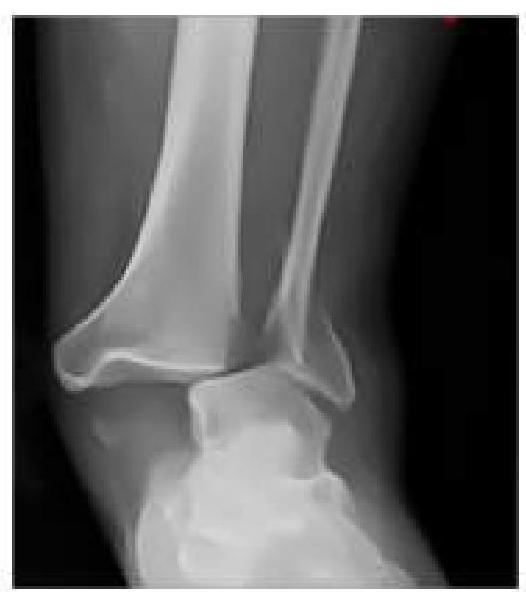
Question 51: An RTA patient presented to the emergency department with severe pain in the ankle. An X-ray was performed, given below. What is the best next step in management?
- A. Neurovascular Assessment and Closed reduction with slab application (Correct Answer)
- B. Neurovascular Assessment and Closed reduction with cast application
- C. Neurovascular Assessment and Immediate surgery
- D. Neurovascular Assessment and Immediate open reduction
Explanation: ***Neurovascular Assessment and Closed reduction with slab application*** - The X-ray shows an **ankle dislocation without an obvious fracture**, making **closed reduction** the appropriate initial treatment. - A **slab (splint)** is preferred over a full cast initially for acute injuries to accommodate for swelling, reducing the risk of compartment syndrome, and allowing for serial neurovascular checks. *Neurovascular Assessment and Closed reduction with cast application* - While closed reduction is correct, applying a **full cast** immediately after an acute injury carries a risk of **compartment syndrome** due to potential swelling that cannot be accommodated by a rigid cast. - A cast would typically be applied after the initial swelling has subsided, usually a few days to a week after initial reduction and splinting. *Neurovascular Assessment and Immediate surgery* - **Immediate surgery** is generally reserved for **open fractures/dislocations**, dislocations that cannot be reduced closed (irreducible dislocations), or those with significant associated fractures that require surgical fixation to stabilize the joint. - In this case, the dislocation appears to be isolated and amenable to closed reduction, making surgery not the immediate next step. *Neurovascular Assessment and Immediate open reduction* - **Open reduction** is performed when closed reduction fails or is contraindicated, for example, due to soft tissue interposition or highly unstable fracture patterns. - Since closed reduction has not yet been attempted, immediate open reduction is premature and unnecessary for an apparently simple dislocation.
Pediatrics
1 questionsAn 11-year-old child with a history of streptococcal pharyngitis presents you with fever and arthralgia. There is no past history of rheumatic heart disease or features of carditis or valvular disease. How often is 600,000 IU of benzathine penicillin recommended for prophylaxis of rheumatic heart disease?
NEET-PG 2022 - Pediatrics NEET-PG Practice Questions and MCQs
Question 51: An 11-year-old child with a history of streptococcal pharyngitis presents you with fever and arthralgia. There is no past history of rheumatic heart disease or features of carditis or valvular disease. How often is 600,000 IU of benzathine penicillin recommended for prophylaxis of rheumatic heart disease?
- A. Immediately
- B. Thrice weekly lifelong
- C. Once in three weeks for 10 years or till the age of 25, whichever is longer
- D. Once in three weeks for 5 years or till the age of 18, whichever is longer (Correct Answer)
Explanation: ***Once in three weeks for 5 years or till the age of 18, whichever is longer*** - For patients with a history of **rheumatic fever** but **no carditis**, secondary prophylaxis with benzathine penicillin G is recommended for **5 years** or until **age 18**, whichever is longer. - The usual dose of benzathine penicillin G for children (under 27 kg) is **600,000 IU** intramuscularly every 3-4 weeks. *Immediately* - This option refers to the timing of initial treatment for **streptococcal pharyngitis**, not the duration or frequency of secondary prophylaxis. - Initiating antibiotic treatment immediately for acute strep throat prevents **acute rheumatic fever**, but long-term prophylaxis follows guidelines. *Thrice weekly lifelong* - This frequency is incorrect; secondary prophylaxis is typically given every **3-4 weeks**, not three times a week. - Lifelong prophylaxis is generally reserved for patients with severe **rheumatic heart disease** or those undergoing valve replacement, which is not the case here. *Once in three weeks for 10 years or till the age of 25, whichever is longer* - This duration is recommended for patients with **rheumatic fever with carditis but no residual heart disease**. - For patients with **carditis** and **residual heart disease**, prophylaxis is often extended for **10 years** or until **age 40**, or even lifelong in severe cases.
Pharmacology
1 questionsA female patient presents to you with a unilateral headache. It is associated with nausea, photophobia, and phonophobia. What is the drug of choice for acute management?
NEET-PG 2022 - Pharmacology NEET-PG Practice Questions and MCQs
Question 51: A female patient presents to you with a unilateral headache. It is associated with nausea, photophobia, and phonophobia. What is the drug of choice for acute management?
- A. Flunarizine
- B. Sumatriptan (Correct Answer)
- C. Propranolol
- D. Topiramate
Explanation: ***Sumatriptan*** - **Sumatriptan**, a **triptan**, is an effective abortive therapy for **acute migraine attacks** due to its selective serotonin 5-HT1B/1D receptor agonist action, leading to vasoconstriction and inhibition of neurogenic inflammation. - The symptoms described—**unilateral headache**, nausea, **photophobia**, and **phonophobia**—are classic features of migraine. *Flunarizine* - **Flunarizine** is a **calcium channel blocker** used for migraine **prophylaxis**, not for acute treatment. - It is typically prescribed for patients experiencing frequent or severe migraine attacks to reduce their incidence. *Propranolol* - **Propranolol** is a **beta-blocker** primarily used for migraine **prophylaxis**. - It helps prevent migraine attacks by modulating cerebral blood flow and neuronal excitability, but it is not effective for acute pain relief during an attack. *Topiramate* - **Topiramate** is an **antiepileptic drug** often used for migraine **prophylaxis**. - It works by various mechanisms, including altering neurotransmitter activity, but it does not provide acute symptomatic relief for an ongoing migraine attack.
Radiology
1 questionsA delayed intravenous urogram of a patient is given below. What is the likely diagnosis?

NEET-PG 2022 - Radiology NEET-PG Practice Questions and MCQs
Question 51: A delayed intravenous urogram of a patient is given below. What is the likely diagnosis?
- A. Pelviureteric junction obstruction (Correct Answer)
- B. Putty kidney
- C. Staghorn calculus
- D. Cystic kidney
Explanation: ***Pelviureteric junction obstruction*** - The image shows marked **dilatation of the renal pelvis and calyces** on the right side, with a relatively abrupt narrowing at the junction of the pelvis and ureter. - The delayed nature of the urogram suggests **impaired drainage** of contrast from the renal pelvis, accumulating proximal to the obstruction. *Putty kidney* - A "putty kidney" (or **autonecrotic kidney**) refers to a chronic, severely diseased kidney, often seen in end-stage **renal tuberculosis**, that has become calcified and non-functional. - This image demonstrates active contrast excretion and pelvicalyceal dilatation, not a calcified, non-functional organ. *Staghorn calculus* - A staghorn calculus is a **large, branched kidney stone** that occupies a significant portion of the renal collecting system. - While it can cause hydronephrosis, the image does not show a dense, radiopaque calculus filling the collecting system. *Cystic kidney* - **Cystic kidneys**, such as in polycystic kidney disease, are characterized by multiple fluid-filled sacs within the kidney parenchyma. - The image depicts dilatation of the collecting system, not diffuse cystic changes throughout the renal parenchyma.
Surgery
1 questionsThe image below shows a pressure sore. Which stage does this belong to?

NEET-PG 2022 - Surgery NEET-PG Practice Questions and MCQs
Question 51: The image below shows a pressure sore. Which stage does this belong to?
- A. Stage 1
- B. Stage 2
- C. Stage 3
- D. Stage 4 (Correct Answer)
Explanation: ***Stage 4*** - The image clearly shows **extensive tissue loss**, including exposed bone and muscle, indicating a **deep tissue injury**. - The presence of large areas of **dead tissue (eschar)**, undermining, and tunneling are characteristic features of a stage 4 pressure sore. *Stage 1* - This stage involves **intact skin** with non-blanchable redness, indicating only superficial damage. - There is no **break in the skin** or tissue loss in Stage 1 pressure sores. *Stage 2* - Characterized by **partial-thickness skin loss**, presenting as an open blister or shallow ulcer. - **No visible deeper tissue** such as fat, muscle, or bone is exposed in this stage. *Stage 3* - Involves **full-thickness skin loss** with visible subcutaneous fat, but bone, tendon, or muscle are not exposed. - While there may be **undermining or tunneling**, the deep structures are not yet visible as seen in the image.