Community Medicine
1 questionsSTEPwise approach to surveillance for Non-Communicable diseases step 2 is
NEET-PG 2022 - Community Medicine NEET-PG Practice Questions and MCQs
Question 121: STEPwise approach to surveillance for Non-Communicable diseases step 2 is
- A. Biochemical Measurement
- B. Behavioral measurement
- C. Physical measurement (Correct Answer)
- D. Emotional Assessment
Explanation: ***Physical measurement*** - The **STEPwise approach** to NCD surveillance involves three steps, with Step 2 specifically focusing on **physical measurements**. - This step includes measurements like **blood pressure**, BMI, weight, height, and waist circumference, which provide crucial data on NCD risk factors. *Biochemical Measurement* - This is typically **Step 3** in the WHO STEPwise approach, focusing on biological measurements from blood or urine samples. - Examples include **blood glucose**, cholesterol levels, and other biomarkers. *Behavioral measurement* - This corresponds to **Step 1** of the WHO STEPwise approach, which involves self-reported data on lifestyle factors. - It covers aspects like **diet**, physical activity, and tobacco/alcohol consumption. *Emotional Assessment* - While emotional and mental health are relevant to overall well-being, **emotional assessment** is not a standard, distinct step in the core WHO STEPwise approach for NCD surveillance. - The STEPs focus on behavioral, physical, and biochemical indicators of NCD risk.
Dermatology
2 questionsA 22-year-old woman presents with diffuse hair loss for 1 month. She had a past history of enteric fever 4 months ago. What is the likely cause?
Pitting of nails is seen in:
NEET-PG 2022 - Dermatology NEET-PG Practice Questions and MCQs
Question 121: A 22-year-old woman presents with diffuse hair loss for 1 month. She had a past history of enteric fever 4 months ago. What is the likely cause?
- A. Telogen effluvium (Correct Answer)
- B. Androgenic alopecia
- C. Alopecia areata
- D. Anagen effluvium
Explanation: ***Telogen effluvium*** - **Telogen effluvium** is characterized by diffuse hair shedding, often occurring 2-4 months after a significant physiological or psychological stressor, such as **enteric fever**. - The stress prematurely shifts a large number of hair follicles from the **anagen (growth)** phase into the **telogen (resting)** phase, leading to synchronized shedding. *Androgenic alopecia* - This condition presents as a gradual, patterned hair loss, typically characterized by **receding hairline** and thinning at the crown in men. - In women, it often appears as **diffuse thinning** over the crown, but it's not usually acute or triggered by an infection in the manner described. *Alopecia areata* - **Alopecia areata** is an autoimmune condition causing **sudden, well-demarcated patches of hair loss**, not diffuse shedding. - It is frequently associated with other autoimmune diseases, and the hair loss pattern is distinct from the patient's presentation. *Anagen effluvium* - **Anagen effluvium** causes rapid, diffuse hair loss during the **anagen (growth)** phase, often triggered by chemotherapy or radiation. - The onset is typically much faster (days to weeks) after the trigger, unlike the delayed onset seen in this case.
Question 122: Pitting of nails is seen in:
- A. Psoriasis and Alopecia areata (Correct Answer)
- B. Psoriasis only
- C. Psoriasis and Lichen planus
- D. Alopecia areata and Eczema
Explanation: ***Psoriasis and Alopecia areata*** - **Nail pitting** is a very common and characteristic finding in **psoriasis**, resulting from defective keratinization of the nail matrix. - While less common, nail pitting can also occur in **alopecia areata**, typically due to inflammation affecting the nail matrix. *Psoriasis only* - While **psoriasis** is a primary cause of nail pitting, stating it as "only" is incorrect as other conditions also present with this sign. - This option incorrectly limits the differential diagnosis for nail pitting. *Psoriasis and Lichen planus* - **Psoriasis** does cause nail pitting, but **lichen planus** typically causes **longitudinal ridging**, splitting, subungual hyperkeratosis, and sometimes pterygium formation, rather than classic pitting. - This option includes a condition that usually manifests with different nail changes. *Alopecia areata and Eczema* - **Alopecia areata** can cause nail pitting, but **eczema** of the hands or fingers more commonly leads to **nail plate dystrophy**, discoloration, ridging, or thickening, rather than distinct pitting. - While eczema can affect nails, pitting is not its characteristic nail manifestation.
Obstetrics and Gynecology
2 questionsA couple comes for evaluation of infertility. The HSG was normal but semen analysis revealed azoospermia. What is the diagnostic test to differentiate between testicular failure and vas deferens obstruction?
Hymenal tear following first sexual intercourse most commonly occurs at which position:
NEET-PG 2022 - Obstetrics and Gynecology NEET-PG Practice Questions and MCQs
Question 121: A couple comes for evaluation of infertility. The HSG was normal but semen analysis revealed azoospermia. What is the diagnostic test to differentiate between testicular failure and vas deferens obstruction?
- A. Serum FSH (Correct Answer)
- B. Testicular FNAC
- C. Testosterone levels
- D. Karyotyping
Explanation: ***Serum FSH*** - In **testicular failure**, the pituitary gland tries to compensate for poor sperm production by increasing **follicle-stimulating hormone (FSH)**, leading to **elevated FSH levels**. - In **vas deferens obstruction**, the testes are producing sperm normally, so the pituitary does not need to overstimulate them, resulting in **normal FSH levels**. *Testicular FNAC* - **Fine needle aspiration cytology (FNAC)** of the testis can *confirm* the presence or absence of sperm production but is not the primary diagnostic test to *differentiate* between the two conditions without prior hormonal assessment. - It is an **invasive procedure** typically considered after initial hormone testing and physical examination. *Testosterone levels* - **Testosterone levels** primarily reflect the Leydig cell function and can be normal in both **testicular failure** (especially germ cell-specific failure) and **vas deferens obstruction**. - While low testosterone can indicate Leydig cell dysfunction, it doesn't specifically differentiate between the two causes of azoospermia in all cases. *Karyotyping* - **Karyotyping** is used to detect **chromosomal abnormalities** (e.g., Klinefelter syndrome) that can cause testicular failure. - While important for identifying underlying genetic causes, it does not directly differentiate between existing testicular failure and vas deferens obstruction based on direct physiological function.
Question 122: Hymenal tear following first sexual intercourse most commonly occurs at which position:
- A. 11 o'clock
- B. 6 o'clock (Correct Answer)
- C. 12 o'clock
- D. All of the above
Explanation: ***Correct: 6 o'clock*** - The **hymen** is most commonly torn at the **6 o'clock position** (inferiorly) due to the direction of typical coital forces during first intercourse. - This area is usually the **thinnest** and **least supported**, making it more susceptible to tearing during initial penetration. - This is the most consistently reported site for initial hymenal tears in forensic and gynecological literature. *Incorrect: 11 o'clock* - While hymenal tears can occur at other positions, the **11 o'clock position** is not the most common site of rupture during first intercourse. - Tears at superior or lateral positions are less frequent unless there are unusual circumstances or anatomical variations. *Incorrect: 12 o'clock* - The **12 o'clock position** (superiorly) is less commonly the primary site of hymenal rupture during first intercourse. - The majority of tears are observed inferiorly (at 6 o'clock) due to the anatomy and mechanics of penetration. *Incorrect: All of the above* - While it is possible for the hymen to tear at **multiple positions** or in various configurations, the question asks for the *most common* position. - The 6 o'clock position is the most consistently reported site for initial hymenal tears, not all positions equally.
Pediatrics
1 questionsA blood specimen for neonatal thyroid screening is obtained on:
NEET-PG 2022 - Pediatrics NEET-PG Practice Questions and MCQs
Question 121: A blood specimen for neonatal thyroid screening is obtained on:
- A. Cord blood
- B. 48 hours after birth (Correct Answer)
- C. 24 hours after birth
- D. 72 hours after birth
Explanation: ***48 hours after birth*** - Neonatal thyroid screening is optimally performed at **48-72 hours** after birth, with **48 hours** being the most practical timing in current practice. - This timing balances two important factors: avoiding the **physiological TSH surge** that occurs in the first 24 hours, while ensuring screening occurs **before early hospital discharge**. - According to **IAP (Indian Academy of Pediatrics)** and international guidelines, screening at 48 hours allows accurate detection of congenital hypothyroidism while being realistic for modern obstetric practices where most mothers are discharged within 48 hours. - The **thyroid-stimulating hormone (TSH)** levels have normalized sufficiently by 48 hours to minimize false-positive results. *Cord blood* - Cord blood is not used for routine neonatal thyroid screening because **maternal thyroid hormones** (T4 and T3) cross the placenta and can mask congenital hypothyroidism in the newborn. - It does not reflect the newborn's **independent thyroid function**, which is essential for identifying congenital disorders. *24 hours after birth* - Drawing blood at 24 hours is generally **too early** for optimal thyroid screening, as the **postnatal TSH surge** is still significant. - This timing would result in a higher rate of **false-positive results**, leading to unnecessary follow-up tests and parental anxiety. - However, if discharge occurs before 48 hours, screening at 24 hours is preferable to missing screening entirely. *72 hours after birth* - While 72 hours was traditionally recommended for thyroid screening, it is **no longer practical** in the era of early hospital discharge. - Most mothers and babies are discharged within **48 hours**, making 72-hour screening logistically difficult and risking missed screening. - Current guidelines recommend **48-72 hours OR at discharge, whichever is earlier**, making 48 hours the most optimal single timepoint.
Pharmacology
1 questionsThe mechanism of action of botulinum toxin A is best described by:
NEET-PG 2022 - Pharmacology NEET-PG Practice Questions and MCQs
Question 121: The mechanism of action of botulinum toxin A is best described by:
- A. Slowing of myelinated nerve fiber transmission
- B. Postsynaptic receptor blockade
- C. Acetylcholinesterase inhibition
- D. Presynaptic blockade of acetylcholine release (Correct Answer)
Explanation: ***Presynaptic blockade of acetylcholine release*** - **Botulinum toxin A** acts by cleaving specific proteins (**SNARE proteins** like SNAP-25, synaptobrevin, and syntaxin) essential for the fusion of **acetylcholine-containing vesicles** with the presynaptic membrane. - This prevents the release of acetylcholine into the **neuromuscular junction**, leading to muscle paralysis. *Slowing of myelinated nerve fiber transmission* - This describes the action of agents that affect **myelin sheaths** (e.g., demyelinating diseases) or ion channels involved in action potential propagation, not the mechanism of botulinum toxin. - Botulinum toxin specifically targets the **synaptic transmission**, not the speed of nerve conduction itself. *Postsynaptic receptor blockade* - This mechanism is seen with drugs like **curare** or **neuromuscular blockers** (e.g., rocuronium, vecuronium), which compete with acetylcholine for binding to **nicotinic acetylcholine receptors** on the muscle endplate. - Botulinum toxin does not affect the postsynaptic receptors directly; its action is entirely presynaptic. *Acetylcholinesterase inhibition* - **Acetylcholinesterase inhibitors** (e.g., neostigmine, pyridostigmine) prevent the breakdown of acetylcholine in the synaptic cleft, increasing its concentration and prolonging its action. - This mechanism would enhance, rather than block, muscle contraction, which is opposite to the effect of botulinum toxin.
Radiology
2 questionsMost sensitive investigation for abdominal trauma in a hemodynamically stable patient is-
What is the role of fixer?
NEET-PG 2022 - Radiology NEET-PG Practice Questions and MCQs
Question 121: Most sensitive investigation for abdominal trauma in a hemodynamically stable patient is-
- A. Ultrasonography (FAST)
- B. Diagnostic peritoneal lavage (DPL)
- C. MRI (Magnetic Resonance Imaging)
- D. CT Scan (Computed Tomography) (Correct Answer)
Explanation: ***CT Scan (Computed Tomography)*** - **CT scans** offer superior anatomical detail and can accurately detect organ damage, hemorrhage, and other injuries in **hemodynamically stable** patients with abdominal trauma. - It is considered the **most sensitive** and specific imaging modality for evaluating blunt and penetrating abdominal trauma when the patient can tolerate the study. *Ultrasonography (FAST)* - While effective for detecting **free fluid** (blood) in specific abdominal areas, **Focused Assessment with Sonography for Trauma (FAST)** has lower sensitivity for solid organ injuries or bowel perforations. - Its primary role is rapid assessment for **hemoperitoneum** to guide immediate management in unstable patients, not detailed injury characterization. *Diagnostic peritoneal lavage (DPL)* - **DPL** is an invasive procedure with high sensitivity for detecting **intraperitoneal bleeding**, but it does not identify specific organ injuries or retroperitoneal hemorrhage. - It is rarely used in hemodynamically stable patients due to its invasiveness and the availability of more detailed imaging techniques. *MRI (Magnetic Resonance Imaging)* - **MRI** provides excellent soft tissue contrast but is typically too **time-consuming** and less accessible in urgent trauma settings compared to CT. - It's generally not the first-line investigation for acute abdominal trauma due to motion artifacts and limited utility in detecting air or bone injuries.
Question 122: What is the role of fixer?
- A. It binds developer to film.
- B. It removes the extra silver halides which are unfixed. (Correct Answer)
- C. It takes away extra developer solution.
- D. It strengthens/fixes the silver halides on to X-ray film.
Explanation: ***It removes the extra silver halides which are unfixed.*** - The fixer solution plays a crucial role in creating a permanent radiographic image by **dissolving and removing all unexposed and undeveloped silver halide crystals** from the film emulsion. - This process prevents the film from darkening over time and ensures that only the areas exposed to radiation, forming the latent image, remain visible. *It binds developer to film.* - The developer's role is to **convert exposed silver halide crystals into metallic silver**, creating the visible image, but it does not bind to the film permanently. - The fixer step follows development to remove unexposed crystals, not to bind the developer. *It takes away extra developer solution.* - While the fixer follows the developer bath, its primary role is not simply to remove residual developer solution; that function is more closely associated with the **rinse step** between development and fixing. - The main action of the fixer involves chemical removal of silver halides. *It strengthens/fixes the silver halides on to X-ray film.* - The developer is responsible for converting exposed silver halides into visible silver, but the fixer actually **removes the *unfixed*** silver halides, rather than strengthening or "fixing" them onto the film. - This removal is essential for a stable and clear image, as any remaining unfixed halides would eventually darken.
Surgery
1 questionsA 40 years old male was brought emergency with severe abdominal pain. On examination, pulse rate was 112/minute and systolic BP was 80 mmHg. Chest x-ray is given below. What is the most appropriate management?

NEET-PG 2022 - Surgery NEET-PG Practice Questions and MCQs
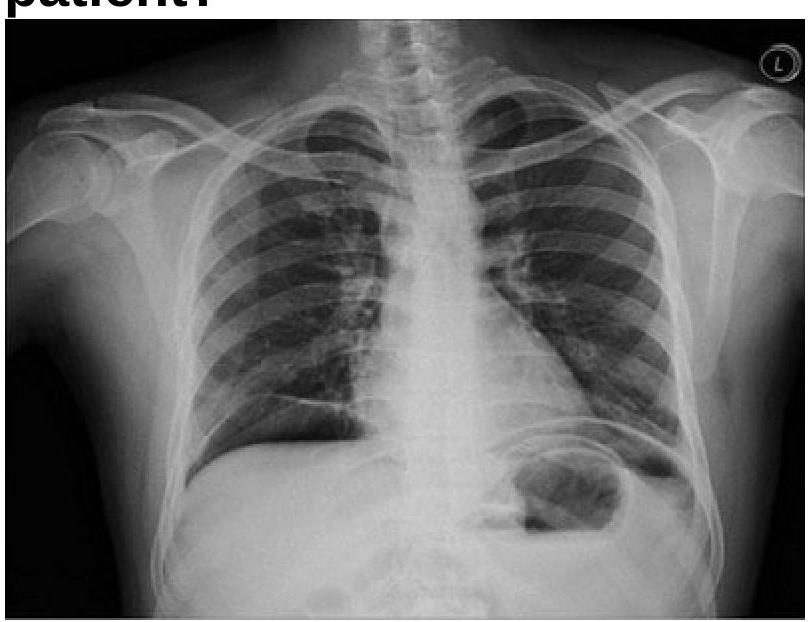
Question 121: A 40 years old male was brought emergency with severe abdominal pain. On examination, pulse rate was 112/minute and systolic BP was 80 mmHg. Chest x-ray is given below. What is the most appropriate management?
- A. Exploratory laparotomy (Correct Answer)
- B. Saline wash of stomach
- C. Intercostal tube drainage
- D. IV antibiotics
Explanation: ***Exploratory laparotomy*** - The chest x-ray shows **pneumoperitoneum (air under the diaphragm)**, which, combined with severe abdominal pain, tachycardia, and hypotension (signs of **septic shock**), is highly indicative of a **perforated viscus**. - **Emergency exploratory laparotomy** is the definitive treatment to identify and repair the perforation, control contamination, and prevent further deterioration. *Saline wash of stomach* - This procedure is typically used for gastric lavage in cases of **poisoning or drug overdose**, or to clear the stomach in preparation for endoscopy. - It does not address a viscus perforation or the widespread abdominal contamination and systemic septic response seen in this patient. *Intercostal tube drainage* - **Intercostal tube drainage** (chest tube placement) is used to drain air (pneumothorax) or fluid (pleural effusion, hemothorax, empyema) from the pleural space, not the abdominal cavity. - While there is air visible on the x-ray, it is **subdiaphragmatic (pneumoperitoneum)**, not within the pleural space, and thus a chest tube would be ineffective and inappropriate. *IV antibiotics* - **Intravenous antibiotics** are crucial for managing sepsis associated with a perforated viscus and should be administered promptly. - However, antibiotics alone are **not sufficient** to treat the underlying mechanical problem of a perforation, which requires surgical repair to prevent ongoing bacterial contamination and sepsis.