Community Medicine
1 questionsWhich of the following agencies is primarily responsible for supporting school feeding programs globally?
NEET-PG 2022 - Community Medicine NEET-PG Practice Questions and MCQs
Question 91: Which of the following agencies is primarily responsible for supporting school feeding programs globally?
- A. WFP (Correct Answer)
- B. UNDP
- C. UNICEF
- D. WHO
Explanation: ***WFP (World Food Programme)*** - **WFP** is the **primary UN agency** responsible for supporting **school feeding programs globally**, operating in over 60 countries and providing meals to millions of schoolchildren. - WFP's school feeding programs are the world's largest safety net initiative, combining hunger relief with education support, and are a **flagship program** of the organization. - The agency focuses specifically on food assistance and hunger, making school feeding programs a core component of their mission to achieve Zero Hunger. *UNICEF* - **UNICEF** does support child nutrition and welfare programs, including some school-based nutrition initiatives, but it is **not the primary agency** for school feeding programs. - UNICEF's broader mandate focuses on child rights, health, education, and protection, with nutrition being one component rather than the specialized focus that WFP has on food assistance. - UNICEF often **collaborates with WFP** on school feeding initiatives rather than leading them independently. *UNDP* - The **UNDP** (United Nations Development Programme) focuses on sustainable development, poverty alleviation, and resilient societies. - While food security is part of development goals, UNDP does not directly implement or primarily fund school feeding programs compared to WFP. *WHO* - The **WHO** (World Health Organization) is the leading international authority on public health, focusing on disease prevention, health standards, and health policy. - While WHO provides guidance on nutritional standards and healthy diets for children, it does **not implement or fund school feeding programs** - this operational role belongs to WFP.
ENT
1 questionsA 45-year-old patient complained of pain on one side of the neck. She is afraid of eating food as it worsens the pain. An ultrasound of the salivary glands is shown below. What is the most likely diagnosis?

NEET-PG 2022 - ENT NEET-PG Practice Questions and MCQs
Question 91: A 45-year-old patient complained of pain on one side of the neck. She is afraid of eating food as it worsens the pain. An ultrasound of the salivary glands is shown below. What is the most likely diagnosis?
- A. Sialolithiasis (Correct Answer)
- B. Salivary gland foreign body
- C. Cervical lymphadenopathy
- D. Osteoma of the floor of the mouth
Explanation: ***Sialolithiasis*** - The ultrasound image shows an **echogenic focus** with clear **posterior acoustic shadowing** within the salivary gland, which is characteristic of a salivary gland stone. - The patient's symptoms of **pain on one side of the neck** and **worsening pain with eating** (likely due to salivary stimulation) are classic for **sialolithiasis**, as the stone obstructs salivary flow. *Salivary gland foreign body* - While a foreign body could present with similar pain, it would typically appear as a distinct object on ultrasound, but its echogenicity and shading characteristics might differ depending on the material. - The history of a foreign body ingestion or insertion would be crucial, which is not mentioned here. *Cervical lymphadenopathy* - **Lymph nodes** on ultrasound typically appear as oval-shaped structures with a **hypoechoic cortex** and an **echogenic hilum**; they do not usually show significant acoustic shadowing unless calcified. - While cervical lymphadenopathy can cause neck pain, it is not typically exacerbated by eating in the same way an obstructed salivary gland would be. *Osteoma of the floor of the mouth* - An **osteoma** is a **benign bone tumor** that would present as a very **dense, highly echogenic mass** with severe posterior acoustic shadowing on ultrasound, originating from bony structures. - While an osteoma could cause pain, its location (floor of the mouth) and nature would not typically explain pain worsening specifically with eating due to salivary gland obstruction.
Forensic Medicine
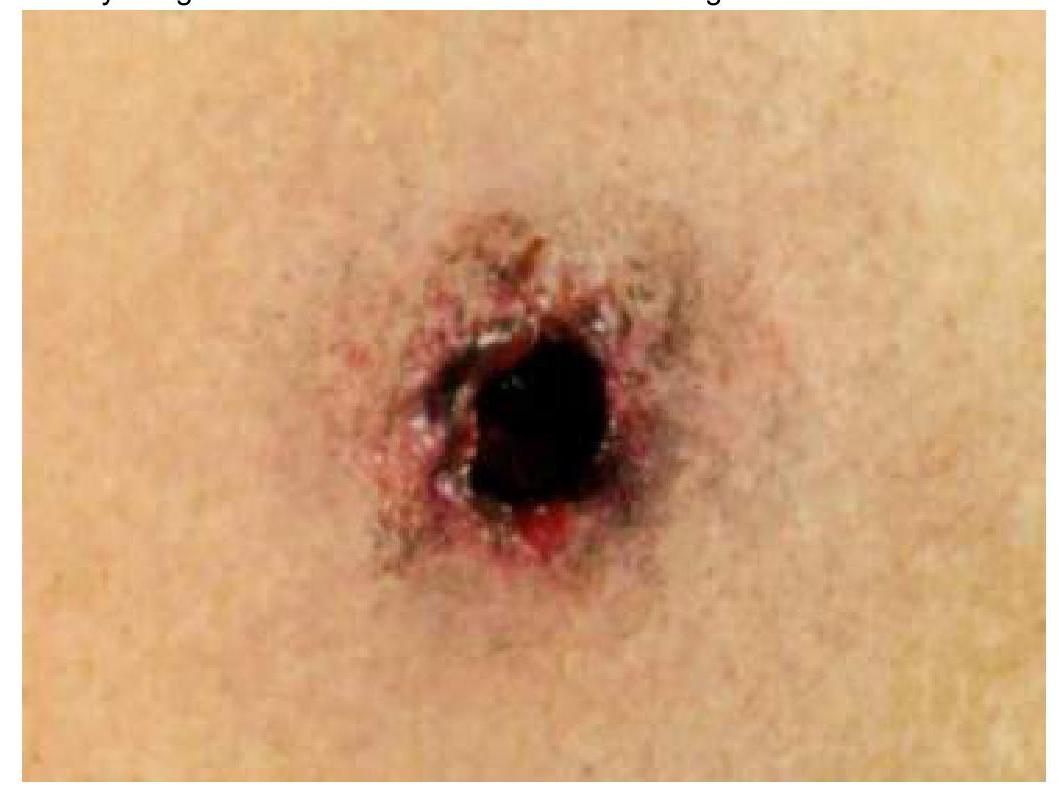
1 questionsBased on the provided wound characteristics, identify the type of firearm used and the estimated range of the shot.
NEET-PG 2022 - Forensic Medicine NEET-PG Practice Questions and MCQs
Question 91: Based on the provided wound characteristics, identify the type of firearm used and the estimated range of the shot.
- A. Shotgun, intermediate range
- B. Shotgun, close range
- C. Pistol, near shot (Correct Answer)
- D. Pistol, close shot
Explanation: ***Pistol, near shot*** - This image shows a **gunshot wound with soot deposition (fouling)** and possibly some **stippling (powder tattooing)**, indicating a **near shot** with a **handgun or rifle**. - The wound edges show a **darkened, burned appearance** due to gas and partially burned powder, characteristic of a shot fired very close to the skin, but not necessarily in contact. *Shotgun, intermediate range* - A shotgun wound at intermediate range would typically show a **spread pattern of multiple pellet wounds**, or a larger, less defined wound if the shot column had not dispersed significantly. - There would be **no soot or stippling** from an intermediate range shotgun shot. *Shotgun, close range* - A shotgun wound at close range (e.g., a few feet) would result in a **larger, ragged wound with significant tissue destruction** due to the wide impact area of the shot column and wadding. - While there might be some burning, the wound characteristics would be distinctly different from a single projectile entry. *Pistol, close shot* - A "close shot" with a pistol is a broad category. While the image does suggest a close range, the specific term "near shot" better describes the presence of **soot and stippling** without deep impressions or a wide contact area typically seen in contact wounds. - A contact pistol shot would often leave a **distinct muzzle imprint** or a **cruciate tear pattern**, which are not clearly evident here.
Internal Medicine
3 questionsA woman with recurrent diarrhea is prescribed a broad-spectrum antibiotic. Which of the following statements is not true regarding Clostridium difficile infection?
A female patient presented with fatigue and a history of piles. Routine complete blood count analysis showed hemoglobin of 9 g/dL, MCV 60fL, and RBC count of 5.2 million. A peripheral smear is provided. Which of the following is the next best investigation after the smear for this patient?

A patient diagnosed to be HIV-positive was started on highly active antiretroviral therapy (HAART). Which of the following can be used to monitor treatment efficacy?
NEET-PG 2022 - Internal Medicine NEET-PG Practice Questions and MCQs
Question 91: A woman with recurrent diarrhea is prescribed a broad-spectrum antibiotic. Which of the following statements is not true regarding Clostridium difficile infection?
- A. Pseudomembrane is a layer of inflammatory debris
- B. Oral fidaxomicin is used for treatment
- C. It is toxin mediated
- D. IgM assay is used to confirm the diagnosis of Clostridium difficile infection. (Correct Answer)
Explanation: ***IgM assay is used to confirm the diagnosis of Clostridium difficile infection*** - An **IgM assay** is **not** the standard or recommended method for diagnosing *Clostridium difficile* infection (CDI). - Diagnosis typically relies on detecting **toxins (A and B)** in stool samples through antigen-based tests, PCR, or enzyme immunoassays [1]. *Oral fidaxomicin is used for treatment* - **Fidaxomicin** is an **oral macrolide antibiotic** specifically approved and highly effective for treating *C. difficile* infection, especially recurrent cases. - It works by inhibiting bacterial RNA polymerase, leading to bactericidal activity against *C. difficile* with minimal systemic absorption. *It is toxin mediated* - The pathogenicity of *C. difficile* is primarily mediated by its **exotoxins, Toxin A (enterotoxin)** and **Toxin B (cytotoxin)** [1]. - These toxins cause mucosal inflammation, increased permeability, and cell death in the colon, leading to the characteristic symptoms of CDI. *Pseudomembrane is a layer of inflammatory debris* - **Pseudomembranes** are a hallmark pathological feature of severe *C. difficile* colitis, visible during colonoscopy [1]. - They consist of an inflammatory exudate composed of **necrotic epithelial cells, fibrin, neutrophils, and mucus**, forming raised yellow-white plaques on the colonic mucosa.
Question 92: A female patient presented with fatigue and a history of piles. Routine complete blood count analysis showed hemoglobin of 9 g/dL, MCV 60fL, and RBC count of 5.2 million. A peripheral smear is provided. Which of the following is the next best investigation after the smear for this patient?
- A. HbA2 levels
- B. Serum ferritin levels (Correct Answer)
- C. Serum folate levels
- D. Serum homocysteine levels
Explanation: ***Serum ferritin levels*** - The **low hemoglobin** and **low MCV (microcytic anemia)** indicate a likely iron deficiency, commonly assessed by serum ferritin levels [1]. - The patient's **history of piles** suggests possible gastrointestinal bleeding, further pointing to the need for iron studies. *Serum folate levels* - Typically evaluated in cases of **macrocytic anemia**, which is not indicated here due to a **low MCV**. - Folate deficiency leads to larger, immature red cells, contrasting the findings of microcytic anemia in this patient. *Serum homocysteine levels* - While elevated levels can indicate **vitamin B12 or folate deficiency**, they are not specific for iron deficiency anemia. - The current presentation does not suggest deficiencies of B12 or folate, making this test less relevant. *HbA2 levels* - Useful in diagnosing **beta-thalassemia**, but not indicated in the context of evident **microcytic anemia** and fatigue without hemolysis or family history [1]. - The patient's profile does not align with thalassemia, thus making this investigation unnecessary. **References:** [1] Cross SS. Underwood's Pathology: A Clinical Approach. 6th ed. Common Clinical Problems From Blood And Bone Marrow Disease, pp. 590-591.
Question 93: A patient diagnosed to be HIV-positive was started on highly active antiretroviral therapy (HAART). Which of the following can be used to monitor treatment efficacy?
- A. CD4+ T cell count
- B. Viral load (Correct Answer)
- C. p24 antigen
- D. Viral serotype
Explanation: ***Viral load*** - **Viral load** (HIV RNA copies per milliliter of plasma) is the most direct and sensitive measure of HAART efficacy, as it indicates the amount of actively replicating virus [1]. - A successful HAART regimen aims to reduce the **viral load** to undetectable levels, signaling effective suppression of viral replication [1]. *CD4+ T cell count* - While important for monitoring immune status and disease progression, **CD4+ T cell count** changes more slowly than viral load [1]. - An increase in **CD4+ T cell count** is a positive sign of immune reconstitution but is a lagging indicator of immediate treatment efficacy [1]. *p24 antigen* - **p24 antigen** is a core structural protein of HIV, primarily detectable early in acute infection and in advanced stages when viral replication is very high. - It is generally not used for routine monitoring of HAART efficacy in chronic HIV infection because its levels fluctuate and become undetectable as the immune system produces antibodies. *Viral serotype* - **Viral serotype** refers to the specific strain or subtype of HIV (e.g., HIV-1 vs. HIV-2, or different clades within HIV-1). - It is determined at diagnosis to understand the specific virus but does not change significantly during the course of treatment and is not used to monitor HAART efficacy.
Microbiology
1 questionsA female patient presents with complaints of thick white vaginal secretions. Which of the following can be used to identify the likely species of the causative agent?
NEET-PG 2022 - Microbiology NEET-PG Practice Questions and MCQs
Question 91: A female patient presents with complaints of thick white vaginal secretions. Which of the following can be used to identify the likely species of the causative agent?
- A. Brain heart infusion agar
- B. Sabouraud dextrose agar
- C. CHROMagar (Correct Answer)
- D. Birdseed agar
Explanation: ***CHROMagar*** - **CHROMagar Candida** is a differential and selective medium used for the isolation and presumptive identification of common yeast species, including *Candida albicans*, *Candida tropicalis*, and *Candida glabrata*, based on chromogenic reactions. - Different *Candida* species produce distinct colonies of varying colors on this medium, aiding in their **presumptive identification** directly from patient samples like vaginal secretions. *Birdseed agar* - This medium (also known as Staib's medium or Niger seed agar) is primarily used for the isolation and identification of **Cryptococcus neoformans**, which produces dark brown to black colonies due to its phenoloxidase activity. - While it's a fungal growth medium, it is not optimized for distinguishing common *Candida* species responsible for vaginal candidiasis. *Brain heart infusion agar* - **Brain heart infusion (BHI) agar** is a general-purpose, enriched non-selective medium used for the cultivation of a wide variety of fastidious bacteria, yeasts, and molds. - It does not contain differential components that would allow for the specific identification or differentiation of *Candida* species based on colony color or morphology. *Sabouraud dextrose agar* - **Sabouraud dextrose agar (SDA)** is a selective medium primarily used for the isolation and cultivation of pathogenic and nonpathogenic fungi, including yeasts and molds. - While *Candida* species will grow well on SDA, it does not provide differential characteristics (like distinct colony colors) to allow for the presumptive identification and differentiation of various *Candida* species.
Psychiatry
1 questionsA 16-year-old girl has intense cravings for food and consumes large amounts of it, followed by purging behaviors. What is the most likely diagnosis?
NEET-PG 2022 - Psychiatry NEET-PG Practice Questions and MCQs
Question 91: A 16-year-old girl has intense cravings for food and consumes large amounts of it, followed by purging behaviors. What is the most likely diagnosis?
- A. Anorexia nervosa
- B. Bulimia nervosa (Correct Answer)
- C. Major depressive disorder
- D. Binge eating disorder
Explanation: ***Bulimia nervosa*** - **Bulimia nervosa** is characterized by recurrent episodes of **binge eating** (consuming large amounts of food with a sense of lack of control), followed by inappropriate **compensatory behaviors** such as self-induced vomiting, laxative abuse, or excessive exercise. - The patient's presentation of "intense cravings for food," consuming "large amounts," and "purging behaviors" directly aligns with DSM-5 diagnostic criteria for bulimia nervosa. - Peak onset is typically in **adolescence and early adulthood**, and it is more common in females. *Anorexia nervosa* - **Anorexia nervosa** is primarily characterized by **restriction of energy intake** leading to significantly low body weight, intense fear of gaining weight, and disturbance in body image. - While the binge-eating/purging subtype of anorexia exists, the defining feature is **persistent restriction** and significantly **low body weight**, which is not mentioned in this clinical scenario. *Major depressive disorder* - **Depression** is a mood disorder with persistent sadness, anhedonia, and neurovegetative symptoms. - While depression commonly co-occurs with eating disorders and may cause appetite changes, the specific cyclical pattern of **binge eating followed by compensatory purging** is not a characteristic feature of depression itself. *Binge eating disorder* - **Binge eating disorder** involves recurrent episodes of consuming large amounts of food with a sense of lack of control, accompanied by marked distress. - The key distinguishing feature is the **absence of regular compensatory behaviors** (purging, excessive exercise, fasting) that are present in bulimia nervosa.
Radiology
1 questionsA delayed intravenous urogram of a patient is given below. What is the likely diagnosis?

NEET-PG 2022 - Radiology NEET-PG Practice Questions and MCQs
Question 91: A delayed intravenous urogram of a patient is given below. What is the likely diagnosis?
- A. Pelviureteric junction obstruction (Correct Answer)
- B. Putty kidney
- C. Staghorn calculus
- D. Cystic kidney
Explanation: ***Pelviureteric junction obstruction*** - The image shows marked **dilatation of the renal pelvis and calyces** on the right side, with a relatively abrupt narrowing at the junction of the pelvis and ureter. - The delayed nature of the urogram suggests **impaired drainage** of contrast from the renal pelvis, accumulating proximal to the obstruction. *Putty kidney* - A "putty kidney" (or **autonecrotic kidney**) refers to a chronic, severely diseased kidney, often seen in end-stage **renal tuberculosis**, that has become calcified and non-functional. - This image demonstrates active contrast excretion and pelvicalyceal dilatation, not a calcified, non-functional organ. *Staghorn calculus* - A staghorn calculus is a **large, branched kidney stone** that occupies a significant portion of the renal collecting system. - While it can cause hydronephrosis, the image does not show a dense, radiopaque calculus filling the collecting system. *Cystic kidney* - **Cystic kidneys**, such as in polycystic kidney disease, are characterized by multiple fluid-filled sacs within the kidney parenchyma. - The image depicts dilatation of the collecting system, not diffuse cystic changes throughout the renal parenchyma.
Surgery
1 questionsIdentify the most common site of an intraperitoneal abscess.
NEET-PG 2022 - Surgery NEET-PG Practice Questions and MCQs
Question 91: Identify the most common site of an intraperitoneal abscess.
- A. Suprahepatic
- B. Left subphrenic space
- C. Pelvis (Pouch of Douglas) (Correct Answer)
- D. Subhepatic
Explanation: ***Pelvis (Pouch of Douglas)*** - The **Pouch of Douglas** (rectouterine or rectovesical pouch) is the **most common site** for intraperitoneal abscesses. - It is the **most dependent (lowest) part** of the peritoneal cavity in both upright and supine positions, allowing gravity to facilitate collection of infected fluid. - Commonly results from **perforated appendicitis**, **diverticulitis**, **gynecological infections** (PID, tubo-ovarian abscess), or any source of peritoneal contamination where infected material flows downward. - **Clinical significance**: Pelvic abscesses can be drained via transrectal or transvaginal approaches, making them accessible for percutaneous drainage. *Subhepatic* - The **subhepatic space** (Morison's pouch on the right) is a **common but not the most common** site for intraperitoneal abscesses. - More specifically associated with **cholecystitis**, **perforated duodenal ulcers**, or hepatobiliary surgery complications. - While dependent in the supine position, it is less dependent than the pelvis in the upright position. *Suprahepatic* - Abscesses in the **suprahepatic space** are relatively uncommon. - May occur from direct extension of liver abscesses or as complications of upper abdominal surgery. - The presence of peritoneal attachments limits widespread fluid collection in this area. *Left subphrenic space* - The **left subphrenic space** is less commonly involved than the pelvis or right subphrenic spaces. - Typically arises from complications of **splenic injury**, **pancreatitis**, **gastric perforations**, or post-splenectomy infections.