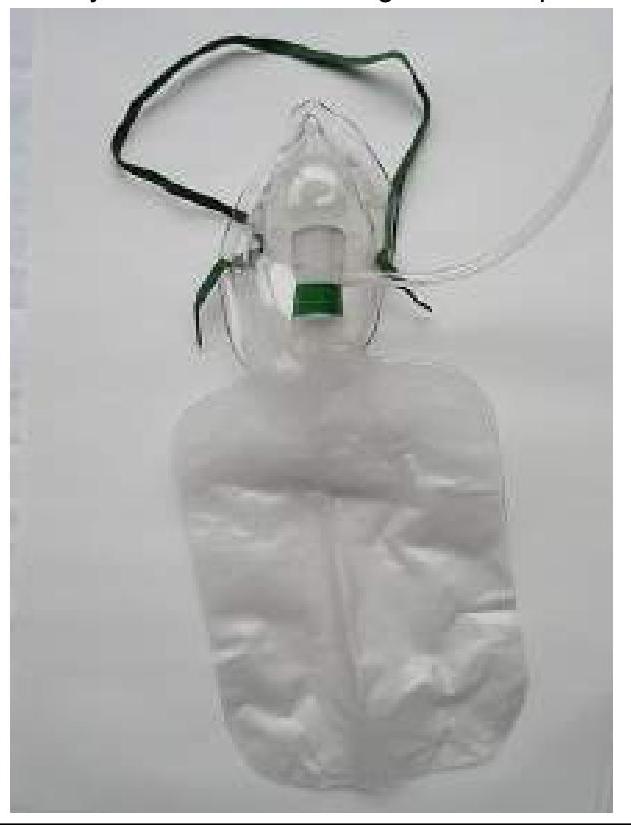
Question 1: Identify the mask used for patients requiring high concentrations of oxygen.
- A. Hudson mask
- B. Nebulizer
- C. Non-rebreathing mask (Correct Answer)
- D. Venturi mask
Explanation: ***Non-rebreathing mask***
- The **non-rebreathing mask** delivers the **highest concentration of oxygen** (FiO2 60-90%) among standard oxygen masks due to a one-way valve that prevents exhaled air from returning to the reservoir bag and ensures only pure oxygen is inhaled.
- It is identifiable by the **reservoir bag** which fills with oxygen and one-way valves.
*Hudson mask*
- The **Hudson mask**, also known as a simple face mask, delivers a **moderate concentration of oxygen (FiO2 35-50%)** and does not have the reservoir bag or one-way valves seen in the image.
- It is used for patients requiring a higher oxygen concentration than nasal cannulae, but less than a non-rebreather.
*Nebulizer*
- A **nebulizer** is a device used to administer medication in the form of a **mist**, typically for respiratory conditions, not primarily for administering high concentrations of oxygen.
- While it can be oxygen-driven, its primary function is drug delivery, not oxygen concentration.
*Venturi mask*
- The **Venturi mask** delivers **precise and consistent concentrations of oxygen (FiO2 24-60%)** through interchangeable jets, which are not visible in the depicted mask.
- It is used when precise control over oxygen delivery is crucial, such as in patients with **COPD**.
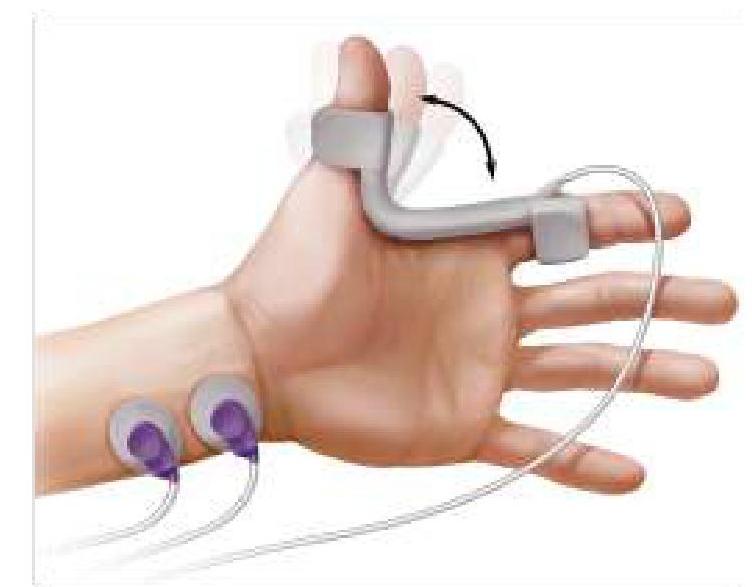
Question 2: The image given below shows neuromuscular monitoring of the patient after anesthesia. What is the most commonly used nerve for monitoring?
- A. Ulnar nerve (Correct Answer)
- B. Median nerve
- C. Radial nerve
- D. Metacarpal nerve
Explanation: ***Ulnar nerve***
- The **ulnar nerve** is the most commonly chosen site for neuromuscular monitoring due to its ease of accessibility and predictable response of the **adductor pollicis muscle**.
- Stimulation of the ulnar nerve at the wrist causes **adduction of the thumb**, which is easily quantifiable and provides reliable information about neuromuscular blockade.
*Median nerve*
- While the median nerve can be monitored, it is **less commonly used** than the ulnar nerve due to potential for confusing responses or less clear twitch measurements.
- Stimulation of the median nerve primarily leads to **flexion of the thumb and fingers**, but the adductor pollicis response from ulnar nerve stimulation is often preferred for its clear isolation.
*Radial nerve*
- The radial nerve innervates muscles involved in **wrist and finger extension**, which are not typically targeted for standard neuromuscular monitoring.
- Its stimulation can be more complex to interpret and may not provide the precise information needed for monitoring paralytic depth in the same way as the ulnar nerve.
*Metacarpal nerve*
- The term "metacarpal nerve" is broad and refers to nerves near the metacarpals, which are **not primary sites** for direct neuromuscular blocking agent monitoring.
- Specific named peripheral nerves like the ulnar, median, or radial nerves are targeted for their predictable muscle responses, not generalized metacarpal innervation.