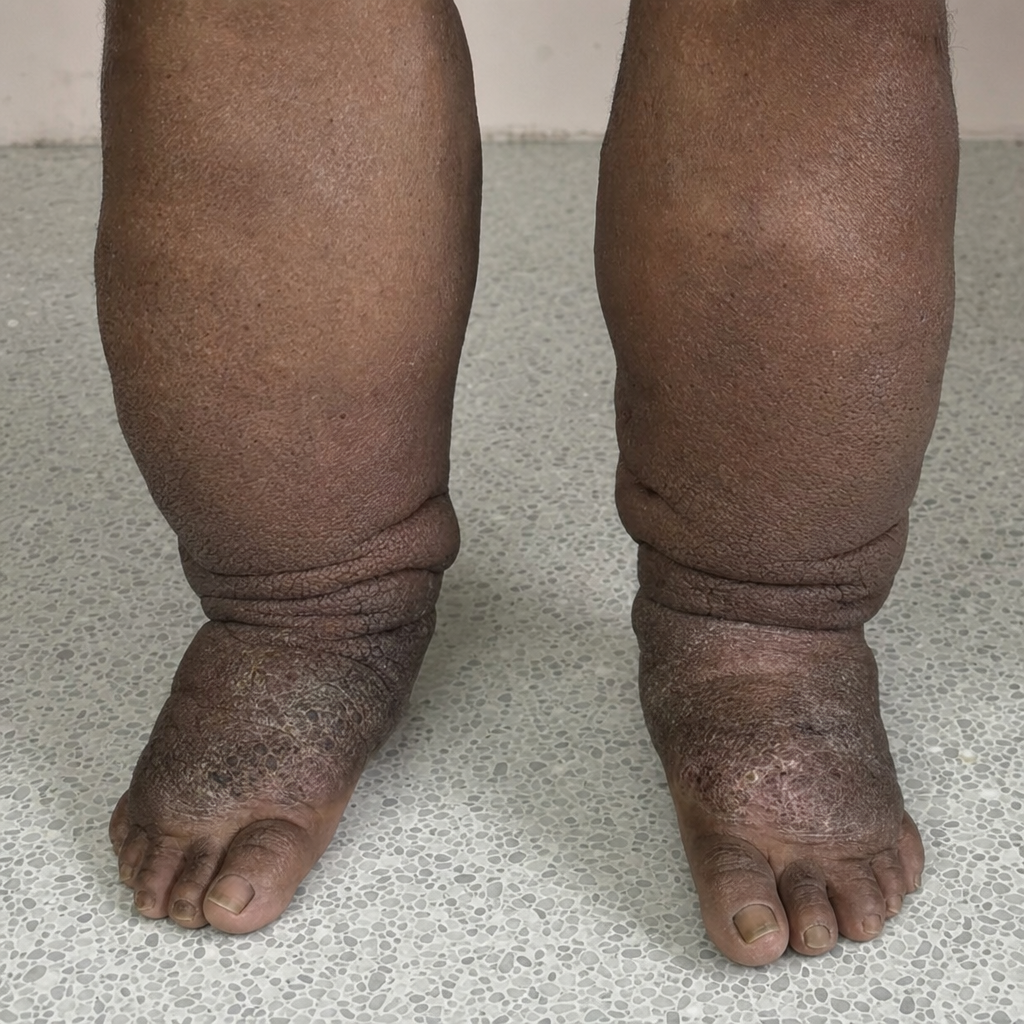
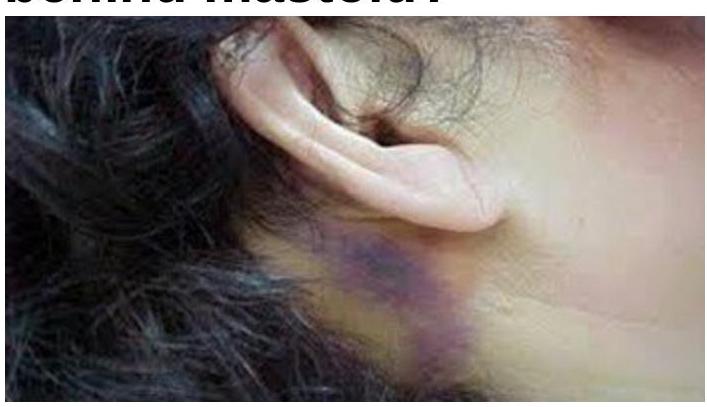
What does a bluish-purple discoloration behind the mastoid indicate?
Not a landmark of facial nerve identification in parotid surgery:
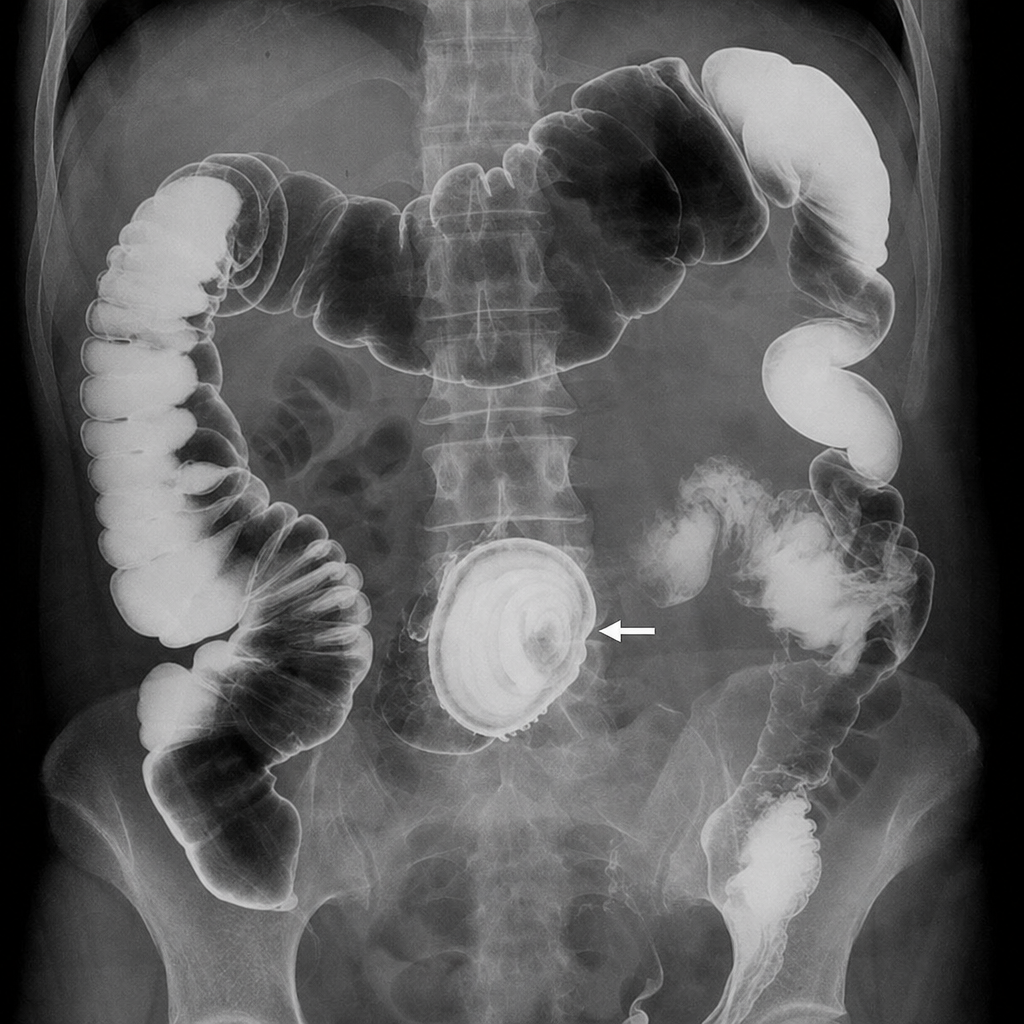
A patient presents with abdominal pain, blood in stools and a palpable mass on examination. A Barium Study was performed, probable diagnosis is?
Which one of the following is not a component of THORACOSCORE?
A 70 year old patient presented with history of fever, repeated aspiration and coughing in the night. On examination there is a swelling on left side of neck which produces gurgling sound on compression. Following is the barium swallow study of the patient. What is the most likely diagnosis?

A patient is on follow-up for recurrent abdominal pain. USG reveals an aortic aneurysm of 40 mm. What should be the next immediate step?
A middle aged man complains of upper abdominal pain after a heavy meal. There is tenderness in the upper abdomen and on X-ray, widening of the mediastinum is seen with air in the mediastinum. What is the diagnosis?
A 20 year old boy is brought to the emergency following a RTA (Road Traffic Accident) with respiratory distress and hypotension. He has subcutaneous emphysema and no air entry on the right side. What is the next best step in the management?
A man is brought to the emergency after he fell into a man hole and injured his perineum. He feels the urge to micturate but is unable to pass urine and there is blood at the tip of the meatus with extensive swelling of the penis and scrotum. What is the location of the injury?
Which of the following statements is true regarding retrosternal goiters?
NEET-PG 2020 - Surgery NEET-PG Practice Questions and MCQs
Question 11: What does a bluish-purple discoloration behind the mastoid indicate?
- A. Battle sign (Correct Answer)
- B. Bezold abscess
- C. Both A and B
- D. None of the options
Explanation: ***Battle sign*** - A **bluish-purple discoloration behind the mastoid** (postauricular ecchymosis) is a classic sign of a **basilar skull fracture**, particularly involving the middle cranial fossa. - This bruising is caused by the extravasation of blood from the fracture site into the soft tissues over the mastoid process. *Bezold abscess* - A Bezold abscess is a rare complication of **mastoiditis**, where infection erodes through the mastoid tip and spreads to the soft tissues of the neck. - It presents as a **painful swelling in the neck** and is typically not associated with a bluish-purple discoloration *behind* the mastoid unless there is significant necrotic tissue or a secondary hematoma, which is not the primary feature. *Both A and B* - These conditions represent distinct pathologies, one related to **trauma (Battle sign)** and the other to **infection (Bezold abscess)**. - While both involve the mastoid region, their underlying causes and typical presentations are different. *None of the options* - The image directly displays the characteristic bruising of a Battle sign, making this option incorrect. - The appearance is highly indicative of a specific medical condition.
Question 12: Not a landmark of facial nerve identification in parotid surgery:
- A. Peripheral branches
- B. Post belly of digastric
- C. Inferior belly of omohyoid (Correct Answer)
- D. Tragal pointer
Explanation: ***Inferior belly of omohyoid*** - The **inferior belly of the omohyoid muscle** is located in the anterior triangle of the neck and is not a surgical landmark for the facial nerve during parotidectomy. - Its anatomical position is too far inferior and anterior to the parotid gland and facial nerve trunk to be useful for facial nerve identification. *Peripheral branches* - While careful dissection of **peripheral branches** is crucial for preserving facial nerve function, they are typically identified *after* locating the main trunk, not as primary landmarks for initially finding the nerve. - Direct identification of peripheral branches first is challenging and carries a higher risk of injury without prior identification of the main trunk or its primary divisions. *Post belly of digastric* - The **posterior belly of the digastric muscle** serves as a vital deep landmark for locating the facial nerve trunk. - The facial nerve typically passes superior to and deep to the posterior belly of the digastric muscle, providing a reliable point of reference for approaching the nerve. *Tragal pointer* - The **tragal pointer**, referring to the anterior surface of the cartilaginous tragus, is a superficial landmark used to approximate the location of the facial nerve trunk. - The facial nerve's main trunk typically emerges from the stylomastoid foramen, which is positioned anterior and inferior to the tragus, making it a useful starting point for surgical dissection.
Question 13: A patient presents with abdominal pain, blood in stools and a palpable mass on examination. A Barium Study was performed, probable diagnosis is?
- A. Volvulus
- B. Meckel's Diverticulum
- C. Diverticulitis
- D. Intussusception (Correct Answer)
Explanation: ***Intussusception*** - This condition is characterized by a "telescoping" of one segment of the intestine into another, which can lead to **abdominal pain**, **rectal bleeding** (often described as "currant jelly" stools), and a **palpable sausage-shaped mass** on examination. - A barium study (specifically a **barium enema**) is often diagnostic and can also be therapeutic for intussusception, revealing a **coiled spring appearance** or an obstruction. *Volvulus* - Volvulus involves the **twisting of a loop of bowel** around its mesentery, often presenting with sudden onset, severe **abdominal pain**, vomiting, and constipation. - While it can cause an obstruction and pain, a palpable mass and bloody stools are less common initial findings compared to intussusception. *Meckel's Diverticulum* - Meckel's diverticulum is a **congenital outpouching** of the small intestine that can be asymptomatic or cause complications like **gastrointestinal bleeding** (due to ectopic gastric mucosa), obstruction, or diverticulitis. - While it can cause painless rectal bleeding, a palpable mass and acute, intermittent abdominal pain are not typical primary presentations for an uncomplicated Meckel’s diverticulum. *Diverticulitis* - Diverticulitis is the **inflammation of diverticula** (small pouches in the colon), typically presenting with **left lower quadrant abdominal pain**, fever, and changes in bowel habits. - While it can cause bleeding, a palpable mass is less common unless there's an abscess, and the clinical picture does not align as strongly with the "currant jelly stool" and classic palpable mass of intussusception.
Question 14: Which one of the following is not a component of THORACOSCORE?
- A. Performance status
- B. Complication of surgery (Correct Answer)
- C. Priority of surgery
- D. ASA grading
Explanation: ***Complication of surgery*** - THORACOSCORE is a **risk prediction model** for thoracic surgery used to estimate the *probability of mortality and significant morbidity*, but it does not account for the complications of surgery itself as a component. - The score uses **pre-operative patient characteristics** and co-morbidities to predict outcomes, not post-operative events. *Performance status* - **Performance status**, such as the **ECOG scale**, is a crucial component of THORACOSCORE, reflecting the patient's general health and functional capacity prior to surgery. - A lower performance status (indicating poorer functional ability) increases the predicted risk in THORACOSCORE. *Priority of surgery* - The **priority of surgery** (e.g., elective, urgent, emergency) is an important factor in THORACOSCORE, as emergency procedures generally carry a higher risk. - This variable helps to capture the urgency and associated physiological stress on the patient at the time of presentation for surgery. *ASA grading* - The **American Society of Anesthesiologists (ASA) physical status classification system** is a component of THORACOSCORE, assessing the patient's overall health status and anesthetic risk. - A higher ASA grade (indicating more severe systemic disease) contributes to a higher predicted risk in the THORACOSCORE model.
Question 15: A 70 year old patient presented with history of fever, repeated aspiration and coughing in the night. On examination there is a swelling on left side of neck which produces gurgling sound on compression. Following is the barium swallow study of the patient. What is the most likely diagnosis?
- A. Plummer vinson syndrome
- B. Dysphagia Lusoria
- C. Laryngocoele
- D. Zenker's diverticulum (Correct Answer)
Explanation: ***Zenker's diverticulum*** - The patient's symptoms of **fever**, **repeated aspiration**, and **coughing at night** are classic for a Zenker's diverticulum, particularly in an older patient. - The presence of a **neck swelling** producing a **gurgling sound on compression** (Boyce's sign) is highly indicative of a Zenker's diverticulum, which is essentially a pharyngeal pouch. The barium swallow image likely shows contrast pooling in such a pouch. *Plummer Vinson syndrome* - Characterized by **dysphagia**, **iron-deficiency anemia**, and **esophageal webs**. - While it causes dysphagia, it does not typically present with a gurgling neck swelling or significant aspiration as described. *Dysphagia Lusoria* - This is a rare condition caused by an **aberrant right subclavian artery** compressing the esophagus. - It primarily causes dysphagia due to extrinsic compression, without the associated neck swelling, gurgling sound, or significant aspiration risk from food pooling within a diverticulum. *Laryngocoele* - A laryngocele is an **abnormal sac** or pouch that arises from the **laryngeal ventricle** and may extend externally, presenting as a neck swelling. - While it can cause a neck swelling, it is **air-filled**, not fluid or food-filled, and therefore would not typically produce a gurgling sound on compression or be clearly visible on a barium swallow as a contrast-filled pouch like in the image provided.
Question 16: A patient is on follow-up for recurrent abdominal pain. USG reveals an aortic aneurysm of 40 mm. What should be the next immediate step?
- A. Establish surveillance protocol with repeat imaging in 6-12 months. (Correct Answer)
- B. Initiate medical management with beta-blockers.
- C. Perform surgical intervention immediately.
- D. Start antihypertensive therapy immediately.
Explanation: ***Establish surveillance protocol with repeat imaging in 6-12 months.*** - A **40mm abdominal aortic aneurysm (AAA)** is below the threshold for elective surgical repair (typically **55mm for men, 50mm for women**). - The **immediate next step** is to establish a **surveillance protocol** with repeat imaging at appropriate intervals (every **6-12 months** for 40-44mm AAAs). - Surveillance allows monitoring of aneurysm growth rate and timely intervention if it expands to surgical threshold or becomes symptomatic. - **Risk factor modification** (smoking cessation, BP control, statin therapy) should accompany surveillance but is secondary to establishing the monitoring plan. *Initiate medical management with beta-blockers.* - **Beta-blockers are NOT recommended** for AAA management and may actually be harmful by reducing aortic wall stress detection. - Current guidelines do not support routine pharmacological therapy specifically to prevent AAA expansion, though **statins** may have some benefit. *Perform surgical intervention immediately.* - A **40mm AAA is well below surgical threshold** and does not require immediate intervention. - Surgery is considered when AAA reaches **≥55mm (men) or ≥50mm (women)**, growth rate **>10mm/year**, or when **symptomatic/ruptured**. *Start antihypertensive therapy immediately.* - While **blood pressure control is important** in AAA management, it is not the immediate next step without first establishing a surveillance protocol. - Antihypertensive therapy should be part of overall cardiovascular risk management but assumes the patient is hypertensive (not specified in the question).
Question 17: A middle aged man complains of upper abdominal pain after a heavy meal. There is tenderness in the upper abdomen and on X-ray, widening of the mediastinum is seen with air in the mediastinum. What is the diagnosis?
- A. Perforated peptic ulcer
- B. Spontaneous perforation of the esophagus (Correct Answer)
- C. Rupture of emphysematous bulla
- D. Foreign body in esophagus
Explanation: ***Spontaneous perforation of the esophagus*** - The combination of **upper abdominal pain after a heavy meal** (suggestive of regurgitation/vomiting), **tenderness in the upper abdomen**, and **widening of the mediastinum with air in the mediastinum (pneumomediastinum)** points strongly to spontaneous esophageal rupture, also known as **Boerhaave syndrome**. - This condition results from a sudden increase in intra-esophageal pressure, often due to forceful vomiting, leading to a full-thickness tear in the esophageal wall. *Perforated peptic ulcer* - While it causes **severe upper abdominal pain** and tenderness, a perforated peptic ulcer primarily leads to **pneumoperitoneum** (free air under the diaphragm) rather than pneumomediastinum. - The abdominal symptoms would be more generalized and severe, and the X-ray findings would typically show free air in the abdominal cavity, not the mediastinum. *Rupture of emphysematous bulla* - This would generally cause **pneumothorax** and/or **subcutaneous emphysema**, and potentially pneumomediastinum, but typically without the profound abdominal pain and tenderness associated with a gastrointestinal event. - It would not be directly linked to a heavy meal or suggest a primary esophageal pathology. *Foreign body in esophagus* - A foreign body could cause pain and dysphagia, and potentially lead to perforation if sharp or impacted for too long, but the primary presentation would likely involve difficulty swallowing or a sensation of obstruction. - The immediate presence of **pneumomediastinum** and severe abdominal pain after a meal makes acute perforation more likely than a simple foreign body impaction without prior perforation.
Question 18: A 20 year old boy is brought to the emergency following a RTA (Road Traffic Accident) with respiratory distress and hypotension. He has subcutaneous emphysema and no air entry on the right side. What is the next best step in the management?
- A. Start IV fluids after insertion of a wide-bore IV line
- B. Shift the patient to the ICU and perform intubation
- C. Initiate positive pressure ventilation
- D. Needle decompression in the 5th intercostal space in the mid-axillary line (Correct Answer)
Explanation: ***Needle decompression in the 5th intercostal space*** - The combination of **respiratory distress**, hypotension, **subcutaneous emphysema**, and absent breath sounds on one side indicates a **tension pneumothorax**, which requires immediate decompression. - Performed using a large-bore needle (14- or 16-gauge) in the **5th intercostal space** in the mid-axillary line to relieve trapped air and restore hemodynamic stability. *Start IV fluids after insertion of a wide-bore IV line* - While **IV fluids** are essential for managing **hypotension** in trauma patients, addressing the underlying cause of tension pneumothorax takes immediate priority as delaying decompression could be fatal. - Fluid resuscitation alone will not resolve the mechanical compression of the heart and lungs caused by the trapped air. *Shift the patient to the ICU and perform intubation* - **Intubation** might become necessary if respiratory distress persists after decompression or if the patient's airway is compromised, but it is not the initial step to address a tension pneumothorax. - Delaying decompression to transport the patient to the **ICU** could lead to further clinical deterioration and cardiac arrest. *Initiate positive pressure ventilation* - **Positive pressure ventilation** in a patient with a tension pneumothorax can worsen the condition by further increasing the amount of trapped air in the pleural space, leading to more severe hemodynamic compromise. - It should only be considered after decompression and stabilization, depending on the patient's respiratory status.
Question 19: A man is brought to the emergency after he fell into a man hole and injured his perineum. He feels the urge to micturate but is unable to pass urine and there is blood at the tip of the meatus with extensive swelling of the penis and scrotum. What is the location of the injury?
- A. Membranous urethra
- B. Prostatic urethra
- C. Bulbar urethra (Correct Answer)
- D. Bladder
Explanation: ***Bulbar urethra*** - Injury to the **bulbar (spongy) urethra** in the perineum, often from a straddle injury or fall into a manhole, typically causes the extravasation of urine and blood into the **superficial perineal pouch**. - This leads to **extensive swelling of the penis and scrotum** (butterfly hematoma) because the superficial perineal fascia (Colles' fascia) is continuous with dartos fascia of the penis and scrotum, preventing blood from extending into the thighs or abdominal wall, combined with an inability to micturate with blood at the meatus. *Membranous urethra* - Injury to the **membranous urethra** is usually associated with **pelvic fractures** and tends to cause extravasation into the **deep perineal space** and then the retroperitoneum, leading to swelling in the lower abdomen or around the anus, not primarily the penis and scrotum. - While it can cause inability to micturate and blood at the meatus, the characteristic extensive swelling of the penis and scrotum points away from this location. *Prostatic urethra* - Injuries to the **prostatic urethra** are rare and typically occur with **severe pelvic crush injuries** given its protected position deep within the pelvis. - While it would cause inability to urinate, the nature of the fall and the distribution of swelling (predominantly penis and scrotum) are not typical for prostatic urethral injury. *Bladder* - A bladder injury from a fall would likely present with suprapubic pain and hematuria, but the inability to urinate combined with **blood at the meatus** and extensive swelling limited to the penis and scrotum is not characteristic of isolated bladder trauma. - **Blood at the meatus** is a classic sign of urethral, not typically bladder, injury.
Question 20: Which of the following statements is true regarding retrosternal goiters?
- A. Majority of the goiters derive their blood supply from mediastinal vessels
- B. Sternal incision is required in all cases
- C. Surgery is performed only if the patient is symptomatic
- D. Most retrosternal goiters can be removed through a neck incision (Correct Answer)
Explanation: ***Most retrosternal goiters can be removed through a neck incision*** - The majority of retrosternal goiters, even those extending significantly into the mediastinum, originate from cervical thyroid tissue and can be safely delivered through a standard **cervical incision**. - While careful dissection is required to free the mass from surrounding mediastinal structures, **rarely is a sternotomy** or thoracotomy needed. *Majority of the goiters derive their blood supply from mediastinal vessels* - Retrosternal goiters typically maintain their primary **blood supply from the superior and inferior thyroid arteries**, which are cervical vessels. - While some small accessory vessels might come from the mediastinum, the bulk of the vascularization remains **cervical in origin**. *Sternal incision is required in all cases* - A **sternal incision (sternotomy)** is required in only a small percentage (less than 10%) of retrosternal goiter cases, usually for very large, highly adherent, or recurrent goiters, or suspicion of malignancy. - The goal is always to avoid a sternotomy due to its increased morbidity and recovery time compared to a cervical approach. *Surgery is performed only if the patient is symptomatic* - Surgery for retrosternal goiters is often recommended even in **asymptomatic patients** due to the risk of future complications, such as airway compromise, superior vena cava syndrome, or malignancy. - The potential for growth and compression of vital mediastinal structures makes prophylactic surgery a common consideration.