Community Medicine
1 questionsBlood bags are disposed of in
NEET-PG 2020 - Community Medicine NEET-PG Practice Questions and MCQs
Question 21: Blood bags are disposed of in
- A. Yellow bag (Correct Answer)
- B. Black bag
- C. Red bag
- D. White bag
Explanation: ***Yellow bag*** - **Yellow bags** are designated for **infectious waste** including items contaminated with **blood and body fluids** according to **Bio-Medical Waste Management Rules, 2016**. - **Blood bags** (both used and expired) are specifically categorized under **soiled waste** requiring disposal in **yellow bags**. - This waste is either incinerated or subjected to plasma pyrolysis to eliminate **bloodborne pathogens**. *Red bag* - **Red bags** are used for **contaminated recyclable waste** such as tubing, catheters, IV sets (without needles), and gloves. - While red bags handle contaminated items, they are meant for waste that can potentially be recycled after appropriate treatment, **not for blood bags**. *Black bag* - **Black bags** are designated for **general non-infectious waste** (municipal solid waste) such as paper, packaging materials, and food waste. - Disposing blood bags in black bags would violate **biomedical waste management regulations** and pose serious **infection control risks**. *White bag* - **White bags/containers** are puncture-proof containers used for **sharp waste** including needles, scalpels, and broken glass. - Blood bags are not classified as sharps and require different disposal methods due to their **infectious liquid content**.
Dermatology
1 questionsElderly man with a long-standing mole on his face that is increasing in size and showing an irregular border. Diagnosis:
NEET-PG 2020 - Dermatology NEET-PG Practice Questions and MCQs
Question 21: Elderly man with a long-standing mole on his face that is increasing in size and showing an irregular border. Diagnosis:
- A. Superficial spreading melanoma
- B. Nodular melanoma
- C. Acral melanoma
- D. Lentigo maligna (Correct Answer)
Explanation: ***Lentigo maligna*** - This type of melanoma commonly affects **elderly individuals** and presents as a **slowly enlarging, irregularly bordered, flat or slightly raised pigmented lesion** on sun-exposed areas like the face. - It often has a **long radial growth phase** before progressing to invasive lentigo maligna melanoma. *Superficial spreading melanoma* - While common, it typically presents on the **trunk or extremities** and has a faster growth rate compared to lentigo maligna. - It often appears as a **flat, asymmetrical lesion with varied colors and irregular borders**, but the age and location details point away from this. *Nodular melanoma* - This is an **aggressive form** that grows vertically from the start, presenting as a **dark, raised, often ulcerated nodule** and typically has a shorter history of rapid growth. - It lacks the characteristic long-standing, flat growth pattern described in the elderly patient's face. *Acral melanoma* - This rare type occurs on the **palms, soles, or under the nails (subungual)**, not typically on the face. - It often appears as a **pigmented streak or patch** in these acral locations.
Internal Medicine
2 questionsA 42-year-old patient with obstructive jaundice. Alp, Ggt, haptoglobin all increased. The most likely cause is:
Which of the following is commonly seen in Pituitary apoplexy?
NEET-PG 2020 - Internal Medicine NEET-PG Practice Questions and MCQs
Question 21: A 42-year-old patient with obstructive jaundice. Alp, Ggt, haptoglobin all increased. The most likely cause is:
- A. Alcohol
- B. Lead
- C. Biliary obstruction (Correct Answer)
- D. None of the options
Explanation: ***Alcohol*** - Chronic **alcohol consumption** leads to hepatic injury, causing cholestasis and increased levels of **Alkaline Phosphatase (ALP)** and **Gamma-glutamyl transferase (GGT)** [1, 2]. - Increased **haptoglobin** indicates hemolysis or hepatic dysfunction, commonly seen in alcohol-related liver disease [1]. *Lead* - Lead poisoning typically causes **anemia** and affects **erythropoiesis**, but does not generally increase ALP and GGT levels significantly. - The classic presentation involves **neurological** deficits and **peripheral neuropathy**, rather than obstructive jaundice. *Chronic rf* - Chronic renal failure primarily affects **uremia** and renal function tests, with minimal impact on liver function tests like ALP and GGT. - It is not directly associated with **increased haptoglobin**, which is usually elevated in liver disease. *None of the above* - This option implies that none of the listed causes could lead to the observed lab changes, which is incorrect as **alcohol** is a known cause [1, 2]. - Enhancing liver damage from substances other than alcohol is not applicable based on the information given.
Question 22: Which of the following is commonly seen in Pituitary apoplexy?
- A. Headache (Correct Answer)
- B. Hypertension
- C. Hypotension
- D. Vomiting
Explanation: ***Headache*** - **Severe headache** is the most common symptom of pituitary apoplexy, resulting from the sudden expansion of a pituitary mass due to hemorrhage or infarction [1]. - The rapid increase in pressure within the sella turcica, especially on the **dura mater**, causes intense pain. *Hypertension* - While stress can elevate blood pressure, **hypertension** is not a characteristic or direct symptom of acute pituitary apoplexy itself. - Instead, the condition often leads to **adrenal insufficiency**, which is associated with hypotension [1]. *Hypotension* - **Hypotension** is a common and serious manifestation of pituitary apoplexy, often due to acute **adrenal insufficiency** caused by the destruction of ACTH-producing cells [1]. - Reduced ACTH leads to decreased cortisol production, impairing vascular tone and fluid balance. *Vomiting* - **Vomiting** is a common symptom in pituitary apoplexy, often accompanying the severe headache. - It results from the increased **intracranial pressure** and irritation of pathways in the brainstem.
Obstetrics and Gynecology
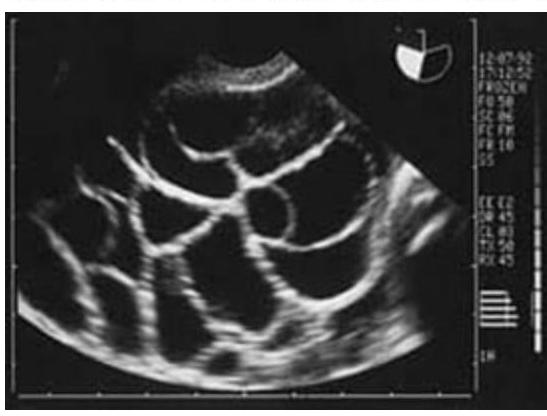
1 questionsA lady on treatment for infertility developed ascites, abdominal pain, and dyspnea. The ultrasound image is shown below. What is the most likely diagnosis?

NEET-PG 2020 - Obstetrics and Gynecology NEET-PG Practice Questions and MCQs
Question 21: A lady on treatment for infertility developed ascites, abdominal pain, and dyspnea. The ultrasound image is shown below. What is the most likely diagnosis?
- A. PCOS
- B. OHSS (Correct Answer)
- C. Theca lutein cyst
- D. Mucinous cystadenomas
Explanation: ***OHSS*** - The clinical presentation of a woman undergoing infertility treatment who develops **ascites**, **abdominal pain**, and **dyspnea** is classic for **Ovarian Hyperstimulation Syndrome (OHSS)**. The ultrasound image showing massively enlarged, multicystic ovaries with numerous follicles further confirms this diagnosis. - OHSS is an iatrogenic complication of **ovarian stimulation**, where ovaries become hyperstimulated, leading to **capillary permeability** and fluid shifts, resulting in ascites and potentially pleural effusions causing dyspnea. *PCOS* - While Polycystic Ovarian Syndrome (PCOS) involves multiple small follicles (usually 12 or more per ovary, each 2-9 mm in diameter), it typically does not present with acute symptoms like **ascites** and **dyspnea** unless severe OHSS occurs after ovulation induction in a woman with PCOS. - The ovaries in PCOS are generally smaller or normal size compared to the massively enlarged ovaries seen in the image, and the presence of significant ascites and dyspnea is not a direct feature of PCOS itself. *Theca lutein cyst* - **Theca lutein cysts** are usually **bilateral**, **multiloculated ovarian cysts** that result from exaggerated stimulation by **human chorionic gonadotropin (hCG)**, often seen in conditions like **gestational trophoblastic disease** or **multiple gestations**. - While they can be large and multicystic, the presentation with acute ascites and dyspnea in the context of infertility treatment points more specifically to OHSS. *Mucinous cystadenomas* - **Mucinous cystadenomas** are benign **epithelial ovarian tumors** that can grow very large and be multiloculated, but they are not typically associated with infertility treatment or the acute systemic symptoms of **ascites** and **dyspnea** via capillary leak syndrome. - Their presence would be coincidental rather than a direct complication of infertility therapy, and their fluid is usually thick and mucinous, enclosed within the cyst wall rather than causing diffuse fluid extravasation.
Ophthalmology
1 questionsEsotropia is common in
NEET-PG 2020 - Ophthalmology NEET-PG Practice Questions and MCQs
Question 21: Esotropia is common in
- A. Myopia
- B. Hypermetropia (Correct Answer)
- C. Emmetropia
- D. Astigmatism
Explanation: ***Hypermetropia*** - **Esotropia**, or inward turning of the eye, is common in **hypermetropia** (farsightedness) due to the accommodative effort required to focus. - In hypermetropia, **excessive accommodation** is needed to see clearly at all distances, especially for **near vision**. - This constant **accommodative effort** stimulates convergence through the **accommodation-convergence reflex**, predisposing to **accommodative esotropia**, particularly in children. *Myopia* - **Myopia** (nearsightedness) is typically associated with **exotropia** (outward turning of the eye). - This is because myopic individuals exert less accommodative effort for near vision, reducing the stimulus for convergence and potentially leading to divergence of the eyes. *Emmetropia* - **Emmetropia** describes an eye with **no refractive error**, where light focuses perfectly on the retina without accommodation for distance. - Individuals with emmetropia generally have **orthophoria** (proper alignment of the eyes) and are less prone to strabismus like esotropia unless an underlying muscle imbalance is present. *Astigmatism* - **Astigmatism** is an optical defect in which the eye does not focus light evenly onto the retina, causing blurred vision at any distance. - While it can be associated with other refractive errors, **astigmatism itself is not directly or commonly associated with esotropia**.
Pediatrics
1 questionsWhat is the most serious complication of measles?
NEET-PG 2020 - Pediatrics NEET-PG Practice Questions and MCQs
Question 21: What is the most serious complication of measles?
- A. Croup
- B. Otitis media
- C. Meningo-encephalitis
- D. Pneumonia (Correct Answer)
Explanation: ***Pneumonia*** - **Pneumonia**, particularly **giant cell pneumonia**, is the most common cause of **measles-related deaths** in young children. - It results from the **direct viral infection** of the lungs or a **secondary bacterial superinfection**. *Croup* - **Croup (laryngotracheobronchitis)** can be a complication of measles, but it is typically **less severe** and **less life-threatening** than pneumonia. - It primarily affects the **upper airways**, causing a barking cough and stridor. *Meningo-encephalitis* - **Meningo-encephalitis** is a serious, albeit **less common**, complication of measles, occurring in approximately 1 in 1,000 cases. - While potentially fatal or leading to neurological sequelae, it is **outranked by pneumonia** in terms of overall mortality attributed to measles. *Otitis media* - **Otitis media** (middle ear infection) is a common complication of measles, but it is generally **not life-threatening**. - It usually responds well to **antibiotic treatment** and rarely leads to severe outcomes.
Pharmacology
1 questionsWhat is the Drug of Choice (DOC) for Onychomycosis?
NEET-PG 2020 - Pharmacology NEET-PG Practice Questions and MCQs
Question 21: What is the Drug of Choice (DOC) for Onychomycosis?
- A. Terbinafine (Correct Answer)
- B. Fluconazole
- C. Itraconazole
- D. Nystatin
Explanation: ***Terbinafine*** - **Terbinafine** is considered the **drug of choice** for **onychomycosis** due to its potent fungicidal activity against **dermatophytes**, which are the most common cause of nail infections [1]. - It accumulates in the nail plate at therapeutic levels, leading to high cure rates and a relatively good safety profile [2]. *Fluconazole* - While effective against some fungi, **fluconazole** is primarily fungistatic and generally less effective against dermatophytes compared to terbinafine for onychomycosis, resulting in lower cure rates [1]. - It is often preferred for **mucocutaneous candidiasis** and other systemic fungal infections [1]. *Itraconazole* - **Itraconazole** is an alternative for onychomycosis, often administered in pulse doses, but it can have more significant drug interactions and a higher risk of hepatic toxicity compared to terbinafine [1]. - Its efficacy against dermatophytes is comparable to terbinafine, but its side effect profile makes it a second-line option [1]. *Nystatin* - **Nystatin** is a topical antifungal effective primarily against **Candida species**, and is not effective against **dermatophytes**, which are the main pathogens in onychomycosis. - It is typically used for mucocutaneous candidiasis, such as oral thrush or vaginal yeast infections, and is not absorbed systemically.
Physiology
1 questionsWhich of the following is referred to as the "Window of the limbic system"?
NEET-PG 2020 - Physiology NEET-PG Practice Questions and MCQs
Question 21: Which of the following is referred to as the "Window of the limbic system"?
- A. Hypothalamus
- B. Hippocampus
- C. Amygdala
- D. Thalamus (Correct Answer)
Explanation: ***Thalamus*** - The thalamus is often referred to as the **"relay station"** of the brain, processing and relaying most **sensory information** (except smell) to the cerebral cortex. - Due to its extensive connections with various limbic structures and its role in integrating and filtering emotional and motivational information before it reaches conscious awareness, it's considered the **"window of the limbic system"**. *Hypothalamus* - The hypothalamus primarily controls **autonomic functions** and maintains **homeostasis**, such as regulating temperature, hunger, thirst, and sleep cycles. - While it has strong connections with the limbic system, its main role is executive autonomic control rather than sensory integration. *Amygdala* - The amygdala is critically involved in processing **emotions**, particularly **fear** and **aggression**, and plays a key role in emotional memory. - It's a central component *within* the limbic system, but it doesn't serve as a general window or relay for the entire system's input. *Hippocampus* - The hippocampus is primarily responsible for **memory formation** (especially new episodic memories) and spatial navigation. - It is an important limbic structure, but its function is more specific to memory rather than being a gateway for broader limbic system activity.
Radiology
1 questionsIdentify the condition in the X-ray given below:

NEET-PG 2020 - Radiology NEET-PG Practice Questions and MCQs
Question 21: Identify the condition in the X-ray given below:
- A. TGA
- B. TAPVC
- C. TOF (Correct Answer)
- D. Ebstein's anomaly
Explanation: ***TOF*** - The chest X-ray shows a **boot-shaped heart (coeur en sabot)**, which is highly characteristic of **Tetralogy of Fallot** due to right ventricular hypertrophy and pulmonary artery hypoplasia. - There is also **reduced pulmonary vascular markings** (oligemia), indicating decreased blood flow to the lungs, a typical finding in TOF. *TGA* - Transposition of the Great Arteries (TGA) typically presents with a **"egg-on-a-string" appearance** on chest X-ray, characterized by a narrow mediastinum and cardiomegaly, which is not seen here. - Pulmonary vascularity can be increased or normal in TGA, unlike the decreased vascularity observed in the image. *TAPVC* - Total Anomalous Pulmonary Venous Connection (TAPVC) usually shows a **"snowman" or "figure-of-8" heart** shadow on chest X-ray, due to enlarged SVC and innominate vein. - This condition is also associated with **increased pulmonary vascular markings** and often cardiomegaly, which are absent in the provided image. *Ebstein's anomaly* - Ebstein's anomaly is characterized by a **massively enlarged heart** on chest X-ray due to right atrial enlargement and tricuspid regurgitation. - It often shows **reduced pulmonary vascular markings** due to functional pulmonary stenosis, but the characteristic "boot shape" is not typically present.