Dental
1 questionsA 30-year-old male presents with a one-week history of severe toothache, swelling in the floor of the mouth, and difficulty swallowing. What is the most likely diagnosis?

NEET-PG 2020 - Dental NEET-PG Practice Questions and MCQs
Question 161: A 30-year-old male presents with a one-week history of severe toothache, swelling in the floor of the mouth, and difficulty swallowing. What is the most likely diagnosis?
- A. Acute parotitis
- B. Angioneurotic edema
- C. Ludwig's angina (Correct Answer)
- D. Parapharyngeal abscess
Explanation: ***Ludwig's angina*** - The combination of a recent **severe toothache** (suggesting odontogenic infection), **swelling in the floor of the mouth**, and **difficulty swallowing (dysphagia)** are classic signs of Ludwig's angina, a rapidly spreading cellulitis of the submandibular, sublingual, and submental spaces. - This condition is particularly dangerous due to its potential to cause **airway obstruction** if the swelling progresses posteriorly. *Acute parotitis* - Acute parotitis typically presents with swelling and pain primarily in the **parotid gland region**, often located anterior to the ear and extending to the angle of the jaw. - While it can cause pain and difficulty swallowing, swelling is not typically described as being predominantly in the **floor of the mouth**. *Angioneurotic edema* - Angioneurotic edema (or angioedema) is characterized by **rapid, localized swelling of subcutaneous or submucosal tissues**, often affecting the face, lips, tongue, and pharynx. - It usually lacks a preceding infectious etiology like a toothache and is typically attributed to allergic reactions or hereditary/acquired deficiencies in C1-esterase inhibitor. *Parapharyngeal abscess* - A parapharyngeal abscess is a deep neck infection located in the **parapharyngeal space** lateral to the pharynx, often presenting with fever, severe sore throat, and trismus (difficulty opening the mouth). - While it can cause dysphagia and neck swelling, the primary swelling location described in the **floor of the mouth** points away from a parapharyngeal abscess as the most likely diagnosis.
Forensic Medicine
2 questionsRelatives of a patient told during postmortem examination that the person had a tattoo - which was now invisible. How to identify?
A body is discovered with burn marks as shown in the image, resembling a 'crocodile skin' pattern. What is the most likely cause?

NEET-PG 2020 - Forensic Medicine NEET-PG Practice Questions and MCQs
Question 161: Relatives of a patient told during postmortem examination that the person had a tattoo - which was now invisible. How to identify?
- A. Examine the Lymph node (Correct Answer)
- B. Spectrophotometer
- C. Ordinary light
- D. X-ray
Explanation: ***Examine the Lymph node*** - Tattoo ink particles are **phagocytosed** by macrophages and subsequently transported to and deposited in the regional **lymph nodes**. - Even if a tattoo is no longer visible on the skin due to decomposition or other factors, the pigment can often still be found in the associated **lymph nodes upon histological examination**. *Spectrophotometer* - A spectrophotometer is used to **measure the absorption or transmission of light** by a sample, which could identify pigments in a *prepared tissue sample*. - However, it would not be the **primary method for initial detection of an invisible tattoo** within a body as it requires a specific tissue sample containing the pigment to work, and would not help in locating the tattoo's original site or the presence of pigment in regional lymph nodes. *Ordinary light* - Ordinary light is suitable for examining **visible surface features** or visible tattoos. - If a tattoo is already described as **invisible**, ordinary light will not reveal its presence, as the pigments are either degraded, covered, or too deep to be seen. *X-ray* - X-rays are primarily used to visualize **bone or dense structures** and can detect foreign bodies that are radiopaque (like some metals). - Tattoo pigments are generally **not sufficiently radiopaque** to be visible on X-ray, making this method ineffective for detecting tattoos.
Question 162: A body is discovered with burn marks as shown in the image, resembling a 'crocodile skin' pattern. What is the most likely cause?
- A. Chemical burns
- B. High voltage electrical burns (Correct Answer)
- C. Scald burns
- D. Radiation burns
Explanation: ***High voltage electrical burns*** - **High voltage electrical burns** can cause severe damage, including charring and deep tissue necrosis, which can result in a contracted, leathery skin appearance often described as **"crocodile skin"** or **alligator hide**. - The alternating current (AC) associated with high voltage can lead to muscle tetany, causing the victim to clench onto the source, prolonging exposure and increasing the severity of damage and the characteristic burn pattern. *Chemical burns* - Chemical burns result from exposure to corrosive substances and typically manifest as **discoloration**, **blistering**, or **deep tissue damage** depending on the agent and duration of contact. - While severe, chemical burns usually do not produce the specific "crocodile skin" pattern of extensive charring and contraction seen with high voltage electricity. *Scald burns* - Scald burns are caused by hot liquids or steam and commonly result in **blistering**, **redness**, and superficial to partial-thickness skin damage without the deep tissue charring. - The pattern of injury would typically be distinct from the described "crocodile skin," often showing flowing or splash patterns. *Radiation burns* - Radiation burns occur due to exposure to high doses of radiation and can lead to **erythema**, **blistering**, and **skin breakdown** over time. - These burns develop progressively and often have a characteristic delayed presentation and pattern related to the radiation field, not the immediate charring seen with electrical injuries.
Internal Medicine
1 questions25-year-old man presents for a routine physical examination. The patient is tall and on examination, he was found to have an early diastolic murmur. His family pedigree is given below (image attached). Which of the following is the mode of inheritance by which the disease is likely to be transmitted?

NEET-PG 2020 - Internal Medicine NEET-PG Practice Questions and MCQs
Question 161: 25-year-old man presents for a routine physical examination. The patient is tall and on examination, he was found to have an early diastolic murmur. His family pedigree is given below (image attached). Which of the following is the mode of inheritance by which the disease is likely to be transmitted?
- A. Autosomal Recessive
- B. X-Linked Recessive
- C. X-Linked Dominant
- D. Autosomal Dominant (Correct Answer)
Explanation: ***Autosomal Dominant*** - The pedigree shows that the disease appears in every generation, and affected individuals have at least one affected parent (e.g., I-1 passes it to II-1, II-5, II-8). This pattern is characteristic of **dominant inheritance**. - Both males and females are affected, and affected fathers can pass the trait to their sons (e.g., I-1 to II-1), ruling out X-linked inheritance and supporting an **autosomal dominant** mode. *Autosomal Recessive* - In autosomal recessive inheritance, affected individuals typically have **unaffected parents** (who are carriers), and the disease often skips generations. This is not observed in the provided pedigree. - While both males and females can be affected, the presence of affected individuals in every generation and vertical transmission makes recessive inheritance unlikely. *X-Linked Recessive* - X-linked recessive disorders typically show more affected males than females, and affected fathers **cannot pass the trait to their sons**. The pedigree clearly shows affected females and father-to-son transmission (I-1 to II-1 and potentially II-8 to III-6), ruling out this pattern. - Also, all daughters of an affected father would be carriers, and some an affected mother would have affected offspring. *X-Linked Dominant* - In X-linked dominant inheritance, all daughters of an affected father would be affected, and there is no male-to-male transmission. - The pedigree shows instances where affected fathers (like I-1) have unaffected daughters (e.g., II-2, II-4, II-6, II-7), and affected mothers (II-5, II-8) have unaffected children, which contradicts X-linked dominant inheritance.
Obstetrics and Gynecology
2 questionsA mother brought her 16-year-old daughter to Gynaecology OPD with a complaint of not attaining menarche. She gives a history of cyclic abdominal pain. On further examination, a midline abdominal swelling is seen. Per rectal examination reveals a bulging mass in the vagina. Which of the following conditions is most likely responsible for these findings?
Which of the following is not considered an absolute contraindication for the use of an Intra Uterine Contraceptive Device (IUD)?
NEET-PG 2020 - Obstetrics and Gynecology NEET-PG Practice Questions and MCQs
Question 161: A mother brought her 16-year-old daughter to Gynaecology OPD with a complaint of not attaining menarche. She gives a history of cyclic abdominal pain. On further examination, a midline abdominal swelling is seen. Per rectal examination reveals a bulging mass in the vagina. Which of the following conditions is most likely responsible for these findings?
- A. Vaginal agenesis
- B. Transverse vaginal septum
- C. Imperforate hymen (Correct Answer)
- D. Mayer-Rokitansky-Küster-Hauser (MRKH) syndrome
Explanation: ***Imperforate hymen*** - An **imperforate hymen** obstructs the outflow of menstrual blood, leading to its accumulation in the vagina (**hematocolpos**) and uterus (**hematometra**), causing **cyclic abdominal pain** and a bulging mass (due to accumulated blood) in the vagina. - The patient presents with **primary amenorrhea** (not having attained menarche) and cyclical abdominal pain caused by the inability of menstrual blood to exit the body. *Transverse vaginal septum* - A **transverse vaginal septum** can also cause primary amenorrhea and cyclic abdominal pain due to obstruction of menstrual flow. However, it is a less common cause than an imperforate hymen. - While it can lead to hematocolpos, the characteristic bulging mass on per rectal examination is more strongly associated with an imperforate hymen presenting at the vaginal introitus. *Vaginal agenesis* - **Vaginal agenesis** (complete absence of the vagina) would present with primary amenorrhea, but there would be no cyclic abdominal pain if the uterus is also absent or rudimentary. If a uterus is present, there would be no accumulation of blood in the vagina or a bulging mass per rectum as there is no vaginal canal. - This condition is typically associated with a rudimentary or absent uterus, leading to an inability to menstruate rather than obstructed flow. *Mayer-Rokitansky-Küster-Hauser (MRKH) syndrome* - **MRKH syndrome** is characterized by congenital aplasia of the uterus and the upper two-thirds of the vagina, with normal ovaries and external genitalia. - Patients present with **primary amenorrhea** but typically do not experience **cyclic abdominal pain** or a bulging vaginal mass because there is no functional uterus to produce menstrual blood or a vaginal canal for blood accumulation.
Question 162: Which of the following is not considered an absolute contraindication for the use of an Intra Uterine Contraceptive Device (IUD)?
- A. Undiagnosed vaginal bleeding
- B. Pregnancy
- C. Pelvic inflammatory disease
- D. Uterine malformation (Correct Answer)
Explanation: ***Uterine malformation*** - While a uterine malformation can make IUD insertion more difficult or reduce its effectiveness, it is often considered a **relative contraindication**, depending on the specific anomaly and the patient's desire for contraception. - In certain cases, an IUD might still be a viable option, but it requires careful consideration and specialized insertion techniques. *Pregnancy* - The presence of an existing pregnancy is an **absolute contraindication** for IUD insertion, as it can lead to complications such as miscarriage or ectopic pregnancy. - An IUD is a contraceptive device, and inserting it when a woman is already pregnant directly contradicts its purpose and poses significant risks. *Undiagnosed vaginal bleeding* - This is an **absolute contraindication** because it could be a symptom of a serious underlying condition, such as cervical cancer, endometrial cancer, or ectopic pregnancy. - Inserting an IUD before diagnosing the cause of the bleeding could delay treatment of a potentially life-threatening condition and exacerbate the bleeding. *Pelvic inflammatory disease* - Current or recent (within the last 3 months) **pelvic inflammatory disease (PID)** is an **absolute contraindication** due to the increased risk of worsening infection. - IUD insertion can introduce bacteria from the vagina into the uterus, potentially exacerbating an existing infection or causing a new one.
Pharmacology
2 questionsAll-trans retinoic acid is primarily used in the treatment of which of the following tumors?
Which of the following antimicrobials should not be given to a chronic asthmatic patient managed on theophylline therapy?
NEET-PG 2020 - Pharmacology NEET-PG Practice Questions and MCQs
Question 161: All-trans retinoic acid is primarily used in the treatment of which of the following tumors?
- A. BCR-ABL
- B. PML-RARA (Correct Answer)
- C. CMYC
- D. CEBPA
Explanation: ***PML-RARA*** - **All-trans retinoic acid (ATRA)** is a cornerstone treatment for **acute promyelocytic leukemia (APML)**, which is characterized by the **PML-RARA fusion gene**. - ATRA works by inducing differentiation of leukemic promyelocytes, overcoming the maturation block caused by the **PML-RARA** oncoprotein. *BCR-ABL* - The **BCR-ABL fusion gene** is characteristic of **chronic myeloid leukemia (CML)**, and sometimes in acute lymphoblastic leukemia (ALL). - The primary treatment for **BCR-ABL positive leukemias** involves **tyrosine kinase inhibitors (TKIs)**, such as imatinib, not ATRA. *CMYC* - **CMYC** is an oncogene whose dysregulation is frequently implicated in various cancers, including **Burkitt lymphoma** and some forms of acute myeloid leukemia (AML). - There is no direct therapeutic role for ATRA specifically targeting tumors driven by **CMYC overexpression**. *CEBPA* - **CEBPA** mutations are found in a subset of **acute myeloid leukemia (AML)**, often leading to a favorable prognosis. - While ATRA can be used in some AML subtypes, it is not specifically indicated or primarily effective for AML characterized solely by **CEBPA mutations**; its role is specific to **PML-RARA**.
Question 162: Which of the following antimicrobials should not be given to a chronic asthmatic patient managed on theophylline therapy?
- A. Amoxicillin
- B. Cefotaxime
- C. Erythromycin (Correct Answer)
- D. Cotrimoxazole
Explanation: ***Erythromycin*** - **Erythromycin**, a macrolide antibiotic, is a potent inhibitor of the **cytochrome P450 (CYP450) enzyme system**, specifically **CYP1A2**, which is the primary enzyme responsible for theophylline metabolism. - Co-administration of erythromycin can significantly **increase theophylline levels**, leading to toxicity such as **nausea, vomiting, seizures, or cardiac arrhythmias.** - This interaction is clinically significant and erythromycin should be avoided in patients on theophylline therapy. *Amoxicillin* - **Amoxicillin** is a penicillin-class antibiotic that has minimal interaction with theophylline metabolism. - It does not significantly inhibit the **CYP1A2 enzyme** and is generally considered safe to use with theophylline. *Cefotaxime* - **Cefotaxime**, a third-generation cephalosporin, does not significantly affect the metabolism of theophylline. - It does not inhibit **CYP1A2 enzymes** and is safe for use in patients on theophylline therapy. *Cotrimoxazole* - **Cotrimoxazole** (trimethoprim/sulfamethoxazole) may slightly increase theophylline levels by inhibiting some CYP450 isoenzymes, but its effect is generally less pronounced than that of erythromycin. - While caution and monitoring are advised, it is not as strongly contraindicated as erythromycin due to a lower risk of significant toxicity in most cases.
Radiology
2 questionsIdentify the radiological sign of Ischemic colitis from the image provided.

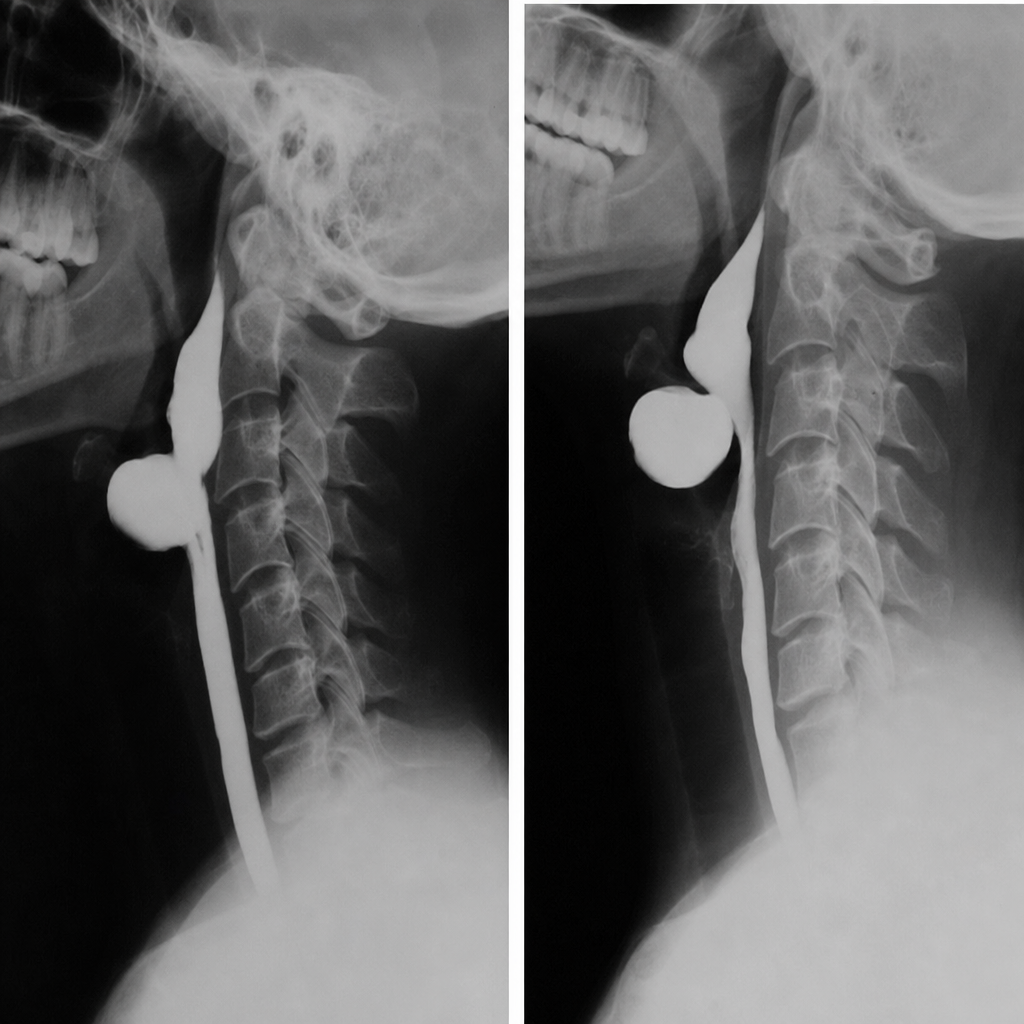
The Barium Swallow examination shows a filling defect in the esophagus. What is the most probable diagnosis?

NEET-PG 2020 - Radiology NEET-PG Practice Questions and MCQs
Question 161: Identify the radiological sign of Ischemic colitis from the image provided.
- A. Diverticulitis
- B. Appendicitis
- C. Thumbprinting sign of Ischemic colitis (Correct Answer)
- D. None of the options
Explanation: ***Thumbprinting sign of Ischemic colitis*** - The image displays prominent **indentations (thumbprinting)** along the bowel wall, especially in the descending colon (indicated by arrows). These indentations are caused by **edema** and **hemorrhage** in the submucosal layer due to ischemia. - This characteristic appearance on a barium enema or CT scan is a classic radiological sign highly suggestive of **ischemic colitis**. *Diverticulitis* - Diverticulitis typically presents with **saccular outpouchings** (diverticula) that become inflamed, potentially showing wall thickening or **pericolonic fat stranding**. - This image does not show typical diverticula or signs of severe inflammation associated with diverticulitis, but rather diffuse mucosal changes. *Appendicitis* - Appendicitis is characterized by inflammation of the **vermiform appendix**, typically seen as a **dilated**, non-compressible appendix with surrounding fat stranding in the right lower quadrant. - The radiological findings in the image are of the colon, not the appendix, and are inconsistent with acute appendicitis. *None of the options* - The image presents a clear and characteristic radiological sign that points to a specific diagnosis, making this option incorrect. - The presence of **thumbprinting** is a well-established indicator for ischemic colitis.
Question 162: The Barium Swallow examination shows a filling defect in the esophagus. What is the most probable diagnosis?
- A. Esophageal Carcinoma (Correct Answer)
- B. Esophageal Ring
- C. Esophageal Tear
- D. Achalasia Cardia
Explanation: ***Esophageal Carcinoma*** - A filling defect on a barium swallow study, especially with irregular borders and luminal narrowing, is highly suggestive of an **esophageal carcinoma**. - The image appears to show an **irregular, obstructing lesion** that displaces the barium column, characteristic of a mass. *Esophageal Ring* - An esophageal ring, such as a **Schatzki ring**, typically presents as a thin, circumferential narrowing of the distal esophagus, forming a smooth, shelf-like indentation, which is not seen here. - Esophageal rings usually cause **intermittent dysphagia** to solids but do not present as a large, irregular filling defect. *Esophageal Tear* - An esophageal tear (e.g., **Mallory-Weiss tear**) is a mucosal laceration that would present with **hematemesis** and would typically appear as a linear defect or streak on a barium swallow if visible, not a filling defect. - A tear is not usually associated with a persistent mass effect or irregular luminal obstruction seen in the image. *Achalasia Cardia* - **Achalasia** is characterized by the failure of the lower esophageal sphincter to relax and **absent peristalsis** in the esophageal body, leading to a classic "bird's beak" or "rat tail" appearance on barium swallow due to distal narrowing and proximal dilation. - While it causes luminal narrowing, it does not typically present as an irregular filling defect within the lumen, but rather as a smooth tapering of the distal esophagus.