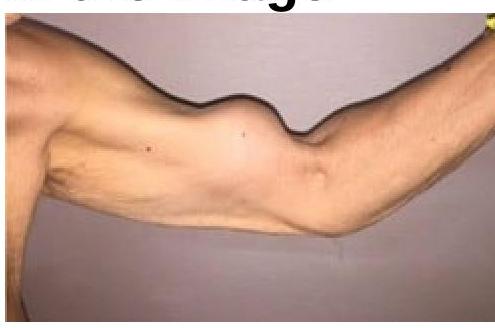
Question 1: What is the most likely diagnosis based on the provided image?
- A. Popeye's sign (Correct Answer)
- B. Griesinger sign
- C. Rising sun sign
- D. Winner sign
Explanation: ***Popeye's sign***
- The image shows a prominent bulge in the distal upper arm, which is characteristic of the **Popeye's sign**.
- This sign indicates a **rupture of the long head of the biceps brachii tendon**, where the muscle belly retracts distally creating a visible lump.
*Griesinger sign*
- The **Griesinger sign** refers to edema and tenderness over the postero-inferior aspect of the mastoid process.
- This sign is associated with **septic thrombosis of the mastoid emissary vein** or superior sagittal sinus thrombosis.
*Rising sun sign*
- The **rising sun sign** is a neuroimaging finding, referring to the upward displacement of the third ventricle and elevation of the cerebral hemispheres.
- It is typically seen in cases of **hydrocephalus** or large suprasellar masses displacing brain structures.
*Winner sign*
- The **Winner sign** is a radiological finding seen in developmental dysplasia of the hip (DDH), specifically referring to a line drawn from the lateral corner of the acetabulum to the femoral shaft.
- It assesses the **coverage of the femoral head** by the acetabulum, and its absence or abnormal position indicates DDH.
Question 2: A 4-year-old child while playing suddenly had his elbow pulled by his servant maid's hand and is now continuously crying, not allowing anyone to touch his elbow. He is keeping his elbow extended. What is the most likely diagnosis?
- A. Radial head fracture
- B. Pulled elbow (Correct Answer)
- C. Elbow dislocation
- D. Supracondylar fracture
Explanation: ***Pulled elbow***
- This classic presentation involves a sudden pull on the extended arm, causing the **annular ligament** to slip over the **radial head**, characteristic of a pulled elbow (Nursemaid's elbow).
- The child holds the arm in a pronated-extended position, refusing to use it due to pain, and cries when the elbow is touched, which aligns with the clinical picture.
*Radial head fracture*
- While a fracture can occur with trauma, a history of a distinct pulling mechanism and the absence of swelling or deformity make a **pulled elbow** more likely.
- A radial head fracture would typically present with more localized pain and potentially **crepitus** or obvious swelling upon examination.
*Supracondylar fracture*
- This fracture usually results from a fall onto an outstretched hand, a different mechanism than described.
- A supracondylar fracture would typically involve significant swelling, **ecchymosis**, and potential neurovascular compromise, which are not mentioned here.
*Elbow dislocation*
- Elbow dislocations usually result from high-energy trauma and present with obvious deformity and severe pain.
- The history of a "pull" and the child holding the arm in an **extended, pronated position** are more consistent with a pulled elbow than a full dislocation.