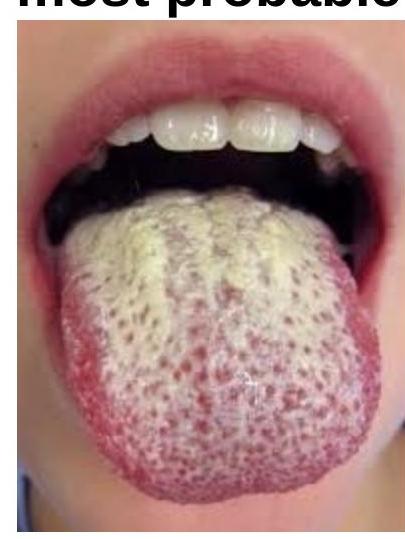
Question 1: An HIV positive patient with a CD4 count of 300/cumm presents with mucosal lesions in the mouth as shown in the figure. On microscopy, budding yeasts and pseudohyphae are seen. A most probable diagnosis is?
- A. Candidiasis (Correct Answer)
- B. Hairy leukoplakia
- C. Lichen planus
- D. Diphtheria
Explanation: ***Candidiasis***
- The image shows **white, creamy patches** on the tongue, which are characteristic of **oral candidiasis** (thrush). These lesions are often easily **scrapable**.
- The presence of **budding yeasts and pseudohyphae** on microscopy confirms a fungal infection, and in an **HIV-positive patient with a CD4 count of 300/cumm**, Candida infection is very common due to immunosuppression.
*Hairy leukoplakia*
- Hairy leukoplakia presents as **white, corrugated, non-scrapable lesions**, typically on the lateral borders of the tongue.
- It is caused by the **Epstein-Barr virus (EBV)** and does not show budding yeasts or pseudohyphae on microscopy.
*Lichen planus*
- Oral lichen planus presents with **white, lacy patterns (Wickham's striae)** on the buccal mucosa or tongue, which are usually not scrapable.
- It is a **chronic inflammatory condition** and not an infectious process characterized by yeasts and pseudohyphae.
*Diphtheria*
- Diphtheria causes the formation of a **thick, gray pseudomembrane** in the throat and tonsils, which is firmly adherent and can cause bleeding if removed.
- It is a **bacterial infection** caused by *Corynebacterium diphtheriae*, and microscopic examination would reveal characteristic gram-positive rods, not yeasts.
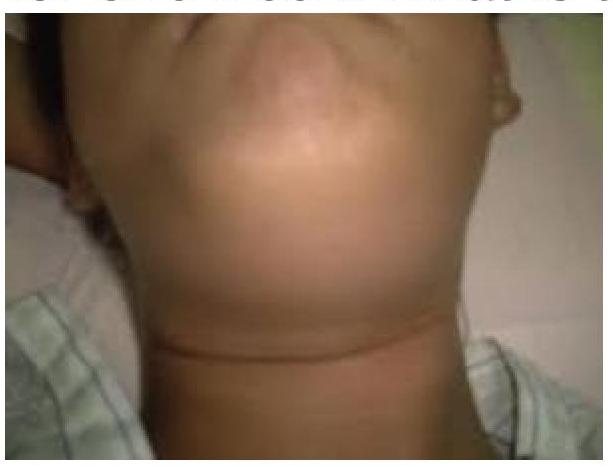
Question 2: A 30-year-old male presents with a one-week history of severe toothache, swelling in the floor of the mouth, and difficulty swallowing. What is the most likely diagnosis?
- A. Acute parotitis
- B. Angioneurotic edema
- C. Ludwig's angina (Correct Answer)
- D. Parapharyngeal abscess
Explanation: ***Ludwig's angina***
- The combination of a recent **severe toothache** (suggesting odontogenic infection), **swelling in the floor of the mouth**, and **difficulty swallowing (dysphagia)** are classic signs of Ludwig's angina, a rapidly spreading cellulitis of the submandibular, sublingual, and submental spaces.
- This condition is particularly dangerous due to its potential to cause **airway obstruction** if the swelling progresses posteriorly.
*Acute parotitis*
- Acute parotitis typically presents with swelling and pain primarily in the **parotid gland region**, often located anterior to the ear and extending to the angle of the jaw.
- While it can cause pain and difficulty swallowing, swelling is not typically described as being predominantly in the **floor of the mouth**.
*Angioneurotic edema*
- Angioneurotic edema (or angioedema) is characterized by **rapid, localized swelling of subcutaneous or submucosal tissues**, often affecting the face, lips, tongue, and pharynx.
- It usually lacks a preceding infectious etiology like a toothache and is typically attributed to allergic reactions or hereditary/acquired deficiencies in C1-esterase inhibitor.
*Parapharyngeal abscess*
- A parapharyngeal abscess is a deep neck infection located in the **parapharyngeal space** lateral to the pharynx, often presenting with fever, severe sore throat, and trismus (difficulty opening the mouth).
- While it can cause dysphagia and neck swelling, the primary swelling location described in the **floor of the mouth** points away from a parapharyngeal abscess as the most likely diagnosis.