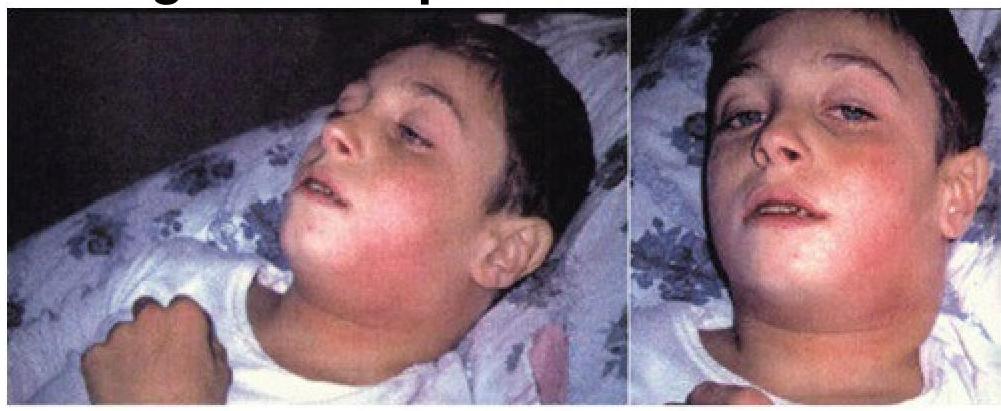
A patient with the following feature shown in the image. The patient reports having another 3-year-old sibling at home, who is fully immunized as per the immunization schedule. What is the best measure to prevent diphtheria in the sibling of the child with diphtheria?
Mission Indradhanush is for:
The difference between the incidence in the exposed and non-exposed group is best given by:
In a study of 200 patients, CA-125 testing was performed. Among the 100 patients who tested positive, 60 had ovarian cancer confirmed by histopathology. Among the 100 patients who tested negative, 20 had ovarian cancer confirmed by histopathology. What is the negative predictive value of this test?
Which of the following is a technique/method based on behavioral sciences
What is the appropriate color for containers used to dispose of chemical liquid biomedical waste?
Admission rate bias is?
Nosocomial infections are defined as infections that develop after how many hours of hospital admission?
What is the target population for a Secondary Service Center as per the Vision 2020 initiative in India?
Which of the following is an example of prospective screening?
NEET-PG 2020 - Community Medicine NEET-PG Practice Questions and MCQs
Question 11: A patient with the following feature shown in the image. The patient reports having another 3-year-old sibling at home, who is fully immunized as per the immunization schedule. What is the best measure to prevent diphtheria in the sibling of the child with diphtheria?
- A. Give diphtheria toxoid booster
- B. Give a full course of DPT vaccine
- C. Give prophylactic erythromycin (Correct Answer)
- D. Nothing is required to be done
Explanation: ***Correct: Give prophylactic erythromycin*** - Erythromycin is the **recommended antimicrobial prophylaxis** for close contacts of diphtheria patients to eradicate *Corynebacterium diphtheriae* carriage. - This prevents asymptomatic carriers from transmitting the bacteria, even if vaccinated, as vaccination provides immunity against the toxin, not necessarily against carriage. *Incorrect: Give diphtheria toxoid booster* - While immunization reduces the risk of symptomatic diphtheria disease by inducing **antitoxin immunity**, it does not reliably prevent nasal or pharyngeal carriage of the bacteria. - A booster might be considered if the last dose was more than 5 years ago, but it is not the primary immediate measure to prevent transmission from a known contact. *Incorrect: Give a full course of DPT vaccine* - The patient's sibling is already reported to be **fully immunized**, implying they have received the appropriate doses of the DPT vaccine according to the immunization schedule. - Giving a full course when already immunized would be redundant and ineffective to prevent immediate exposure and potential carriage. *Incorrect: Nothing is required to be done* - Close contacts of diphtheria cases are at **high risk of acquiring and transmitting the infection**, even if they are fully immunized, as immunization protects against the toxin but not necessarily carriage. - Failure to intervene would allow potential colonization and transmission, posing a risk to the community and the contact themselves.
Question 12: Mission Indradhanush is for:
- A. Non-communicable diseases
- B. Universal immunization (Correct Answer)
- C. Family planning
- D. Safe water and sanitation
Explanation: ***Universal immunization*** - **Mission Indradhanush** is a flagship program launched by the Government of India in 2014 to achieve **full immunization coverage** for children and pregnant women. - The mission aims to immunize children against 12 vaccine-preventable diseases, including diphtheria, whooping cough, tetanus, polio, tuberculosis, measles, hepatitis B, and meningitis/pneumonia caused by Haemophilus influenzae type b. *Non-communicable diseases* - Programs for **non-communicable diseases** typically focus on screening, early detection, and management of conditions like diabetes, hypertension, and cancer. - While important for public health, this is not the primary focus of Mission Indradhanush, which targets infectious diseases. *Family planning* - **Family planning programs** aim to provide information and access to contraception and reproductive health services to individuals and couples. - This is a distinct public health initiative separate from the immunization efforts of Mission Indradhanush. *Safe water and sanitation* - Initiatives for **safe water and sanitation** focus on improving access to clean drinking water and proper waste disposal systems to prevent waterborne and sanitation-related diseases. - While crucial for preventing many infections, this is not within the scope of Mission Indradhanush's primary objective of increasing vaccine coverage.
Question 13: The difference between the incidence in the exposed and non-exposed group is best given by:
- A. Attributable risk (Correct Answer)
- B. Population attributable risk
- C. Odds ratio
- D. Relative risk
Explanation: ***Attributable risk*** - **Attributable risk** (AR), also known as risk difference, directly quantifies the absolute difference in disease incidence between an **exposed group** and an **unexposed group**. - It represents the amount of disease incidence (or risk) in the exposed group that is **directly attributable to the exposure**, assuming a causal relationship. *Population attributable risk* - **Population attributable risk** (PAR) measures the proportion of disease incidence in the **total population** that is attributable to the exposure. - It takes into account both the impact of the exposure and the **prevalence of the exposure** in the population, which is distinct from simply comparing exposed and non-exposed groups. *Odds ratio* - The **odds ratio** (OR) is a measure of association between an exposure and an outcome, representing the **odds of an outcome occurring in the exposed group** compared to the odds of it occurring in the unexposed group. - It does not directly express the difference in incidence but rather the **ratio of odds**, often used in case-control studies. *Relative risk* - **Relative risk** (RR), or risk ratio, is the ratio of the **incidence of an outcome in the exposed group** to the incidence in the unexposed group. - It indicates how many times more likely an exposed group is to develop the outcome compared to an unexposed group, expressing a **ratio rather than a difference**.
Question 14: In a study of 200 patients, CA-125 testing was performed. Among the 100 patients who tested positive, 60 had ovarian cancer confirmed by histopathology. Among the 100 patients who tested negative, 20 had ovarian cancer confirmed by histopathology. What is the negative predictive value of this test?
- A. 20/100
- B. 40/100
- C. 60/100
- D. 80/100 (Correct Answer)
Explanation: ***80/100*** - The **negative predictive value (NPV)** is the probability that a patient who tests negative actually does not have the disease. - In this case, 100 patients tested negative, and 20 of them *did* have ovarian cancer, meaning 80 **did not** have ovarian cancer. Thus, NPV = 80/100. *20/100* - This represents the number of **false negatives** among all patients who tested negative, not the negative predictive value. - A false negative occurs when the test result is negative, but the disease is actually present. *40/100* - This value represents the number of patients who tested positive but **did not** have the disease (false positives), calculated as 100 (total positive tests) - 60 (true positives) = 40. - This is not the calculation for negative predictive value. *60/100* - This represents the number of **true positives** among all patients who tested positive. - This is a component of **positive predictive value**, not negative predictive value.
Question 15: Which of the following is a technique/method based on behavioral sciences
- A. Management by objectives (Correct Answer)
- B. Network analysis
- C. Systems analysis
- D. Decision making
Explanation: ***Management by objectives (MBO)*** - MBO is a **strategic management model** that aims to improve organizational performance by clearly defining objectives that are agreed to by both management and employees. - This approach is deeply rooted in **behavioral sciences** as it relies on principles of motivation, goal setting, feedback, and participation to influence employee behavior and performance. *Network analysis* - **Network analysis** is a quantitative method used to understand the structure and dynamics of relationships among entities in a system. - While it can be applied to human interactions, its primary focus is on **mathematical and computational modeling** rather than direct behavioral principles. *Systems analysis* - **Systems analysis** is a problem-solving technique that involves breaking down a system into its component parts to study how they interact and contribute to the overall system's function. - It is primarily an **engineering and information technology methodology** focused on optimizing processes and structures, not inherently on human behavior. *Decision making* - **Decision-making** is a cognitive process involving selecting a course of action from several alternatives. - While behavioral sciences study decision-making processes, decision-making itself is a **fundamental human activity** and a subject of various fields (economics, psychology) rather than a single technique primarily "based on behavioral sciences" in the same way MBO is.
Question 16: What is the appropriate color for containers used to dispose of chemical liquid biomedical waste?
- A. Yellow container (Correct Answer)
- B. White container
- C. Blue container
- D. Red container
Explanation: ***Yellow container*** - **Yellow containers** are specifically designated for disposal of **chemical liquid biomedical waste** as per BMW Management Rules, 2016. - This includes **disinfectants, chemical waste from laboratories, discarded medicines, and cytotoxic drugs**. - Yellow containers are used for Category 10 waste (Chemical Waste) which comprises chemicals used in production of biologicals, chemicals used in disinfection, and chemical liquid waste. - This waste typically requires **incineration or plasma pyrolysis** for safe disposal. *White/Translucent container* - **White or translucent containers** are used for **sharp waste** including needles, syringes with fixed needles, scalpels, blades, and contaminated broken glass. - This is Category 4 waste under BMW Rules and requires autoclaving or dry heat sterilization followed by shredding or mutilation. - These containers are puncture-proof and leak-proof to prevent needle-stick injuries. *Blue container* - **Blue containers** are designated for **glassware and metallic body implants** that can be recycled after proper disinfection. - This includes broken or unbroken glass vials (without chemical contamination), ampoules, and other glass items. - Also used for disposal of metallic implants removed during surgeries. *Red container* - **Red containers** are used for **contaminated recyclable plastic waste** including tubing, bottles, IV sets without needles, catheters, and urine bags. - This is Category 3 waste which requires autoclaving or microwaving followed by shredding before recycling. - Helps in waste segregation for potential recycling of plastic materials.
Question 17: Admission rate bias is?
- A. Reporting bias
- B. Response bias
- C. Berksonian bias (Correct Answer)
- D. None of the options
Explanation: ***Berksonian bias*** - **Berksonian bias** is a form of selection bias, also known as **admission rate bias**, that occurs when different rates of admission to a hospital or clinical setting distort the association between diseases or between a disease and a risk factor. - This bias arises because the hospitalized population may not be representative of the general population, leading to spurious associations or masking real ones. *Reporting bias* - **Reporting bias** is a type of information bias where the outcome or exposure information is reported inaccurately, often due to social desirability or recall issues. - It does not specifically refer to distortions stemming from hospital admission rates. *Response bias* - **Response bias** occurs when participants in a study alter their answers or behavior from what is true due to factors like leading questions, social desirability, or acquiescence. - This is an issue related to data collection, not an unrepresentative study population due to hospital admission protocols. *None of the options* - Berksonian bias directly corresponds to the definition of admission rate bias, making this option incorrect.
Question 18: Nosocomial infections are defined as infections that develop after how many hours of hospital admission?
- A. A) 48 hours (Correct Answer)
- B. B) 72 hours
- C. C) 24 hours
- D. D) 50 hours
Explanation: ***A) 48 hours*** - Nosocomial infections, also known as **hospital-acquired infections (HAI)**, are defined as infections that develop **48 hours or more** after hospital admission. - This is the **standard definition** used by the **CDC, WHO**, and major medical textbooks including **Park's Textbook of Preventive and Social Medicine**. - The 48-hour threshold helps differentiate infections acquired during hospitalization from those that were **incubating at the time of admission** (typical incubation periods for most common infections are less than 48 hours). - Infections can also be classified as nosocomial if they occur **within 3 days after discharge** or **within 30 days after surgery**. *B) 72 hours* - While **72 hours** is occasionally mentioned in some contexts or specific institutional protocols, it is **not the standard definition** for nosocomial infections. - Using 72 hours would be too restrictive and could miss true hospital-acquired infections that manifest between 48-72 hours. - The universally accepted standard remains **48 hours**. *C) 24 hours* - An infection developing within **24 hours** is very likely to have been **present or incubating prior to admission**. - This timeframe is too short to establish that the infection was acquired during hospitalization. - Most common bacterial and viral infections have incubation periods longer than 24 hours. *D) 50 hours* - This is **not a standard threshold** for defining nosocomial infections. - The conventional definitions use **48 hours** as the cutoff point, which is based on typical incubation periods and epidemiological evidence.
Question 19: What is the target population for a Secondary Service Center as per the Vision 2020 initiative in India?
- A. 10000
- B. 50000
- C. 1 lac
- D. 5 lac (Correct Answer)
Explanation: ***5 lac*** - As per the **Vision 2020 initiative** (National Programme for Control of Blindness) in India, Secondary Service Centers are designed to cater to a target population of **500,000 (5 lac) individuals**. - This population size allows for efficient resource allocation and ensures comprehensive secondary-level eye care services, including cataract surgery and other specialist ophthalmological procedures, are accessible to a significant segment of the population. - Secondary Centers serve as referral units between Primary Centers and tertiary-level District Centers. *10000* - A target population of 10,000 is typically served by **Primary Vision Centers** or sub-centers, which provide basic eye screening and first-contact eye care. - Secondary Service Centers offer a broader range of specialized services that require a larger catchment area to be economically viable and effectively utilized. *50000* - A population of 50,000 is too small for a Secondary Service Center under the Vision 2020 framework. - This population size might be appropriate for enhanced Primary Care facilities, but Secondary Centers require a much larger demographic base to justify the specialized infrastructure and trained ophthalmologists necessary for comprehensive secondary eye care. *1 lac* - While 100,000 (1 lac) represents a substantial population, it is still **smaller than the intended target** for a Secondary Service Center under Vision 2020. - The centers are designed to serve **5 times this population** (5 lac), acting as major hubs for secondary eye care with surgical facilities and specialist services for multiple primary centers.
Question 20: Which of the following is an example of prospective screening?
- A. Immigrant screening
- B. Neonate for thyroid diseases (Correct Answer)
- C. Pap smear for 45-year female
- D. Diabetes mellitus for 40-year male
Explanation: ***Neonate for thyroid diseases*** - **Prospective/Mass screening** involves screening an **entire population or specific subgroup** before symptoms appear for early detection and intervention - **Neonatal screening for congenital hypothyroidism** is performed universally on all newborns to identify and treat the condition early, preventing severe developmental disabilities and intellectual impairment - This represents **true population-wide screening** applied systematically to every member of the birth cohort *Immigrant screening* - This is **selective screening** targeting a specific high-risk group rather than universal population screening - Primary goal is to **control disease transmission** and identify conditions posing public health risks upon entry - Not applied to the general population systematically *Pap smear for 45-year female* - This is an example of **organized screening** for cervical cancer in a specific age group - While valuable for secondary prevention, it targets women within defined age ranges (typically 21-65 years) - Not universal across all age groups like neonatal screening *Diabetes mellitus for 40-year male* - This represents **opportunistic or selective screening** based on age and risk factors - Not a universal population-wide program applied systematically to everyone - Typically done as part of routine health checks for at-risk individuals