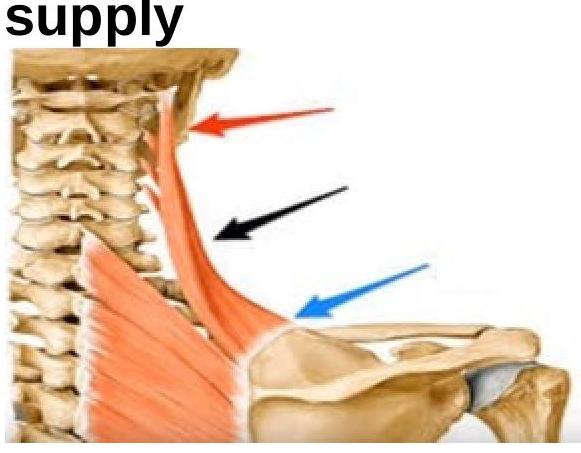
What is the nerve supply of the shown muscle?
Remnants of Wolffian ducts in a female are found in
NEET-PG 2020 - Anatomy NEET-PG Practice Questions and MCQs
Question 11: What is the nerve supply of the shown muscle?
- A. Suprascapular
- B. Dorsal scapular (Correct Answer)
- C. Dorsal rami of C1
- D. Subscapular
Explanation: ***Dorsal scapular*** - The image points to the **levator scapulae muscle**, which elevates and rotates the scapula. - The **dorsal scapular nerve** (C5 root, with contributions from C3-C4) innervates the levator scapulae, as well as the rhomboid major and minor muscles. - This nerve arises from the C5 root of the brachial plexus and pierces through the middle scalene muscle. - Clinically, injury to the dorsal scapular nerve can cause **medial scapular winging** and difficulty elevating the shoulder. *Suprascapular* - The suprascapular nerve (C5-C6) primarily innervates the **supraspinatus and infraspinatus muscles**, which are involved in rotator cuff function. - It does not supply the levator scapulae muscle. - This nerve passes through the suprascapular notch beneath the superior transverse scapular ligament. *Dorsal rami of C1* - The **dorsal ramus of C1** (suboccipital nerve) primarily innervates the muscles of the suboccipital triangle: rectus capitis posterior major and minor, obliquus capitis superior and inferior. - These nerves are involved in fine head and neck movements but do not innervate the levator scapulae. - The levator scapulae receives segmental innervation from C3-C4 cervical nerves directly, in addition to the dorsal scapular nerve. *Subscapular* - The subscapular nerves (upper and lower, from C5-C6) innervate the **subscapularis muscle**, which is part of the rotator cuff. - They also innervate the **teres major muscle**, but not the levator scapulae. - These are branches from the posterior cord of the brachial plexus.
Question 12: Remnants of Wolffian ducts in a female are found in
- A. Broad ligament (Correct Answer)
- B. Uterovesical pouch
- C. Pouch of Douglas
- D. Iliac fossa
Explanation: ***Broad ligament*** - In females, remnants of the **Wolffian (mesonephric) ducts** can persist as structures such as the **epoophoron**, **paroophoron**, and **Gartner's duct cysts**, which are typically found within the broad ligament [1]. - The **broad ligament** is a fold of peritoneum that extends from the lateral walls of the uterus to the sidewalls of the pelvis, enclosing these developmental remnants. *Uterovesical pouch* - This is a peritoneal reflection between the **uterus and the bladder** and does not typically contain remnants of the Wolffian ducts. - It is a common site for fluid accumulation but not for developmental anomalies related to the mesonephric system. *Pouch of Douglas* - Also known as the **recto-uterine pouch**, this is the most dependent part of the peritoneal cavity in females, located between the **uterus and the rectum**. - While it can accumulate fluid or pathology, it is not where Wolffian duct remnants are primarily located. *Iliac fossa* - The **iliac fossa** contains structures like the **iliacus muscle**, **lymph nodes**, and parts of the bowel, but it is not the anatomical location for the remnants of the Wolffian ducts in females. - This region is more involved in supporting abdominal contents and housing major blood vessels and nerves rather than reproductive developmental remnants.