Anatomy
1 questionsWhat is the pattern of inheritance in neural tube defects?
FMGE 2022 - Anatomy FMGE Practice Questions and MCQs
Question 1: What is the pattern of inheritance in neural tube defects?
- A. Multifactorial inheritance (Correct Answer)
- B. Autosomal recessive
- C. X-linked dominant
- D. Autosomal dominant
- E. X-linked recessive
Explanation: ***Multifactorial inheritance*** - Neural tube defects (NTDs) are a classic example of **multifactorial inheritance**, meaning they result from a combination of **genetic predispositions** and **environmental factors**. - Risk is influenced by multiple genes, and environmental factors like **folate deficiency** play a significant role. *Autosomal recessive* - This pattern involves two copies of an altered gene to cause disease, typically resulting in a **25% recurrence risk** for siblings. - While some rare isolated NTDs might have an autosomal recessive component, the general presentation of NTDs does not fit this classic mendelian pattern. *X-linked dominant* - Involves genes on the **X chromosome** where one altered copy is sufficient to cause disease; affected fathers pass it to all daughters, but no sons. - This inheritance pattern is very rare for NTDs and would present with a distinct sex-linked pattern of affected individuals. *Autosomal dominant* - Requires only one copy of an altered gene to cause disease, leading to a **50% recurrence risk** for offspring. - While some syndromes associated with NTDs can be autosomal dominant, the primary mechanism for isolated NTDs is not solely due to a single dominant gene. *X-linked recessive* - Involves genes on the **X chromosome** where two altered copies are needed in females, but only one in males; typically affects males predominantly. - This inheritance pattern does not account for the observed familial clustering and environmental contribution seen in NTDs.
Community Medicine
2 questionsThe major contributor to the demographic burden is
Blood spill in the operation theater is cleaned with _____?
FMGE 2022 - Community Medicine FMGE Practice Questions and MCQs
Question 1: The major contributor to the demographic burden is
- A. Decreased old age dependency ratio
- B. Decreased young age dependency ratio
- C. Increased young age dependency ratio
- D. Increased old age dependency ratio (Correct Answer)
Explanation: ***Increased old age dependency ratio*** - An **increased old-age dependency ratio** indicates a larger proportion of older, non-working individuals relative to the working-age population. - This demographic shift places a significant **economic and social burden** on the working population and social welfare systems due to increased healthcare and pension costs. *Decreased old age dependency ratio* - A **decreased old-age dependency ratio** would imply a smaller proportion of elderly dependents, which would actually reduce the demographic burden, making it an unlikely correct answer. - This scenario would generally be considered economically favorable as it suggests more working-age individuals supporting fewer retirees. *Decreased young age dependency ratio* - A **decreased young-age dependency ratio** means fewer children are dependent on the working-age population, which generally lessens the demographic burden. - While it has its own long-term implications (e.g., future workforce shortages), in the immediate sense, it does not contribute to an increased demographic burden. *Increased young age dependency ratio* - An **increased young-age dependency ratio** does contribute to a demographic burden, as more children need support from the working-age population. - However, in many developed and transitioning countries, the **old-age dependency ratio** is emerging as the major or growing contributor to the overall demographic burden due to increasing life expectancy and declining birth rates.
Question 2: Blood spill in the operation theater is cleaned with _____?
- A. Phenolic compounds
- B. Quaternary ammonium compounds
- C. Alcoholic compounds
- D. Chlorine compound (Correct Answer)
Explanation: ***Chlorine compound*** - **Chlorine-releasing agents** like 1% sodium hypochlorite (bleach) are highly effective against a broad spectrum of microorganisms, including **blood-borne pathogens** such as HIV and Hepatitis B. - Their rapid action and strong oxidizing properties make them the preferred choice for disinfecting surfaces contaminated with blood spills in healthcare settings, ensuring efficient **decontamination**. *Phenolic compounds* - Phenolic compounds are generally used for cleaning and disinfecting **hard, non-porous surfaces** but are less preferred for blood spills due to their slower action and potential for leaving residues. - They are effective against some bacteria and fungi but may not be as rapidly virucidal as chlorine compounds, especially against enveloped viruses in organic matter. *Quaternary ammonium compounds* - **Quaternary ammonium compounds** (Quats) are good general disinfectants for routine cleaning and disinfection of environmental surfaces but have a **lower efficacy against non-enveloped viruses** and spores. - They tend to be inactivated by organic matter, making them less suitable for effective decontamination of **blood spills with high protein content**. *Alcoholic compounds* - **Alcoholic compounds** (e.g., 70% ethanol or isopropanol) are effective disinfectants but are often limited to **small surface areas** or for antiseptic use on skin. - They evaporate quickly and are not ideal for cleaning large blood spills as they may not provide sufficient contact time for effective sterilization in the presence of organic material.
Internal Medicine
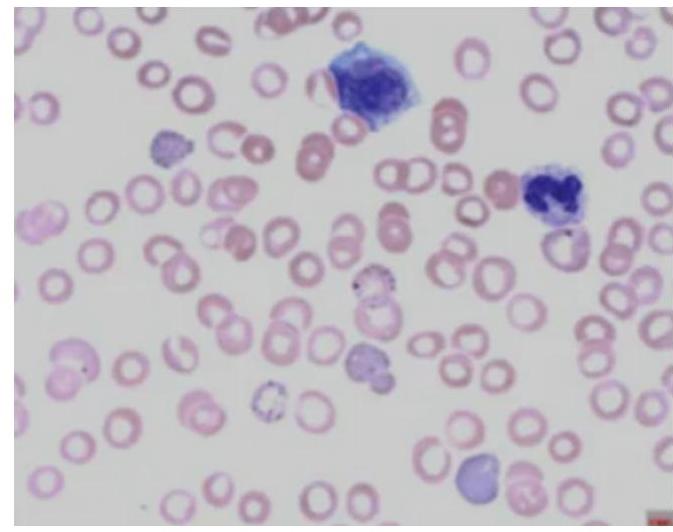
1 questionsWhich of the following diagnoses give the hematological picture as given below?
FMGE 2022 - Internal Medicine FMGE Practice Questions and MCQs
Question 1: Which of the following diagnoses give the hematological picture as given below?
- A. Saturnism (Correct Answer)
- B. Arsenic poisoning
- C. Chronic iron toxicity
- D. Minamata disease
Explanation: ***Saturnism*** - The image displays **basophilic stippling** in red blood cells, which is a classic hematological finding in **lead poisoning** (saturnism). - Lead inhibits enzymes involved in **heme synthesis**, leading to the accumulation of ribosomal RNA aggregates detected as basophilic stippling. *Arsenic poisoning* - Arsenic poisoning can cause various hematological abnormalities, including **anemia** and **pancytopenia**, but **basophilic stippling** is not a characteristic feature. - Its mechanism of toxicity involves inhibiting enzyme function and cellular respiration, distinct from lead's effect on heme synthesis. *Chronic iron toxicity* - Chronic iron toxicity typically leads to **hemochromatosis**, with iron deposition in various organs, and can cause **liver damage** and **cardiomyopathy**. - It does not primarily manifest with **basophilic stippling** in red blood cells. *Minamata disease* - Minamata disease is a severe neurological syndrome caused by **mercury poisoning**, particularly **methylmercury**. - It primarily affects the **nervous system**, causing symptoms like ataxia, sensory disturbances, and tremors, and does not typically present with **basophilic stippling**.
OB/GYN
1 questionsA 34-year-old woman presents at 6 weeks of delivery. She wants contraception for the next 3 years. What will be the best contraceptive method in this case?
FMGE 2022 - OB/GYN FMGE Practice Questions and MCQs
Question 1: A 34-year-old woman presents at 6 weeks of delivery. She wants contraception for the next 3 years. What will be the best contraceptive method in this case?
- A. Nothing besides lactation amenorrhea
- B. IUCD with progesterone
- C. Injectable progesterone
- D. Copper T (Correct Answer)
Explanation: ***Copper T*** - A **Copper T intrauterine device (IUD)** is an excellent choice for long-term contraception (up to 10 years), making it suitable for her 3-year requirement. - It's **non-hormonal**, making it safe for breastfeeding mothers and avoiding potential hormonal side effects. *Nothing besides lactation amenorrhea* - **Lactational amenorrhea method (LAM)** is effective for only the first six months postpartum, provided the mother is exclusively breastfeeding and her periods have not returned. - It is not a reliable method for contraception beyond six months postpartum or for the requested 3-year duration. *IUCD with progesterone* - An **intrauterine device (IUD) with progesterone** (e.g., Mirena) can be a good long-term option, but it releases hormones which can potentially affect breastfeeding, especially if initiated very early postpartum. - While generally safe for breastfeeding, a non-hormonal option like the copper T is often preferred if there are concerns about hormonal exposure or side effects. *Injectable progesterone* - **Injectable progesterone** (e.g., Depo-Provera) is an effective contraceptive, but it needs to be administered every 3 months. - While safe for breastfeeding, it's not considered as convenient for a 3-year duration as a single-insertion IUD, and some women experience side effects like irregular bleeding or weight gain.
Pediatrics
1 questionsA laborer's younger child is brought to the OPD with a swollen belly and dull face. He has been fed rice water (rice milk) in his diet mostly. On investigations, the child is found to have low serum protein and low albumin. What is the probable diagnosis?
FMGE 2022 - Pediatrics FMGE Practice Questions and MCQs
Question 1: A laborer's younger child is brought to the OPD with a swollen belly and dull face. He has been fed rice water (rice milk) in his diet mostly. On investigations, the child is found to have low serum protein and low albumin. What is the probable diagnosis?
- A. Kwashiorkor (Correct Answer)
- B. Kawasaki disease
- C. Marasmus
- D. Indian childhood cirrhosis
- E. Nephrotic syndrome
Explanation: ***Kwashiorkor*** - The symptoms of a **swollen belly** (due to **edema** from low albumin), **dull face**, and a diet primarily of **rice water** (low in protein) are classic signs of Kwashiorkor. - Kwashiorkor is a form of severe protein-energy malnutrition characterized by **protein deficiency** that is greater than the calorie deficit, leading to **hypoalbuminemia** and fluid retention. - The **dietary history** of rice water (carbohydrate-rich but protein-poor) is the key distinguishing feature. *Kawasaki disease* - This is an **acute vasculitis** primarily affecting young children, presenting with fever, rash, conjunctivitis, mouth changes, and lymphadenopathy. - It does not involve a swollen belly or dull face as primary symptoms, nor is it linked to dietary protein deficiency. *Marasmus* - Marasmus is a form of severe malnutrition characterized by an **overall deficiency of calories** and nutrients, resulting in severe **wasting** of muscle and fat. - While it involves low weight and energy deficit, the prominent **edema** (swollen belly) seen in this case points away from marasmus. *Indian childhood cirrhosis* - This is a rare, **fatal liver disease** in young children, often characterized by jaundice, hepatosplenomegaly, and liver failure. - It is not primarily caused by protein deficiency and its symptoms are distinct from the presentation described. *Nephrotic syndrome* - While nephrotic syndrome also presents with **hypoalbuminemia and edema**, it would show **proteinuria** (>3.5 g/day), hyperlipidemia, and lipiduria on urinalysis. - The **dietary history** and absence of urinary findings distinguish kwashiorkor from nephrotic syndrome.
Pharmacology
3 questionsWhich antithyroid drug is safer during the first trimester of pregnancy?
A chronic smoker wants to quit smoking. Which of the following is the MOST appropriate first-line pharmacotherapy for smoking cessation?
A patient presents with swelling in MCP joints, and his serum uric acid levels were found to be elevated. His physician prescribed a drug which is considered as the first line agent in the management of this condition. What is the mechanism of this drug?
FMGE 2022 - Pharmacology FMGE Practice Questions and MCQs
Question 1: Which antithyroid drug is safer during the first trimester of pregnancy?
- A. Radioactive iodine
- B. Carbimazole
- C. Propylthiouracil (Correct Answer)
- D. Methimazole
- E. Propranolol
Explanation: ***Propylthiouracil*** - **Propylthiouracil (PTU)** is the preferred drug for treating hyperthyroidism in the **first trimester of pregnancy** due to a lower risk of teratogenic effects compared to methimazole or carbimazole. - While PTU carries a risk of hepatic toxicity, it is generally favored during early pregnancy to avoid the established teratogenic risks of other thionamides. *Radioactive iodine* - **Radioactive iodine (RAI)** is absolutely contraindicated in pregnancy as it crosses the placenta and can cause permanent **fetal hypothyroidism** or **agenesis of the fetal thyroid gland**. - Its use can lead to the destruction of the fetal thyroid, which is unacceptable given the availability of safer alternatives. *Carbimazole* - **Carbimazole** is converted to methimazole in the body and is associated with a higher risk of **fetal embryopathy** during the first trimester, including aplasia cutis, choanal atresia, and esophageal atresia. - It should generally be avoided in the first trimester if possible, switching to PTU instead. *Methimazole* - **Methimazole** is structurally similar to carbimazole and also carries a significant risk of **teratogenic effects** such as **aplasia cutis**, omphalocele, and choanal atresia when used in the first trimester. - It is often reserved for the second and third trimesters if a thionamide is required, or for patients who cannot tolerate PTU, but ideally avoided in early pregnancy. *Propranolol* - **Propranolol** is a beta-blocker used for symptomatic management of hyperthyroidism (controlling tachycardia, tremor, anxiety) but is not an antithyroid drug and does not treat the underlying hyperthyroidism. - While generally safe in pregnancy, it only provides adjunctive therapy and cannot replace definitive antithyroid treatment.
Question 2: A chronic smoker wants to quit smoking. Which of the following is the MOST appropriate first-line pharmacotherapy for smoking cessation?
- A. Mirtazapine
- B. Varenicline (Correct Answer)
- C. Bupropion
- D. Nicotine replacement therapy
- E. Clonidine
Explanation: ***Varenicline*** - **Varenicline** is a **partial agonist** at the **α4β2 nicotinic acetylcholine receptor**, the primary receptor involved in nicotine addiction. - It reduces cravings and withdrawal symptoms while blocking the reinforcing effects of nicotine from cigarettes. - Studies show **varenicline has the highest efficacy** among pharmacological agents for smoking cessation, with superior quit rates compared to bupropion and NRT. - **First-line agent** recommended by clinical guidelines for smoking cessation. *Mirtazapine* - Mirtazapine is a **tetracyclic antidepressant** (α2-antagonist, 5-HT2 and 5-HT3 antagonist) used for **major depressive disorder**. - **Not indicated** for smoking cessation and lacks evidence for efficacy in this context. - May cause weight gain and sedation, which are not beneficial for smoking cessation. *Bupropion* - **Bupropion** is an **atypical antidepressant** and **norepinephrine-dopamine reuptake inhibitor (NDRI)** that also antagonizes nicotinic receptors. - Effective **first-line agent** for smoking cessation, reducing cravings and withdrawal symptoms. - However, studies show **lower efficacy compared to varenicline** in head-to-head trials. - Contraindicated in patients with seizure disorders or eating disorders. *Nicotine replacement therapy* - **NRT** (patches, gum, lozenges, inhalers, nasal spray) provides controlled nicotine delivery without harmful tobacco combustion products. - Effective **first-line therapy** that reduces withdrawal symptoms and cravings. - Generally **less effective than varenicline** when used alone, but can be combined with other therapies. - Safest option with minimal contraindications. *Clonidine* - **Clonidine** is a **central α2-agonist** primarily used for hypertension. - Considered a **second-line agent** for smoking cessation, used only when first-line therapies fail or are contraindicated. - Less effective than first-line agents and associated with more adverse effects (sedation, dry mouth, hypotension). - Not routinely recommended for smoking cessation.
Question 3: A patient presents with swelling in MCP joints, and his serum uric acid levels were found to be elevated. His physician prescribed a drug which is considered as the first line agent in the management of this condition. What is the mechanism of this drug?
- A. Uricosuric drug
- B. Pyrimidine antimetabolite
- C. Xanthine oxidase inhibitor (Correct Answer)
- D. Inhibitor of neutrophil recruitment
Explanation: ***Xanthine oxidase inhibitor*** - The presentation of **swollen MCP joints** and **elevated uric acid** is highly suggestive of **gout**. - **Allopurinol**, a **xanthine oxidase inhibitor**, is the **first-line drug** for chronic gout management, reducing uric acid production. *Uricosuric drug* - **Uricosuric agents** like **probenecid** increase uric acid excretion, but they are generally **second-line** or used in specific cases, not first-line for most patients. - These drugs are typically only effective if there is **sufficient renal function** and are contraindicated in patients with a history of **kidney stones**. *Pyrimidine antimetabolite* - **Pyrimidine antimetabolites** like **5-fluorouracil** are primarily used in **chemotherapy** for certain cancers by interfering with DNA and RNA synthesis. - They have **no role** in the treatment of gout or hyperuricemia. *Inhibitor of neutrophil recruitment* - **Colchicine**, which inhibits neutrophil migration, is used to treat **acute gout flares** by reducing inflammation, but it's not the first-line agent for **long-term management** of hyperuricemia. - This mechanism targets the inflammatory response rather than the underlying **uric acid production** or excretion.
Psychiatry
1 questionsA man regularly derives sexual gratification by inflicting pain upon his partner. He would often produce cuts and cigarette burns on his partner's arms. This is best described as?
FMGE 2022 - Psychiatry FMGE Practice Questions and MCQs
Question 1: A man regularly derives sexual gratification by inflicting pain upon his partner. He would often produce cuts and cigarette burns on his partner's arms. This is best described as?
- A. Masochism
- B. Voyeurism
- C. Sadism (Correct Answer)
- D. Fetishism
Explanation: ***Sadism*** - **Sexual sadism** is defined by recurrent, intense sexually arousing fantasies, urges, or behaviors involving inflicting **physical or psychological suffering** on another person. - In this case, the man derives sexual gratification from causing pain (cuts and cigarette burns) to his partner, which is a direct manifestation of sadistic behavior. *Masochism* - **Sexual masochism** involves deriving sexual gratification from being **humiliated, beaten, bound, or otherwise made to suffer**. - The scenario describes the individual inflicting pain, not experiencing it, thus ruling out masochism. *Voyeurism* - **Voyeurism** is characterized by deriving sexual gratification from **observing unsuspecting people** who are naked, disrobing, or engaging in sexual activity. - The behavior described involves active participation and infliction of pain, not covert observation. *Fetishism* - **Fetishism** involves recurrent, intense sexually arousing fantasies, urges, or behaviors involving the use of **non-living objects (fetishes)** or a highly specific focus on non-genital body parts. - While some fetishes might involve pain, the primary driver here is the act of inflicting suffering, not the attachment to an inanimate object or specific body part.
About FMGE 2022 Questions
This page contains 15 questions from the FMGE 2022 paper, organised across 11 subjects for focused practice. Every question comes with the correct answer and a detailed explanation to help you understand the underlying concept. Subject-wise organisation lets you target specific areas and identify which topics carried the most weight in this particular year.
Practising year-wise papers is essential for understanding how the FMGE exam evolves — you can spot trending topics, gauge difficulty shifts, and benchmark your readiness against a real paper. To take your preparation further, download the Oncourse app for AI-driven performance insights, spaced repetition of questions you got wrong, and a personalised study plan built around your FMGE goals.