

Overview & Types - Picky Eaters vs Problem Feeders
Feeding disorders involve refusing food or having a restricted diet for >1 month, leading to nutritional deficits or impaired function. Differentiated from transient picky eating, a normal developmental phase.
| Feature | Picky Eater | Problem Feeder |
|---|---|---|
| Food Variety | >30 foods | <20 foods |
| Food Groups | Eats ≥1 food from most | Skips entire food groups |
| New Foods | Accepts after multiple tries | Cries/tantrums with new food |
| Family Meals | Eats same meal, just less | Requires a separate meal |
| %%{init: {'flowchart': {'htmlLabels': true}}}%% | ||
| flowchart TD |
Start["👶 Normal Development
• Typical growth• Age appropriate"]
Picky["🍽️ Picky Eating Phase
• Limited variety• Food refusal"]
Resolves["✅ Resolves With Time
• Normal variation• Spontaneous exit"]
Severe["⚠️ Persistent and Severe
• Chronic issues• Narrow selection"]
Disorder["🩺 Feeding Disorder
• Problem feeder• Intervention needed"]
Start --> Picky Picky -->|Transient| Resolves Picky -->|Ongoing| Severe Severe --> Disorder
style Start fill:#F6F5F5, stroke:#D1D5DB, stroke-width:1.5px, rx:12, ry:12, color:#525252 style Picky fill:#FEF8EC, stroke:#FBECCA, stroke-width:1.5px, rx:12, ry:12, color:#854D0E style Resolves fill:#F1FCF5, stroke:#BEF4D8, stroke-width:1.5px, rx:12, ry:12, color:#166534 style Severe fill:#FDF4F3, stroke:#FCE6E4, stroke-width:1.5px, rx:12, ry:12, color:#B91C1C style Disorder fill:#F7F5FD, stroke:#F0EDFA, stroke-width:1.5px, rx:12, ry:12, color:#6B21A8
> ⭐ **High-Yield:** Problem feeders often have a severely restricted food repertoire of fewer than **20** specific food items, a key diagnostic red flag.
## Etiology & Risk Factors - Why Won't They Eat?
* **Organic Causes (Hardware Issues)**
- Gastrointestinal: GERD, eosinophilic esophagitis, constipation, food allergies
- Cardiorespiratory: Chronic lung disease, congenital heart defects
- Neurological: Cerebral palsy, hypotonia, cranial nerve palsies
- Anatomical: Cleft lip/palate, tongue-tie (ankyloglossia)
* **Developmental & Behavioral (Software Issues)**
- Oral-motor skill delay: Poor suck/swallow/chew coordination
- Sensory processing disorders: Aversion to textures, smells, or tastes
- Autism Spectrum Disorder (ASD): Restricted interests, rigidity
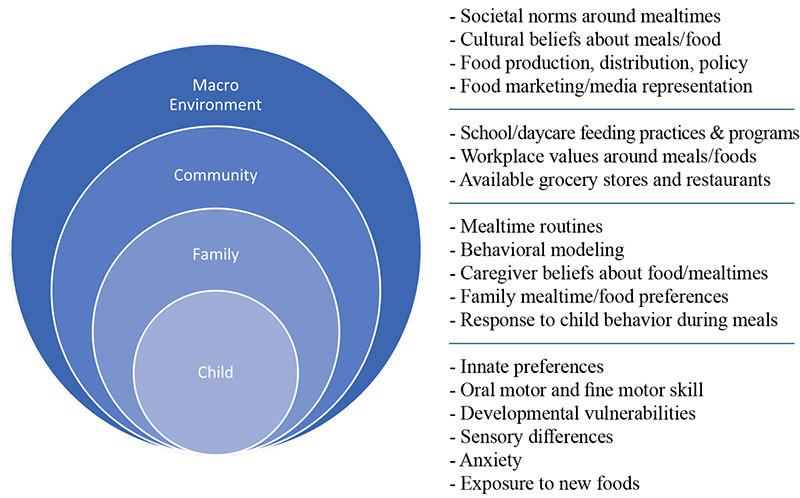
* **Psychosocial & Environmental (User Error)**
- Parent-child interaction: Coercive/forceful feeding, parental anxiety
- Inappropriate expectations or mealtime structure
- Behavioral mismanagement: Allowing grazing, long meal times (>**30** min)
> ⭐ **High-Yield:** History of prematurity, low birth weight (LBW), and prolonged neonatal ICU stays are major risk factors for developing severe feeding disorders.
## Clinical Evaluation - The Feeding Detective Work
* **Comprehensive History:**
- **Feeding Diary:** Document what, when, how much, duration, and specific symptoms (choking, gagging, refusal).
- **Developmental & Medical Hx:** Note birth history, milestones, and recurrent infections.
* **Physical & Oral-Motor Exam:**
- **Growth Assessment:** Plot weight, height, and head circumference. **Weight-for-length** is a critical indicator for Failure to Thrive (FTT).
- **Oral-Motor Skills:** Directly observe suck-swallow-breathe coordination. Check for tongue-tie, high-arched palate, or clefts.
> ⭐ Direct observation of a feeding session is the single most crucial diagnostic step. It reveals parent-child interaction, motor skills, and subtle signs of distress.
```mermaid
%%{init: {'flowchart': {'htmlLabels': true}}}%%
flowchart TD
History["<b>📋 History & Exam</b><br><span style='display:block; text-align:left; color:#555'>• Clinical screen</span><span style='display:block; text-align:left; color:#555'>• Review symptoms</span>"]
Observe["<b>👁️ Observe Feed</b><br><span style='display:block; text-align:left; color:#555'>• Watch technique</span><span style='display:block; text-align:left; color:#555'>• Assess swallow</span>"]
RedFlags{"<b>⚠️ Red Flags?</b><br><span style='display:block; text-align:left; color:#555'>• Identify risks</span><span style='display:block; text-align:left; color:#555'>• Urgent signs</span>"}
Investigations["<b>🔬 Investigations</b><br><span style='display:block; text-align:left; color:#555'>• Barium swallow</span><span style='display:block; text-align:left; color:#555'>• Targeted tests</span>"]
Management["<b>💊 Management</b><br><span style='display:block; text-align:left; color:#555'>• Behavioral care</span><span style='display:block; text-align:left; color:#555'>• Dietary changes</span>"]
History --> Observe
Observe --> RedFlags
RedFlags -->|Yes| Investigations
RedFlags -->|No| Management
Investigations --> Management
style History fill:#FEF8EC, stroke:#FBECCA, stroke-width:1.5px, rx:12, ry:12, color:#854D0E
style Observe fill:#EEFAFF, stroke:#DAF3FF, stroke-width:1.5px, rx:12, ry:12, color:#0369A1
style RedFlags fill:#FDF4F3, stroke:#FCE6E4, stroke-width:1.5px, rx:12, ry:12, color:#B91C1C
style Investigations fill:#FFF7ED, stroke:#FFEED5, stroke-width:1.5px, rx:12, ry:12, color:#C2410C
style Management fill:#F1FCF5, stroke:#BEF4D8, stroke-width:1.5px, rx:12, ry:12, color:#166534
Management Approach - Fixing the Food Fight
-
Parental Education & Routine:
- Establish structured meal & snack times.
- Limit meal duration to 20-30 minutes.
- Minimize distractions (no screens).
- Maintain a calm, neutral attitude.
-
Behavioral Strategies:
- Positive Reinforcement: Praise for trying new foods (avoid food rewards).
- Systematic Exposure: Repeated, neutral offerings of new foods (may take 10-15 tries).
- Modeling: Parents eat the same food.
-
Medical/Nutritional Therapy:
- Address any underlying organic cause.
- High-calorie supplements if FTT is present.
- Appetite stimulants (e.g., Cyproheptadine) are rarely used.
⭐ Ellyn Satter's Division of Responsibility: The parent is responsible for what, when, where of feeding; the child is responsible for how much and whether they eat.

High‑Yield Points - ⚡ Biggest Takeaways
- Pica, the compulsive eating of non-nutritive substances, is strongly associated with iron deficiency anemia and lead poisoning.
- Rumination disorder involves repeated, effortless regurgitation and re-chewing of food, typically seen in infants 3-12 months old.
- Avoidant/Restrictive Food Intake Disorder (ARFID) is food avoidance without body image distortion, leading to significant nutritional deficiencies.
- Unlike anorexia nervosa, ARFID lacks the intense fear of gaining weight or distorted body perception.
- Management is multidisciplinary, centered on behavioral therapy and correcting nutritional deficiencies.
Unlock the full lesson and continue reading
Signup to continue reading this lesson and unlimited access questions, flashcards, AI notes, and more
