

Gastric Gland Cells - The Stomach's Crew
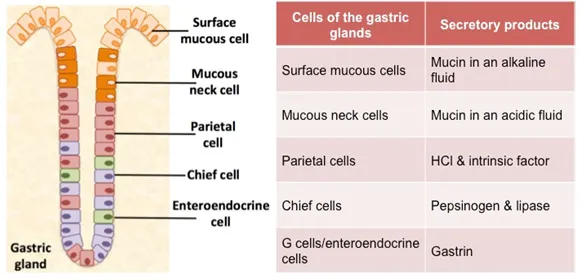
| Cell Type | Secretion(s) | Key Function(s) |
|---|---|---|
| Mucous Cells | Mucin, Bicarbonate | Protects stomach lining from acid |
| Parietal Cells | Gastric Acid (HCl), Intrinsic Factor (IF) | Kills microbes; digests food; required for Vitamin B12 absorption |
| Chief Cells | Pepsinogen, Gastric Lipase | Precursor to pepsin for protein digestion; fat digestion |
| G Cells | Gastrin | Stimulates acid secretion by parietal cells |
Secretion Phases - Thinking, Tasting, Digesting
Gastric secretion is regulated in three phases, aligning acid release with the presence of food. The initial phases are stimulatory, while the final phase is primarily inhibitory.
- Cephalic Phase: Triggered by thought, sight, or taste of food. Mediated entirely by the vagus nerve, accounting for ~30% of total secretion.
- Gastric Phase: Activated by food in the stomach (distension, peptides). Accounts for ~60% of secretion, driven by gastrin and vago-vagal reflexes.
- Intestinal Phase: Chyme entering the duodenum initiates inhibitory signals (Secretin, CCK) to ↓ acid.
⭐ The intestinal phase is crucial for negative feedback. Release of Secretin in response to duodenal acid ($H^+$) is the most potent inhibitor of gastrin release and gastric acid secretion.
Molecular Regulators - The Chemical Orchestra
-
Stimulatory Pathways (↑ H⁺) 📌 Mnemonic: All Good Health (ACh, Gastrin, Histamine).
- Acetylcholine (ACh): Released from vagal nerve endings.
- Binds M3 receptors on parietal cells.
- Pathway: $G_q \rightarrow \uparrow IP_3/Ca^{2+}$.
- Gastrin: Secreted by G-cells in the antrum.
- Binds CCK2 receptors on parietal and ECL cells.
- Pathway: $G_q \rightarrow \uparrow IP_3/Ca^{2+}$.
- Potently stimulates histamine release.
- Histamine: Released from Enterochromaffin-like (ECL) cells.
- Binds H2 receptors on parietal cells.
- Pathway: $G_s \rightarrow \uparrow cAMP$.
- Acetylcholine (ACh): Released from vagal nerve endings.
-
Inhibitory Pathways (↓ H⁺)
- Somatostatin: Secreted by D-cells.
- Acts via $G_i$ to ↓cAMP.
- Inhibits G-cells, ECL cells, and parietal cells.
- Prostaglandins (PGE₂):
- Act via $G_i$ to ↓cAMP.
- Cytoprotective: ↑ mucus and $HCO_3^-$ secretion.
- Somatostatin: Secreted by D-cells.
⭐ Potentiation: Histamine potentiates the effects of gastrin and ACh. The combined effect of all three is greater than the sum of their individual effects, a key principle for drug action (e.g., H2 blockers).
Clinical Tie-ins - When Glands Go Rogue
- Zollinger-Ellison Syndrome (ZES): Caused by a gastrin-secreting tumor (gastrinoma), often in the pancreas or duodenum.
- Leads to unrelenting acid production (↑↑ HCl), causing multiple, refractory, or unusually located (e.g., jejunal) peptic ulcers.
- Presents with abdominal pain, chronic diarrhea (pancreatic enzyme inactivation), and heartburn.
- Associated with Multiple Endocrine Neoplasia type 1 (📌 MEN1).
- Pernicious Anemia: Autoimmune gastritis targeting parietal cells.
- Results in ↓ HCl (achlorhydria) and loss of intrinsic factor (IF).
- IF deficiency causes vitamin B12 malabsorption, leading to megaloblastic anemia and neurological symptoms.
- Achlorhydria stimulates G-cell hyperplasia, causing ↑ serum gastrin.
⭐ In ZES, a secretin stimulation test is diagnostic. Normally, secretin inhibits G-cell gastrin release, but it paradoxically stimulates gastrin release from a gastrinoma.
High-Yield Points - ⚡ Biggest Takeaways
- Vagal stimulation (ACh) is a key driver, directly acting on parietal cells and stimulating gastrin and histamine release.
- Gastrin from G cells potently stimulates acid, primarily by triggering histamine release from ECL cells.
- Histamine is the strongest direct stimulant of parietal cells via H2 receptors.
- Somatostatin from D cells is the universal inhibitory signal for parietal, G, and ECL cells.
- Low gastric pH (<3) stimulates somatostatin release, providing essential negative feedback.
- Prostaglandins are cytoprotective, inhibiting acid while stimulating mucus/bicarbonate secretion.
Unlock the full lesson and continue reading
Signup to continue reading this lesson and unlimited access questions, flashcards, AI notes, and more
