

Ocular Lubricants: Basics & Tear Film - Eye's Natural Shield
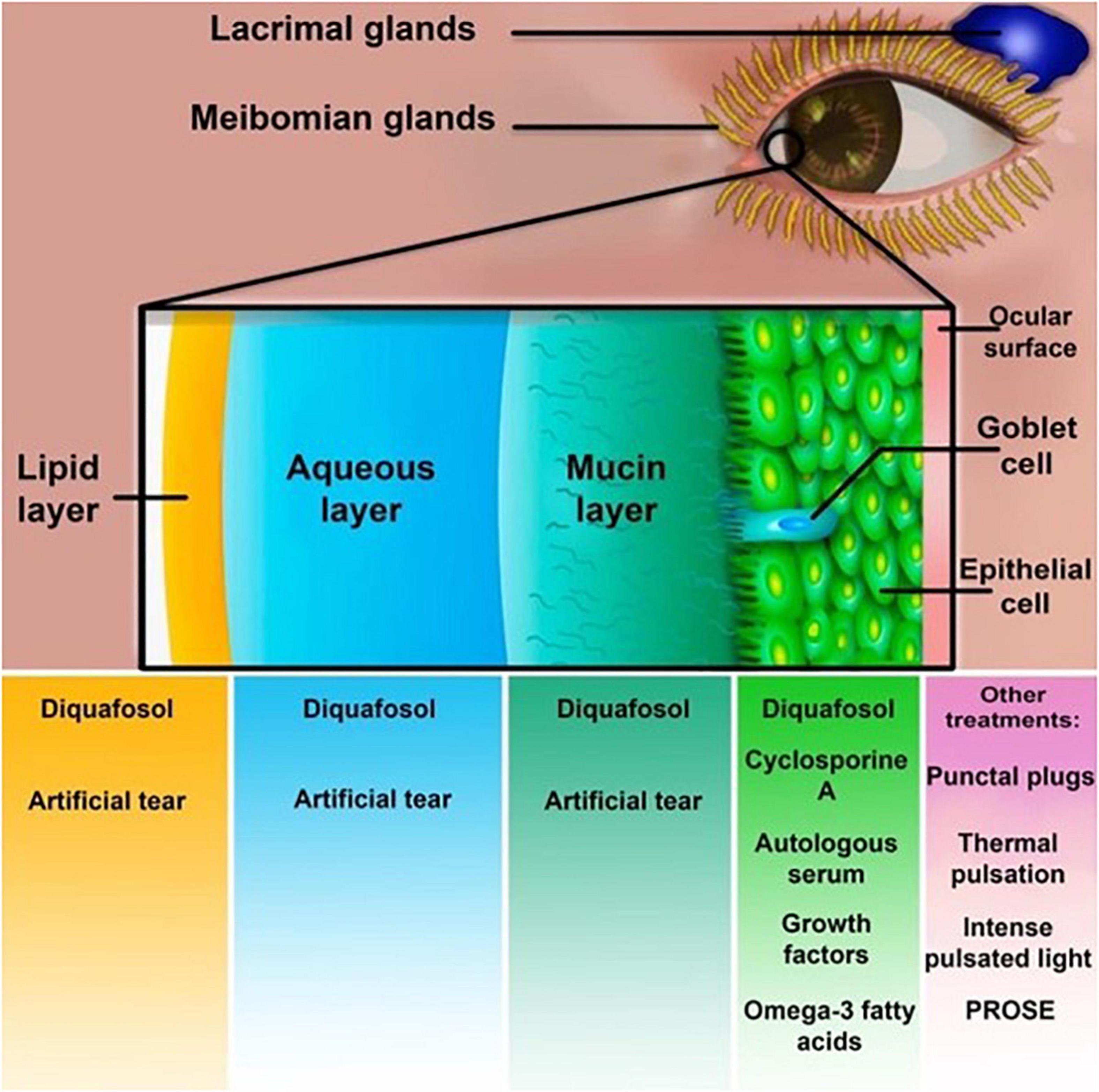
The eye's natural shield, the tear film, has 3 layers. 📌 LAM:
| Layer | Origin | Key Functions |
|---|---|---|
| Lipid | Meibomian glands | ↓Evaporation, surface tension, smooth optical surface |
| Aqueous | Lacrimal glands | Corneal nutrition/O₂, antibacterial, washes debris |
| Mucin | Conjunctival goblet cells | Lubrication, corneal wetting (hydrophilic), traps debris |
- Dry Eye Disease (DED): Multifactorial ocular surface disease; loss of tear film homeostasis & symptoms.
- Lubricant Therapy Goals: Relieve symptoms, protect ocular surface, restore tear film stability, improve visual function.
⭐ Schirmer I: >10 mm/5min; TBUT: >10 sec.
Ocular Lubricants: Lubricant Lineup - The Soothing Squad
This table outlines the common classes of ocular lubricants, their key examples, primary actions, and viscosity profiles, crucial for managing dry eye conditions.
| Class | Key Examples | Primary Action | Viscosity Profile |
|---|---|---|---|
| Demulcents | Aqueous phase enhancers | ||
| - Cellulose Deriv. | HPMC, CMC | ↑Retention time, Film-forming | High |
| - PVA | Polyvinyl Alcohol | Film-forming | Moderate |
| - Povidone | Povidone (PVP) | Film-forming, Wetting agent | Moderate |
| - Glycols/Glycerin | PEG, Propylene Glycol, Glycerin | Humectants, Lubricate | Low to Moderate |
| Emollients | Mineral oil, Castor oil, Lanolin | Lipid layer stabilizers, ↓Evaporation | Oily (Non-aqueous) |
| Osmoprotectants | L-carnitine, Erythritol, Taurine | Cellular protection vs hyperosmotic stress | Low |
| Hyaluronates | Sodium Hyaluronate (NaHA) | Viscoelastic, Mucoadhesive, Promotes healing | Very High |
Ocular Lubricants: Mechanism & More - The Comfort Code
- Mechanism of Action (MOA): Surface wetting & tear film stabilization, volume repletion & mucoadhesion, reduced friction, osmoprotection.
- Key Properties:
- Viscosity: Newtonian (e.g., HPMC) vs. Non-Newtonian (e.g., HP-Guar, HA) for varied retention.
- Osmolarity: Hypo/Isotonic preferred; e.g., <308 mOsm/L for Dry Eye Disease (DED).
- pH: Neutral for comfort.
- Preservatives: Benzalkonium chloride (BAK), Polyquad, Sodium Perborate vs. Preservative-Free (PF).
| Preservative | Pro | Con |
|---|---|---|
| BAK | Effective | Toxic, worsens DED |
| Polyquad | Gentler | Less broad spectrum |
| Sodium Perborate | Vanishing (on eye as $H_2O + O_2$) | Initial sting possible |
| Preservative-Free | Safest (frequent use) | Costly, single-use packs |
| %%{init: {'flowchart': {'htmlLabels': true}}}%% | ||
| flowchart TD |
Start["<b>👁️ Dry Eye Patient</b><br><span style='display:block; text-align:left; color:#555'>• Redness and gritty</span><span style='display:block; text-align:left; color:#555'>• Burning sensation</span>"]
Assess["<b>📋 Assess Severity</b><br><span style='display:block; text-align:left; color:#555'>• Clinical exam</span><span style='display:block; text-align:left; color:#555'>• Symptom score</span>"]
Mild["<b>💊 Low Viscosity</b><br><span style='display:block; text-align:left; color:#555'>• Artificial tears</span><span style='display:block; text-align:left; color:#555'>• Watery drops</span>"]
ModSev["<b>💊 High Viscosity</b><br><span style='display:block; text-align:left; color:#555'>• Gels or ointments</span><span style='display:block; text-align:left; color:#555'>• Longer retention</span>"]
Allergy["<b>⚖️ Allergy/Use?</b><br><span style='display:block; text-align:left; color:#555'>• Allergy history</span><span style='display:block; text-align:left; color:#555'>• Frequent dosing</span>"]
PF["<b>✅ Preservative-Free</b><br><span style='display:block; text-align:left; color:#555'>• PF formulations</span><span style='display:block; text-align:left; color:#555'>• Safer for surface</span>"]
PC["<b>💊 Preservative Drop</b><br><span style='display:block; text-align:left; color:#555'>• e.g. Polyquad</span><span style='display:block; text-align:left; color:#555'>• Sodium Perborate</span>"]

Start --> Assess
Assess -->|Mild| Mild
Assess -->|Mod/Severe| ModSev
Mild --> Allergy
ModSev --> Allergy
Allergy -->|Yes| PF
Allergy -->|No| PC

style Start fill:#F7F5FD,stroke:#F0EDFA,stroke-width:1.5px,rx:12,ry:12,color:#6B21A8
style Assess fill:#FEF8EC,stroke:#FBECCA,stroke-width:1.5px,rx:12,ry:12,color:#854D0E
style Mild fill:#F1FCF5,stroke:#BEF4D8,stroke-width:1.5px,rx:12,ry:12,color:#166534
style ModSev fill:#F1FCF5,stroke:#BEF4D8,stroke-width:1.5px,rx:12,ry:12,color:#166534
style Allergy fill:#FEF8EC,stroke:#FBECCA,stroke-width:1.5px,rx:12,ry:12,color:#854D0E
style PF fill:#F6F5F5,stroke:#E7E6E6,stroke-width:1.5px,rx:12,ry:12,color:#525252
style PC fill:#F1FCF5,stroke:#BEF4D8,stroke-width:1.5px,rx:12,ry:12,color:#166534
> ⭐ Benzalkonium chloride (BAK), a common preservative, is cytotoxic and can exacerbate dry eye symptoms with long-term use.
## Ocular Lubricants: Clinical Choices - Smart Soothing Strategies
* **Indications:**
* Dry Eye Disease (DED): Aqueous Deficient, Evaporative MGD-related.
* Contact Lens (CL) Discomfort.
* Post-refractive surgery.
* Environmental irritation.
* **Selection Strategy:**
* **Gels & Ointments:** Use for moderate-severe DED, prolonged relief, or nocturnal application.
> ⭐ Preservative-free (PF) lubricants are vital if dosing >**4-6** times/day or for sensitive eyes to avoid preservative toxicity.
## Ocular Lubricants: Caution Corner - Safe Use & Side Notes
* **Common Adverse Effects:**
- Transient blurred vision (esp. viscous preps)
- Mild stinging/burning
- Stickiness of lids
* **Allergic/Hypersensitivity Reactions:** Rare.
* **Preservative Toxicity:** Risk with long-term use.
> ⭐ Benzalkonium chloride (BAK), a common preservative, can cause ocular surface toxicity with chronic use.
* **Drug Interactions:** Minimal; space **5-10 min** from other drops.
* **Proper Instillation:** Avoid nozzle contamination. 📌 **"Don't Touch Tip!"**
## High‑Yield Points - ⚡ Biggest Takeaways
> * **Ocular lubricants** primarily supplement the **tear film**, increasing viscosity and reducing evaporation.
> * Key indications include **Dry Eye Syndrome (Keratoconjunctivitis Sicca - KCS)**, **exposure keratitis**, and **post-operative care**.
> * Common agents: **Carboxymethylcellulose (CMC)**, **Hydroxypropyl Methylcellulose (HPMC)**, **Polyvinyl Alcohol (PVA)**, and **Sodium Hyaluronate**.
> * **Preservative-free (PF)** formulations are preferred for frequent use or sensitive eyes to avoid **Benzalkonium Chloride (BAK) toxicity**.
> * Higher viscosity agents like **ointments/gels** offer longer relief but may cause **transient blurred vision**.
> * **Sodium hyaluronate** also promotes **corneal epithelial healing** and offers viscoelastic properties.
> * **Lipid-containing lubricants** are beneficial for **evaporative dry eye** by stabilizing the tear film's lipid layer.
Unlock the full lesson and continue reading
Signup to continue reading this lesson and unlimited access questions, flashcards, AI notes, and more
