Pelvic Floor Anatomy and Function Indian Medical PG Practice Questions and MCQs
Practice Indian Medical PG questions for Pelvic Floor Anatomy and Function. These multiple choice questions (MCQs) cover important concepts and help you prepare for your exams.
Pelvic Floor Anatomy and Function Indian Medical PG Question 1: Which muscle is a key component of the pelvic diaphragm?
- A. Piriformis
- B. Gluteus maximus
- C. Obturator internus
- D. Levator ani (Correct Answer)
Pelvic Floor Anatomy and Function Explanation: ***Levator ani***
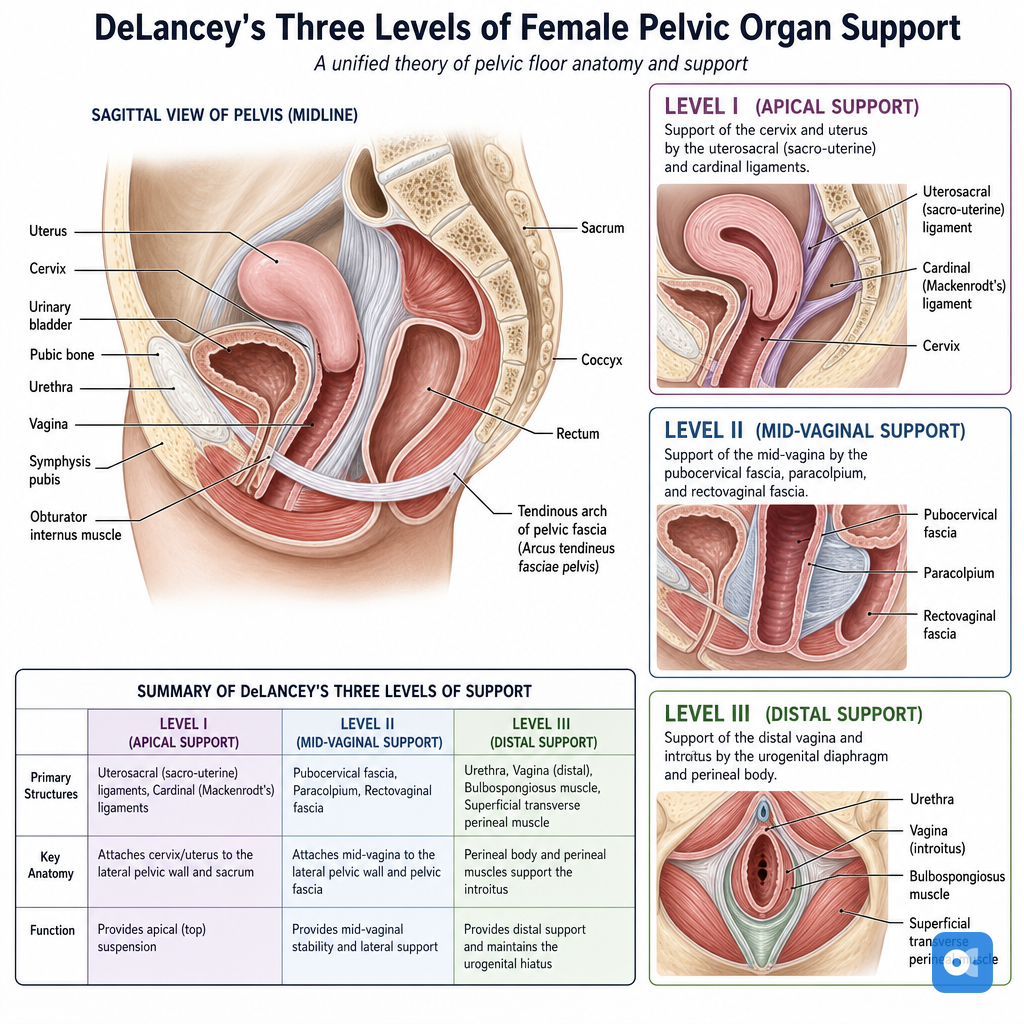
- The **levator ani** is a broad, thin muscle forming the major part of the **pelvic diaphragm**, which supports the pelvic viscera [2].
- It consists of three main parts: **puborectalis**, **pubococcygeus**, and **iliococcygeus**, all contributing to the integrity and function of the pelvic floor [1].
*Piriformis*
- The **piriformis** muscle is located in the **gluteal region** and passes through the greater sciatic foramen, playing a role in external rotation and abduction of the hip.
- It is part of the deep gluteal muscles and not a direct component of the pelvic diaphragm.
*Gluteus maximus*
- The **gluteus maximus** is the largest and most superficial of the gluteal muscles, primarily responsible for hip extension and external rotation.
- It is a muscle of the **buttocks** and is located external to the pelvis, acting on the hip joint rather than forming part of the pelvic floor.
*Obturator internus*
- The **obturator internus** muscle lies along the lateral wall of the pelvis and exits through the lesser sciatic foramen, contributing to external rotation of the thigh.
- While it is located within the pelvic region, it is part of the **hip rotators** and does not form a structural component of the pelvic diaphragm.
Pelvic Floor Anatomy and Function Indian Medical PG Question 2: Injury to which of the following muscles that forms the deep support of the perineal body causes cystocele, enterocele and urethral descent?
- A. Sphincter of urethra and anus
- B. Pubococcygeus (Correct Answer)
- C. Bulbospongiosus
- D. Ischiocavernosus
Pelvic Floor Anatomy and Function Explanation: ***Pubococcygeus***
- The **pubococcygeus muscle** is a major component of the **levator ani muscle** group, forming the primary support structure of the pelvic floor [1]. Damage to this muscle impairs the support for the bladder, rectum, and uterus, leading to prolapse conditions like **cystocele**, **enterocele**, and **urethral descent**.
- Its integrity is crucial for maintaining the position of pelvic organs and proper function of the urinary and defecatory systems, as it directly supports the vagina, rectum, and bladder neck [3].
*Sphincter of urethra and anus*
- The **external urethral sphincter** primarily controls voluntary urination, and its injury mainly leads to **stress urinary incontinence**, not necessarily prolapse [2].
- The **external anal sphincter** controls defecation, and its injury would primarily lead to **fecal incontinence**, not cystocele, enterocele, or urethral descent [2].
*Bulbospongiosus*
- The **bulbospongiosus muscle** is superficial, supporting the clitoris and compressing erectile tissue in females, and expelling semen/urine in males.
- Its injury would primarily affect sexual function and perineal body integrity but is **not a primary cause of pelvic organ prolapse** like cystocele or enterocele [3].
*Ischiocavernosus*
- The **ischiocavernosus muscle** is also superficial, maintaining erection of the clitoris/penis by compressing the crura.
- Injury to this muscle would mainly disrupt **erectile function** and contribute minimally to pelvic organ support or prolapse.
Pelvic Floor Anatomy and Function Indian Medical PG Question 3: What is the landmark for performing a pudendal nerve block?
- A. Ischial tuberosity
- B. Sacroiliac joint
- C. Ischial spine (Correct Answer)
- D. None of the options
Pelvic Floor Anatomy and Function Explanation: ***Ischial spine***
- The **ischial spine** serves as a crucial anatomical landmark for a pudendal nerve block as it is where the **pudendal nerve crosses dorsally** just before it enters Alcock's canal.
- Palpating the ischial spine allows for precise needle placement to anesthetize the pudendal nerve, providing pain relief to the **perineum, vulva**, and **distal vagina**.
*Ischial tuberosity*
- The **ischial tuberosity** is a bony prominence that is inferior to the ischial spine and is a superficial landmark.
- While it helps in general orientation of the perineum, it is **not the direct landmark** for the pudendal nerve itself, which is located more superiorly and medially in relation to the main nerve trunk.
*Sacroiliac joint*
- The **sacroiliac joint** connects the sacrum and the ilium and is involved in transmitting weight from the upper body to the lower limbs.
- It is **anatomically distant** from the pudendal nerve's path and is not used as a landmark for a pudendal nerve block.
*None of the options*
- This option is incorrect because the **ischial spine** is a recognized and essential landmark for performing a pudendal nerve block.
Pelvic Floor Anatomy and Function Indian Medical PG Question 4: The most important structure preventing uterine prolapse is:
- A. Uterosacral ligament
- B. Broad ligament
- C. Cardinal ligament (Correct Answer)
- D. Round ligament
Pelvic Floor Anatomy and Function Explanation: ***Cardinal ligament***
- The **cardinal ligaments** (also known as transverse cervical ligaments) are crucial for supporting the uterus and preventing **uterine prolapse** by anchoring the cervix and upper vagina laterally to the pelvic sidewalls [1].
- They provide significant **suspension and stability** to the uterus due to their strong fibrous and muscular composition [1].
*Uterosacral ligament*
- These ligaments attach the posterior cervix to the sacrum, primarily preventing **retroversion** of the uterus and providing posterior support [1].
- While they contribute to uterine support, their role in preventing descent is secondary to the cardinal ligaments [1].
*Broad ligament*
- The **broad ligament** is a wide fold of peritoneum that drapes over the uterus, fallopian tubes, and ovaries, providing a suspensory role rather than strong structural support [1].
- It contains blood vessels and nerves but offers minimal support against **uterine prolapse** itself.
*Round ligament*
- The **round ligaments** extend from the uterine horns, through the inguinal canal, and insert into the labia majora, primarily helping to maintain the **anteverted and antiflexed position** of the uterus [2].
- They do not play a significant role in preventing the downward descent or **prolapse** of the uterus.
Pelvic Floor Anatomy and Function Indian Medical PG Question 5: Tibial and common peroneal nerves supply which of the following muscles?
- A. Gracilis
- B. Adductor longus
- C. Biceps femoris (Correct Answer)
- D. Adductor magnus
Pelvic Floor Anatomy and Function Explanation: **Biceps femoris**
- The **long head** of the biceps femoris is supplied by the **tibial nerve**.
- The **short head** of the biceps femoris is supplied by the **common peroneal nerve**.
*Gracilis*
- The gracilis muscle is solely innervated by the **obturator nerve**.
- It participates in **hip adduction** and **knee flexion**, but its innervation is distinct.
*Adductor longus*
- The adductor longus muscle is innervated exclusively by the **obturator nerve**.
- Its primary function is **adduction of the thigh**.
*Adductor magnus*
- The adductor magnus has a dual innervation, but not by the tibial and common peroneal nerves.
- Its **adductor part** is innervated by the **obturator nerve**, while its **hamstring part** is supplied by the **tibial nerve**.
Pelvic Floor Anatomy and Function Indian Medical PG Question 6: Which of the following statements about the Levator Ani is false?
- A. Converges downwards & medially
- B. Attached to the pelvic brim. (Correct Answer)
- C. Made up of iliococcygeus, pubococcygeus, and puborectalis.
- D. Supports pelvic viscera.
Pelvic Floor Anatomy and Function Explanation: Attached to the pelvic brim
- This statement is **false** because the levator ani does not attach to the pelvic brim (the inlet of the true pelvis).
- The levator ani originates from: the **posterior surface of the body of pubis**, the **tendinous arch of obturator fascia** (thickening of obturator fascia on lateral pelvic wall), and the **ischial spine**.
- All these attachments are on the **lateral pelvic wall below the pelvic brim**, not at the pelvic brim itself.
- The muscles insert into the **perineal body**, **anococcygeal ligament**, and walls of pelvic viscera.
*Converges downwards & medially*
- This statement is **true** - the levator ani muscles arise from lateral attachments on the pelvic sidewalls and converge **medially and downward** toward the midline.
- This creates the characteristic **funnel-shaped pelvic diaphragm** that narrows inferiorly.
- The fibers run inferomedially to form a muscular sling supporting pelvic structures.
*Supports pelvic viscera*
- This is the **primary function** of the levator ani muscle group [1].
- It forms a muscular floor that supports the **bladder, uterus/prostate, and rectum**, preventing prolapse.
- The muscle maintains the position of pelvic organs against intra-abdominal pressure.
*Made up of iliococcygeus, pubococcygeus, and puborectalis*
- This statement is **correct** - the levator ani consists of three main components [1]:
- **Puborectalis** - forms a sling around the anorectal junction, important for fecal continence [1].
- **Pubococcygeus** - middle portion, supports pelvic viscera [1].
- **Iliococcygeus** - most posterior portion, extends from ischial spine to coccyx [1].
Pelvic Floor Anatomy and Function Indian Medical PG Question 7: Sensory afferent fibers from the fallopian tubes ascend to:
- A. T 8
- B. T 10 (Correct Answer)
- C. L 2
- D. L 4
Pelvic Floor Anatomy and Function Explanation: ***T 10***
- The **fallopian tubes** and **ovaries** share sensory innervation primarily through the **T10** and **T11** spinal segments. [2]
- This is consistent with the **visceral pain** referral pattern often experienced in the periumbilical region during pain originating from these organs. [2]
*T 8*
- Sensory innervation to **T8** primarily covers the epigastric region, which is typically associated with organs higher in the abdomen, such as the stomach and gallbladder. [1]
- Pain from the fallopian tubes is generally referred lower than the epigastrium.
*L 2*
- The **L2** spinal segment mainly innervates structures in the lower abdomen and upper thigh, like parts of the colon and the hip joint. [1]
- This dermatomal level is too low to be the primary sensory afferent pathway for the fallopian tubes.
*L 4*
- **L4** sensory innervation is largely associated with the knee and medial calf regions.
- It does not correspond to the visceral sensory pathways from pelvic organs like the fallopian tubes.
Pelvic Floor Anatomy and Function Indian Medical PG Question 8: A woman of child-bearing age develops a second-degree uterine prolapse with supravaginal elongation of the cervix. What will be the most appropriate management?
- A. Fothergill's operation (Correct Answer)
- B. Sling operation
- C. Vaginal hysterectomy and pelvic floor repair
- D. Amputation of the cervix
Pelvic Floor Anatomy and Function Explanation: ***Fothergill's operation***
- This procedure, also known as **mancuni operation**, is ideal for women of childbearing age with **second-degree uterine prolapse** and **supravaginal elongation of the cervix**.
- It involves **cervical amputation**, anterior colporrhaphy, and posterior colpoperineorrhaphy, effectively correcting the prolapse while preserving the uterus for future pregnancies.
*Sling operation*
- A sling operation (e.g., sacrocolpopexy) is primarily used for **vaginal vault prolapse** after hysterectomy, or for severe uterine prolapse when preservation of the uterus is not a priority.
- It involves suspending the uterus or vagina using synthetic mesh or biological material, which is not the first-line for this specific presentation in a woman desiring future fertility.
*Vaginal hysterectomy and pelvic floor repair*
- This approach is typically chosen for women who have **completed childbearing** or do not desire future pregnancies, as it involves removal of the uterus.
- While it effectively corrects prolapse, it is not the most appropriate management for a woman of childbearing age who may wish to conceive.
*Amputation of the cervix*
- While cervical amputation is a component of Fothergill's operation, performing only **cervical amputation in isolation** would not adequately address the entire prolapse or offer sufficient pelvic floor support.
- This option is incomplete as a definitive management strategy for uterine prolapse with supravaginal elongation.
Pelvic Floor Anatomy and Function Indian Medical PG Question 9: 3rd degree genital prolapse in the first trimester of pregnancy is managed by :
- A. Le Fort's repair
- B. Right transvaginal sacrospinous colpopexy
- C. Fothergill's repair
- D. Ring pessary (Correct Answer)
Pelvic Floor Anatomy and Function Explanation: ***Ring pessary***
- A ring pessary is a **non-surgical** option often used during pregnancy to support the uterus and prevent further prolapse, especially in the first trimester.
- It provides **conservative management**, avoiding surgical risks to both mother and fetus during early pregnancy.
*Le Fort's repair*
- **Le Fort's repair** is a colpocleisis procedure, typically performed on elderly women who are no longer sexually active, as it surgically obliterates the vaginal canal. It is contraindicated in pregnancy and unlikely to be performed in a woman of childbearing age who is pregnant.
*Right transvaginal sacrospinous colpopexy*
- This is a **surgical procedure** to correct vaginal vault prolapse by attaching the vaginal apex to the sacrospinous ligament. It is inappropriate for managing prolapse in the first trimester of pregnancy due to surgical risks and potential fetal harm.
*Fothergill's repair*
- **Fothergill's repair (Manchester repair)** is a surgical procedure that involves cervical amputation, shortening of the cardinal ligaments, and colporrhaphy. This surgery is not suitable during pregnancy due to the risk of miscarriage and is typically reserved for cases of uterocervical elongation causing prolapse in non-pregnant women.
Pelvic Floor Anatomy and Function Indian Medical PG Question 10: Risk factors for stress urinary incontinence are all except
- A. Obesity
- B. Hypertension (Correct Answer)
- C. Smoking
- D. Pregnancy
Pelvic Floor Anatomy and Function Explanation: ***Hypertension***
- While hypertension is a significant health concern, it is **not directly a recognized risk factor** for stress urinary incontinence.
- Risk factors for stress urinary incontinence primarily involve factors that increase **intra-abdominal pressure** or weaken pelvic floor support.
*Obesity*
- **Increased intra-abdominal pressure** due to excess weight places constant strain on the pelvic floor muscles and urethral sphincter.
- This persistent pressure can lead to weakening of the supporting structures, predisposing to **stress urinary incontinence**.
*Smoking*
- Smoking is associated with chronic cough, which repeatedly increases **intra-abdominal pressure**, potentially leading to pelvic floor muscle weakness.
- It also affects **collagen synthesis**, which can weaken connective tissues supporting the bladder and urethra.
*Pregnancy*
- The growing uterus during pregnancy places significant **mechanical stress** on the pelvic floor muscles and ligaments.
- **Hormonal changes** during pregnancy can also relax connective tissues, further contributing to pelvic floor laxity.
More Pelvic Floor Anatomy and Function Indian Medical PG questions available in the OnCourse app. Practice MCQs, flashcards, and get detailed explanations.