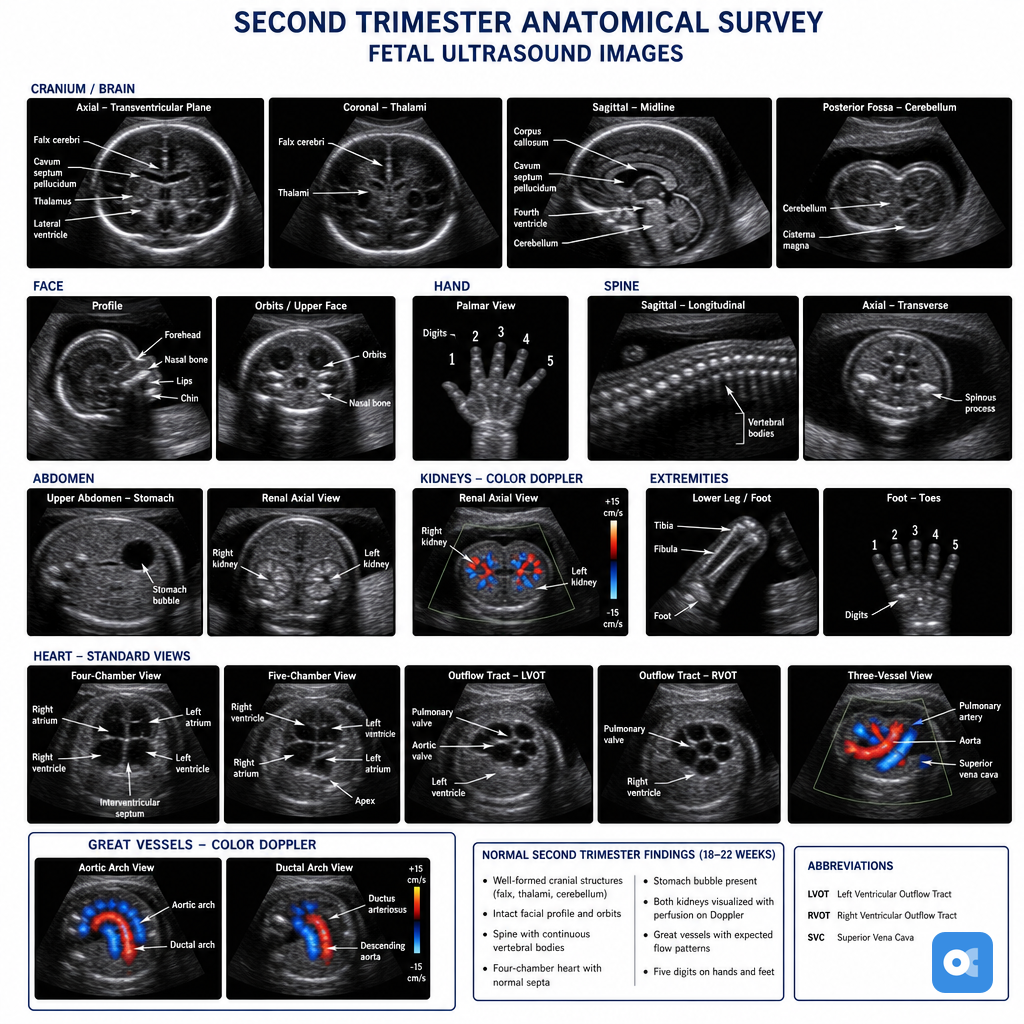
Routine Antenatal Assessments Indian Medical PG Practice Questions and MCQs
Practice Indian Medical PG questions for Routine Antenatal Assessments. These multiple choice questions (MCQs) cover important concepts and help you prepare for your exams.
Routine Antenatal Assessments Indian Medical PG Question 1: Best time to perform the quadruple test is:
- A. 8-12 weeks
- B. 11-15 weeks
- C. 15-20 weeks (Correct Answer)
- D. 18-22 weeks
Routine Antenatal Assessments Explanation: ***15-20 weeks***
- The quadruple test measures levels of four substances (**alpha-fetoprotein**, **human chorionic gonadotropin**, **unconjugated estriol**, and **inhibin A**) in the mother's blood.
- This window is optimal for detecting neural tube defects and chromosomal abnormalities like **Down syndrome** and **Trisomy 18**, allowing for timely counseling and further diagnostic testing if needed.
*8-12 weeks*
- This period is generally too early for the quadruple test to be accurate, as the levels of the markers would not be sufficiently distinct for reliable screening.
- The **combined first-trimester screening** (nuchal translucency and blood tests for PAPP-A and hCG) is typically performed during this time.
*11-15 weeks*
- While some components might be detectable at the later end of this range, 15-20 weeks offers a more accurate window for all four markers of the quadruple test.
- **Integrated screening**, which combines first and second-trimester markers, would involve blood draws around 10-14 weeks and then 15-20 weeks.
*18-22 weeks*
- This period is generally considered too late for optimal results of the quadruple test, as the fetal markers might be less indicative or diagnostic interventions options might be limited.
- A **detailed ultrasound** for anatomical survey is usually performed around this time.
Routine Antenatal Assessments Indian Medical PG Question 2: Most accurate method to confirm viable intrauterine pregnancy at 6 weeks' gestation is
- A. USG fetal cardiac activity (Correct Answer)
- B. Clinical examination
- C. Urine HCG test
- D. Doppler ultrasound in specific clinical situations
Routine Antenatal Assessments Explanation: **USG fetal cardiac activity**
- At 6 weeks' gestation, the presence of **fetal cardiac activity** on ultrasound is the definitive sign of a **viable intrauterine pregnancy**.
- This finding confirms both the presence of an embryo and its vital status, providing direct evidence of viability.
*Urine HCG test*
- A **urine HCG test** confirms the presence of pregnancy but does not provide information about its viability or location (intrauterine vs. ectopic).
- High HCG levels can be present even in non-viable or ectopic pregnancies.
*Clinical examination*
- A **clinical examination** may reveal signs consistent with pregnancy, such as an enlarged uterus, but it cannot definitively confirm **intrauterine location** or **fetal viability** at 6 weeks' gestation.
- These findings are supportive but not diagnostic of viability.
*Doppler ultrasound in specific clinical situations*
- Doppler ultrasound is typically used to assess **blood flow** to various structures and may be useful in later pregnancy for assessing fetal well-being or placental function.
- It is not the primary or most accurate method to confirm early **fetal cardiac activity** or viability at 6 weeks' gestation compared to standard grayscale ultrasound.
Routine Antenatal Assessments Indian Medical PG Question 3: A woman presents with painless ulcers on the vulva, she gives a history of having multiple sexual partners and has had a stillbirth at 28 weeks in the past. What is the next best step of investigation?
- A. PCR
- B. VDRL (Correct Answer)
- C. Vaginal swab and culture
- D. NAT
Routine Antenatal Assessments Explanation: ***VDRL***
- The presentation of **painless vulvar ulcers**, a history of **multiple sexual partners**, and a past **stillbirth at 28 weeks** are highly suggestive of **syphilis**.
- A **VDRL (Venereal Disease Research Laboratory) test** is a non-treponemal serologic test used for screening and monitoring the treatment of syphilis.
*PCR*
- While **PCR** can be used to detect the genetic material of *Treponema pallidum*, it is not the primary diagnostic test for syphilis, especially given the classic clinical picture.
- It is more commonly used for detecting other sexually transmitted infections (STIs) or for specific situations where direct detection of the organism from a lesion is preferred.
*Vaginal swab and culture*
- A **vaginal swab and culture** would be appropriate for diagnosing bacterial vaginosis, candidiasis, or certain bacterial STIs, but it is not suitable for diagnosing syphilis.
- Syphilis is caused by a spirochete (*Treponema pallidum*) that cannot be cultured on standard media.
*NAT*
- **Nucleic Acid Amplification Tests (NATs)** are a broad category of tests that include PCR.
- Like PCR, while potentially applicable for *Treponema pallidum* detection, they are not the standard or first-line diagnostic investigation for syphilis given the strong clinical indicators.
Routine Antenatal Assessments Indian Medical PG Question 4: USG can detect a gestation sac earliest at what time?
- A. 5–6 weeks of gestation (Correct Answer)
- B. 7–8 weeks of gestation
- C. 10 weeks of gestation
- D. 12 weeks of gestation
Routine Antenatal Assessments Explanation: ***5–6 weeks of gestation***
- A **gestation sac** is typically visible by **transvaginal ultrasound** when the **beta-hCG level** reaches approximately 1500-2000 mIU/mL, which corresponds to around **5 weeks of gestation**.
- By **6 weeks**, a **yolk sac** and often a **fetal pole** with cardiac activity can be identified within the gestational sac.
*7–8 weeks of gestation*
- By this gestational age, the **embryo** and **cardiac activity** are clearly visible, and the **crown-rump length (CRL)** can be accurately measured for dating.
- While a gestation sac is undoubtedly present, it would have been visible much earlier.
*10 weeks of gestation*
- At this stage, the **gestation sac** is significantly larger, and the **fetus** is well-defined, with developing limbs and organs.
- This is far beyond the earliest detection window for a gestation sac.
*12 weeks of gestation*
- By **12 weeks**, the first-trimester screening, including **nuchal translucency** measurement, is often performed, meaning the pregnancy is well-established.
- The gestation sac would have been visible for several weeks prior to this.
Routine Antenatal Assessments Indian Medical PG Question 5: Which screening test is not performed in pregnant women?
- A. VDRL
- B. Hep B
- C. Hep D (Correct Answer)
- D. Hep A
Routine Antenatal Assessments Explanation: ***Hep D***
- **Hepatitis D (HDV) screening is NOT routinely performed** in pregnant women, even in those who are HBsAg-positive.
- While HDV can only infect those with Hepatitis B, **routine prenatal screening protocols do not include HDV testing**.
- HDV testing may only be considered in specific scenarios such as **severe or fulminant hepatitis** in HBsAg-positive pregnant women, but it is not part of standard antenatal screening.
- The **absence of routine HDV screening** reflects its low prevalence and the fact that management focuses primarily on HBV status.
*VDRL*
- The **Venereal Disease Research Laboratory (VDRL)** test is a **routine universal screening** test for **syphilis** during pregnancy.
- Early detection and treatment of syphilis are crucial to prevent **congenital syphilis**, which can cause severe fetal and neonatal complications.
- Screening is typically performed in the **first trimester** and may be repeated in the third trimester in high-risk populations.
*Hep B*
- **Hepatitis B surface antigen (HBsAg)** testing is a **universal screening recommendation** for all pregnant women.
- This screening helps identify mothers who could transmit the virus to their infants during birth.
- Positive mothers' infants receive **hepatitis B immunoglobulin (HBIG) and HBV vaccine** within 12 hours of birth to prevent vertical transmission.
*Hep A*
- **Hepatitis A screening** is not routinely performed in all pregnant women as a universal screening measure.
- However, it **may be tested** in pregnant women with **specific risk factors** (travel to endemic areas, exposure history), **symptoms** (jaundice, elevated liver enzymes), or during outbreak investigations.
- Unlike Hep D, Hep A testing has clinical utility in symptomatic cases and is more readily available in clinical practice.
Routine Antenatal Assessments Indian Medical PG Question 6: According to Naegele's rule, what is the estimated date of delivery (EDD) for a patient with a last menstrual period (LMP) of 1st September 2017? (Dates given in DD/MM/YYYY format)
- A. 08/06/2018 (Correct Answer)
- B. 16/05/2018
- C. 16/07/2018
- D. 16/06/2018
Routine Antenatal Assessments Explanation: ***08/06/2018***
- Naegele's rule: Add **7 days** to the LMP, subtract **3 months**, and add **1 year**.
- For an LMP of 1st September 2017: (1 Sept 2017 + 7 days) = 8 Sept 2017; (8 Sept 2017 - 3 months) = 8 June 2017; (8 June 2017 + 1 year) = **8 June 2018**.
- In DD/MM/YYYY format: **08/06/2018** is the correct EDD.
*16/05/2018*
- This represents 16th May 2018, which is incorrect.
- The error involves miscalculating both the month (May instead of June) and the day (16th instead of 8th).
- Subtracting 3 months from September yields June, not May.
*16/07/2018*
- This represents 16th July 2018, which is incorrect.
- This reflects errors in both adding the days (resulting in 16th instead of 8th) and the month calculation (July instead of June).
- Subtracting 3 months from September yields June, not July.
*16/06/2018*
- This represents 16th June 2018, which has the correct month but wrong day.
- The error is in adding days: adding 7 days to the 1st gives the 8th, not the 16th.
- This is a common calculation error when applying Naegele's rule.
Routine Antenatal Assessments Indian Medical PG Question 7: EDD ( Expected Date of Delivery) is calculated by:
- A. Cardiff Formula
- B. McDonald's rule
- C. Hadlock Formula
- D. Naegele's formula (Correct Answer)
Routine Antenatal Assessments Explanation: ***Naegele's formula***
- **Naegele's formula** is the most common and widely accepted method for calculating the estimated date of delivery (EDD).
- It involves adding one year, subtracting three months, and adding seven days to the **first day of the last menstrual period (LMP)**.
*Cardiff Formula*
- The **Cardiff Formula** is a method used for assessing fetal movements, particularly for monitoring fetal well-being, not for calculating EDD.
- It establishes a baseline of fetal movements over a specific period to detect any significant decrease.
*McDonald's rule*
- **McDonald's rule** is a clinical method used to estimate the gestational age based on fundal height measurements.
- While it helps in estimating gestational age, it is not primarily used for calculating the precise EDD.
*Hadlock Formula*
- The **Hadlock Formula** refers to a set of widely used ultrasound-based formulas for estimating fetal weight and gestational age, typically involving biometry measurements like BPD, HC, AC, and FL.
- While accurate for gestational age estimation, it's an imaging-based method, not a direct calculation of EDD from the LMP like Naegele's.
Routine Antenatal Assessments Indian Medical PG Question 8: A G1 P0 woman at 36 weeks presents with newly diagnosed gestational diabetes. What is the most appropriate initial management?
- A. Induction of labor
- B. Oral hypoglycemics
- C. Diet control (Correct Answer)
- D. Insulin
Routine Antenatal Assessments Explanation: ***Diet control (Medical Nutrition Therapy)***
- For newly diagnosed gestational diabetes, **lifestyle modifications**, primarily **dietary changes**, are the **first-line treatment** per ACOG and ADA guidelines
- Medical nutrition therapy (MNT) aims to control blood glucose levels through proper nutrition and should be attempted for **1-2 weeks** before considering pharmacologic interventions
- Target goals: Fasting glucose <95 mg/dL, 1-hour postprandial <140 mg/dL, 2-hour postprandial <120 mg/dL
*Induction of labor*
- **Induction of labor** is typically considered for gestational diabetes if there are concerns about **fetal macrosomia** (EFW >4000-4500g), **poor glycemic control despite treatment**, or other maternal-fetal complications
- Generally considered at **39-40 weeks** in well-controlled GDM or earlier with complications
- Not the initial management for a new diagnosis at 36 weeks without additional concerning features
*Oral hypoglycemics*
- **Metformin** or **glyburide** may be used as second-line agents when **dietary management fails** to achieve adequate glycemic control after 1-2 weeks
- Metformin is increasingly preferred as it does not cross the placenta as readily as glyburide
- They are **not the initial step** in management
*Insulin*
- **Insulin therapy** is indicated when **dietary modifications alone** are insufficient in maintaining target blood glucose levels
- Also preferred if oral agents are contraindicated or fail to achieve glycemic targets
- Represents a **secondary intervention** when primary non-pharmacological methods are inadequate
Routine Antenatal Assessments Indian Medical PG Question 9: 18 weeks pregnant female presents with no high risk of NTD and low risk of trisomy 21 on quad test. What is the most appropriate next step in management?
- A. Repeat non-invasive screening test.
- B. Perform invasive diagnostic testing.
- C. Perform amniotic fluid analysis.
- D. Perform a detailed fetal ultrasound. (Correct Answer)
Routine Antenatal Assessments Explanation: ***Perform a detailed fetal ultrasound.***
- A **detailed fetal ultrasound** (often referred to as an **anatomy scan**) at around 18-22 weeks is a standard component of prenatal care for all pregnant women, regardless of screening test results.
- This ultrasound evaluates fetal anatomy for structural anomalies, assesses fetal growth, and confirms gestational age, providing crucial information even with low-risk screening.
*Repeat non-invasive screening test.*
- Repeating a non-invasive screening test (like another quad screen or NIPT) is generally **not indicated** when initial results show a low risk and there are no other clinical concerns.
- Such tests are primarily for screening purposes, and a second low-risk result would offer little additional actionable information, as their positive predictive value is low.
*Perform invasive diagnostic testing.*
- **Invasive diagnostic testing**, such as **amniocentesis** or **chorionic villus sampling (CVS)**, carries a risk of miscarriage and is reserved for situations with a high risk of chromosomal abnormalities or genetic conditions.
- Given the low-risk quad screen results for trisomy 21 and no high risk for NTDs, invasive testing is **not warranted** at this stage.
*Perform amniotic fluid analysis.*
- **Amniotic fluid analysis** is part of an amniocentesis, an **invasive diagnostic procedure** designed to detect chromosomal abnormalities or genetic disorders.
- This procedure is typically reserved for cases where screening tests indicate a high risk or there is a clinical suspicion of a genetic condition; it's **not a routine step** after a low-risk quad screen.
Routine Antenatal Assessments Indian Medical PG Question 10: The widest transverse diameter of the fetal skull is what?
- A. Biparietal diameter (BPD) (Correct Answer)
- B. Occipito-frontal diameter (OFD)
- C. Bitemporal diameter (BTD)
- D. Suboccipito-frontal diameter (SFD)
Routine Antenatal Assessments Explanation: ***Biparietal diameter (BPD)***
- The **biparietal diameter** measures the distance between the two parietal eminences of the fetal skull, representing the widest transverse diameter.
- This measurement is crucial for assessing fetal growth and is a key indicator during ultrasound examinations for dating pregnancy and estimating fetal weight.
*Occipito-frontal diameter (OFD)*
- The **occipito-frontal diameter** measures the distance from the occipital protuberance to the most prominent part of the frontal bone.
- While an important longitudinal measurement, it does not represent the widest transverse diameter.
*Bitemporal diameter (BTD)*
- The **bitemporal diameter** measures the distance between the two temporal bones.
- It is typically smaller than the biparietal diameter and is not considered the widest transverse diameter of the fetal skull.
*Suboccipito-frontal diameter (SFD)*
- The **suboccipito-frontal diameter** is a measurement taken from just below the occipital protuberance to the anterior fontanelle.
- This diameter is relevant in specific fetal head positions during labor but is not the widest transverse diameter.
More Routine Antenatal Assessments Indian Medical PG questions available in the OnCourse app. Practice MCQs, flashcards, and get detailed explanations.