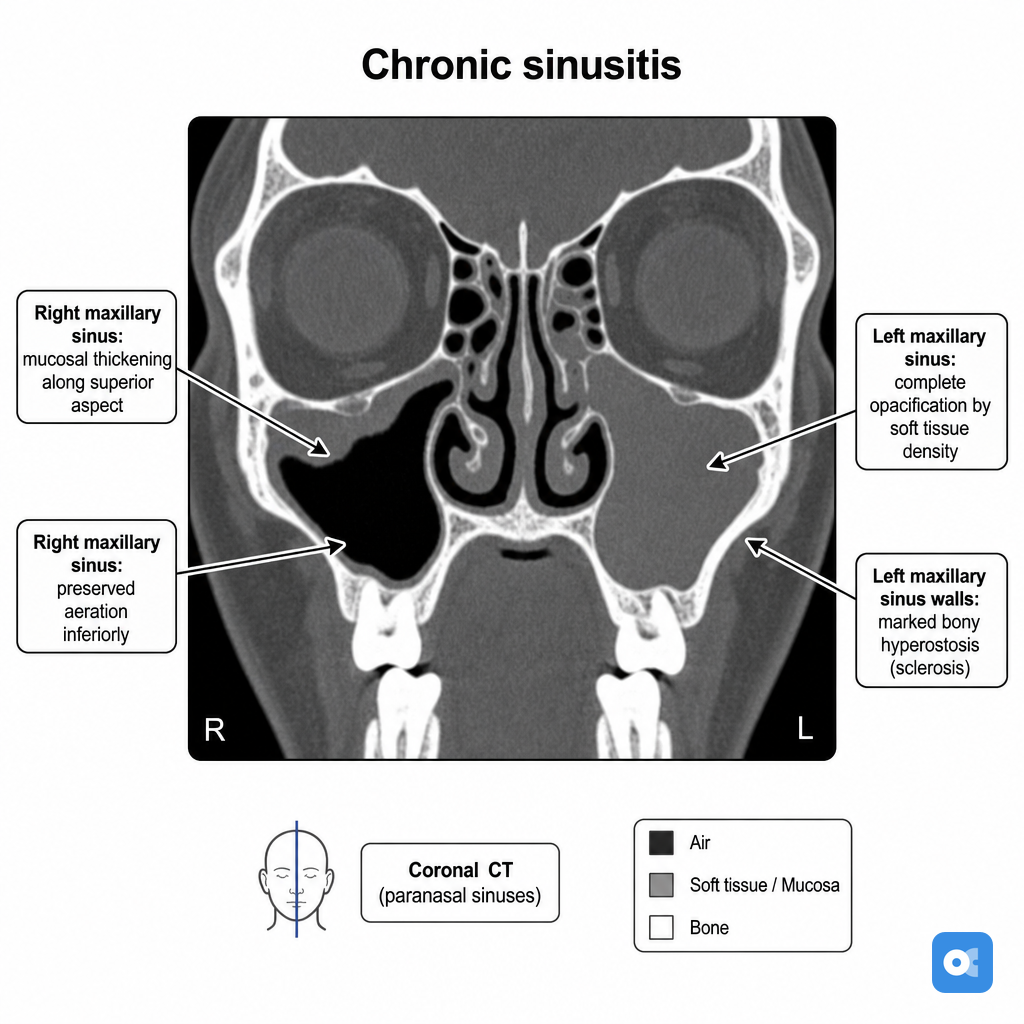
Chronic Rhinosinusitis Indian Medical PG Practice Questions and MCQs
Practice Indian Medical PG questions for Chronic Rhinosinusitis. These multiple choice questions (MCQs) cover important concepts and help you prepare for your exams.
Chronic Rhinosinusitis Indian Medical PG Question 1: All are intracranial complications of otitis media except which of the following?
- A. Brain abscess
- B. Hydrocephalus
- C. Lateral sinus thrombophlebitis
- D. Facial nerve palsy (Correct Answer)
Chronic Rhinosinusitis Explanation: ***Facial nerve palsy***
- This is an **extracranial complication** of otitis media affecting the **facial nerve within the temporal bone**, not an intracranial structure.
- The facial nerve (CN VII) runs through the **fallopian canal** in the temporal bone and can be affected by inflammation from adjacent mastoid or middle ear infection.
- Classified as a **temporal bone complication** rather than an intracranial complication.
*Lateral sinus thrombophlebitis*
- This is a true **intracranial complication** involving thrombosis of the **sigmoid and lateral venous sinuses** within the cranial cavity.
- Results from direct extension of infection through the **mastoid tegmen** or via septic thrombophlebitis.
- Presents with features of sepsis, headache, and papilledema.
*Brain abscess*
- A severe **intracranial complication** representing focal suppurative infection within the **brain parenchyma** (commonly temporal lobe or cerebellum).
- Occurs through direct extension via bony erosion, retrograde thrombophlebitis, or hematogenous spread.
- Requires urgent neurosurgical intervention.
*Hydrocephalus*
- An **intracranial complication** that can occur secondary to **otogenic meningitis** or **lateral sinus thrombosis**.
- Results from impaired CSF absorption or obstruction of CSF pathways.
- More common in pediatric otitis media with CNS complications.
Chronic Rhinosinusitis Indian Medical PG Question 2: Which of the following is not a diagnostic criterion for SIRS?
- A. Hypotension (Correct Answer)
- B. Tachypnoea
- C. Leucocytosis
- D. Tachycardia
Chronic Rhinosinusitis Explanation: ### Hypotension
- **Hypotension** is a criterion for **sepsis** and **septic shock**, but not for **SIRS** itself.
- **SIRS** criteria are based on inflammatory responses, while hypotension indicates a more severe systemic compromise.
*Tachycardia*
- **Tachycardia**, defined as a **heart rate >90 beats per minute**, is a diagnostic criterion for **SIRS** [1].
- It reflects the body's physiological stress response to a systemic inflammatory state [1].
*Tachypnoea*
- **Tachypnoea**, indicated by a **respiratory rate >20 breaths per minute** or a **PaCO2 <32 mmHg**, is a diagnostic criterion for **SIRS** [1].
- This symptom shows the body's effort to compensate for metabolic acidosis or increased oxygen demand.
*Leucocytosis*
- **Leucocytosis**, defined as a **white blood cell count >12,000/mm³** or **<4,000/mm³**, or the presence of **>10% immature neutrophils (bands)**, is a diagnostic criterion for **SIRS** [1].
- This indicates a significant systemic inflammatory response in the blood [1].
Chronic Rhinosinusitis Indian Medical PG Question 3: What imaging study is typically required before endoscopic sinus surgery?
- A. MRI of paranasal sinus
- B. CT of PNS (Correct Answer)
- C. Acoustic tests
- D. Mucociliary clearing testing
Chronic Rhinosinusitis Explanation: ***CT of PNS***
- A **CT scan of the paranasal sinuses** is crucial prior to endoscopic sinus surgery for detailed anatomical mapping.
- It helps identify **key anatomical landmarks**, variations, and the extent of disease, minimizing surgical risks.
*MRI of paranasal sinus*
- **MRI** is generally reserved for evaluating **soft tissue abnormalities**, such as tumors, fungal infections, or intracranial extension.
- It provides less detail regarding **bony anatomy** and is not the primary imaging modality for surgical planning in routine cases.
*Mucociliary clearing testing*
- **Mucociliary clearing tests** assess the function of the **mucociliary escalator** in the nasal cavity and sinuses.
- These tests are primarily diagnostic for conditions like **primary ciliary dyskinesia** and do not provide anatomical detail for surgical guidance.
*Acoustic tests*
- **Acoustic tests** are typically used to assess **hearing function** in the ear.
- They have **no relevance** to the anatomical evaluation of the paranasal sinuses or planning for endoscopic sinus surgery.
Chronic Rhinosinusitis Indian Medical PG Question 4: Which of the following is NOT typically associated with acute bacterial sinusitis?
- A. Purulent nasal discharge
- B. Epistaxis (Correct Answer)
- C. Facial pain
- D. Fever
Chronic Rhinosinusitis Explanation: ***Epistaxis***
- While possible due to **mucosal inflammation** or irritation from forceful blowing, **epistaxis (nosebleeds)** is not considered a typical or primary symptom of acute bacterial sinusitis.
- The main symptoms revolve around pressure, discharge, and systemic signs of infection.
*Purulent nasal discharge*
- This is a hallmark symptom of acute bacterial sinusitis, indicating the presence of **bacterial infection** and inflammation in the sinuses.
- The discharge is often thick, colored (yellow, green), and can be accompanied by a **foul odor**.
*Facial pain*
- **Facial pain** or pressure, especially around the cheeks, forehead, or eyes, is a characteristic symptom stemming from inflammation and fluid accumulation within the **sinus cavities**.
- This pain often worsens when bending forward.
*Fever*
- **Fever** is a systemic sign of infection and is commonly present in acute bacterial sinusitis, especially in more severe cases.
- It indicates the body's immune response to the bacterial invasion.
Chronic Rhinosinusitis Indian Medical PG Question 5: Allergic salute is seen in -
- A. Nasal Myiasis
- B. Allergic rhinitis (Correct Answer)
- C. Chronic sinusitis
- D. Chronic conjunctivitis
Chronic Rhinosinusitis Explanation: ***Allergic rhinitis***
- The **allergic salute** is a characteristic physical finding in allergic rhinitis [1], where individuals repeatedly push their nose upward with their hand to relieve nasal itching and clear obstruction.
- This repetitive gesture can lead to a visible transverse crease on the dorsum of the nose, known as the **nasal crease**.
*Nasal Myiasis*
- **Nasal myiasis** is an infestation of the nasal cavity by fly larvae, causing symptoms like nasal discharge, epistaxis, and local pain.
- It does not involve nasal itching that would provoke the "allergic salute" action.
*Chronic sinusitis*
- **Chronic sinusitis** is a prolonged inflammation of the sinuses, causing facial pain/pressure, nasal obstruction, and discharge.
- While it can cause nasal obstruction, it typically doesn't present with the intense nasal itching that would lead to the "allergic salute."
*Chronic conjunctivitis*
- **Chronic conjunctivitis** is an inflammation of the conjunctiva, primarily affecting the eyes with symptoms like redness, itching, and discharge.
- It does not directly affect the nasal passages or provoke nasal symptoms like itching that would result in an allergic salute.
Chronic Rhinosinusitis Indian Medical PG Question 6: Allergic rhinitis treatment include all except
- A. Corticosteroids
- B. Surgery
- C. Antibiotics (Correct Answer)
- D. Avoiding allergen
Chronic Rhinosinusitis Explanation: ***Antibiotics***
- Allergic rhinitis is an **inflammatory response to allergens**, not a bacterial infection.
- Antibiotics are ineffective against allergic reactions and are associated with risks like **antibiotic resistance** and adverse drug reactions.
*Corticosteroids*
- **Intranasal corticosteroids** are a first-line treatment for allergic rhinitis due to their potent anti-inflammatory effects [1].
- They effectively reduce symptoms like **nasal congestion**, sneezing, itching, and rhinorrhea [1].
*Surgery*
- In certain severe cases, surgery may be considered for allergic rhinitis, particularly to address **structural abnormalities** like nasal polyps or turbinate hypertrophy that contribute to symptoms.
- Procedures like **turbinate reduction** can improve nasal airflow and symptom control.
*Avoiding allergen*
- **Allergen avoidance** is a fundamental and often primary strategy in managing allergic rhinitis.
- Identifying and minimizing exposure to specific allergens (e.g., pollen, dust mites, pet dander) can significantly **prevent symptom exacerbations** [1].
Chronic Rhinosinusitis Indian Medical PG Question 7: What is not true about the use of intranasal steroids in nasal polyposis?
- A. Effective in all types of nasal polyps (Correct Answer)
- B. May cause nasal irritation
- C. Reduce recurrence
- D. Most effective in eosinophilically predominant polyps
Chronic Rhinosinusitis Explanation: ***Effective in all types of nasal polyps***
- Intranasal steroids are primarily effective in nasal polyps with an **eosinophilic inflammatory component**, which is the most common type.
- They are **not effective in all types** - efficacy is significantly reduced in polyps with **neutrophilic inflammation** or those related to conditions like **cystic fibrosis**, reflecting different underlying pathologies.
- This statement is **FALSE**, making it the correct answer to this negation question.
*May cause nasal irritation*
- **Nasal irritation**, including **burning, stinging**, or **dryness**, is a common local side effect associated with the use of intranasal steroids.
- Other local side effects can include **epistaxis** (nosebleeds) and mucosal atrophy, though less common.
- This statement is **TRUE**.
*Reduce recurrence*
- **Intranasal steroids** are crucial in **reducing the recurrence** of nasal polyps after surgical removal.
- Their anti-inflammatory action helps to **control the underlying inflammation** that contributes to polyp formation.
- This statement is **TRUE**.
*Most effective in eosinophilically predominant polyps*
- Intranasal steroids primarily target the **eosinophilic inflammatory pathway**, which is characteristic of the majority of **chronic rhinosinusitis with nasal polyps (CRSwNP)**.
- While they have **maximal efficacy** in eosinophilic polyps, they may have limited benefit in mixed inflammatory patterns.
- Their efficacy is significantly reduced in polyps that are predominantly **neutrophilic** or associated with systemic conditions like **cystic fibrosis**, as these involve different inflammatory mechanisms.
- This statement is **TRUE**.
Chronic Rhinosinusitis Indian Medical PG Question 8: A 35-year-old woman presents with facial pain, nasal congestion, and purulent nasal discharge for 10 days. What is the most likely diagnosis?
- A. Migraine
- B. Tension headache
- C. Trigeminal neuralgia
- D. Acute sinusitis (Correct Answer)
Chronic Rhinosinusitis Explanation: ***Acute sinusitis***
- The combination of **facial pain**, **nasal congestion**, and **purulent nasal discharge** for 10 days is highly characteristic of acute sinusitis, indicating inflammation and infection of the paranasal sinuses.
- The persistence of symptoms for over 7-10 days, or worsening symptoms after initial improvement, supports a bacterial etiology rather than a self-limiting viral infection.
*Migraine*
- Migraines typically present with **unilateral, throbbing headache**, often accompanied by **photophobia, phonophobia**, and nausea, without purulent nasal discharge [1].
- While facial pain can occur, it's usually not associated with nasal congestion or discharge [1].
*Tension headache*
- Tension headaches are usually characterized by **bilateral, pressing or tightening pain**, often described as a band around the head, and are not associated with nasal symptoms or purulent discharge [1].
- They typically lack the other features of sinusitis or migraines.
*Trigeminal neuralgia*
- This condition involves **sudden, severe, brief, stabbing or shock-like pain** in the distribution of the trigeminal nerve, often triggered by light touch or movement.
- It does not present with nasal congestion or purulent discharge.
Chronic Rhinosinusitis Indian Medical PG Question 9: Investigations used for CSF rhinorrhea are all except:
- A. Skull X-ray (Correct Answer)
- B. CT cisternogram
- C. Beta-2 transferrin
- D. Nasal endoscopy
Chronic Rhinosinusitis Explanation: ***Skull X-ray***
- A **skull X-ray** is generally not useful for diagnosing **CSF rhinorrhea** as it lacks the detailed soft tissue resolution needed to identify CSF leaks.
- It cannot visualize small defects in the skull base or detect the presence of CSF distinct from other nasal secretions.
*CT cisternogram*
- A **CT cisternogram** is a highly effective imaging modality for localizing **CSF leaks**, involving an intrathecal injection of contrast followed by CT scanning.
- It can pinpoint the exact site of the leak in the skull base, which is crucial for surgical planning.
*Beta-2 transferrin*
- **Beta-2 transferrin** is a protein found almost exclusively in **cerebrospinal fluid (CSF)**, making its detection in nasal discharge diagnostic of CSF rhinorrhea.
- This biochemical test offers high specificity for confirming the presence of CSF.
*Nasal endoscopy*
- **Nasal endoscopy** allows direct visualization of the nasal cavity and can help identify the source of the leak, especially if active dripping is observed.
- During the procedure, the Valsalva maneuver or changes in head position can sometimes provoke or increase the flow of CSF, aiding in localization.
Chronic Rhinosinusitis Indian Medical PG Question 10: Which of the following is not a feature of ethmoidal polyp?
- A. Common in adults
- B. Commonly bilateral
- C. Associated with chronic rhinosinusitis
- D. Commonly found as a single polyp (Correct Answer)
Chronic Rhinosinusitis Explanation: ***Commonly found as a single polyp***
- **Ethmoidal polyps** are typically **multiple** and bilateral, originating from the ethmoid sinuses.
- They rarely present as a single, isolated polyp, which is more characteristic of antrochoanal polyps.
- This is the key distinguishing feature that makes this statement INCORRECT.
*Common in adults*
- **Ethmoidal polyps** are indeed **more prevalent in adults** than in children.
- Peak incidence occurs between 30-50 years of age.
- Their incidence tends to increase with age, often associated with chronic rhinosinusitis.
*Commonly bilateral*
- **Ethmoidal polyps** almost invariably present as **bilateral polyps**, involving both sides of the nasal cavity.
- This bilateral nature is a key differentiating feature from antrochoanal polyps, which are typically unilateral.
- Bilateral presentation is one of the hallmark characteristics of ethmoidal polyps.
*Associated with chronic rhinosinusitis*
- **Ethmoidal polyps** are strongly associated with **chronic rhinosinusitis with nasal polyposis (CRSwNP)**.
- They arise from chronic mucosal inflammation of the ethmoid sinuses.
- Often associated with conditions like aspirin-exacerbated respiratory disease (AERD/Samter's triad) and non-allergic eosinophilic inflammation.
More Chronic Rhinosinusitis Indian Medical PG questions available in the OnCourse app. Practice MCQs, flashcards, and get detailed explanations.