

Membrane Transport Basics - Gateway Guardians
- Passive Transport (No ATP): Movement down an electrochemical gradient.
- Simple Diffusion: Small, nonpolar molecules (e.g., O₂, CO₂) pass directly through the membrane. Rate proportional to gradient & lipid solubility.
- Facilitated Diffusion: Via membrane proteins (channels or carriers) for specific solutes (e.g., glucose via GLUT, ions). Saturable kinetics.
- Osmosis: Water movement across a semipermeable membrane from low to high solute concentration (or high to low water potential).
- Active Transport (Requires ATP): Movement against an electrochemical gradient.
- Primary: Direct ATP hydrolysis fuels transport (e.g., Na⁺/K⁺-ATPase, H⁺ pumps).
- Secondary: Uses energy from an ion gradient (established by primary active transport) to co-transport another solute (e.g., SGLT1 for glucose/Na⁺).
- Driving Forces: Governed by concentration and electrochemical gradients. For ions, transport energy is $\Delta G = RT \ln(C_2/C_1) + zF\Delta\Psi$. 📌 Mnemonic: Active PUMPS (uphill, ATP), Passive FLOWS (downhill, no ATP).
⭐ GLUT4 (glucose transporter) in muscle and adipose tissue is insulin-dependent, a key example of facilitated diffusion.
oka

Ion Channels - Selective Speedsters
Integral membrane proteins forming pores for rapid, selective ion passage. Governed by selectivity (ion-specific) and gating (open/closed states). Nernst potential: $E_{ion} = (RT/zF) \ln([ion]{out}/[ion]{in})$.
- Types & Examples:
- Voltage-gated: Respond to membrane potential (Vm) changes.
- Na+ channels (action potentials), K+ channels (repolarization), Ca2+ channels (neurotransmitter release).
- Ligand-gated (Ionotropic): Ligand binding opens channel.
- Nicotinic Acetylcholine Receptor (nAChR): Na+/K+ influx.
- GABA-A Receptor: Cl- influx.
- Mechanosensitive: Mechanical stress opens channel.
- Voltage-gated: Respond to membrane potential (Vm) changes.
- Voltage-gated Na+ Channel States:
Loading diagram…
- Channelopathies (Diseases):
- Cystic Fibrosis: Defective CFTR (functions as a Cl- channel).
- Long QT Syndromes: Mutations in K+ or Na+ channel genes.
⭐ Tetrodotoxin (TTX) from pufferfish specifically blocks voltage-gated Na+ channels, halting action potentials.
📌 Remember: Lidocaine & Tetrodotoxin (TTX) are prominent blockers of voltage-gated Na+ channels.
Carrier Proteins - Picky Packers
Integral membrane proteins that bind specific solutes and undergo conformational changes to transport them across the membrane. Slower than ion channels.
- Properties:
- Specificity: Bind to a specific molecule or a group of structurally similar molecules.
- Saturation: Exhibit $V_{max}$ due to a finite number of binding sites, similar to enzyme kinetics.
- Conformational Change: Essential for shuttling solutes.
- Kinetics: Follow Michaelis-Menten like kinetics ($K_m$ reflects affinity, $V_{max}$ is maximum transport rate).
Types of Carrier Proteins:
| Type | Mechanism | Example(s) | Energy |
|---|---|---|---|
| Uniporter | Transports a single solute down its gradient. | GLUT1 (glucose in RBCs, brain) | Passive |
| Symporter | Co-transports two solutes in same direction. | SGLT1 (Na+/glucose in intestine, kidney) | Secondary Active |
| Antiporter | Co-transports two solutes in opp. directions. | Na+/Ca2+ exchanger (cardiac muscle), Cl-/HCO3- exchanger (RBCs) | Secondary Active |
Active Transport Pumps - Energy Guzzlers
- Active Transport: Solute movement against gradient; needs energy.
- Primary Active Transport: Direct ATP hydrolysis.
- P-type ATPases: Phosphorylated.
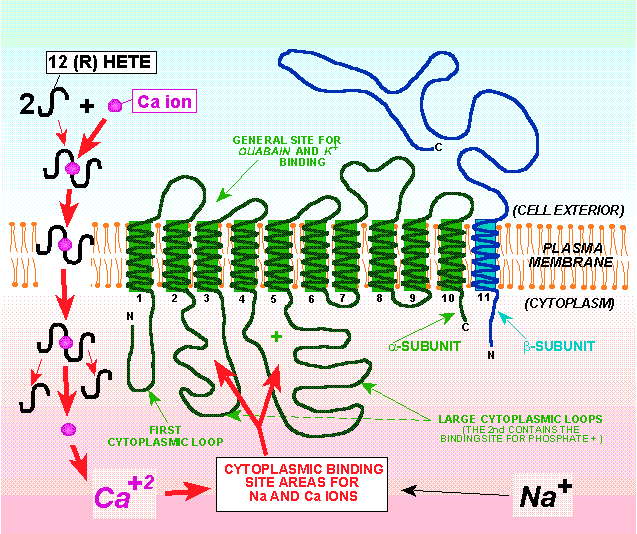
- Na+/K+ ATPase: Pumps $\textbf{3 Na}^+ \textbf{ out}$ & $\textbf{2 K}^+ \textbf{ in}$. 📌 PUMPKIN. Inhibitor: Ouabain.
- Ca2+ ATPase (SERCA): Pumps Ca2+ into SR/ER.
- H+/K+ ATPase: Gastric H+ secretion. Inhibitor: Omeprazole.
- F-type ATPases: ATP Synthase (mitochondria).
- V-type ATPases: Acidify lysosomes, endosomes.
- ABC Transporters (ATP-Binding Cassette):
- CFTR: Cl- channel.
- MDR1/P-glycoprotein: Drug efflux.
- P-type ATPases: Phosphorylated.
- Secondary Active Transport: Uses gradient from primary transport. E.g., SGLT1 (Na+-glucose cotransporter).
Table: Key Active Transporters
| Type | Transporter | Key Function | Inhibitor(s) |
|---|---|---|---|
| P-type | Na+/K+ ATPase | $\textbf{3 Na}^+ \textbf{ out} / \textbf{2 K}^+ \textbf{ in}$ | Ouabain |
| P-type | H+/K+ ATPase | Gastric H+ secretion | Omeprazole |
| ABC | CFTR | Cl- channel | - |
| ABC | MDR1 | Drug efflux | Verapamil |
| %%{init: {'flowchart': {'htmlLabels': true}}}%% | |||
| flowchart TD |
Start["🔋 Step 1: Binding
• ATPase + 3 Na+ in• Cytosolic binding"]
Phos["⚡ Phosphorylation
• ATP hydrolysis• Structural change"]
NaOut["📤 Na+ Efflux
• 3 Na+ out• Extracellular exit"]
Dephos["🔄 Dephosphorylation
• Pi release• Return to E1 state"]
KIn["📥 K+ Influx
• 2 K+ in• Intracellular move"]
Start -->|Using ATP| Phos Phos --> NaOut NaOut -->|2 K+ binds| Dephos Dephos --> KIn KIn --> Start
style Start fill:#FEF8EC, stroke:#FBECCA, stroke-width:1.5px, rx:12, ry:12, color:#854D0E style Phos fill:#FDF4F3, stroke:#FCE6E4, stroke-width:1.5px, rx:12, ry:12, color:#B91C1C style NaOut fill:#F6F5F5, stroke:#E7E6E6, stroke-width:1.5px, rx:12, ry:12, color:#525252 style Dephos fill:#F7F5FD, stroke:#F0EDFA, stroke-width:1.5px, rx:12, ry:12, color:#6B21A8 style KIn fill:#F6F5F5, stroke:#E7E6E6, stroke-width:1.5px, rx:12, ry:12, color:#525252
> ⭐ **Mutations in the CFTR gene, an ABC transporter, cause Cystic Fibrosis by disrupting chloride ion transport.**
## High‑Yield Points - ⚡ Biggest Takeaways
> * **Ion channels** mediate **rapid, passive diffusion** of ions down **electrochemical gradients**.
> * **Voltage-gated channels** (e.g., Na+, K+, Ca2+) respond to **membrane potential changes**.
> * **Ligand-gated channels** (e.g., nAChR, GABA-A) are activated by **neurotransmitter binding**.
> * **Transporters** (carriers/permeases) facilitate **slower, conformational change-dependent** solute movement.
> * **Primary active transport** uses **ATP hydrolysis** to move solutes **against concentration gradients** (e.g., Na+/K+ ATPase).
> * **Secondary active transport** couples solute movement to an **existing ion gradient** (e.g., SGLT1).
> * **Channelopathies** (e.g., Cystic Fibrosis - CFTR, Long QT syndrome - KCNQ1) are diseases due to **defective ion channels** or transporters.
Unlock the full lesson and continue reading
Signup to continue reading this lesson and unlimited access questions, flashcards, AI notes, and more
