Trauma Indian Medical PG Flashcards - Medical Study Cards
Master Trauma with OnCourse flashcards. These spaced repetition flashcards are designed for medical students preparing for NEET PG, USMLE Step 1, USMLE Step 2, MBBS exams, and other medical licensing examinations.
Trauma Flashcard Deck - 117 Cards
Flashcard 1: Parkland’s formula for burns: No answer _____]
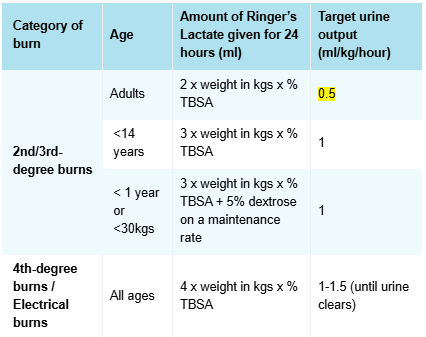
Answer: :)
Flashcard 2: AAST Kidney injury scale: No answer _____
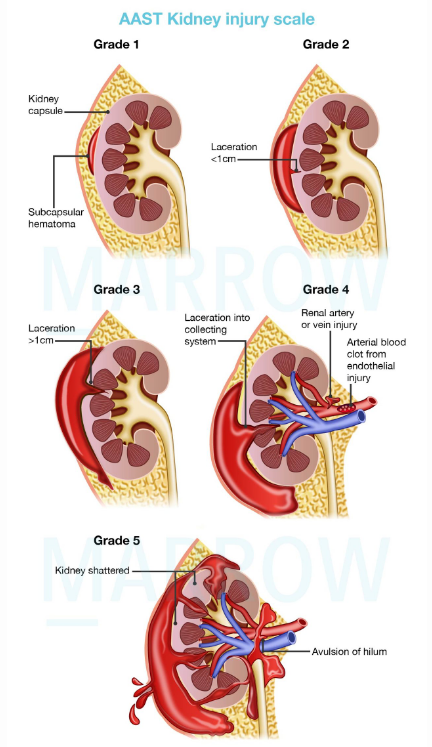
Answer: :)
Flashcard 3: _____ is the next best step to manage a case of intraperitoneal bladder rupture
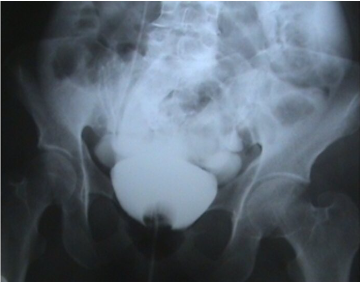
Answer: Laparotomy
Flashcard 4: Deep partial thickness burns are _____ and are painful to pressure only
Answer: not blanchable
Flashcard 5: Massive transfusion (MT) is defined as the replacement by transfusion of _____ units of pRBCs in 24 hours or more than 4 units of pRBCs in one hour.
Answer: 10
Flashcard 6: Spurious wounds in burn victims:Skin Splits: occur because of _____ of heated skin, present classically over extensor surfaces, and head
Answer: contraction
Flashcard 7: While deep partial thickness burns _____ heal without scarring, simple partial thickness burns do heal without scarring
Answer: do not
Flashcard 8: Superficial partial thickness burns are _____ and painful
Answer: blanchable
Flashcard 9: CSF _____orrhea is seen in transverse fractures of the petrous part of the temporal bone
Answer: rhin
Flashcard 10: Ongoing Tube Thoracostomy drainage of >_____ ml/ hr for 3 consecutive hours is an indication for thoracotomy
Answer: 200
Flashcard 11: The _____ stage classification of burn degrees was provided by Heister
Answer: four
Flashcard 12: Full thickness burns are _____ and not painful
Answer: not blanchable
Flashcard 13: The _____ stage classification of burn degrees was provided by Dupuytren
Answer: six
Flashcard 14: In degloving injury, _____ and subcutaneous fat are stripped by avulsion from the underlying fascia
Answer: skin
Flashcard 15: Surgical evacuation for epidural hematoma is recommended for patients with worsening neurological status or hematoma volume >_____ml or if the thickness of hematoma is >1.5cm regardless of neurological status
Answer: 30
Flashcard 16: Chest physiotherapy like _____ breathing, frequent coughing, incentive spirometry should be encouraged in flail chest
Answer: deep
Flashcard 17: Initial Tube Thoracostomy drainage of >_____ ml (penetrating injury) or >1500 ml (blunt injury) of frank blood is an indication for thoracotomy
Answer: 1000
Flashcard 18: The _____ segment of the urethra is prone to injury from pelvic fracture
Answer: membranous
Flashcard 19: Significant / serious burns are treated with surgery, restoration of _____ status, infection prophylaxis, and testosterone to promote recovery
Answer: volume
Flashcard 20: In a blunt cardiac injury, the _____ is the most common structure to be injured, while the aortic valve is the most common valve to be injured
Answer: right ventricle
Flashcard 21: The _____ stage classification of burn degrees was provided by Wilson, Hebra and Boyer
Answer: three
Flashcard 22: _____ hematoma often presents with a loss of consciousness followed by a lucid interval for up to 48 hours
Answer: Epidural
Flashcard 23: Phase II of damage control sx consists of secondary resuscitation to correct _____, coagulopathy, and acidosis
Answer: hypothermia
Flashcard 24: _____ hematoma is characterized by rapid expansion due to high arterial pressure and can present with a scalp hematoma as well
Answer: Epidural
Flashcard 25: The primary cause of late mortality in burns is _____ and multiorgan failure.
Answer: septicemia
Flashcard 26: Waddell's traid is a classic pattern of transportation injury seen in a pedestrian child due to motor vehicle, consisting of:Fractures of _____ or PelvisIntra-abdominal or Intra-thoracic injuriesContra-lateral head injury
Answer: Femur
Flashcard 27: Injury to the long thoracic nerve can occur during:#1 - _____ wounds#2 - axillary lymph node dissection#3 - chest tube insertion
Answer: stab
Flashcard 28: If uncal herniation is so severe that it is able to reach the opposite cerebral peduncle, it will cause an _____lateral paresis and/or contralateral CNIII palsy (this phenomenon is known as Kernohan's Notch)
Answer: ipsi
Flashcard 29: Cauda equina syndrome is treated with emergent _____ and steroids
Answer: surgery
Flashcard 30: _____ reflex and anal wink is commonly used to detect spinal shock.
Answer: Bulbocavernous
Flashcard 31: Full thickness burns have a _____ or leathery appearance
Answer: waxy
Flashcard 32: The most common type of intracranial _____ following trauma is cerebral contusion.
Answer: lesion
Flashcard 33: A needle should be positioned for a tension pneumothorax at the _____ ICS along the mid clavicular line
Answer: 5th
Flashcard 34: A _____ ventricular stab wound, may present with slight bleeding, whereas, a right ventricular stab wound may present with copious bleeding.
Answer: left
Flashcard 35: The Revised Trauma Score is made up of three categories: Glasgow Coma Scale, _____, and respiratory rate.
Answer: systolic blood pressure
Flashcard 36: Surgical evacuation for acute SDH is recommended if the thickness is >_____ cm or midline shift is >5 mm or GCS drops by 2 points or more from the time of injury to hospitalization
Answer: 1
Flashcard 37: Superficial burns are _____ and painful
Answer: blanchable
Flashcard 38: Parkland formula for burns is _____ml/kg/TBSA% given IV for adults where half is given in the first 8 hours and the remaining in the next 16 hours
Answer: 2
Flashcard 39: Phase I of damage control sx consists of initial operative exploration to attain rapid control of active _____ and contamination
Answer: hemorrhage
Flashcard 40: A drain for pneumothorax and haemothorax should aim towards the _____ of the lung.
Answer: apex
Flashcard 41: What is the least common type of brain membrane bleeding?_____
Answer: Extradural hemorrhage
Flashcard 42: Le Fort _____ is associated with facial skeleton completely disconnected from its cranial attachment
Answer: III
Flashcard 43: Parkland's formula for burns includes only _____ degree burns
Answer: second and third
Flashcard 44: Measurement of _____ pressure is the standard method to screen for intra-abdominal hypertension
Answer: bladder
Flashcard 45: Le Fort II is a _____ # of the maxilla
Answer: pyramidal
Flashcard 46: What is the mx of choice for early cases of post-traumatic CSF rhinorrhea?_____
Answer: conservative
Flashcard 47: The entry wound is sealed on _____ sides with an occlusive dressing if a pneumothorax is suspected
Answer: 3
Flashcard 48: Parkland formula for burns is calculated as _____ml x kg body wt. x TBSA%
Answer: 4
Flashcard 49: Presence of _____ red cells/L in blunt trauma indicates an intermediate diagnostic peritoneal lavage
Answer: 50,000 100,000
Flashcard 50: _____ is the next best step to manage a case of intraperitoneal bladder rupture
Answer: Laparotomy
Flashcard 51: 'Pincer contusions' may be seen in trauma to the _____
Answer: lungs
Flashcard 52: The _____ is the second most common organ involved in abdominal trauma.
Answer: liver
Flashcard 53: In what skull fracture is base of skull is divided into 2 halves, each moving independently of each other like a hinge?_____
Answer: Hinge fracture
Flashcard 54: Safest site for insertion of a chest drain is the _____,in the 5th ICS
Answer: Triangle of safety
Flashcard 55: The _____ at the end of the K-nail is useful while removing it
Answer: eye
Flashcard 56: Degloving injuries is classified under _____ colour on traiging
Answer: yellow
Flashcard 57: _____ is the most common organ to be injured in penetrating stab injury of the abdomen
Answer: Liver
Flashcard 58: What is the next step in mx of a patient of pneumothorax with a failed needle thoracostomy?_____
Answer: finger thoracostomy followed by tube thoracostomy
Flashcard 59: Early mortality in pelvic # is mostly the result of _____
Answer: haemorrhage
Flashcard 60: _____ deformity of infraorbital margin may occur with zygoma #
Answer: Step
Flashcard 61: The minimum amount of blood required to manifest symptoms in case of extradural haemorrhage is _____ ml
Answer: 35
Flashcard 62: TRISS (Trauma and Injury Severity Score) : includes IRMA_____
Answer: RTS + ISS + age + mechanism of injury
Triss is Rima
Flashcard 63: Types of skull fractures:_____ skull fractures are breaks in the bone that traverse the full thickness of the skull from the outer to inner table.
Answer: Linear
Flashcard 64: Grade _____ renal injury includes laceration extending through the renal cortex, medulla, and collecting system
Answer: IV
Flashcard 65: Late mortality in pelvic # is mostly the result of _____
Answer: sepsis or MODS
Flashcard 66: Which zone of retroperitoneum is explored only if the hematoma is pulsatile or expanding, else conservative/ angioembolization?_____
Answer: Zone 2 and 3
Flashcard 67: The most commonly affected organ in a blast injury is the _____
Answer: lungs
Flashcard 68: Aiming for permissive _____ is a part of balanced resuscitation (damage control resuscitation)
Answer: hypotension
Flashcard 69: Parkland formula for burns is _____ml/kg/TBSA% given IV for children (
Answer: 3
Flashcard 70: Grade _____ renal injury includes shattered kidney, or avulsion of renal hilum which devascularizes kidney
Answer: V
Flashcard 71: Sluggish pinprick bleeding is typically indicative of a _____ compromise
Answer: arterial
Flashcard 72: Strapping is not done for the rib fractures because it prevents the patient from taking deep breaths which can lead to _____
Answer: lung collapse
Flashcard 73: What is the initial management in a trauma patient presenting with pericardial tamponade?_____
Answer: Needle pericardiocentesis
Flashcard 74: _____ - a voilent jerk or shock, or the condition which results from such an injury.
Answer: Concussion
Flashcard 75: Which zone of retroperitoneum is always explored, after proximo-distal vascular control?_____
Answer: Zone 1/Central
Flashcard 76: What is the most important prognostic factor for burns?_____
Answer: Age>BSA
Flashcard 77: Phase III of damage control sx consists of _____ typically occuring 48 to 72 hours following initial and after successful secondary resuscitation
Answer: definitive surgery
Flashcard 78: Administration of pre-defined blood products in ratios similar to _____ is a part of balanced resuscitation (damage control resuscitation)
Answer: whole blood
Flashcard 79: The primary cause of early mortality in burns is _____
Answer: burn shock.
Flashcard 80: Are scalp contusions better felt or seen?_____
Answer: Felt
Flashcard 81: _____ is associated with motorcyclist injury.
Answer: Tail-gating (Type of injury)
Flashcard 82: Grade _____ renal injury includes subcapsular, nonexpanding hematoma, without parenchymal laceration
Answer: I
Flashcard 83: Surgical evacuation for epidural hematoma is recommended whenever GCS is
Answer: Surgical evacuation for epidural hematoma is recommended whenever GCS is
Flashcard 84: Grade _____ renal injury includes laceration of without urinary extravasation
Answer: II
Flashcard 85: A ruptured subcapsular hematoma is suggestive of grade _____ splenic injury.
Answer: III
Flashcard 86: Which scoring system is used to assess risk of mortality in a burns patient?_____
Answer: Baux score
Flashcard 87: _____ is the most common cause of CSF rhinorrhea.
Answer: Trauma
Flashcard 88: Parkland formula for electrical injury is _____ml/kg/TBSA% given IV until urine clears
Answer: 4
Flashcard 89: Pelvic fractures is classified under _____ colour on traiging
Answer: yellow
Flashcard 90: Periorbital _____, due to escape of air from the maxillary sinus on nose blowing may occur with zygoma #
Answer: emphysema
Flashcard 91: _____ is the most common organ involved in blunt trauma injury of Abdomen.
Answer: Spleen
Flashcard 92: Trauma most commonly causes _____ hemorrhage in the skull.
Answer: Subarachnoid
Flashcard 93: If there is a _____ injury in any of the retroperitoneal zones, surgical management is done.
Answer: penetrative
Flashcard 94: Stab and low velocity injuries to the colon with minimal contamination and hemodynamical stability can be managed by _____
Answer: ileotransverse anastomosis
Flashcard 95: Grade _____ renal injury includes vascular injury to renal artery or vein with contained hemorrhage
Answer: IV
Flashcard 96: Grade _____ renal injury includes laceration of >1 cm parenchymal depth of renal cortex without urinary extravasation
Answer: III
Flashcard 97: The most common cause of hemobilia is _____
Answer: iatrogenic trauma.
Flashcard 98: Le Fort _____ is associated with CSF rhinorrhea
Answer: II and III
Flashcard 99: Presence of _____ units amylase/dL indicates a positive diagnostic peritoneal lavage
Answer: 175
Flashcard 100: _____ is the most common organ to be injured in gunshot injury of the abdomen
Answer: Small intestine
Flashcard 101: If the patient's blood pressure improves to >_____ mm Hg, he needs to be re-evaluated as he may no longer be a candidate for damage control surgery
Answer: 90/60
Flashcard 102: The most commonly affected organ in an underwater blast injury is the _____
Answer: intestines
Flashcard 103: Voluntary splinting as a result of pain, mechanically impaired chest wall movement and the associated lung contusion are all causes of _____ in flail chest
Answer: respiratory failure
Flashcard 104: The TRISS score takes into consideration the "_____" to calculate the severity of the patient.
Answer: injury mechanism
Flashcard 105: Which structures are fixed first during reimplantation of an amputated limb?_____
Answer: Bone
Flashcard 106: Ruptured abdominal viscera is classified under _____ colour on traiging
Answer: yellow
Flashcard 107: In patients of polytrauma, crystalloids are administered at _____ml/kg if hypotension is present or when the serum lactate levels measured are > 4mmol/L
Answer: 30
Flashcard 108: Approximately _____% of the EDH is associated with skull fracture
Answer: 85
Flashcard 109: What is the investigation of choice for suspected diaphragmatic injury?_____
Answer: Laparoscopy
Flashcard 110: Injury to Zone _____ of the retroperitoneum with a _____ hematoma should be treated surgically.
Answer: 2; pulsatile::pulsatile/non-pulsatile
Flashcard 111: For patients with persistent air leak (>72 hours) and failure of the lung to expand fully after tube thoracostomy, _____ is recommended
Answer: Surgical intervention
Flashcard 112: In Adults, Needle thoracostomy is performed in _____ ICS Anterior to Mid-_____ line
Answer: 5th; axillary
Flashcard 113: Chest strapping or splinting should be _____ in the management of a flail chest.
Answer: avoided::performed/avoided
Flashcard 114: _____ hemorrhage is characterised by a _____ interval.
Answer: Extradural; Lucid
Flashcard 115: Deep second-degree burns involve the epidermis and the reticular dermis and have _____ capillary refill
Answer: no
Flashcard 116: Parkland formula for an adult with 2nd-degree burns is given by: _____ x weight in kg x % TBSA
Answer: 2
Flashcard 117: Injury to Zone _____ of the retroperitoneum with a _____ hematoma should be treated surgically.
Answer: 2; pulsatile::pulsatile/non-pulsatile
Keywords: Trauma flashcards, medical flashcards, NEET PG preparation, USMLE Step 1 flashcards, Anki alternative, spaced repetition medical, OnCourse flashcards