
Non-Bicarbonate Buffer Systems — Flashcards

The _____ in red blood cells (from H2CO3) is transported into the plasma in exchange for Cl-
Fixed H+ (e.g. from protein and phospholipid catabolism) is excreted in the urine as _____ and NH4+
The primary disturbance in metabolic acidosis is a _____ in HCO3-
The major buffer of the **extracellular fluid** is _____, whereas phosphate is a major buffer of the **intracellular fluid** (and urine).
In chronic _____, there is an adaptive increase in NH3 synthesis in the cells of the proximal tubule
Renal correction of respiratory acidosis includes increased excretion of excess fixed H+ as _____ and NH4+
_____ in pH cause the O2-hemoglobin dissociation curve to shift to the left
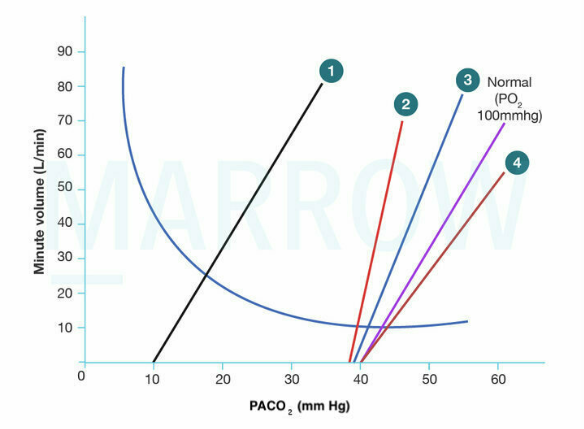
If the pH is reduced from 7.4 to 7.3 with the alveolar PO2 being constant at 100 mmHg, PCO2 would follow line _____.
At _____ urine pH, the HA form of a weak acid exists, thus decreasing excretion
The arterial blood profile seen in compensated metabolic acidosis is: pH: _____[HCO3-]: decreasedPCO2: decreased
Non-Bicarbonate Buffer Systems Flashcards for NEET-PG
Study 10 flashcards on Non-Bicarbonate Buffer Systems for NEET-PG Physiology. These active recall cards cover the key concepts, clinical associations, and high-yield facts from this chapter of Acid-Base Balance. Each card is designed to test your understanding rather than just recognition, building stronger and more durable memories for exam day.
For personalised spaced repetition scheduling and unlimited flashcards, download the Oncourse app.
Frequently Asked Questions
Are Non-Bicarbonate Buffer Systems flashcards free?
How many flashcards does this chapter have?
How should I use these flashcards for NEET-PG?
Are there more flashcards for Acid-Base Balance?
Want unlimited flashcards?
Get full access to all flashcards, spaced repetition, and progress tracking.
Scan to download app