
Pediatric Critical Care — Flashcards

On this page
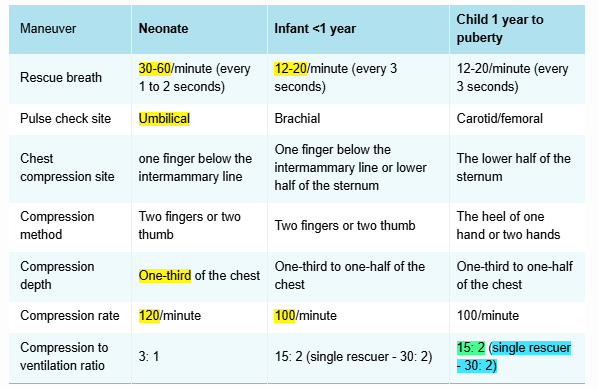
Guidelines for pediatric basic life support: No answer _____
Initial stabilization phase of SAM treatment includes SHIELDED:S_____,Hypothermia, Infection, ELectrolyte imbalance, DEhydration, Deficiency of nutrients
Treatment of dehydration based on severity: Plan CIn infants _____ first 30ml/kg is given in the first 1 hr and the remaining 70ml/kg in the next 5 hours.
Hint: age
Treatment of Reye's syndrome involves infusion of 20% _____ and fresh frozen plasma
Treatment of dehydration based on severity: Plan CIn infants _____ first 30ml/kg is given in the first 0.5 hr and the remaining 70ml/kg in the next 2.5 hours.
Hint: age
The depth of compression for CPR should be about _____ cm in children and 4 cm in infants
In a choking responsive infant, the first thing to be done is to perform 5 _____ and 5 downward thrusts
Which phase of SAM treatment deals with restoring homeostasis and treating medical conditions?_____
The ideal rescue breath rate for children is _____ breaths/min
_____(ideal) or normal saline is used as intravenous fluids for resuscitation in dehydrated children.
Study by Chapter
Respiratory Failure
Flashcards
Shock
Flashcards
Cardiopulmonary Resuscitation
Flashcards
Acute Respiratory Distress Syndrome
Flashcards
Mechanical Ventilation in Children
Flashcards
Sedation and Analgesia
Flashcards
Status Epilepticus
Flashcards
Diabetic Ketoacidosis
Flashcards
Pediatric Trauma
Flashcards
Poisoning and Toxidromes
Flashcards
Near-Drowning
Flashcards
Multiple Organ Dysfunction Syndrome
Flashcards
About Pediatric Critical Care Flashcards for NEET-PG
These Pediatric Critical Care flashcards are designed for NEET-PG Pediatrics preparation, using active recall to help you retain high-yield concepts, clinical correlations, and commonly tested facts. Each card prompts you to retrieve information from memory rather than passively reviewing notes, which research shows leads to significantly better exam performance.
The 24 cards in this deck cover the most important topics in Pediatric Critical Care, including key mechanisms, diagnostic criteria, treatment protocols, and clinical pearls that frequently appear in NEET-PG examinations. Cards are organised by chapter so you can focus on specific areas or work through the entire topic systematically.
For personalised spaced repetition scheduling that adapts to your performance, unlimited flashcards, and detailed progress analytics, download the Oncourse app.
Frequently Asked Questions
Are Pediatric Critical Care flashcards free on Oncourse?
How do flashcards help with NEET-PG preparation?
How many Pediatric Critical Care flashcards are available?
Can I study Pediatric Critical Care flashcards by chapter?
What topics do these Pediatrics flashcards cover?
Want unlimited flashcards?
Get full access to all flashcards, spaced repetition, and progress tracking.
Start For Free