
Ovulation Induction — Flashcards

In polycystic ovarian syndrome, increased _____ production causes excess androgen production (from theca cells), resulting in hirsutism
Polycystic ovarian syndrome is a condition characterized by at least 2/3 of the following criteria:- signs of _____- irregular periods (typically oligomenorrhea)- polycystic ovaries on ultrasound
In a pre-menopausal woman with simple hyperplasia with atypia, management is done using _____
Anovulatory cycle results in an estrogen-driven proliferative phase, but no _____-driven secretory phase
The response of testosterone to hCG is _____ in ovotesticular disorder
Polycystic ovarian syndrome is characterized by _____ LH and low FSH
The luteal phase of the menstrual cycle is dominated by the hormone _____, causing increased secretory activity and vascularity of the endometrium
In a patient with amenorrhoea and raised FSH and LH levels, the next step would be to check for _____
Not more than _____ ovarian cysts are punctured/drilled in each ovary in polycystic ovary syndrome.
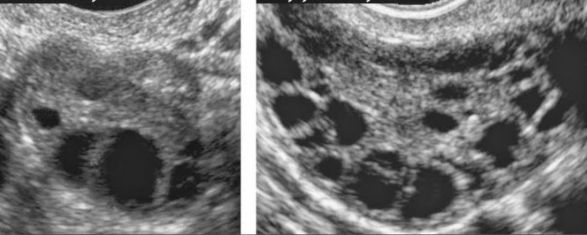
_____ presents with enlarged, bilateral cystic ovaries
Ovulation Induction Flashcards for NEET-PG
Study 10 flashcards on Ovulation Induction for NEET-PG Obstetrics and Gynecology. These active recall cards cover the key concepts, clinical associations, and high-yield facts from this chapter of Reproductive Endocrinology. Each card is designed to test your understanding rather than just recognition, building stronger and more durable memories for exam day.
For personalised spaced repetition scheduling and unlimited flashcards, download the Oncourse app.
Frequently Asked Questions
Are Ovulation Induction flashcards free?
How many flashcards does this chapter have?
How should I use these flashcards for NEET-PG?
Are there more flashcards for Reproductive Endocrinology?
Want unlimited flashcards?
Get full access to all flashcards, spaced repetition, and progress tracking.
Scan to download app