Back
USMLE Step 3 New Format 2026: What Changed and How to Prepare
USMLE Step 3 changed its format in 2026 with fewer CCS cases and increased clinical management focus. Learn exactly what changed and how to adapt your study plan for success.
USMLE Step 3 New Format 2026: What Changed and How to Prepare
You are probably staring at outdated prep materials right now. The USMLE Step 3 format changed in 2026, and students who keep drilling the old structure are walking into the exam underprepared.
Step 3 dropped from 13 CCS (Computer-Based Case Simulations) to just 9 cases. The test interface got redesigned. Clinical management now carries more weight than pure diagnosis. If your study plan was built around the pre-2026 format, you need to recalibrate — fast.
The good news? These changes make Step 3 more predictable. Fewer CCS cases means each one carries more weight, so you can focus your practice on high-yield categories. The new interface is cleaner and faster to navigate. The increased emphasis on management over diagnosis aligns Step 3 with what you actually do as a resident.
Here's exactly what changed, why it matters, and how to rebuild your study approach around the new format.
What Actually Changed in the Step 3 New Format
The 2026 Step 3 format overhaul wasn't subtle. These are the changes that matter for your prep:
Fewer CCS Cases (13 → 9)
The biggest change: Step 3 dropped from 13 to 9 CCS cases on Day 2. Each case now carries more weight in your final score. This sounds easier, but it's actually higher stakes — one poorly handled case impacts your score more significantly.
The 9 cases break down across these categories:
Internal medicine: 3-4 cases
Emergency medicine: 2 cases
OB-GYN: 1 case
Pediatrics: 1-2 cases
Surgery/other: 1 case
Redesigned Test Interface
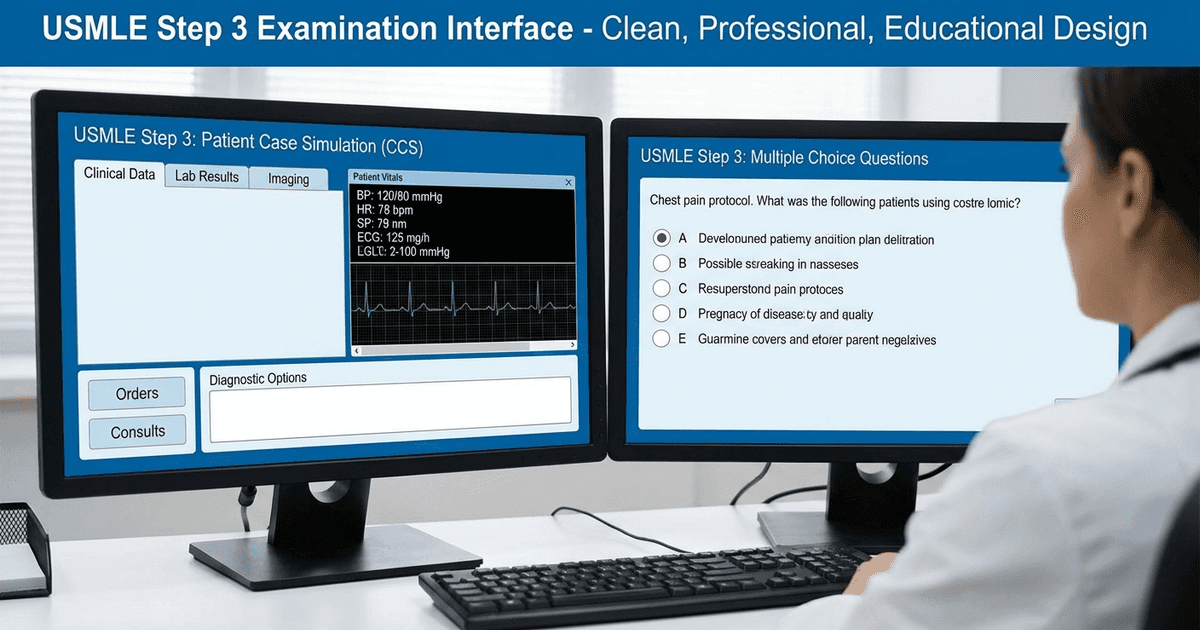
The new interface streamlined patient navigation. Laboratory ordering is now grouped by category (chemistry, hematology, microbiology) instead of alphabetical lists. Physical exam findings display with anatomical diagrams rather than text blocks. Treatment options are organized by urgency level.
This matters because faster navigation means more time for clinical thinking. The old interface wasted time hunting for orders — the new one presents options logically.
Clinical Management Emphasis
Step 3 now weights clinical management decisions more heavily than diagnostic accuracy. Getting the right diagnosis still matters, but how you sequence your workup, which labs you order when, and your treatment progression carry more points.
For example: A chest pain case might give you full credit for ordering an ECG and troponins immediately, even if your initial differential was incomplete. The emphasis is on appropriate next steps, not encyclopedic knowledge.
Day 1 vs Day 2 Breakdown
Understanding what each day tests helps you allocate study time correctly.
Day 1: Foundation Testing
233 MCQs across 6 blocks
60 minutes per block (approximately 1.5 minutes per question)
Covers all specialties: internal medicine, surgery, pediatrics, OB-GYN, psychiatry, emergency medicine
Focus: Clinical knowledge, pattern recognition, basic management
Day 1 questions test your foundation across all specialties. They're similar to Step 2 CK but with more emphasis on outpatient management and chronic disease. Think diabetes follow-up, hypertension adjustments, depression screening — the bread and butter of practice.
When studying for Day 1, internal medicine lessons provide the clinical foundation you need. The key is breadth over depth — you need working knowledge across six specialties, not subspecialty expertise.
Day 2: Clinical Skills Testing
180 MCQs in 4 blocks
9 CCS cases
9 hours total (MCQs and CCS combined)
Focus: Real-time clinical decision making, case progression, management sequencing
Day 2 is where Step 3 gets real. The 9 CCS cases simulate actual patient encounters from start to finish. You take histories, order exams, interpret results, make diagnoses, and manage treatment over simulated time periods.
The Clinical Rounds feature mirrors this exact format — interactive patient cases where you navigate step-by-step encounters with feedback on each clinical decision. This builds the navigation muscle memory Step 3 actually tests.
High-Yield CCS Case Categories
With only 9 CCS cases, certain scenarios appear repeatedly. Focus your practice on these categories:
Internal Medicine (3-4 Cases)
Acute coronary syndrome management
Heart failure exacerbation
COPD exacerbation
Diabetes management (DKA/HHS)
Sepsis workup and treatment
These cases test your ability to stabilize, diagnose, and manage common inpatient scenarios. The key skill: knowing which orders to place immediately vs. which can wait.
Emergency Medicine (2 Cases)
Chest pain workup
Shortness of breath evaluation
Abdominal pain assessment
Trauma evaluation (ATLS protocols)
Emergency cases emphasize triage and stabilization. You need to demonstrate appropriate urgency — ordering stat labs for unstable patients, getting imaging quickly for concerning presentations.
OB-GYN (1 Case)
Labor management
Antepartum complications
Postpartum complications
Gynecologic emergencies
OB cases often involve time-sensitive decisions. Practice normal labor progression, when to intervene, and recognizing complications early.
Pediatrics (1-2 Cases)
Fever workup by age
Respiratory distress
Common childhood emergencies
Growth and development assessment
Pediatric cases test age-appropriate management. A fever in a 2-month-old requires full sepsis workup; the same fever in a 2-year-old might not.
How to Practice CCS Correctly
Most students practice CCS wrong. They treat it like MCQs — read case, pick answer, move on. CCS requires active clinical thinking.
Active Navigation Practice
Don't just read cases passively. Practice clicking through the interface:
Take focused histories based on chief complaint
Order physical exam components systematically
Request labs progressively, not all at once
Monitor patient response to treatments
Adjust management based on new information
Progressive Lab Ordering
Real CCS cases unfold over simulated time. You don't order every possible test upfront — you start with basics and add based on results.
For chest pain:
1. Start: ECG, basic metabolic panel, troponins
2. If troponins elevated: Cardiology consult, antiplatelet therapy
3. If ECG shows STEMI: Emergent cath lab, heparin, aspirin
4. Continue: Monitor serial troponins, echo if indicated
Don't Over-Order
CCS scoring penalizes unnecessary orders. Ordering a CT head for simple headache costs points. The system tracks clinical appropriateness, not thoroughness.
Focus on indicated orders based on clinical presentation. If you're unsure whether to order something, ask: "Would this change my management?" If not, skip it.
When practicing CCS-style cases, the AI feedback in Clinical Rounds tracks your history questions, diagnoses, and treatment choices against reference standards — the same skills Step 3 evaluates.
MCQ Strategy for Step 3
Step 3 MCQs aren't pure pathophysiology recall. They test clinical scenarios you'll encounter in practice.
Real Clinical Scenarios
Questions present actual patient situations:
"A 45-year-old with diabetes comes for routine follow-up. HbA1c is 8.2%. Current medications include metformin 1000mg twice daily. What is the most appropriate next step?"
"A 28-year-old pregnant woman at 32 weeks presents with severe headache and visual changes. BP is 160/100. Urinalysis shows 3+ protein. What is the immediate priority?"
These aren't zebra diagnoses — they're common clinical decisions you'll make as a resident.
Management Over Diagnosis
Many Step 3 questions give you the diagnosis and ask about management:
Given CHF exacerbation, what's the next step?
Given confirmed MI, which medication is indicated?
Given preeclampsia, what's the delivery timing?
This aligns with clinical practice. You often know what's wrong — the skill is knowing what to do about it.
When a Step 3 MCQ stumps you, the Explanation Chat with Rezzy surfaces detailed explanations as natural conversations. It identifies your specific misconception and explains the correct clinical reasoning chain — exactly what Step 3 rewards.
Outpatient Focus
Unlike Step 2 CK's hospital focus, Step 3 includes significant outpatient management:
Chronic disease follow-up
Preventive care guidelines
Medication adjustments
Screening recommendations
Study outpatient protocols for diabetes, hypertension, hyperlipidemia, and depression. Know vaccination schedules, cancer screening intervals, and routine lab monitoring.
Recommended Step 3 Study Approach
Step 3 requires a different prep strategy than Steps 1 and 2. Here's the approach that works:
Timeline: 8-10 Weeks Dedicated
Step 3 covers more ground than Step 2 CK but in less depth. 8-10 weeks dedicated study works for most students. Less than 6 weeks doesn't allow adequate CCS practice. More than 12 weeks leads to knowledge decay.
Phase 1: Foundation Review (3-4 Weeks)
Start with broad specialty review:
Internal medicine: 1.5 weeks
Emergency medicine: 1 week
OB-GYN: 1 week
Pediatrics: 1 week
Surgery/psychiatry: 0.5 weeks
Focus on high-yield topics within each specialty. Don't get lost in subspecialty details — Step 3 tests common presentations, not rare diseases.
The Daily Plan feature uses a momentum + rotation model, keeping you progressing in strong areas while cycling through weak specialties so nothing gets neglected.
Phase 2: Mixed Practice (3-4 Weeks)
Switch to mixed specialty question blocks:
200-300 questions per day
Review explanations thoroughly
Note knowledge gaps for targeted review
Track performance by specialty
Mixed practice builds the mental flexibility Step 3 requires. You need to switch between pediatric fever workups and adult chest pain evaluations seamlessly.
Phase 3: Heavy CCS Practice (2-3 Weeks)
Final weeks focus intensively on CCS:
3-5 CCS cases per day
Time yourself on each case
Practice all high-yield categories
Review case management principles
Simulate test day conditions
CCS skills deteriorate quickly without practice. Front-load your CCS work in the final weeks when it's fresh for test day.
Common Preparation Mistakes to Avoid
These mistakes trip up otherwise well-prepared students:
Over-Studying Low-Yield Topics
Step 3 doesn't test rare diseases or subspecialty details. Spending weeks on dermatology pathways or infectious disease minutiae wastes time. Focus on common presentations across the major specialties.
Passive CCS Practice
Reading CCS explanations isn't the same as practicing navigation. You need hands-on experience with the interface, ordering labs, and managing cases over time. Passive review doesn't build the skills Step 3 tests.
Ignoring Outpatient Management
Many students over-prepare for inpatient scenarios and under-prepare for outpatient management. Step 3 heavily tests chronic disease management, preventive care, and routine follow-up — the actual work of most physicians.
Cramming in Final Week
Step 3 tests clinical thinking patterns, not memorized facts. These patterns take time to develop. Cramming in the final week doesn't work — you need consistent practice building clinical decision-making skills.
Test Day Strategy
Know what to expect on test day:
Day 1 Approach
Pace yourself: 1.5 minutes per MCQ average
Don't get stuck on difficult questions — mark and return
Use break time to decompress between blocks
Stay hydrated and maintain energy
Day 2 CCS Management
Start each case by reading the scenario completely
Take systematic histories before jumping to orders
Monitor patient status throughout the case
Don't over-order — focus on clinically indicated tests
Use available time fully — don't rush through cases
Between Days
Take the evening between Day 1 and Day 2 to rest. Don't study — your knowledge won't improve overnight, but fatigue will hurt your clinical thinking on Day 2.
Frequently Asked Questions
How long should I spend on each CCS case?
Plan for 15-20 minutes per case, but use the full time available. CCS cases provide 10-25 minutes depending on complexity. Don't rush — the time limits are generous, and thorough evaluation scores better than speed.
Can I still pass if I mess up one CCS case?
Yes. With 9 cases total, one poor performance won't sink you, but it carries more weight than in the old 13-case format. Focus on consistent performance across all cases rather than perfection on individual scenarios.
What's the minimum score to pass Step 3 in 2026?
The passing score remains around 196, but scoring algorithms adjust with format changes. Focus on demonstrating competent clinical decision-making rather than targeting specific score thresholds.
Should I take Step 3 during residency or as a medical student?
Most students take Step 3 during intern year when clinical experience reinforces test content. Taking it as a student requires more dedicated study time but allows you to focus without residency responsibilities.
How different are the new CCS cases from practice materials?
The case content remains similar, but navigation is streamlined. Practice with current materials, but spend time familiarizing yourself with the new interface layout and organization.
What happens if I run out of time on a CCS case?
Partial credit applies based on completed actions. The system scores your clinical decisions up to the point where time expires. Complete initial evaluation and stabilization steps first before moving to detailed management.
Final Thoughts
The Step 3 format changes make the exam more focused and clinically relevant. Fewer CCS cases mean higher stakes per case, but also more predictable content areas to master. The interface improvements help you spend more time thinking clinically and less time navigating menus.
Success comes from adapting your study approach to the new format. Focus on the 9 high-yield CCS categories. Practice active case navigation, not passive reading. Build clinical management skills, not just diagnostic knowledge.
Most importantly, don't let the format changes psyche you out. Step 3 still tests the same core clinical competencies — the packaging just got cleaner and more efficient.
Prepare smarter with Oncourse AI — adaptive MCQs, spaced repetition, and AI explanations built for USMLE Step 3. Download free on Android and iOS.