Back
USMLE Step 1 Pass Rate Statistics 2025: Complete Data by IMG, USMG, First-Timers and Repeaters
Official USMLE Step 1 pass rates for 2025: US MD students (91%), IMGs (72%), first-timers vs repeaters. Complete statistical analysis for medical licensing exam success.
USMLE Step 1 Pass Rate Statistics 2025: Complete Data by IMG, USMG, First-Timers and Repeaters
You are probably wondering what your actual odds are of passing USMLE Step 1 on your first attempt. The numbers matter because failing Step 1 as an IMG creates a steep uphill battle for residency matching. Here are the official statistics from the United States Medical Licensing Examination that every IMG needs to know before walking into that testing center.
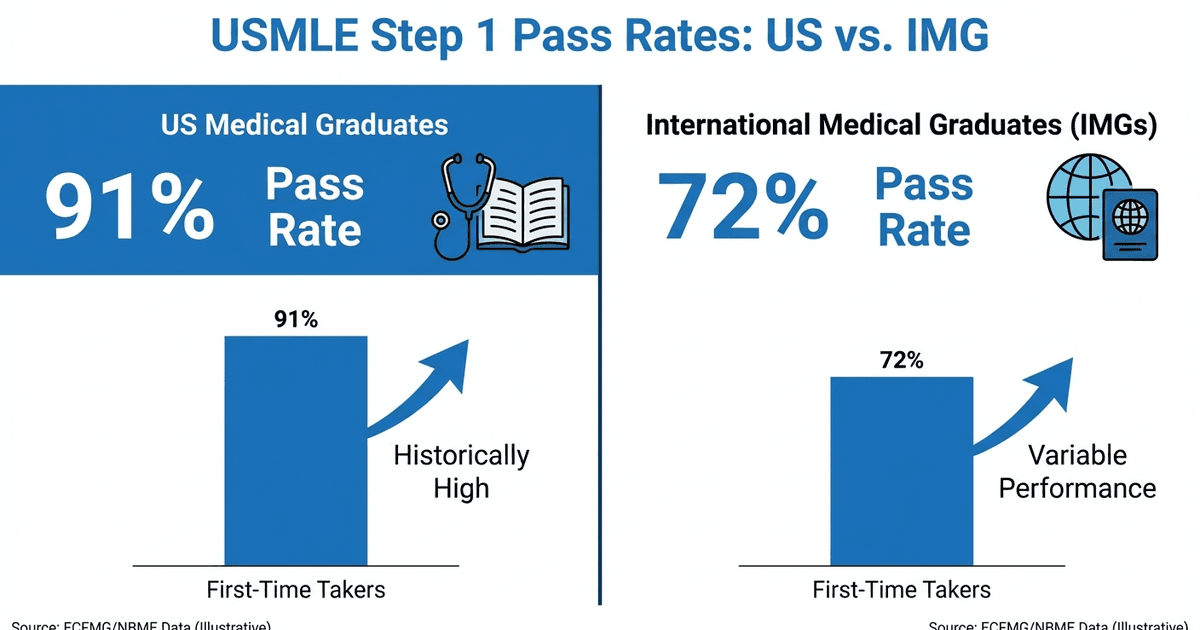
The gap between US medical graduates and International Medical Graduates (IMGs) remains significant in 2025: 91% of US MD students pass Step 1 compared to 72% of IMGs. That 19-percentage-point difference isnt random — it reflects preparation strategies, resource access, and test familiarity that you can control.
Even more stark: first-time IMG pass rates hit 75%, but repeaters drop to just 54%. Once you fail Step 1 as an IMG, your odds of passing on the second attempt become worse than a coin flip.
2025 USMLE Step 1 Pass Rate Data: The Complete Picture
US Medical Graduates (LCME-Accredited Schools)
Category | Examinees | Pass Rate |
|---|---|---|
Total US MD Schools | 25,126 | 91% |
First-time takers | 23,028 | 93% |
Repeat takers | 2,098 | 71% |
US Osteopathic Medical Schools (COCA-Accredited)
Category | Examinees | Pass Rate |
|---|---|---|
Total US DO Schools | 4,744 | 89% |
First-time takers | 4,623 | 89% |
Repeat takers | 121 | 79% |
International Medical Graduates (Non-US Schools)
Category | Examinees | Pass Rate |
|---|---|---|
Total Non-US IMGs | 25,660 | 72% |
First-time takers | 22,066 | 75% |
Repeat takers | 3,594 | 54% |
The total testing volume shows 55,530 candidates took Step 1 in 2025, with IMGs representing 46% of all test-takers. This makes Step 1 preparation a global competition where IMGs need every strategic advantage.
Three-Year Trend Analysis: How IMG Pass Rates Are Evolving
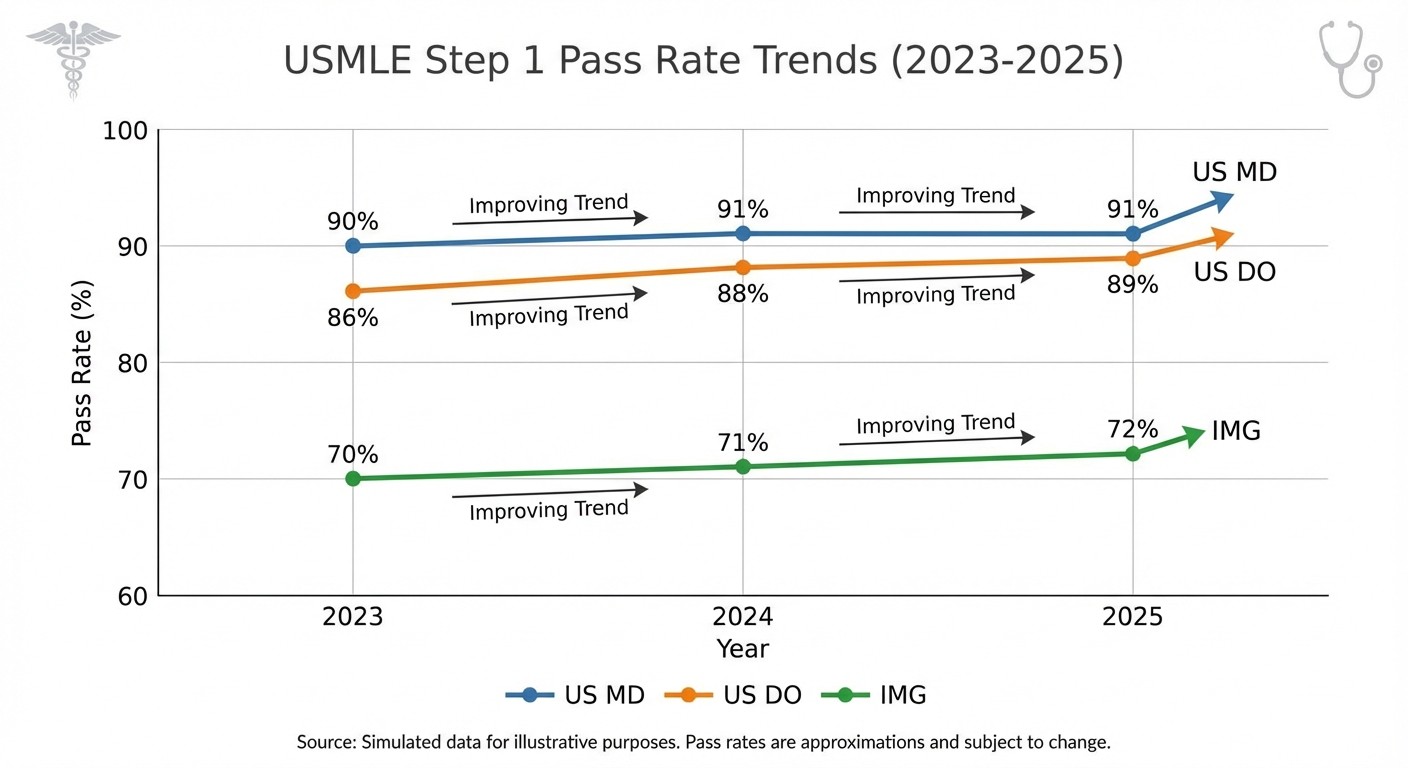
Year | US MD Pass Rate | US DO Pass Rate | IMG Pass Rate | IMG First-Time | IMG Repeat |
|---|---|---|---|---|---|
2023 | 90% | 86% | Not available | Not available | Not available |
2024 | 89% | 86% | 70% | 73% | 52% |
2025 | 91% | 89% | 72% | 75% | 54% |
The trend reveals good news for IMGs: pass rates improved 2 percentage points from 2024 to 2025 (70% to 72%). First-time IMG pass rates also increased from 73% to 75%. This improvement suggests that IMG preparation strategies are becoming more effective, possibly due to better access to US-style question banks and adaptive learning platforms.
However, the repeat taker numbers remain concerning. IMGs who failed their first attempt passed at only 54% in 2025, up slightly from 52% in 2024. This means nearly half of IMGs who retake Step 1 will fail again.
Why the 19-Point Gap Exists: US Medical Students vs IMGs
The persistent gap between US medical graduates (91%) and IMGs (72%) isnt about intelligence or medical knowledge. It reflects three key factors:
1. Clinical Reasoning Under Pressure
US medical students practice clinical vignettes throughout medical school. IMG curricula often emphasize factual recall over pattern recognition. Step 1 questions require you to eliminate wrong answers quickly and identify the most likely diagnosis or treatment within 90 seconds per question.
2. Question Bank Exposure Volume
Successful US students typically complete 3,000-4,000 practice questions during dedicated Step 1 prep. Many IMGs attempt the exam after completing only 1,500-2,000 questions. The difference shows in pattern recognition and timing.
3. Adaptive Learning vs Passive Review
US students increasingly use spaced repetition and adaptive question platforms that adjust difficulty based on performance. Traditional IMG preparation often relies on reading comprehensive textbooks and doing questions linearly rather than focusing on weak areas.
The Pass/Fail Format: What It Means for IMG Residency Chances
Step 1 became Pass/Fail in January 2022, fundamentally changing IMG strategy. Before this change, high Step 1 scores could compensate for other application weaknesses. Now, failing Step 1 creates a binary disadvantage.
For IMGs, the math is brutal:
Pass Step 1 + competitive Step 2 CK score = residency possible
Fail Step 1 = residency match rates drop below 30% in most specialties
This makes first-attempt success critical for IMGs. The 25% failure rate for first-time IMG test-takers represents thousands of medical careers derailed or significantly delayed each year.
Research programs and uncompetitive specialties may still consider IMGs with Step 1 failures, but the vast majority of residency programs use Step 1 pass/fail status as an initial screening filter.
What Correlates with Failing Step 1: The Data Behind the Numbers
Analysis of unsuccessful candidates reveals consistent patterns:
Inadequate Question Bank Practice
Failed candidates typically completed fewer than 2,000 practice questions. Successful IMGs average 3,500+ questions during their dedicated study period.
Weak Clinical Reasoning Skills
Step 1 questions test application of basic science knowledge to clinical scenarios. Students who focused primarily on memorizing facts without practicing clinical reasoning consistently underperformed.
Poor Time Management
Many failed candidates ran out of time on exam blocks. The 280-question exam requires sustained focus and efficient elimination of wrong answers.
Insufficient Simulated Testing Conditions
Successful candidates practiced full-length, timed exams regularly. Failed candidates often studied individual topics without simulating real exam pressure.
Limited Spaced Repetition
Failed candidates typically reviewed material once and moved on. Successful candidates used spaced repetition to ensure long-term retention of high-yield concepts.
How IMGs Can Maximize First-Attempt Pass Probability
Based on the statistical patterns of successful candidates, here are evidence-based preparation strategies:
Complete 3,500+ High-Quality Practice Questions
Successful IMGs consistently report completing at least 3,500 practice questions during dedicated Step 1 preparation. Focus on NBME-style questions that mirror actual exam format and difficulty.
Practice with adaptive question banks that adjust difficulty based on your performance. This mimics the actual exam's adaptive format and helps identify knowledge gaps efficiently.
Use Spaced Repetition for High-Yield Facts
Step 1 requires instant recall of thousands of medical facts under time pressure. Spaced repetition systems help move information from short-term to long-term memory.
Create digital flashcards for high-yield concepts and review them daily using algorithms that prioritize weaker areas.
Simulate Real Exam Conditions Weekly
Take full-length, 7-hour practice exams every week during your dedicated study period. This builds stamina and identifies timing issues before exam day.
Focus on Clinical Application, Not Pure Memorization
Every basic science concept you study should connect to a clinical scenario. Ask yourself: "How would this present as a patient case?" and "What would I need to rule out?"
Use AI Tutoring for Personalized Weak Area Focus
Modern preparation platforms use AI to identify your specific knowledge gaps and create personalized study plans. This is more efficient than following generic study schedules.
Oncourse AI provides adaptive learning that adjusts to your performance patterns, helping you focus study time on areas where you are most likely to gain points. The platform combines spaced repetition, clinical case practice, and AI explanations built specifically for medical licensing exams.
The Repeater Challenge: Why Second Attempts Have 54% Pass Rates
IMGs who failed their first Step 1 attempt face unique challenges:
Psychological Pressure: The knowledge that failure means another 6-12 month delay creates anxiety that interferes with performance. Knowledge Decay: The 90-day waiting period between attempts allows knowledge to fade, especially for memorized facts not reinforced through spaced repetition. Study Strategy Inertia: Many repeaters use the same preparation methods that led to initial failure instead of fundamentally changing their approach. Financial Stress: The additional costs of rescheduling, extended preparation time, and delayed residency applications create financial pressure. Content Updates: Medical knowledge evolves, and the question bank changes between attempts, requiring updates to preparation materials.
First-Time Success Strategy: The 6-Month Blueprint
Based on analysis of successful first-time IMG test-takers:
Months 1-2: Foundation Building
Complete comprehensive review of high-yield basic science topics
Begin question bank practice (target: 50 questions daily)
Start spaced repetition flashcard system
Months 3-4: Pattern Recognition Development
Increase to 100+ questions daily
Focus on clinical reasoning and differential diagnosis
Take weekly practice exams
Months 5-6: Exam Simulation and Weak Area Focus
Complete 150+ questions daily
Take practice exams under strict timing conditions
Use adaptive platforms to focus on remaining weak areas
Successful candidates report studying 8-10 hours daily during dedicated preparation, with 60% of time spent on questions and 40% on targeted review of missed concepts.
How the Data Should Inform Your Study Strategy
The pass rate statistics reveal clear patterns that should guide your preparation approach:
If you are a first-time test-taker: The 75% pass rate for first-time IMGs means your odds are favorable with proper preparation. Focus on question volume and clinical reasoning practice. If you are retaking Step 1: The 54% repeater pass rate demands a complete strategy overhaul. Identify what went wrong in your first attempt and fundamentally change your preparation approach. If you are comparing yourself to US students: The 19-percentage-point gap isnt insurmountable, but it requires acknowledging that you need more intensive preparation than the average US medical student.
Resource Allocation Based on Success Patterns
Successful IMGs consistently report this resource allocation during dedicated Step 1 prep:
60% Question Practice: High-quality NBME-style questions with detailed explanations
25% Targeted Content Review: Focused study of concepts from incorrect questions
10% Spaced Repetition Review: Daily flashcard review of high-yield facts
5% Full-Length Practice Exams: Weekly simulation of real exam conditions
This allocation differs significantly from traditional medical school study patterns that emphasize comprehensive reading followed by question practice.
Long-Term Implications: How Step 1 Performance Affects Residency Matching
While Step 1 is now Pass/Fail, the pass rate statistics have important implications for residency matching:
Step 2 CK Becomes Critical: With Step 1 Pass/Fail, Step 2 CK scores become the primary objective measure of medical knowledge. IMGs who struggle with Step 1 often face similar challenges with Step 2 CK. Program Confidence: Residency programs use Step 1 pass/fail status as a proxy for test-taking ability and persistence. Failing Step 1 raises questions about performance on board certification exams. Timeline Impact: Step 1 failures delay graduation and residency applications, creating gaps that programs view unfavorably.
The statistics suggest that Step 1 preparation intensity should match the stakes involved. For IMGs, passing Step 1 on the first attempt isnt just about licensing — it maintains momentum toward successful residency matching.
Frequently Asked Questions
What is the average USMLE Step 1 pass rate for IMGs in 2025?
The overall IMG pass rate for USMLE Step 1 in 2025 is 72%, with first-time test-takers achieving a 75% pass rate and repeat test-takers achieving a 54% pass rate.
How do IMG USMLE Step 1 pass rates compare to US medical students?
US MD students have a 91% Step 1 pass rate compared to 72% for IMGs — a 19-percentage-point difference. US DO students achieve an 89% pass rate.
What happens if you fail USMLE Step 1 as an IMG?
IMGs who fail Step 1 must wait 60 days before retaking the exam. Repeat test-takers have only a 54% pass rate, and failing Step 1 significantly reduces residency match chances across all specialties.
How many times can you take USMLE Step 1?
You can take USMLE Step 1 up to 6 times, but most residency programs strongly prefer candidates who passed on their first or second attempt. Multiple failures essentially eliminate residency prospects.
What is the best way to prepare for USMLE Step 1 as an IMG?
Successful IMGs complete 3,500+ practice questions, use spaced repetition for high-yield facts, take weekly full-length practice exams, and focus on clinical reasoning rather than pure memorization.
Has the USMLE Step 1 pass rate for IMGs improved over time?
Yes, IMG pass rates improved from 70% in 2024 to 72% in 2025, suggesting that preparation strategies are becoming more effective.
Prepare smarter with Oncourse AI — adaptive MCQs, spaced repetition, and AI explanations built for USMLE Step 1. Download free on Android and iOS.