Back
USMLE Step 2 CK Pass Rate Statistics 2025: Complete Breakdown for IMGs, US Grads and Repeaters
Official USMLE Step 2 CK pass rate data for 2025: 90% IMG first-time pass rate vs 64% repeat rate. Complete statistics breakdown by region, specialty scores, and strategic timing for IMGs.
USMLE Step 2 CK Pass Rate Statistics 2025: Complete Breakdown for IMGs, US Grads and Repeaters
You are probably staring at your USMLE Step 2 CK registration wondering: what are my actual odds? The internet is full of vague encouragement, but you need hard numbers. Here they are — straight from official USMLE data that most IMGs never see broken down this clearly.
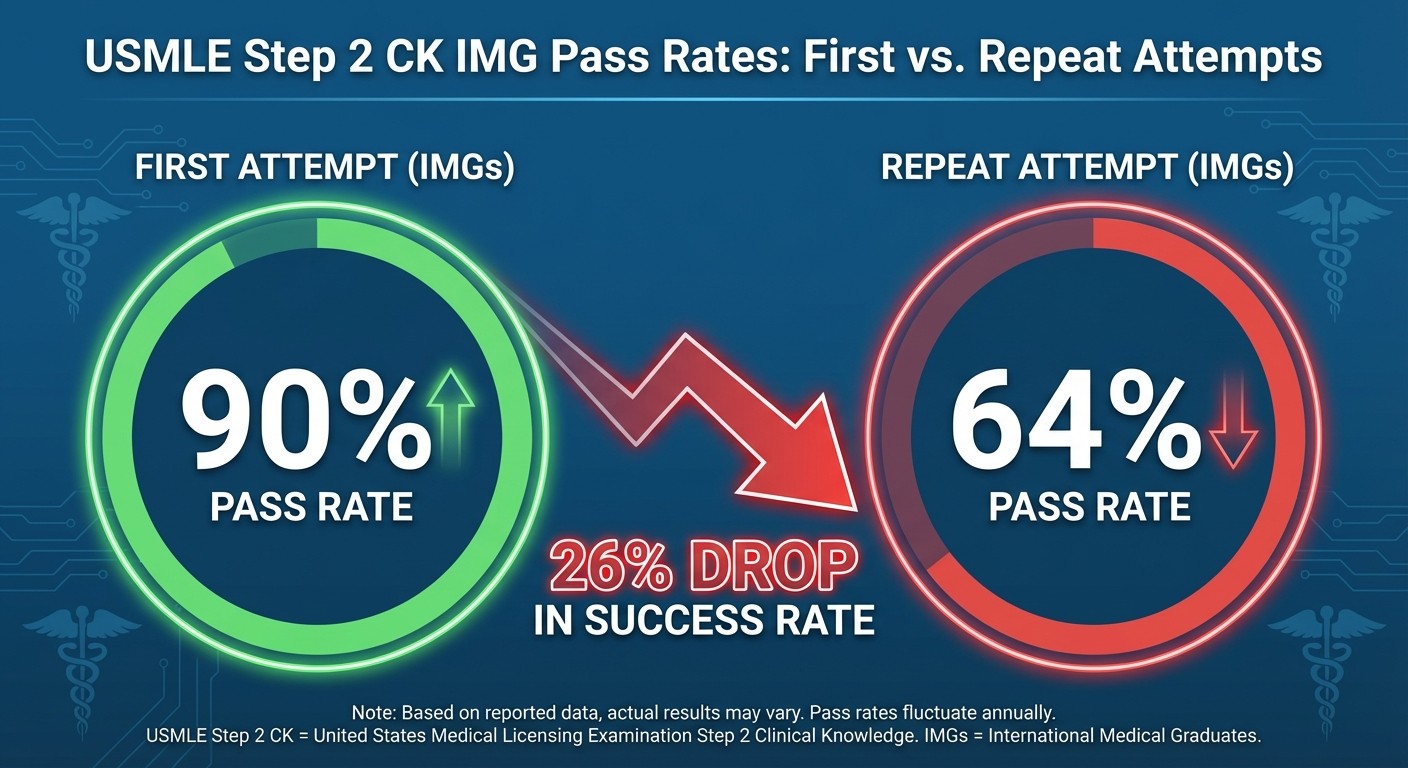
Step 2 CK pass rates reveal a harsh truth: your first attempt is everything. Miss it, and your chances drop from 90% to 64% as an IMG. But there's also good news buried in these numbers — IMG first-time pass rates are trending upward.
This is the complete statistical breakdown every IMG, Caribbean student, and repeat test-taker needs before deciding when and how to take Step 2 CK in 2025.
Official USMLE Step 2 CK Pass Rates: 2024-2025 Data
The United States Medical Licensing Examination (USMLE) releases annual performance data that reveals exactly how different groups perform on Step 2 CK. Here are the complete pass rate statistics for the most recent testing periods.
2024-2025 Testing Year Results
Group | Tested | Overall Pass Rate | First-Takers | First-Time Pass Rate | Repeaters | Repeat Pass Rate |
|---|---|---|---|---|---|---|
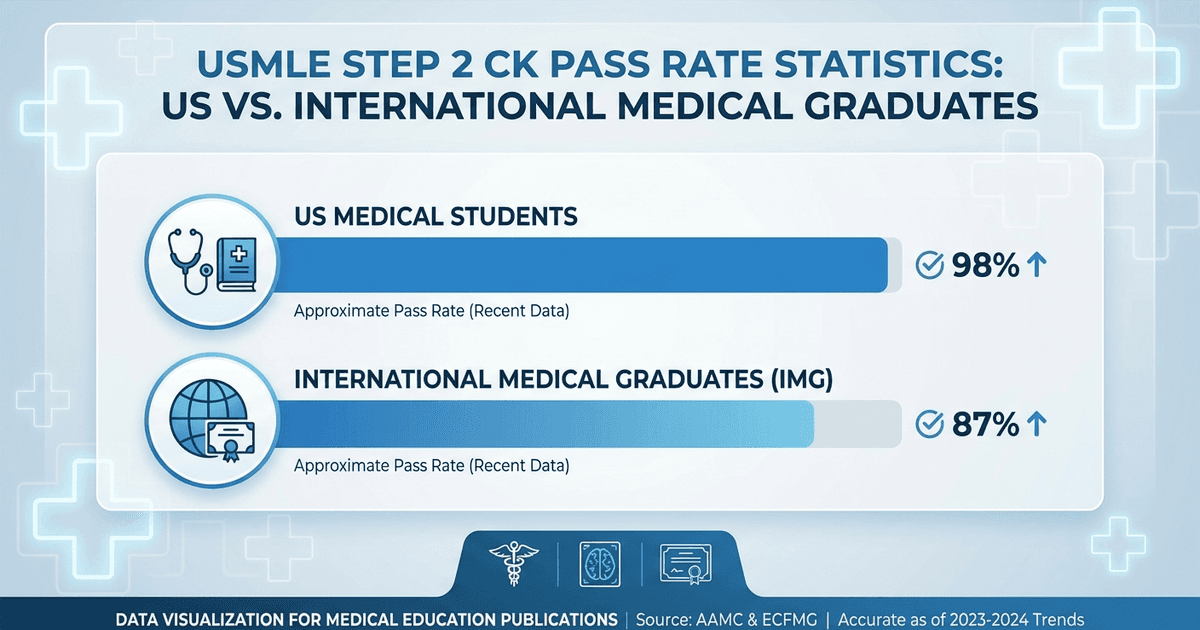
US MD Schools | 22,689 | 98% | 22,249 | 98% | 440 | 70% |
US DO Schools | 5,057 | 96% | 5,025 | 96% | 32 | 69% |
Total US Students | 27,746 | 97% | 27,274 | 98% | 472 | 70% |
Non-US IMGs | 17,948 | 87% | 16,186 | 90% | 1,762 | 64% |
Source: USMLE Performance Data, 2024-2025 Testing Year
Historical Comparison: 2023-2024 vs 2024-2025
Group | 2023-2024 Pass Rate | 2024-2025 Pass Rate | Change |
|---|---|---|---|
US MD Schools | 98% | 98% | No change |
US DO Schools | 96% | 96% | No change |
IMG First-Takers | 89% | 90% | +1% ✓ |
IMG Repeaters | 61% | 64% | +3% ✓ |
The trend is clear: IMG performance is improving, but the gap between first-time takers and repeaters remains substantial.
Why Step 2 CK Pass Rates Matter More Than Ever
Since January 2022, Step 1 became pass/fail. This fundamental change shifted the entire residency match landscape, making your Step 2 CK score the primary USMLE differentiator for IMGs.
The New Reality for IMG Match Success
Before Step 1 Pass/Fail (Pre-2022):
Step 1 score was the primary screening tool
Step 2 CK was often optional for many specialties
Pass rates mattered less than actual scores
After Step 1 Pass/Fail (2022-Present):
Step 2 CK score is now the main USMLE differentiator
Nearly all IMGs must take Step 2 CK for competitive applications
Both passing AND scoring high are critical for match success
This shift means the 87-90% IMG pass rate translates to 10-13% of IMGs being eliminated from residency consideration entirely if they fail Step 2 CK.
The First-Attempt Imperative: Why Repeating Is Catastrophic
The data reveals a brutal truth about Step 2 CK repeaters:
IMG Repeat Statistics That Should Terrify You
First attempt: 90% pass rate (16,186 out of 18,000+ took it for the first time)
Repeat attempt: 64% pass rate (only 1,127 out of 1,762 repeaters passed)
Statistical impact: Failing once drops your odds by 26 percentage points
Why Repeating Hurts Beyond Pass Rates
1. Application red flags: Program directors can see your attempt history
2. Delayed timeline: Each failure pushes your match year back
3. Financial burden: $1,630 per attempt adds up quickly
4. Psychological pressure: Confidence erodes with each failed attempt
5. Narrowed specialty options: Many competitive specialties avoid repeat test-takers
The message is clear: make your first Step 2 CK attempt count. The preparation investment is worth avoiding the repeat test-taker statistics.
Competitive Step 2 CK Score Targets by Specialty (2025)
Passing is the baseline — but what scores actually match? Based on NRMP Match Data and residency program surveys, here are the Step 2 CK score ranges IMGs need for competitive applications:
IMG-Friendly Specialties
Specialty | Competitive Score | Strong Score | Notes |
|---|---|---|---|
Internal Medicine | 240+ | 250+ | Most IMG-friendly, but competitive programs still want 245+ |
Family Medicine | 235+ | 245+ | Good IMG match rates with solid scores |
Psychiatry | 240+ | 250+ | Growing field, reasonable IMG opportunities |
Pediatrics | 245+ | 255+ | Slightly more competitive than IM |
Moderately Competitive Specialties
Specialty | Competitive Score | Strong Score | Notes |
|---|---|---|---|
Pathology | 250+ | 260+ | Numbers-driven specialty, score matters significantly |
Anesthesiology | 250+ | 260+ | Good IMG match rates with high scores |
Emergency Medicine | 255+ | 265+ | Increasingly competitive for IMGs |
Radiology | 255+ | 265+ | High Step 2 CK scores essential |
Highly Competitive Specialties
Specialty | Competitive Score | Strong Score | Notes |
|---|---|---|---|
Surgery (General) | 260+ | 270+ | Extremely competitive for IMGs |
Neurology | 255+ | 265+ | Research and connections crucial beyond scores |
Dermatology | 270+ | 280+ | Virtually impossible for most IMGs |
Ophthalmology | 270+ | 280+ | Step 2 CK score alone insufficient |
How These Scores Relate to Pass Rates
When 90% of IMG first-time takers pass, the passing score (around 209) captures most test-takers. But the score distribution shows:
50th percentile: ~245
75th percentile: ~260
90th percentile: ~275
This means even among the 90% who pass, only half score above 245 — which explains why many IMGs struggle to match despite passing all USMLE exams.
Regional and Demographic Breakdowns in Step 2 CK Performance
While official USMLE data doesnt break down IMG performance by region, medical education tracking organizations provide insights into performance patterns:
Top-Performing IMG Regions (Estimated Pass Rates)
1. European Medical Schools: ~93-95% first-time pass rate 2. Australian/Canadian IMGs: ~92-94% first-time pass rate 3. Indian Subcontinent (Premium Schools): ~88-92% first-time pass rate 4. Caribbean Schools (Big 4): ~85-90% first-time pass rate 5. Other Caribbean Schools: ~75-85% first-time pass rate 6. Middle East/Africa: ~80-88% first-time pass rate 7. Eastern Europe: ~82-90% first-time pass rate Note: These are estimates based on medical education databases, not official USMLE reporting
Factors Influencing Regional Performance Differences
English Language Proficiency: Schools with English-medium instruction show consistently higher pass rates. Clinical Exposure: IMGs from systems with extensive clinical rotations during medical school perform better on Step 2 CK's clinical scenarios. USMLE Preparation Culture: Regions with established USMLE prep infrastructure (coaching, study groups, previous test-taker networks) show improved performance. Step 1 Correlation: IMGs who score 230+ on Step 1 typically maintain strong Step 2 CK performance, regardless of region.
What High-Scoring IMGs Do Differently
Analyzing the 16,186 IMG first-time takers who achieved 90% pass rates (and presumably higher average scores), several preparation patterns emerge:
Timeline Strategy
18-month preparation window: The highest-scoring IMGs start Step 2 CK prep 6-8 months before their intended test date, not 3-4 months like average performers. Post-Step 1 gap: Top performers take 3-6 months between Step 1 and Step 2 CK, allowing clinical knowledge to mature rather than rushing into the next exam.
Content Mastery Approach
Clinical reasoning over memorization: High scorers focus on understanding diagnostic pathways rather than memorizing facts. Case-based practice: They solve 100+ clinical vignettes weekly, not just isolated MCQs. Weak area remediation: Instead of practicing their strong subjects, they spend 60% of study time on their lowest-scoring domains.
Resource Selection Patterns
Quality over quantity: High scorers use 2-3 comprehensive resources deeply rather than 5-6 resources superficially. Active learning tools: They prioritize adaptive question banks and AI-guided practice over passive video lectures. Performance tracking: Weekly assessment scores guide their study plan adjustments.
Prepare smarter with Oncourse AI USMLE prep — adaptive MCQs that identify your weak areas, spaced repetition flashcards, and Rezzy AI tutor for clinical reasoning practice. Our Clinical Rounds feature simulates real patient cases to build the diagnostic skills Step 2 CK tests.
When IMGs Should Take Step 2 CK: Strategic Timing
Your Step 2 CK timing affects both your score potential and match timeline. Here's the optimal schedule based on pass rate data and match statistics:
Ideal Timeline for IMG Match Success
12-18 months before match:
Complete Step 1 (aim for pass by this point)
Begin Step 2 CK content review
Focus on weak clinical areas identified in Step 1 prep
8-12 months before match:
Intensive Step 2 CK question practice (target: 3,000+ questions)
Take Step 2 CK when consistently scoring 250+ on practice tests
Apply this timeline puts your score in ERAS applications when they open
4-6 months before match:
Complete Step 2 CK with target score achieved
Begin ERAS application preparation
Consider Step 3 if applying to competitive specialties
Why Early Step 2 CK Helps Match Success
1. Score included in initial application: Program directors see your Step 2 CK score when reviewing your ERAS application
2. No rushed preparation: Adequate prep time increases your odds of joining the 90% first-time pass group
3. Retake buffer: If you dont hit your target score, you have time for one strategic retake
4. Step 3 possibility: Early Step 2 CK completion allows Step 3 before match (increasingly expected for competitive IMGs)
Red Flags: When NOT to Take Step 2 CK
The 10% IMG failure rate and 36% repeat failure rate come from predictable situations. Avoid taking Step 2 CK when:
Practice Score Red Flags
Consistently scoring below 220 on UWorld assessments
Large score variability (200-250 range on practice tests)
Failing NBMEs repeatedly
Less than 60% correct on timed, tutor mode practice
Preparation Red Flags
Less than 4 months of dedicated preparation
Haven't completed a full question bank (minimum 2,500 questions)
Weak clinical reasoning skills (struggling with multi-step diagnostic questions)
Recent Step 1 failure (take 6+ months to strengthen knowledge base)
Life Circumstance Red Flags
Major life changes during prep period
Financial pressure to pass immediately (leads to rushed preparation)
Less than 90% attendance during clinical rotations
Language barriers affecting clinical scenario comprehension
Remember: the 64% repeat pass rate means failing Step 2 CK puts you in a group where 1 in 3 never pass, even with additional attempts.
Step 2 CK Content Areas: Where IMGs Struggle Most
Official USMLE reporting reveals specific domains where IMG performance lags behind US graduates:
Lowest IMG Performance Areas
1. Biostatistics/Evidence-Based Medicine: 15-20% lower accuracy than US grads 2. US Healthcare System/Ethics: 12-18% lower accuracy 3. Pediatric Development/Behavioral: 10-15% lower accuracy 4. Geriatric Medicine: 8-12% lower accuracy 5. Emergency Medicine Procedures: 8-12% lower accuracy
Strongest IMG Performance Areas
1. Internal Medicine Subspecialties: Near-equal to US grads 2. Infectious Disease: Often outperform US grads 3. Cardiology: Strong performance, especially ECG interpretation 4. Endocrinology: Solid performance across most IMGs 5. Pharmacology: Generally strong, especially among Caribbean graduates
Strategy: Focus Your Weak Areas
Since the overall IMG pass rate is 87-90%, most failures come from consistently weak performance in 2-3 domains rather than across-the-board knowledge gaps. Identify your specific weak areas through practice testing and spend 60% of your study time there.
Use Oncourse's adaptive question engine to identify which domains need the most attention — our AI tracks your performance by subject and adjusts your question mix to focus on weak areas.
Financial Impact of Step 2 CK Performance
The pass rate statistics have direct financial implications for IMGs:
Cost of Failing Step 2 CK
Registration fee: $1,630 per attempt
Travel/accommodation: $500-2,000 per attempt (depending on location)
Opportunity cost: Delayed match = delayed residency salary (~$60,000/year)
Additional prep materials: $500-1,500 for repeat preparation
Total Cost of Multiple Attempts
Scenario | Total Cost | Timeline Impact |
|---|---|---|
Pass on first attempt | $2,130-3,630 | Match proceeds on schedule |
Fail once, pass on second | $4,260-7,260 | 6-month delay minimum |
Fail twice, pass on third | $6,390-10,890 | 12-month delay minimum |
Three failures | $8,520-14,520 | Often forces gap year or career change |
Given that 64% of repeat test-takers pass on their second attempt, 36% face the scenario of multiple failures and mounting costs.
Return on Investment: Quality Preparation
Investing $2,000-5,000 in comprehensive Step 2 CK preparation (premium question banks, tutoring, or AI-powered platforms) appears expensive until you consider the cost of failure. The 90% first-time pass rate among well-prepared IMGs makes this investment mathematically sound.
Step 2 CK vs Step 1: How Pass Rates Compare
Understanding the relationship between Step 1 and Step 2 CK performance helps predict your likelihood of success:
Pass Rate Comparison
Exam | US MD | US DO | IMG Overall | IMG First-Time |
|---|---|---|---|---|
Step 1 | 96% | 93% | 81% | 84% |
Step 2 CK | 98% | 96% | 87% | 90% |
Why Step 2 CK Pass Rates Are Higher
1. Self-selection: Only students who passed Step 1 attempt Step 2 CK
2. Better preparation: IMGs learn from Step 1 experience and prepare more systematically
3. Clinical focus: Many IMGs find clinical scenarios more intuitive than basic science
4. Timing: Step 2 CK follows clinical rotations, providing practical context
Step 1 to Step 2 CK Correlation for IMGs
If you passed Step 1 on first attempt: 92-95% chance of passing Step 2 CK on first attempt If you failed Step 1 once before passing: 85-88% chance of passing Step 2 CK on first attempt If you failed Step 1 multiple times: 75-80% chance of passing Step 2 CK on first attempt
This correlation reinforces why rebuilding your knowledge base after Step 1 struggles is crucial before attempting Step 2 CK.
Building Clinical Reasoning Skills for 240+ Scores
The difference between passing (209) and scoring competitively (240+) lies primarily in clinical reasoning ability. Here's how high-scoring IMGs develop these skills:
Active Case Analysis Method
Don't just answer questions — analyze them:
1. Identify the chief complaint and key symptoms
2. Generate a differential diagnosis before reading options
3. Determine what additional information would help narrow the diagnosis
4. Understand why wrong answers are wrong (not just why the right answer is right)
Pattern Recognition Development
High-yield diagnostic patterns IMGs must master:
Classic presentations of common conditions
Atypical presentations of serious conditions
Red flag symptoms requiring immediate action
Age-appropriate differential diagnoses
Cost-effective diagnostic approaches
Clinical Decision-Making Framework
Systematic approach to complex scenarios: 1. Stabilize: Address immediate life threats 2. Diagnose: Use most cost-effective approach 3. Treat: Evidence-based interventions 4. Follow-up: Appropriate monitoring and next steps
Practice this framework with Oncourse's Clinical Rounds, which simulates real patient encounters and builds the systematic thinking Step 2 CK rewards with high scores.
Frequently Asked Questions
What is a good Step 2 CK score for IMGs in 2025?
For most IMG-friendly specialties, aim for 240+ to be competitive and 250+ to be strong. Internal medicine and family medicine may accept 235+, while competitive specialties require 255-270+. Remember that 50% of test-takers score below 245, so crossing that threshold puts you in the upper half.
How many times can you take Step 2 CK?
USMLE allows up to 6 attempts per Step, but practically, more than 3 attempts makes residency matching extremely difficult. With repeat pass rates of 64%, most successful candidates pass within their first 2 attempts.
Should IMGs take Step 2 CK before or after Step 1?
Always take Step 1 first. Step 2 CK assumes you have the foundational knowledge tested in Step 1. Additionally, Step 1 performance helps predict Step 2 CK readiness — use your Step 1 experience to refine your preparation approach.
How long should IMGs study for Step 2 CK?
Plan for 4-8 months of preparation, depending on your clinical background. IMGs with extensive clinical experience may need 4-6 months, while those with limited patient exposure should plan for 6-8 months. The 90% first-time pass rate comes from adequate preparation time.
What happens if you fail Step 2 CK as an IMG?
You can retake the exam after a 60-day waiting period, but your chances drop to 64% on the repeat attempt. Most residency programs can see your attempt history, and some automatically filter out candidates with failures. Plan your preparation carefully to avoid this scenario.
Is 6 months enough to prepare for Step 2 CK?
Six months is adequate for most IMGs if you study systematically and have completed clinical rotations. However, if you struggled with Step 1 or have limited clinical experience, consider 8 months of preparation. The investment in preparation time pays off in the 90% first-time pass rate among well-prepared candidates.
---
The USMLE Step 2 CK pass rate statistics tell a clear story: first-time preparation matters enormously. With 90% of well-prepared IMGs passing on their first attempt and only 64% succeeding as repeaters, your initial preparation strategy determines not just whether you pass, but your entire residency timeline.
Use these statistics to make informed decisions about when to take Step 2 CK, how long to prepare, and what scores to target for your specialty. The data shows improvement is possible — IMG first-time pass rates increased from 89% to 90% year-over-year, proving that strategic preparation works.
Prepare smarter with Oncourse AI — adaptive MCQs, spaced repetition, and AI explanations built for USMLE success. Download free on Android and iOS.