Back
UKMLA Exam Pattern 2026: AKT Format, Question Types, Scoring System and What to Expect on Exam Day
Complete breakdown of UKMLA AKT exam structure for 2026: 200 SBA questions, 3-hour format, competency domains, criterion-referenced scoring, and practical exam day logistics for IMGs.

UKMLA Exam Pattern 2026: AKT Format, Question Types, Scoring System and What to Expect on Exam Day
You are probably staring at your UKMLA study timeline, wondering what exactly you've signed up for. The UK Medical Licensing Assessment replaced PLAB in 2024, and as an IMG planning your 2026 attempt, you need clarity on this unfamiliar territory.
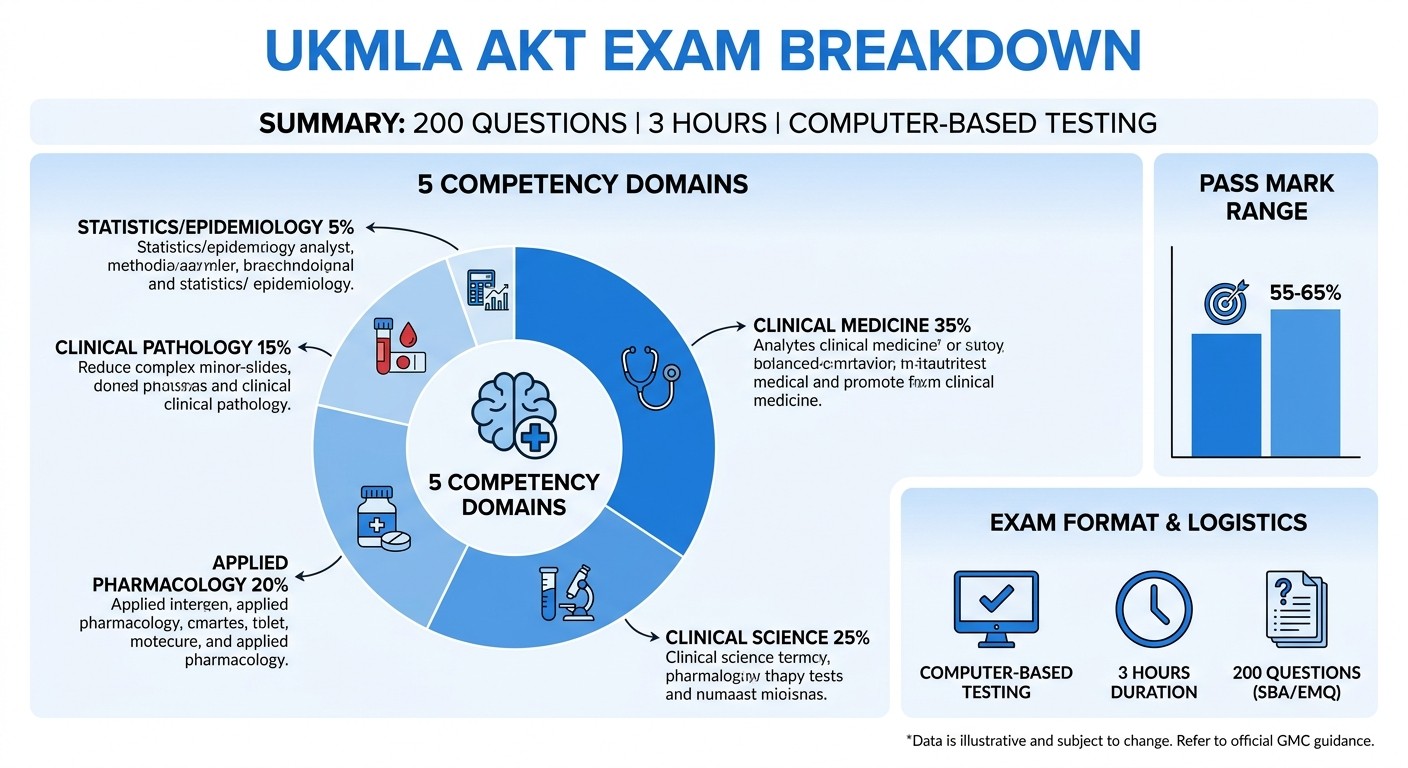
Here's what matters: UKMLA consists of approximately 200 single best answer (SBA) questions spread across 3 hours. The stakes are high — this determines your path to GMC registration and Foundation Programme entry. But understanding the exact format, competency domains, and exam-day logistics removes the anxiety of the unknown.
The Applied Knowledge Test (AKT) isn't just another MCQ exam. It tests clinical reasoning at Foundation Year 2 level, demanding you apply knowledge to real patient scenarios rather than recall isolated facts. This comprehensive breakdown covers everything from question types to pass marks, so you can walk into that Pearson VUE center with confidence.
Understanding UKMLA Structure and Components
The UKMLA operates as a two-part licensing assessment replacing the traditional PLAB pathway. Both components must be passed for GMC registration.
Applied Knowledge Test (AKT): Computer-based examination testing clinical knowledge and reasoning through 200 SBA questions over 3 hours. Clinical and Professional Skills Assessment (CPSA): OSCE-style practical examination with 18 stations, each lasting 8 minutes, held at the GMC assessment center in Manchester.
For IMGs, the examination pathway effectively mirrors PLAB 1 and PLAB 2, but with content aligned to the updated Medical Licensing Assessment content map. The exam maintains the same booking system through Pearson VUE centers worldwide.
UKMLA vs PLAB: Key Differences for IMGs
While booking systems may still display "PLAB" terminology during the transition period, the content has been fully aligned with UKMLA standards since August 2024. The core difference lies in clinical expectations and reasoning depth.
PLAB traditionally focused on factual recall with shorter clinical vignettes. UKMLA demands higher-order thinking, presenting longer case scenarios that test differential diagnosis, clinical reasoning, and evidence-based management at Foundation Programme level.
The pass validity remains unchanged — your PLAB 1 pass (if obtained) remains valid for PLAB 2/CPSA entry.
AKT Exam Format and Structure
Question Count and Duration
The AKT contains approximately 200 single best answer questions to be completed in 3 hours (180 minutes). This translates to roughly 54 seconds per question — significantly tighter than most medical exams.
Each question follows the standard SBA format: clinical vignette followed by a question stem and five answer options. You must select the single most appropriate response.
Question Types and Clinical Scenarios
Questions are structured around clinical presentations rather than disease-based classification. Instead of "What is the treatment for pneumonia?", expect "A 67-year-old presents with acute breathlessness and productive cough. Temperature 38.2°C, oxygen saturation 89% on room air. What is your immediate management priority?"
Vignette characteristics:
3-5 sentence clinical scenarios
Real patient presentations with multiple clinical clues
Integration of history, examination, and investigation findings
Age, demographic, and social context included where relevant
Emphasis on clinical reasoning over pattern recognition
Common question stems:
"What is the most appropriate next step?"
"Which investigation would be most helpful?"
"What is the most likely diagnosis?"
"Which management approach is most suitable?"
"What advice should be given to this patient?"
Practice with Oncourse's adaptive question bank helps you master this format — the spaced-repetition engine identifies weak Foundation-level clinical reasoning areas and surfaces relevant scenarios until you develop pattern recognition speed.
UKMLA Competency Domains and Content Areas
The AKT tests knowledge across five core competency areas mapped to Foundation Programme requirements:
1. Clinical Science (Approximately 25% of questions)
Anatomy, physiology, and pathophysiology
Pharmacokinetics and pharmacodynamics
Applied basic science in clinical contexts
Disease mechanisms and progression
2. Applied Pharmacology (Approximately 20% of questions)
Drug interactions and contraindications
Dosing calculations and adjustments
Adverse effects and monitoring
Therapeutic drug monitoring
Prescribing safety and errors
3. Clinical Medicine (Approximately 35% of questions)
History taking and clinical examination
Differential diagnosis and clinical reasoning
Investigation interpretation
Evidence-based management
Emergency presentations and red flags
4. Clinical Pathology (Approximately 15% of questions)
Laboratory test interpretation
Histopathology and cytology basics
Microbiology and infection control
Hematology parameters and abnormalities
Biochemical markers in disease
5. Statistics and Epidemiology (Approximately 5% of questions)
Study design and interpretation
Statistical significance and confidence intervals
Screening and diagnostic tests
Public health measures
Evidence-based medicine principles
Scoring System and Pass Mark Determination
Criterion-Referenced Scoring
UKMLA uses criterion-referenced scoring, not norm-referenced. Your performance is measured against a predetermined standard, not ranked against other candidates. This means the pass mark remains consistent regardless of how well or poorly other candidates perform.
Standard Setting Process
The pass mark is determined through the Angoff method:
Subject matter experts review each question
They estimate the percentage of minimally competent Foundation Year doctors who would answer correctly
These percentages are averaged to create the overall pass threshold
Historical data and statistical analysis refine the final cut-score
Typical pass marks range from 55-65%, varying by exam difficulty. The exact threshold is not published until after the examination.
Score Reporting and Results Timeline
Results are typically released 6-8 weeks after the examination date. You receive:
Overall pass/fail decision
Performance breakdown by competency domain
Percentile ranking (for passed candidates)
Detailed feedback for failed attempts
Failed candidates receive diagnostic information showing performance in each competency area to guide focused restudy.
Exam Day Logistics and What to Expect
Before the Exam
Arrival time: 30 minutes before your scheduled start time Required documents:
Valid passport or national ID
GMC booking confirmation
English language proficiency evidence (if required)
Prohibited items: Mobile phones, smartwatches, bags, notes, calculators, food, or drinks (water may be provided) What to bring: Only yourself and required identification documents
At the Test Center
Check-in process:
1. Document verification and photograph
2. Biometric enrollment (fingerprint/palm scan)
3. Security screening and locker assignment
4. Orientation to computer interface
Test environment:
Individual computer workstations with privacy screens
Standardized lighting and temperature control
Noise-canceling headphones available on request
Basic calculator function available in software
Use Oncourse's timed mock exams to familiarize yourself with this 3-hour format — each mock produces domain-by-domain breakdowns showing which competency areas need attention before your actual exam day.
During the Exam
Time management strategies:
Aim for 45-60 seconds per question initially
Mark uncertain questions for review
Leave 15-20 minutes for final review
Don't spend more than 2 minutes on any single question
Navigation features:
Question palette showing answered/unanswered status
Flag system for questions requiring review
Previous/Next buttons for sequential navigation
Submit function available anytime after completion
Technical support: Raise your hand for any computer issues — time will be paused during technical problems.
Preparing for UKMLA Success
Study Timeline Recommendations
6-month preparation: 2-3 hours daily focused study 3-month intensive: 4-6 hours daily with structured revision plan 1-month crash course: 8-10 hours daily (not recommended for first attempts)
Evidence-Based Study Techniques
Research shows active recall outperforms passive reading by 300% for medical exam retention. Focus your preparation on:
Spaced repetition practice questions rather than repeated textbook reading Timed mock examinations simulating real exam conditions Clinical vignette analysis developing systematic reasoning approaches
Track your progress with Oncourse's performance analytics — the dashboard maps scores to UKMLA competency domains, providing data-driven insights into readiness and helping prioritize final weeks of preparation.
High-Yield Preparation Areas
Based on competency weighting and past examination patterns:
Clinical Medicine (35% of marks):
Acute medical presentations
NICE guideline management pathways
Red flag recognition and escalation
Differential diagnosis methodology
Clinical Science (25% of marks):
Cardiovascular physiology and pathology
Respiratory mechanics and gas exchange
Endocrine feedback mechanisms
Renal function and acid-base balance
Applied Pharmacology (20% of marks):
Drug interactions and contraindications
Adverse effect profiles
Prescribing calculations
Therapeutic monitoring
Technical Requirements and Accessibility
Computer Skills Required
Basic computer literacy suffices:
Mouse navigation and clicking
Reading text on screen for 3 hours
Using dropdown menus and radio buttons
Scrolling through questions and options
Accessibility Accommodations
The GMC provides reasonable adjustments for candidates with:
Visual impairments (screen readers, magnification)
Hearing impairments (written instructions)
Learning disabilities (extra time, separate room)
Physical disabilities (ergonomic equipment)
Applications for accommodations must be submitted at least 6 weeks before the exam with supporting medical documentation.
Common Mistakes and How to Avoid Them
Time Management Errors
Mistake: Spending too long on difficult questions early in the exam Solution: Use the 90-second rule — if unsure after 90 seconds, flag and move on Mistake: Rushing through the final 50 questions Solution: Maintain steady pace throughout, reserving 20 minutes for review
Clinical Reasoning Pitfalls
Mistake: Choosing the "most correct" answer instead of "most appropriate next step" Solution: Focus on question stem requirements — next step, immediate management, first-line treatment Mistake: Overthinking straightforward presentations Solution: Trust initial clinical instincts for common presentations
Content Gaps
Mistake: Focusing only on hospital medicine Solution: Include primary care, emergency medicine, and public health topics Mistake: Memorizing facts without understanding application Solution: Practice clinical vignettes requiring knowledge synthesis
What Happens If You Don't Pass
Immediate Steps After Results
Failed candidates should:
1. Review performance breakdown by competency domain
2. Identify weakest areas requiring focused study
3. Plan minimum 6-week gap before reattempt (GMC requirement)
4. Register for next available sitting — seats fill quickly
Reattempt Strategy
Diagnostic analysis: Use failure breakdown to create targeted study plan Focused revision: Allocate 70% of study time to weak domains, 30% to maintaining strong areas Practice emphasis: Increase question volume in failed competency areas Maximum attempts: While no official limit exists, most candidates pass within 3-4 attempts. Consider professional guidance after two failures.
Impact on Career Timeline
Failed UKMLA attempts delay:
GMC registration and F1 entry
Specialist training applications
Overall career progression
Plan examination attempts carefully, allowing adequate preparation time rather than rushing into reattempts.
Booking Your UKMLA Exam
Exam Dates and Availability
UKMLA sittings typically occur:
March: Registration opens December-January
June: Registration opens March-April
October: Registration opens July-August
Specific dates vary yearly and are announced on the GMC website approximately 6 months in advance.
Prerequisites for Booking
Before booking, ensure you have:
GMC Online account created and verified
English language evidence: IELTS Academic (7.5 overall, 7.0 each band) or OET Medicine (Grade B all sections)
Primary Medical Qualification verified through EPIC system
Required documentation uploaded and approved
Booking Process
1. Log into GMC Online account
2. Select examination type (UKMLA AKT)
3. Choose preferred test center and available date
4. Complete payment (approximately £280-300)
5. Receive booking confirmation via email
6. Note exam details and required documentation
Costs and Payment Options
AKT exam fee: £270-300 (varies by year) CPSA exam fee: £980-1,000 (separate booking after AKT pass) Total pathway cost: Approximately £1,250-1,300
From April 2026, staged payment options allow splitting costs across two installments.
Frequently Asked Questions
How many questions are on the UKMLA AKT?
The UKMLA AKT contains approximately 200 single best answer questions to be completed in 3 hours.
What's the pass mark for UKMLA AKT?
The pass mark is set through standard setting and typically ranges from 55-65%, varying by exam difficulty. The exact threshold isn't published until after the examination.
How is UKMLA different from PLAB 1?
UKMLA uses longer clinical vignettes requiring higher-order clinical reasoning rather than factual recall. Content aligns with Foundation Programme competencies and emphasizes evidence-based management.
Can I use a calculator during the exam?
A basic calculator function is available within the computer software. External calculators are not permitted.
When are UKMLA results released?
Results are typically released 6-8 weeks after the examination date, with detailed performance breakdown by competency domain.
How many times can I attempt UKMLA?
There's no official limit, but most candidates pass within 3-4 attempts. Consider professional guidance after multiple failures.
Prepare smarter with Oncourse AI — adaptive MCQs, spaced repetition, and AI explanations built for UKMLA success. Download free on Android and iOS.