Back
Desirable Difficulties in Medical Study: Why Making Learning Harder Makes You Score Higher
Discover why challenging study methods outperform easy ones for USMLE success. Learn Robert Bjork's desirable difficulties framework and apply it to your medical exam preparation for better retention and higher scores.

Desirable Difficulties in Medical Study: Why Making Learning Harder Makes You Score Higher
You are probably cramming through practice questions right now, feeling good when you cruise through easy blocks, and frustrated when you hit tough stretches. Here is what your intuition gets wrong: that frustration is not a bug in your study system — it is the entire point.
USMLE Step 1 has 280 questions across 8 hours. Step 2 CK throws 318 questions at you over 9 hours. You have roughly 90 seconds per question to synthesize years of medical knowledge into a single correct answer. The students who score highest are not the ones who feel most confident during study. They are the ones who deliberately seek out struggle during practice and make their learning harder, not easier.
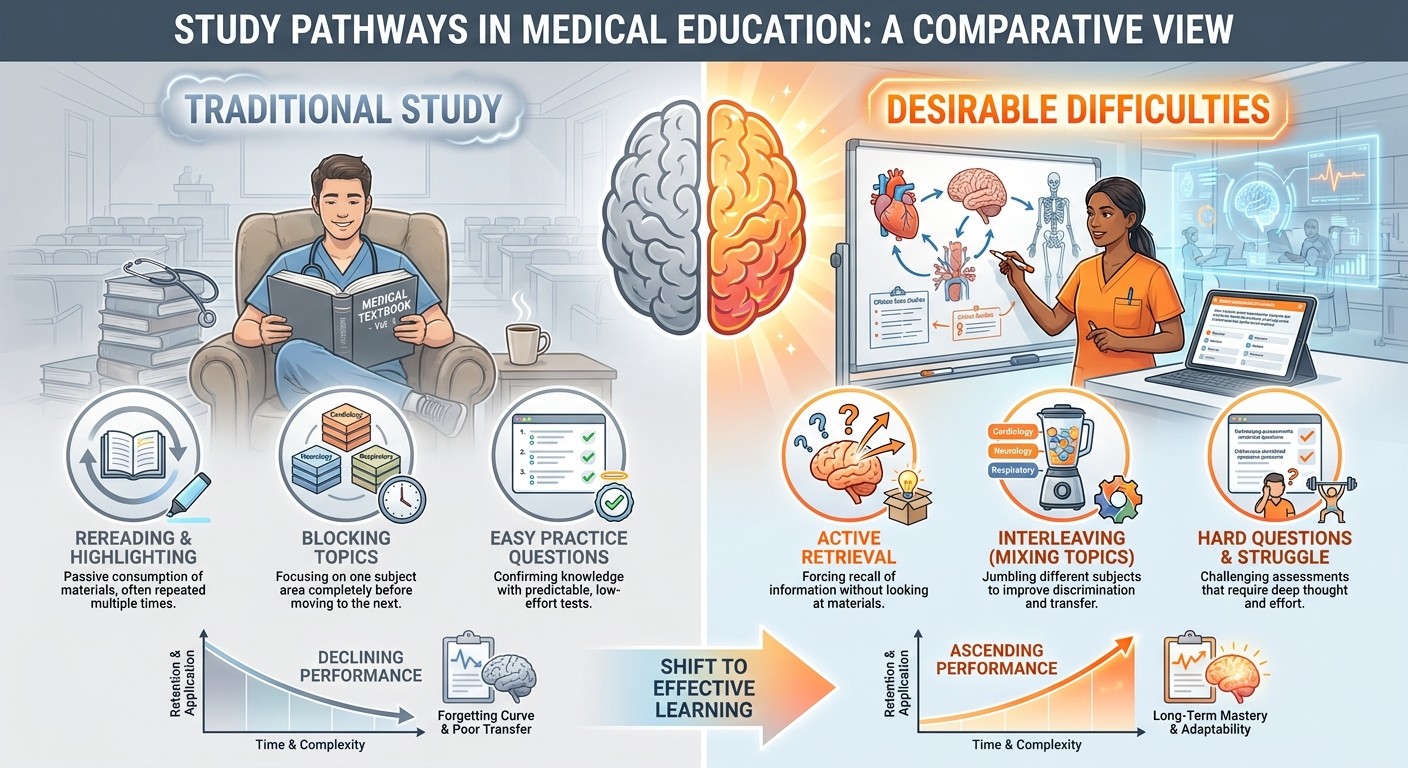
This is desirable difficulties — the counterintuitive finding from cognitive psychology that challenging study conditions create stronger, more durable memories than easy ones. When UCLA psychologist Robert Bjork first described this phenomenon, he upended decades of assumptions about effective learning. The research is now unequivocal: strategies that feel effortful and frustrating during study produce superior long-term retention and transfer compared to methods that feel smooth and confidence-building.
For USMLE preparation, this changes everything about how you should approach question banks, review sessions, and knowledge retention. The students who understand desirable difficulties do not just study harder — they study in ways that contradict their instincts and optimize for exam day performance over daily comfort.
Why Easy Practice Creates the Illusion of Competence
Most medical students fall into the same trap: they mistake performance during study for actual learning. You read through a pathophysiology chapter and it clicks immediately. You answer 15 cardiology questions in a row correctly. Your confidence soars — you have mastered this topic.
Then exam day arrives, and the knowledge evaporates.
This is what Bjork calls the "illusion of competence." When information flows easily during study, your brain interprets this fluency as evidence of strong memory. But fluency during study and retrieval under test conditions are completely different cognitive processes.
Here is why this illusion devastates USMLE performance:
Reading comprehension is not recall. When you review notes with the answers in front of you, you are exercising recognition, not retrieval. Your brain can recognize the correct pathophysiology pathway while being unable to reconstruct it from memory. On the USMLE, no one gives you the answer choices first. Context-dependent learning misleads. When you study in your familiar environment with your notes, textbooks, and unlimited time, your brain encodes these environmental cues along with the medical content. During the actual exam — different room, time pressure, stress — these retrieval cues disappear. Your knowledge was more dependent on context than you realized. Immediate feedback inflates confidence. When you get a practice question wrong and immediately read the explanation, you often think "Oh, I knew that." This immediate clarification creates a false sense of understanding. You mistake temporary comprehension for durable retention.
The research on this is stark. Studies of medical students show that learners consistently overestimate their performance on upcoming exams after smooth, easy study sessions. Conversely, students who struggle during study — but stick with challenging retrieval practices — show the greatest improvement from pre-test to post-test performance.
The Science Behind Desirable Difficulties
Desirable difficulties work because they force your brain to work harder during encoding and retrieval, creating more robust and accessible memories. Bjork identified four core mechanisms that make learning "desirably difficult":
Spaced Repetition: The Power of Strategic Forgetting
Traditional medical school wisdom says to review material immediately after learning it. Bjork is research shows this is backward. Optimal retention occurs when you review material just as you are beginning to forget it — typically after a delay of days or weeks, not minutes or hours.
When you space out your reviews, each retrieval attempt requires more mental effort because the memory trace has weakened. This effort strengthens the memory pathway more than easy, immediate retrieval. For USMLE preparation, this means reviewing cardiology concepts one week after your initial study, not the same day.
Oncourse automatically adjusts question difficulty based on your performance, creating the optimal level of desirable difficulty for each user. Instead of staying comfortable with topics you already know, the system pushes you into productive struggle zones where long-term retention is maximized.
Retrieval Practice: Testing as Learning
Most students use practice questions to assess their knowledge. This completely misses the point. Testing is not just evaluation — it is one of the most powerful learning strategies available.
When you actively retrieve information from memory — rather than simply reviewing it — you strengthen the neural pathways that make that information accessible later. Every time you recall a mechanism, pathway, or clinical finding without looking at notes, you are making that knowledge more likely to surface during your actual exam.
The retrieval effect is dose-dependent. Multiple retrieval attempts produce better long-term retention than a single intensive study session, even when total study time is identical. For USMLE preparation, this means self-quizzing on microbiology mechanisms is more effective than re-reading your microbiology review book.
Interleaved Practice: Learning Through Contrast
Block practice — studying one topic for extended periods — feels efficient and builds confidence quickly. You work through 50 cardiology questions in a row, get into a rhythm, and feel mastery building. This is exactly the wrong approach for USMLE success.
Interleaved practice mixes different topics or question types within the same session. Instead of 50 cardiology questions, you rotate between cardiology, pulmonology, and nephrology every few questions. This feels chaotic and frustrating. Your performance during practice drops. But your performance on delayed tests — which better simulate actual exam conditions — improves dramatically.
Unlike static topic blocks, Oncourse mixes subjects and systems within a session, implementing interleaving that forces retrieval across domains and better mirrors the real USMLE exam format.
Interleaving works because it forces your brain to actively discriminate between concepts rather than falling into automatic patterns. On the USMLE, you never know if the next question will test cardiac pathology, pulmonary physiology, or renal pharmacology. Interleaved practice prepares you for this cognitive flexibility in a way that blocked practice cannot.
Varied Practice Conditions
Studying in identical conditions every day creates context-dependent learning that fails to transfer to the exam environment. Desirable difficulties research shows that varying your study conditions — location, time of day, question format, even your mental state — produces more robust and transferable learning.
For USMLE preparation, this means intentionally changing your study environment, mixing timed and untimed blocks, and practicing questions when you are slightly tired or stressed. These variations force your brain to encode information in multiple ways, making it accessible under the actual testing conditions you will face.
Applying Desirable Difficulties to USMLE Preparation
The research is clear, but implementation requires overriding your study instincts. Here is how to build desirable difficulties into your USMLE preparation:
Question Bank Strategy
Most students approach question banks backward. They start with easier questions to build confidence, study topics in blocks, and avoid challenging material until they feel "ready." This optimizes for comfort during study while undermining performance on test day.
A desirable difficulties approach flips these assumptions:
Start with mixed, timed blocks from day one. Even if you are only getting 40% correct initially, the retrieval practice is building the neural pathways you will need later. Your early performance is not predictive of your final score — your learning trajectory is. Prioritize questions you get wrong. Easy questions that you answer correctly provide minimal learning benefit. Questions that challenge you — especially those you get wrong for conceptual rather than factual reasons — create the most learning. Use your question bank analytics to identify and repeatedly practice your weakest areas. Review explanations with delay. Instead of immediately reading the explanation after each question, complete an entire block first. This prevents you from using the explanation as a crutch and forces genuine retrieval during each question.
Review and Retention Methods
Traditional review methods — re-reading notes, highlighting textbooks, watching lectures repeatedly — feel productive but create minimal long-term retention. Desirable difficulties approaches prioritize active retrieval:
Self-quizzing without cues. Instead of reviewing your notes on renal physiology, close the book and try to explain the renin-angiotensin system from memory. Only check your notes after you have exhausted your ability to retrieve the information. Teach-back method. Regularly explain concepts to study partners or even to yourself out loud. If you cannot clearly explain the pathophysiology of heart failure without notes, you do not understand it well enough for the USMLE. Spaced review schedules. Use tools like the Leitner system or algorithms built into platforms like Oncourse to schedule review sessions at expanding intervals. Review cardiology concepts 1 day after initial learning, then 3 days, then 1 week, then 2 weeks.
Performance Analytics on Oncourse tracks your accuracy patterns over time, helping you identify where you are experiencing the illusion of competence (high confidence, low accuracy) vs. genuine mastery — directly tied to the desirable difficulties research on metacognition and calibration.
Managing Cognitive Load and Difficulty
Desirable difficulties are only beneficial when the difficulty level matches your current knowledge base. Too much difficulty becomes unproductive and overwhelming. Too little difficulty provides insufficient learning benefit.
Progressive difficulty scaling. Start with moderately challenging questions and gradually increase difficulty as your knowledge base expands. If you are consistently scoring below 30% on practice blocks, the difficulty may be too high to provide learning benefits. Error pattern analysis. Track whether your mistakes stem from knowledge gaps, reasoning errors, or test-taking strategy issues. Knowledge gaps require content review; reasoning errors require more practice with similar question types; strategy issues require timing and approach adjustments. Strategic struggle zones. Aim for practice question performance in the 60-75% range during study. This indicates that you are working in the optimal difficulty zone — challenging enough to promote learning without becoming discouraging.
The Neuroscience of Struggle and Memory
Recent neuroscience research illuminates why desirable difficulties are so effective for medical learning. When your brain encounters easy, familiar information, it relies primarily on automatic processing systems that require minimal cognitive effort. These systems are efficient but create shallow, context-dependent memories.
Challenging retrieval conditions activate the prefrontal cortex and hippocampus more intensively, creating stronger and more elaborate memory traces. The effort required to reconstruct information from partial cues builds more robust neural pathways than simply recognizing correct answers.
This has direct implications for USMLE performance. The exam requires you to synthesize information across multiple medical disciplines, integrate clinical and basic science knowledge, and apply concepts to novel scenarios. These cognitive demands mirror the conditions created by desirable difficulties during study.
When you practice retrieval under challenging conditions — time pressure, mixed topics, incomplete information — you are training the same neural systems that will activate during your actual exam. Easy practice conditions do not engage these systems sufficiently, leaving you unprepared for the cognitive demands of test day.
Common Mistakes in Implementing Desirable Difficulties
Understanding the concept is different from applying it effectively. Here are the most common errors that undermine desirable difficulties approaches:
Abandoning Strategies Too Early
Desirable difficulties feel counterproductive initially. Your practice scores may drop when you switch from blocked to interleaved practice. Your confidence decreases when you attempt retrieval without cues. Many students interpret this as evidence that the approach is not working and revert to easier methods.
This initial performance drop is not a sign of failure — it is evidence that you are engaging different learning systems that will pay dividends later. Research consistently shows that learners who persist through this uncomfortable transition period show superior long-term retention and transfer.
Confusing Difficulty with Confusion
Not all difficulties are desirable. Poorly written questions, unclear explanations, and overwhelming cognitive load impede rather than enhance learning. Desirable difficulties should challenge your retrieval and application abilities without creating unnecessary confusion about content or format.
Choose question banks and study materials that provide appropriate challenge levels with clear, educational explanations. The difficulty should come from the cognitive effort required to access and apply your knowledge, not from ambiguous or poorly constructed materials.
Neglecting Foundation Building
Desirable difficulties are most effective when applied to information you have some familiarity with. If you attempt challenging retrieval practice on completely unfamiliar material, the cognitive load becomes unproductive.
Build a foundation of basic knowledge through initial content review, then apply desirable difficulties strategies for retention and application. This typically means spending your first few weeks of USMLE preparation on content acquisition, then transitioning to retrieval-focused practice methods.
Advanced Applications for High Performers
Students targeting high USMLE scores can leverage additional desirable difficulties strategies:
Dual N-Back Training
Some evidence suggests that working memory training through tasks like dual n-back can enhance the cognitive control systems that benefit from desirable difficulties. While not specific to medical content, these exercises may improve your ability to manage cognitive load during challenging retrieval practice.
Mnemonics and Elaborative Encoding
Counter-intuitively, creating your own mnemonics and memory devices requires desirable effort during encoding that enhances later retrieval. Rather than memorizing pre-made mnemonics, develop your own memory systems for high-yield information. The cognitive effort required to create these connections strengthens the memory traces more than passive memorization.
The Synapses feature on Oncourse helps students create and review personalized mnemonics through spaced repetition, turning the effort of mnemonic creation into a retrieval practice opportunity.
Meta-cognitive Training
Advanced learners can apply desirable difficulties to their study strategy itself. Regularly assess your confidence in different topics, then preferentially focus study time on areas where your confidence exceeds your actual performance. This meta-cognitive approach prevents overconfidence from undermining your preparation.
Research Evidence from Medical Education
Multiple studies in medical education contexts have validated desirable difficulties approaches:
A randomized controlled trial with internal medicine residents found that spaced retrieval practice improved diagnostic accuracy by 23% compared to traditional review methods. The effect was maintained at 6-month follow-up, suggesting genuine learning rather than temporary improvement.
Research on radiology training showed that interleaved practice with different imaging modalities produced better diagnostic accuracy than blocked practice, even though learners expressed less confidence in the interleaved condition during training.
A meta-analysis of medical education interventions found that retrieval-based learning strategies produced effect sizes of 0.5-0.8 for knowledge retention, compared to 0.2-0.3 for traditional lecture and review-based approaches.
These studies consistently demonstrate that desirable difficulties are not just laboratory curiosities — they translate to real improvements in clinical knowledge and reasoning.
Implementation Timeline for USMLE Preparation
Here is a practical timeline for incorporating desirable difficulties into your USMLE study schedule:
Weeks 1-3: Foundation Phase
Focus on content acquisition through high-yield resources
Begin incorporating retrieval practice through end-of-chapter self-quizzing
Start building spaced repetition habits with basic facts and mechanisms
Weeks 4-8: Integration Phase
Transition to mixed-topic question blocks
Implement interleaved study sessions across different organ systems
Begin using delayed review of question explanations
Weeks 9-12: Application Phase
Increase question difficulty and time pressure
Focus on error pattern analysis and targeted review
Emphasize retrieval practice for previously learned material
Final 2 weeks: Consolidation Phase
Maintain spaced review schedule for high-yield topics
Practice under full exam conditions
Continue retrieval practice but avoid learning completely new material
Frequently Asked Questions
How do I know if desirable difficulties are working for my USMLE prep?
Track your performance on practice questions over time, not just day-to-day scores. Desirable difficulties should produce gradually improving trends on mixed-topic blocks, even if daily performance feels inconsistent. Look for improvements in your ability to handle questions on topics you studied weeks ago — this indicates genuine retention rather than short-term memorization.
Should I use desirable difficulties if Im already struggling with basic concepts?
Build a foundation first. Desirable difficulties are most effective when you have some familiarity with the material. If you are consistently scoring below 30% on basic questions, focus on content acquisition before implementing challenging retrieval practices. Once you can achieve 40-50% on practice questions, begin incorporating desirable difficulties strategies.
How much should my practice scores drop when I implement desirable difficulties?
Expect an initial drop of 10-20% when transitioning from blocked to interleaved practice or from easy to challenging questions. This drop should be temporary — within 2-3 weeks, your scores should return to previous levels and then continue improving. If scores dont recover after a month, reassess whether the difficulty level is appropriate for your knowledge base.
Can desirable difficulties help with USMLE Step 2 CK preparation?
Absolutely. Step 2 CK requires even more integration across clinical disciplines than Step 1. Interleaved practice mixing internal medicine, surgery, pediatrics, and other specialties directly mirrors the exam format. The clinical reasoning required for Step 2 CK also benefits from retrieval practice under challenging conditions.
How do I balance desirable difficulties with maintaining motivation?
Set appropriate expectations. Desirable difficulties feel harder because they are harder — this is not a sign that you are doing something wrong. Track your long-term progress rather than daily performance. Consider study partners or communities where you can discuss the temporary discomfort of effective learning strategies.
What if my question bank doesnt support interleaved practice?
Create your own interleaving by manually selecting questions from different topics within each study session. Many question banks allow custom quizzes — use this feature to mix organ systems, medical specialties, or basic science and clinical topics. The key is avoiding long blocks of identical question types.
The research on desirable difficulties represents one of the most robust findings in learning science. For USMLE preparation, implementing these strategies requires overriding your intuitions about effective study, but the payoff is substantial and measurable. Students who embrace productive struggle during study consistently outperform those who prioritize comfort and confidence building.
Your brain is designed to learn from challenges, not from easy repetition. Make your study sessions harder, and make your exam scores higher.
Prepare smarter with Oncourse AI — adaptive MCQs, spaced repetition, and AI explanations built for USMLE success. Download free on Android and iOS.