Back
UKMLA Preparation 2026: Complete Study Guide for AKT, SJT and Clinical Assessment
Master the UKMLA 2026 with this complete study guide covering AKT, SJT, and Clinical Assessment. Includes realistic timelines, high-yield topics, and proven study strategies.
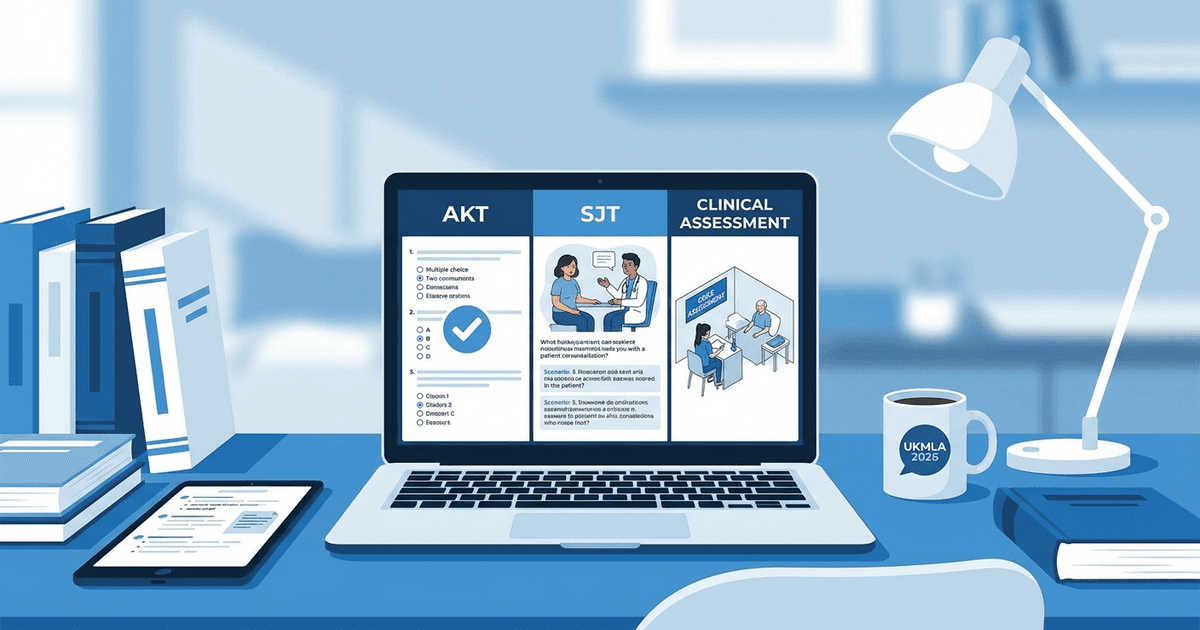
UKMLA Preparation 2026: Complete Study Guide for AKT, SJT and Clinical Assessment
You are probably staring at the UKMLA requirement and thinking: "180 AKT questions in 3 hours, 18 CPSA stations, plus an SJT component — where do I even start?"
Here's what you need to know upfront: the UKMLA 2026 isnt just another exam. Its the single gateway to UK medical practice, combining what used to be separate pathways into one unified assessment. The content map expanded from 311 to 430 core conditions this year, and questions now test clinical reasoning over rote recall.
But heres the thing — students who pass consistently follow a specific pattern. They dont just study harder; they study the three components differently. The AKT needs retrieval practice and pattern recognition. The SJT requires ethical frameworks and UK-specific professional standards. The Clinical Assessment demands structured communication and examination skills.
This guide breaks down exactly how to tackle each component with realistic timelines, high-yield topics, and a study plan that actually works across all three assessments.
What is the UKMLA? The 2026 Format Breakdown
The UK Medical Licensing Assessment replaced both UK medical school finals and the PLAB pathway. Every doctor entering UK practice must pass it — no exceptions.
Three core components:
Component | Format | Duration | Purpose |
|---|---|---|---|
AKT (Applied Knowledge Test) | 180 single-best-answer MCQs | 3 hours | Tests clinical knowledge and reasoning |
SJT (Situational Judgement Test) | Scenario-based questions | Integrated | Assesses professional behavior and ethics |
CPSA (Clinical Assessment) | 18 OSCE stations | 144 minutes | Evaluates practical skills and communication |
The entire exam maps to the MLA Content Map, which lists 430 core conditions across 15 clinical domains. Unlike previous years, any condition can now appear in any clinical context — they removed the rigid mapping grid. Key 2026 updates:
Expanded content from 311 to 430 conditions
New emphasis on transgender health, genetics, updated sepsis guidelines
Questions focus on clinical presentations (like "breathlessness") rather than isolated diseases
Greater integration between knowledge application and professional capabilities
UKMLA Study Timeline: How Long Do You Really Need?
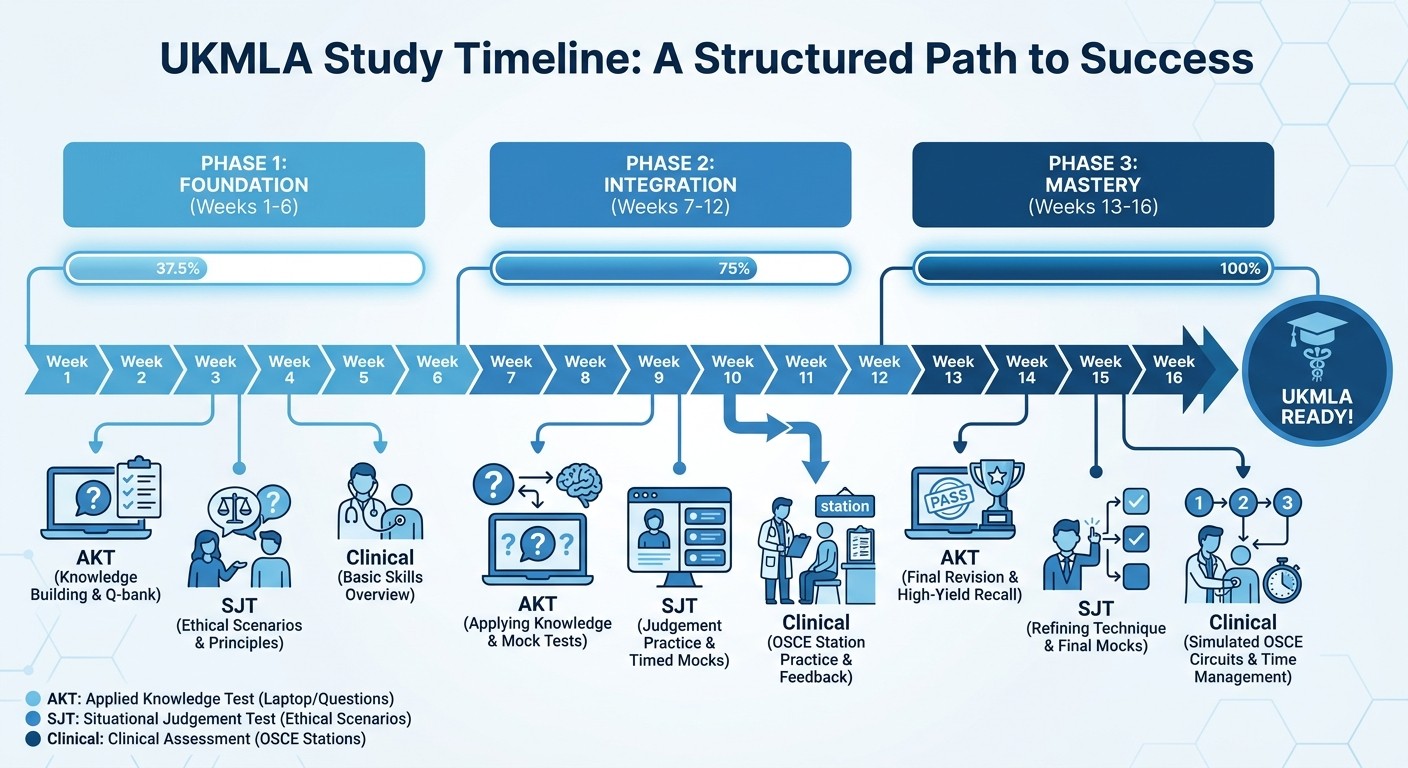
Most successful candidates follow a 12-16 week intensive preparation period. Heres the realistic breakdown:
Minimum viable timeline: 12 weeks
Weeks 1-4: Foundation building across all 15 clinical domains
Weeks 5-8: Intensive practice with mixed AKT/SJT scenarios
Weeks 9-12: CPSA skills practice plus exam simulation
Optimal timeline: 16-20 weeks
Additional 4-8 weeks allows deeper coverage of the 430 conditions
More time for CPSA station practice with feedback
Buffer for weak areas identified during mock exams
Extended timeline: 6+ months
Common for IMGs transitioning to UK clinical frameworks
Allows gradual integration of NICE guidelines and UK-specific pathways
Time to develop communication skills in UK healthcare context
Oncourse adaptive MCQ engine helps you identify weak AKT topics faster by adjusting difficulty based on your performance. Start with a diagnostic set, let the engine surface gaps, then focus on targeted topic blocks rather than broad review.
AKT Preparation: Applied Knowledge Test Strategy
The AKT tests your ability to apply clinical knowledge to patient scenarios, not memorize facts. Here's how to approach it systematically.
High-Yield AKT Domains (by frequency and impact)
Tier 1 - Core domains (40% of questions):
Cardiovascular: ACS, heart failure, arrhythmias, hypertension
Respiratory: Asthma, COPD, pneumonia, PE, pleural disease
Gastroenterology: GI bleeding, IBD, liver disease, peptic ulcer disease
Neurology & Psychiatry: Stroke, epilepsy, headaches, depression, anxiety
Tier 2 - Essential domains (35% of questions):
Endocrine: Diabetes, thyroid disorders, adrenal disease
Renal & Urology: AKI, CKD, UTIs, stone disease
Infectious Diseases: Sepsis, pneumonia, meningitis, antimicrobial stewardship
Women's Health: Pregnancy complications, contraception, menstrual disorders
Tier 3 - Specialist domains (25% of questions):
Dermatology: Common rashes, skin cancer, inflammatory conditions
Ophthalmology: Red eye, visual loss, diabetic retinopathy
ENT: Hearing loss, vertigo, throat infections
Musculoskeletal: Joint pain, back pain, fracture management
AKT Study Method: The 70/30 Split
70% focused practice on your weakest domains (identified through diagnostic testing) 30% mixed practice across all domains to maintain breadth
Daily routine that works:
1. Morning (60-90 minutes): 40-50 focused questions from your weakest domain
2. Afternoon (45 minutes): 20-25 mixed questions across all domains
3. Evening (30 minutes): Review incorrect answers and update weak topic list
SJT and AKT content overlaps significantly in professional behavior scenarios. SJT questions often embed clinical knowledge, while AKT questions test professional judgement within clinical vignettes.
AKT Common Pitfalls to Avoid
Pitfall 1: Memorizing non-UK guidelines Many candidates waste time learning American or other national protocols. The AKT tests UK-specific pathways from NICE, BNF, and Royal College guidelines. Pitfall 2: Focusing on rare conditions
With 430 conditions on the map, its tempting to study everything equally. Focus on common presentations first — 80% of questions test the top 100 conditions.
Pitfall 3: Ignoring clinical reasoning
AKT questions present long vignettes requiring you to identify the most appropriate next step. Practice applying guidelines to patient care, not just recalling facts.
Pitfall 4: Poor time management
180 questions in 180 minutes means 60 seconds per question. If youre spending 90+ seconds reading vignettes, you need targeted practice with timed blocks.
For weak areas surfaced by practice questions, Oncourse spaced repetition schedules reviews at optimal intervals so high-yield material sticks for exam day rather than fading after initial study.
SJT Preparation: Situational Judgement Test Mastery
The SJT component integrates with both AKT and CPSA, testing your professional judgement in healthcare scenarios. Unlike clinical knowledge, SJT has specific frameworks that work consistently.
SJT Core Frameworks
The Professional Hierarchy (for delegation/escalation questions):
1. Patient safety comes first, always
2. Seek help when uncertain
3. Escalate appropriately through proper channels
4. Document everything
5. Reflect and learn from incidents
The Communication Framework (for difficult conversations): 1. Listen actively and acknowledge concerns 2. Explain using clear, jargon-free language 3. Check understanding and invite questions 4. Support with resources and follow-up 5. Document the interaction The Ethical Decision-Making Model: 1. Identify the ethical issue and stakeholders 2. Consider relevant principles (autonomy, beneficence, non-maleficence, justice) 3. Explore options and consequences 4. Choose the most appropriate action 5. Evaluate outcomes and learn
High-Yield SJT Scenarios
Patient Safety Situations (30% of SJT questions):
Medication errors and near misses
Safeguarding concerns (child protection, domestic violence)
Capacity assessment and consent issues
Breaking bad news appropriately
Professional Relationships (25% of SJT questions):
Conflict with colleagues or seniors
Whistleblowing and raising concerns
Team communication breakdowns
Professional boundaries with patients
Resource Management (20% of SJT questions):
Time management and prioritization
Appropriate use of investigations
Cost-effective prescribing
Managing workload and stress
Legal and Regulatory (25% of SJT questions):
GMC Good Medical Practice principles
Confidentiality and information sharing
Consent for treatment and procedures
Professional development and revalidation
SJT Practice Strategy
Daily SJT practice (20-30 minutes): 1. Read the scenario carefully, identifying key ethical issues 2. Apply the relevant framework before looking at options 3. Rank options from most to least appropriate 4. Review explanations, focusing on the reasoning behind rankings 5. Note any UK-specific professional standards you missed
The key insight: SJT questions have consistent patterns. Once you recognize the framework being tested, the correct ranking becomes predictable.
Clinical Assessment (CPSA): OSCE Station Mastery
The Clinical and Professional Skills Assessment tests practical skills through 18 stations, each lasting 8 minutes. Success depends on structure and consistency, not just clinical knowledge.
CPSA Station Types and Distribution
History Taking Stations (4-5 stations):
Presenting complaint and history of presenting illness
Systems review and risk factor assessment
Social history and impact on daily living
Communication skills and rapport building
Physical Examination Stations (4-5 stations):
Cardiovascular, respiratory, abdominal, neurological examinations
Joint examination and functional assessment
ENT, ophthalmology, and dermatology focused exams
Interpretation of findings and differential diagnosis
Practical Procedures (2-3 stations):
Venepuncture, cannulation, urinalysis
Peak flow, blood pressure measurement
Basic life support and emergency scenarios
Prescription writing and medication counselling
Communication Skills (3-4 stations):
Breaking bad news and discussing prognosis
Obtaining informed consent for procedures
Explaining diagnoses and treatment options
Addressing patient concerns and anxieties
Professional Skills (2-3 stations):
Safeguarding and capacity assessment
Data interpretation (ECGs, X-rays, blood results)
Clinical reasoning and management planning
Team communication and handover skills
CPSA Success Framework: SOLER Method
For every patient interaction, use the SOLER structure:
S - Sit at eye level, maintain appropriate eye contact O - Open posture, avoid crossed arms or defensive positions L - Lean in slightly to show engagement and interest E - Eye contact balanced with note-taking and observation R - Relax and let the patient speak without interruption
CPSA Common Mistakes
Mistake 1: Rushing through checklists
Examiners want to see fluid, patient-centered communication, not mechanical checklist completion. Practice until techniques feel natural.
Mistake 2: Poor time management
8 minutes per station isnt long. Practice with a timer until you can complete core tasks in 6-7 minutes, leaving buffer time.
Mistake 3: Inadequate communication skills
Many candidates excel at clinical knowledge but struggle with empathy, active listening, and patient-centered communication.
Mistake 4: Insufficient practice with real people Reading about communication skills isnt enough. Practice with colleagues, friends, or standardized patients regularly.
Track AKT vs SJT performance separately using Oncourse performance analytics dashboard — see which clinical domains need attention and measure week-over-week improvement to allocate study hours for highest return.
Integrated Study Plan: 16-Week UKMLA Preparation
This plan integrates all three components while respecting their different learning requirements.
Weeks 1-4: Foundation Phase
Daily schedule (6-7 hours total):
Morning (2 hours): AKT domain study + 30 targeted questions
Midday (1 hour): SJT scenarios + framework practice
Afternoon (2 hours): Clinical skills practice (history/examination)
Evening (1 hour): Spaced repetition review of weak topics
Weekly targets:
Week 1: Cardiovascular + Respiratory (AKT), Patient safety scenarios (SJT), History taking skills (CPSA)
Week 2: GI + Neurology (AKT), Communication ethics (SJT), CVS examination (CPSA)
Week 3: Endocrine + Renal (AKT), Professional relationships (SJT), Respiratory examination (CPSA)
Week 4: Infectious diseases + Psychiatry (AKT), Resource management (SJT), Abdominal examination (CPSA)
Weeks 5-8: Integration Phase
Daily schedule (7-8 hours total):
Morning (2.5 hours): 60-80 mixed AKT questions across all domains
Midday (1 hour): Integrated AKT/SJT scenarios
Afternoon (2.5 hours): Full CPSA station practice with timing
Evening (1.5 hours): Review sessions focusing on weak areas
Weekly targets:
Week 5: Mixed practice across top 8 domains, communication skills stations
Week 6: Specialty domains (Derm, ENT, Ophthalmology), practical procedures
Week 7: First full-length mock exams for all components
Week 8: Targeted remediation based on mock results
Weeks 9-12: Consolidation Phase
Daily schedule (8-9 hours total):
Morning (3 hours): Full AKT simulation blocks (60 questions in 60 minutes)
Midday (1 hour): High-yield SJT scenarios and difficult cases
Afternoon (3 hours): Complete CPSA circuits (6-8 stations)
Evening (1.5 hours): Weak area remediation and spaced review
Weekly targets:
Week 9: Focus on weakest 3 AKT domains, challenging communication scenarios
Week 10: Full mock exam simulation for all components
Week 11: Final knowledge gaps remediation, stress management techniques
Week 12: Light review, final mock, rest and preparation for exam day
Weeks 13-16: Mastery Phase (Optional Extension)
For candidates wanting extra preparation or those with significant knowledge gaps:
Daily schedule (6-7 hours total):
Morning (2.5 hours): Maintenance practice (40-50 questions daily)
Afternoon (2 hours): Advanced CPSA scenarios and edge cases
Evening (1.5 hours): Professional development and UK healthcare system knowledge
High-Yield Resources for UKMLA 2026
Essential References
MLA Content Map: Your primary syllabus — every topic you study should map back to this
NICE Guidelines: UK-specific management pathways for common conditions
BNF (British National Formulary): Prescribing guidance and drug interactions
GMC Good Medical Practice: Professional standards framework for SJT preparation
Digital Resources
Oncourse UKMLA Preparation: Adaptive question bank aligned to the 2026 content map with performance analytics
UK General Practice questions: Practice questions covering chronic disease management and primary care scenarios
Clinical interview techniques lessons: Communication skills development for CPSA stations
Question Banks and Practice Materials
Passmedicine: Comprehensive SBA question bank with detailed explanations
Quesmed: Modern platform with integrated notes and spaced repetition
BMJ OnExamination: Official BMJ question bank with case-based scenarios
Frequently Asked Questions
How long should I spend preparing for UKMLA 2026?
Most successful candidates prepare for 12-16 weeks intensively. If youre transitioning from non-UK training, consider 16-20 weeks to adapt to UK clinical frameworks and guidelines. The key is consistent daily practice rather than cramming.
What's the difference between UKMLA and PLAB?
UKMLA is the updated, unified assessment that replaced PLAB for international graduates and UK medical school finals. The content is now identical for both pathways, using the same 430-condition content map and testing standards.
Can I take AKT and CPSA separately?
Yes, you can sit the components at different times, but both must be passed within a certain timeframe for GMC registration. Most candidates prefer to take them close together to maintain momentum and avoid restudying.
What happens if I fail one component?
You can resit individual components without repeating the entire assessment. Most candidates have up to 4 attempts per component, but check current GMC regulations as policies may change.
How important is the SJT component?
SJT is integrated throughout the assessment rather than being a separate section. Professional judgement scenarios appear in both AKT questions and CPSA stations, making it essential rather than optional.
What's the pass rate for UKMLA 2026?
Pass rates vary by sitting and candidate background, typically ranging from 60-75% for first-time takers. The 2026 format expansion may initially lower pass rates as candidates adjust to the broader content scope.
Prepare smarter with Oncourse AI — adaptive MCQs, spaced repetition, and AI explanations built for UKMLA success. Download free on Android and iOS.