Back
USMLE Step 2 CK Prep Course 2026: How to Choose the Right One and Structure Your Study Plan
Complete guide to selecting the best USMLE Step 2 CK prep course for 2026. Learn what features matter, avoid common mistakes, and get proven 8-12 week study plans.

USMLE Step 2 CK Prep Course 2026: How to Choose the Right One and Structure Your Study Plan
You are 8 weeks out from Step 2 CK. You know you need a solid prep course, but staring at UWorld vs AMBOSS vs Kaplan comparisons feels overwhelming. Every Reddit thread says something different. Every senior resident has their own "secret formula."
Here is what actually matters: Step 2 CK isnt Step 1. Clinical vignettes test pattern recognition and next-step thinking, not memorized pathways. The prep course you choose needs to match that reality — adaptive questions that get harder as you improve, analytics that show exactly where your clinical reasoning breaks down, and a study plan that builds diagnostic confidence week by week.
In this guide, we will break down what separates effective Step 2 CK prep courses from expensive question dumps, then give you a proven 8-12 week study framework you can start using today.
What Makes a Step 2 CK Prep Course Actually Work
The passing score increased to 218 in July 2025. Generic question banks wont cut it anymore. You need a course built around four core components that directly impact your clinical decision-making speed and accuracy.
1. Adaptive Question Bank Quality
Your prep course needs a question bank that adjusts to your performance in real-time. Static difficulty curves teach you to answer easy questions confidently and panic on hard ones — exactly the wrong skill set for an exam where question difficulty varies unpredictably.
Look for these features:
4,000+ questions minimum across all Step 2 CK domains (Internal Medicine, Surgery, Pediatrics, OB/GYN, Psychiatry, Preventive Medicine)
Dynamic difficulty adjustment that pushes harder questions when you demonstrate mastery of a topic area
Clinical vignette style that mirrors real NBME formatting, not multiple-choice trivia
The best courses use your accuracy trends to predict which question types you should see next. When you consistently nail cardiology diagnosis questions, the system should automatically serve you more complex cardiology management scenarios. This accelerates mastery without wasting time on content you already know.
For students drilling clinical reasoning, Oncourse's adaptive question bank dynamically adjusts question difficulty based on performance — students drilling Step 2 CK topics get harder questions as they improve, accelerating mastery in high-yield clinical vignette areas like Medicine, Surgery, OB/GYN, and Pediatrics. This unlocks a new study path: targeted weak-subject drilling without wasting time on already-mastered content.
2. Explanation Depth and Clinical Reasoning
Step 2 CK explanations need to teach you how attending physicians think through cases, not just why option C is correct. The difference is massive for exam performance and residency preparation.
Effective explanations include:
Differential diagnosis frameworks that walk through the logical process of ruling in and out similar conditions
Next-step reasoning that explains why certain diagnostic tests or treatments are chosen over alternatives
Visual learning aids including imaging, ECGs, lab values, and clinical photos relevant to the condition
High-yield clinical pearls that help you recognize patterns faster on future questions
Weak explanations just state the answer. Strong explanations change how you approach similar clinical scenarios. When reviewing a heart failure question, you should learn the systematic approach to dyspnea evaluation, not just memorize that "BNP is elevated in heart failure."
3. Performance Analytics That Drive Decisions
Generic "you got 73% correct" feedback is useless. You need analytics that tell you exactly where your clinical reasoning breaks down and which systems need immediate attention.
Essential analytics features:
Subject-level performance tracking with trend lines over weeks of study
System-based breakdowns (cardiovascular, respiratory, GI, etc.) that align with how Step 2 CK is actually organized
Question type analysis showing whether you struggle more with diagnosis, management, or next-step questions
Comparative benchmarking against other students at similar preparation stages
Real-time performance data eliminates guesswork. Instead of "feeling weak" in surgery, you can see that your surgical diagnosis accuracy is 67% while your surgical management accuracy is 84%. That specific insight shapes exactly how you spend your remaining study weeks.
Oncourse's performance analytics dashboard provides real-time breakdown of accuracy by subject, system, and question type. Students preparing for Step 2 CK can instantly see which clinical domains need the most work and how their trend lines move over weeks — replacing guesswork with data-driven prioritization.
4. Integration with Study Planning and Scheduling
The best prep courses dont just give you questions — they help you build a sustainable daily study routine that adapts to your clinical schedule and target exam date.
Look for:
Automated study plan generation based on your baseline performance and target exam date
Daily question targets that account for time available and weak areas identified through analytics
Progress milestones with recommended practice exam timing (NBME Self-Assessments, Free 120)
Mobile access for studying during hospital downtime, commutes, and call nights
Advanced platforms create custom study calendars that balance new content exposure with spaced review of previously missed questions. For Step 2 CK candidates juggling rotations, Oncourse generates a custom daily study plan aligned to the student's target exam date and current performance baseline. This means a structured ramp from foundation review to NBMEs without manual scheduling overhead.
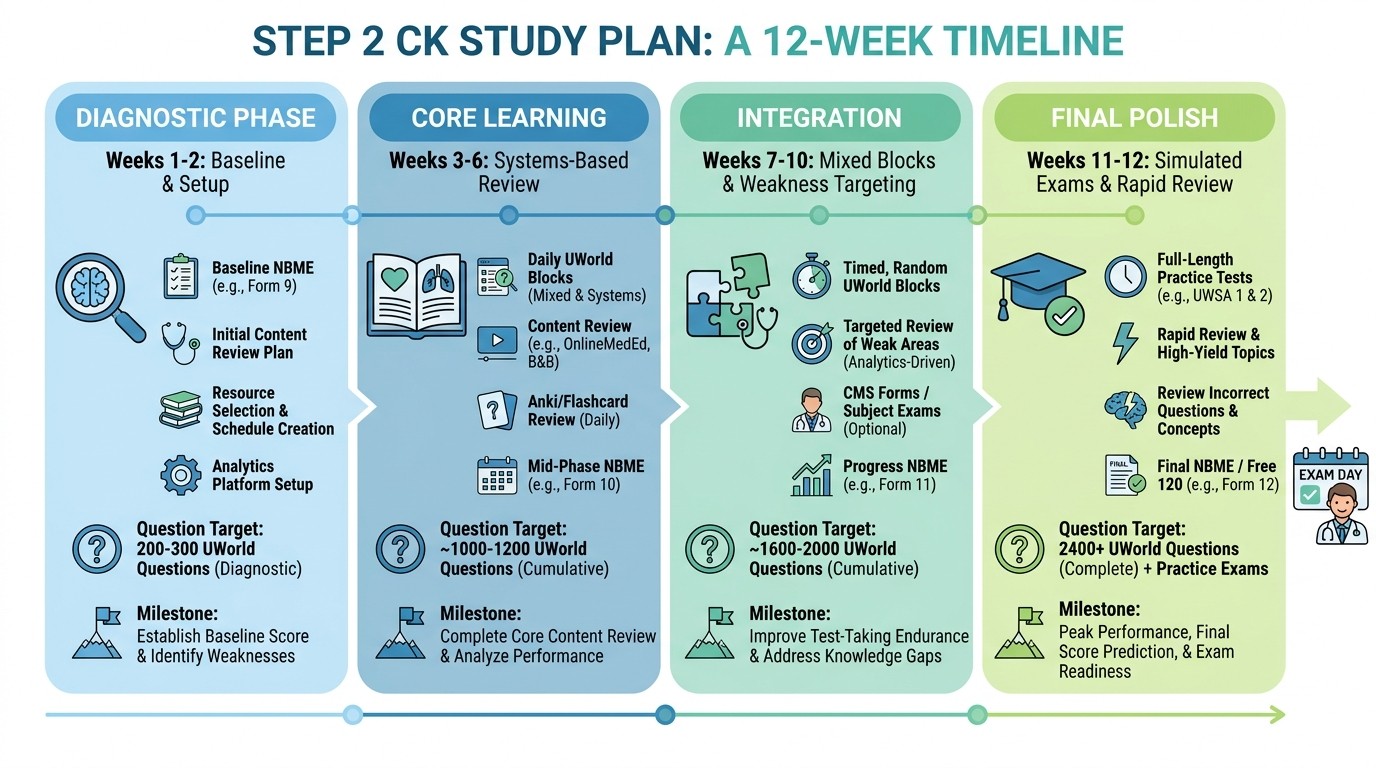
How to Structure Your 8-12 Week Step 2 CK Study Plan
Most students need 6-8 weeks of focused preparation, but extending to 12 weeks works better if you are balancing clinical rotations. The key is consistency, not cramming.
Week 1-2: Diagnostic Phase and Foundation Building
Goals: Establish baseline performance, identify major knowledge gaps, create targeted study focus Daily targets:
60-80 practice questions in tutor mode
2-3 hours of content review focusing on weakest subjects identified in baseline assessment
Complete first NBME Self-Assessment by end of Week 2
Key activities:
Take a full-length diagnostic exam (NBME CCSSA or UWorld Self-Assessment 1) to map your starting point
Analyze results by subject and system to identify 3-4 priority areas
Begin systematic question practice, focusing on understanding explanations rather than volume
Review high-yield concepts in Internal Medicine (makes up ~50% of exam content)
This phase is about honest assessment, not performance. Use the diagnostic results to guide which clinical domains deserve the most attention in coming weeks.
Week 3-6: Core Learning and Pattern Recognition
Goals: Build clinical reasoning skills, complete majority of question bank, strengthen weak areas Daily targets:
80-100 practice questions (mix of tutor and timed blocks)
1-2 hours targeted review of consistently missed topics
Weekly subject rotation: IM → Surgery → Pediatrics → OB/GYN → Psychiatry
Key activities:
Switch to mixed-subject question blocks to simulate exam conditions
Focus heavily on explanation review — spend 2-3 minutes per explanation, even for correct answers
Create a running list of high-yield facts and clinical pearls from question review
Take NBME Self-Assessment 2 at the end of Week 4 to track improvement
The magic happens during explanation review. Dont just read why you got it wrong — understand the systematic approach that would have led you to the right answer. For complex clinical vignettes, practice summarizing the case in your own words before looking at options.
When working through adaptive question sequences, you will notice the platform adjusting difficulty based on your recent performance — embrace this instead of getting frustrated by harder questions, since it means you are improving in that domain.
Memory techniques become crucial here. Oncourse's Synapses feature helps students memorize clinical patterns through visual mnemonics — perfect for Step 2 CK where rapid pattern recognition separates average performers from top scorers. The visual associations stick better than raw memorization when you are facing time pressure during actual exam conditions.
Week 7-10: Integration and Weak Area Focus
Goals: Integrate knowledge across specialties, drill remaining weak areas, build exam stamina Daily targets:
100-120 practice questions in timed blocks only
1 hour of targeted weak area review using spaced repetition
Mixed subject blocks that simulate full exam conditions
Key activities:
Complete all remaining first-pass questions in your primary question bank
Begin second-pass review of previously incorrect questions, focusing on whether your reasoning has improved
Take NBME Self-Assessment 3 to gauge exam readiness
Practice full-length question blocks (80 questions) to build stamina
Analytics dashboards become crucial during this phase. Track which question types consistently trip you up and whether your performance trends are improving week over week. If surgical management questions remain problematic, dedicate extra review time to treatment algorithms and next-step decision trees.
During intense drilling sessions, Oncourse's Probe Game turns clinical reasoning practice into rapid-fire pattern recognition training. Students can drill through case presentations and differential diagnoses at game speed, building the mental reflexes needed for Step 2 CK's time pressure while keeping study sessions engaging during long preparation blocks.
Week 11-12: Final Polish and Confidence Building
Goals: Fine-tune performance, build confidence, optimize test-taking strategy Daily targets:
60-80 questions focusing on previously incorrect answers and flagged topics
30 minutes reviewing high-yield facts and clinical pearls
Full practice exam conditions with proper timing
Key activities:
Complete UWorld Self-Assessment 2 and Free 120 under strict exam conditions
Review all flagged questions and ensure understanding of core concepts
Practice relaxation and pacing strategies for exam day
Avoid learning completely new material — focus on reinforcement
The final weeks are about confidence, not cramming. Trust the systematic preparation you have built over the previous 10 weeks. Use remaining time to reinforce concepts you have already learned rather than panicking about topics you havent covered.
Common Prep Course Selection Mistakes That Tank Performance
Mistake 1: Resource Overload Instead of Depth
The biggest trap is subscribing to UWorld + AMBOSS + Kaplan + First Aid + online lectures, then jumping between resources instead of mastering one deeply. Students who excel pick 2-3 high-quality resources and know them inside out.
Better approach: Choose one comprehensive question bank as your primary resource, one clinical reference (like AMBOSS library or UpToDate), and one spaced repetition system for weak topics. Resist the urge to add more when you hit a rough patch.
Mistake 2: Ignoring Performance Analytics
Many students treat question banks like practice tests — they check if they got it right, then move on. This wastes the most valuable part of digital prep courses: the analytics that show exactly where clinical reasoning breaks down.
Better approach: Review your performance dashboard weekly. If pediatric cardiology consistently shows 45% accuracy while adult cardiology shows 82%, you know exactly where to focus your next study sessions. Let the data drive your priorities, not your feelings about which topics seem "harder."
Mistake 3: Poor Study Schedule Integration
Students often pick prep courses based on question quality alone, then struggle to maintain consistent study habits because the platform doesnt integrate with their actual schedule. They end up cramming instead of following a sustainable pace.
Better approach: Choose courses that generate realistic daily study plans based on your available time and target exam date. Platforms that sync with your rotation schedule and automatically adjust question targets when you miss days are worth the investment.
Mistake 4: Focusing on Volume Over Understanding
The instinct is to complete as many questions as possible, but Step 2 CK rewards deep understanding of clinical reasoning patterns, not raw question exposure. Students who rush through 5,000 questions often score lower than those who carefully review 3,000.
Better approach: Spend 2-3 minutes reviewing every explanation, even for questions you answered correctly. Ask yourself: "What pattern should I recognize if I see a similar case?" Build frameworks for approaching clinical vignettes systematically.
How to Track Progress and Adjust Mid-Prep
Effective Step 2 CK preparation requires regular course corrections based on performance data, not blind faith in your initial study plan.
Weekly Performance Reviews
Every Sunday, spend 20 minutes analyzing your week:
Subject-level accuracy trends: Are weak areas improving or staying flat?
Question type breakdown: Do you struggle more with diagnosis, management, or next-step questions?
Daily consistency: Did you hit your target question volumes, or are you falling behind?
Practice exam scores: Are NBME scores trending toward your target range?
Use this data to adjust the following week's focus. If Emergency Medicine accuracy jumped from 63% to 78% over two weeks, you can reduce EM review time and redirect energy toward persistently weak areas.
Mid-Prep Adjustments
At the 4-week mark, perform a deeper evaluation:
Pace check: Are you on track to complete your primary question bank with time for review?
Score trajectory: Do practice exam trends suggest you will hit your target score by exam day?
Weak area persistence: Which 2-3 subjects still need concentrated attention?
Study method effectiveness: Is your current approach yielding consistent improvements?
Common adjustments include extending your timeline if progress is slower than expected, increasing daily question targets if you are ahead of schedule, or switching more study time to weak areas if analytics show persistent gaps.
Red Flags That Require Strategy Changes
Plateau in practice scores after 3+ weeks: Usually indicates you need to change your approach to question review, not just do more questions Consistent performance gaps in 2+ major systems: Suggests you need structured content review in addition to question practice Wide score variation between practice exams: Often means test-taking strategy needs work, not just more content knowledge Declining accuracy despite increased study time: Classic sign of burnout — take 2-3 days off and reassess study method efficiency
The best prep courses provide analytics tools that make these patterns visible before they derail your preparation timeline.
Making Your Final Prep Course Decision
When evaluating Step 2 CK prep courses, focus on four decision factors that directly impact your exam readiness, not marketing claims or peer recommendations.
Course Evaluation Checklist
Feature | Why It Matters | What to Look For |
|---|---|---|
Question Bank Size | Need sufficient volume for pattern recognition | 3,500+ questions minimum |
Adaptive Difficulty | Builds clinical reasoning under varied conditions | Dynamic question selection based on performance |
Analytics Depth | Enables targeted study focus | Subject/system breakdowns with trend analysis |
Mobile Integration | Maximizes study opportunities during rotations | Full functionality across devices |
Study Planning | Creates sustainable daily routines | Custom schedules based on target date and baseline |
Explanation Quality | Teaches clinical reasoning frameworks | Differential diagnosis walkthroughs, not just answer keys |
Sample 8-Week Intensive Schedule
For students with dedicated study time and solid clinical foundations:
Week 1-2 (Foundation): 80 questions/day, complete diagnostic assessment, begin systematic review of Internal Medicine Week 3-4 (Expansion): 100 questions/day, rotate through major specialties, take NBME 1 Week 5-6 (Integration): 120 questions/day, mixed subject blocks, focus on weak areas identified Week 7-8 (Polish): 100 questions/day, review incorrect answers, take UWSA2 and Free 120
Sample 12-Week Rotation-Compatible Schedule
For students balancing clinical duties:
Weeks 1-3: 40 questions on workdays, 80 on days off, establish baseline and routine Weeks 4-8: 60 questions on workdays, 100 on days off, systematic subject rotation Weeks 9-11: 80 questions on workdays, 120 on days off, intensive weak area focus Week 12: 60 questions on workdays, 80 on days off, final review and confidence building
The key is picking a timeline you can sustain consistently, not the most aggressive schedule possible.
For comprehensive lesson coverage across all Step 2 CK domains, explore Oncourse's biostatistics lessons and physiology content to strengthen your clinical foundation. The platform also offers targeted practice questions and spaced repetition flashcards to reinforce key concepts.
Frequently Asked Questions
How long should I study for USMLE Step 2 CK?
Most students need 6-8 weeks of dedicated preparation. If you are strong clinically and did well on shelf exams, 6 weeks is sufficient. If you need to rebuild clinical knowledge or are an IMG, plan for 8-10 weeks. Students balancing rotations should extend to 12 weeks but study consistently.
Should I use multiple question banks or focus on one?
Focus on mastering one comprehensive question bank (UWorld, AMBOSS, or equivalent) rather than spreading effort across multiple resources. Deep understanding of explanations matters more than total question exposure. Use additional question banks only after completing a full pass of your primary resource.
When should I take NBME practice exams?
Take your first NBME Self-Assessment at the end of Week 2 for baseline assessment. Take NBME 2 around Week 4-5 to track improvement. Save NBME 3 or UWorld Self-Assessment 2 for 1-2 weeks before your exam as a final readiness check. The Free 120 works well as a final confidence builder.
What score should I target on Step 2 CK?
With the passing score at 218, aim for practice scores consistently above 230 before scheduling your exam. For competitive specialties, target 240+ on practice exams. Your prep course analytics should show steady improvement over 4-6 weeks before you are exam-ready.
How do I balance Step 2 CK prep with clinical rotations?
Use a 12-week timeline with lower daily question targets (40-60 per day) but maintain consistency. Focus study time during lighter rotations and use mobile platforms for studying during hospital downtime. Prioritize high-yield subjects during busy rotations.
Is it worth paying for premium prep course features?
Advanced analytics, adaptive question selection, and automated study planning are worth the investment if they fit your budget. These features eliminate guesswork about where to focus study time. Free resources can work, but require more manual tracking and planning.
Prepare smarter with Oncourse AI — adaptive MCQs, spaced repetition, and AI explanations built for USMLE Step 2 CK. Download free on Android and iOS.