Back
USMLE Step 2 CK Study Plan 2026: The Complete Week-by-Week Schedule for US Medical Students
Complete 6-8 week USMLE Step 2 CK study plan with daily schedules, subject breakdown, and question targets. Perfect for US medical students aiming for 250+ scores in 2026.
USMLE Step 2 CK Study Plan 2026: The Complete Week-by-Week Schedule for US Medical Students
You're staring at your calendar, counting backwards from your Step 2 CK exam date. Eight weeks. Maybe six. The weight of 318 questions, 63 seconds each, testing everything from internal medicine to ethics hits you. Here's what separates students who score 250+ from those who barely pass: a systematic, week-by-week study plan that treats each subject with surgical precision.
This isnt another generic "study hard" guide. This is the exact 6-8 week framework that high scorers use, with daily hour targets, subject rotation strategies, and the AI-powered study tools that didnt exist when your seniors were grinding through Step 2 CK.
How Long Should Your USMLE Step 2 CK Dedicated Period Be?
The magic number isnt what you think. Most students default to 6-8 weeks because it sounds right, but the real answer depends on your NBME baseline:
4 weeks: NBME practice score ≥230, consistently high shelf scores, UWorld mostly complete 6 weeks: NBME 215-235, mixed shelf performance, need margin for error 8 weeks: NBME <215, weaker clerkship performance, or building from scratch
Take an NBME practice exam before planning anything else. Your baseline score matters more than arbitrary time frames.
USMLE Step 2 CK Subject Breakdown: Where to Focus Your Energy
Step 2 CK weights subjects differently than you might expect:
Subject | Exam Weight | Weekly Priority |
|---|---|---|
Internal Medicine | 50-60% | 3-4 weeks focus |
Surgery | 25-30% | 2 weeks |
Pediatrics | 20-25% | 1.5-2 weeks |
OB-GYN | 10-20% | 1-1.5 weeks |
Psychiatry | 10-15% | 1 week |
Ethics/Communication | 10-15% | Woven throughout |
Internal medicine dominates. Cardiology, endocrinology, gastroenterology, and infectious diseases appear in 50% of questions. Treat these like your clinical foundation, not just another subject to check off.
The Complete 8-Week USMLE Step 2 CK Study Schedule
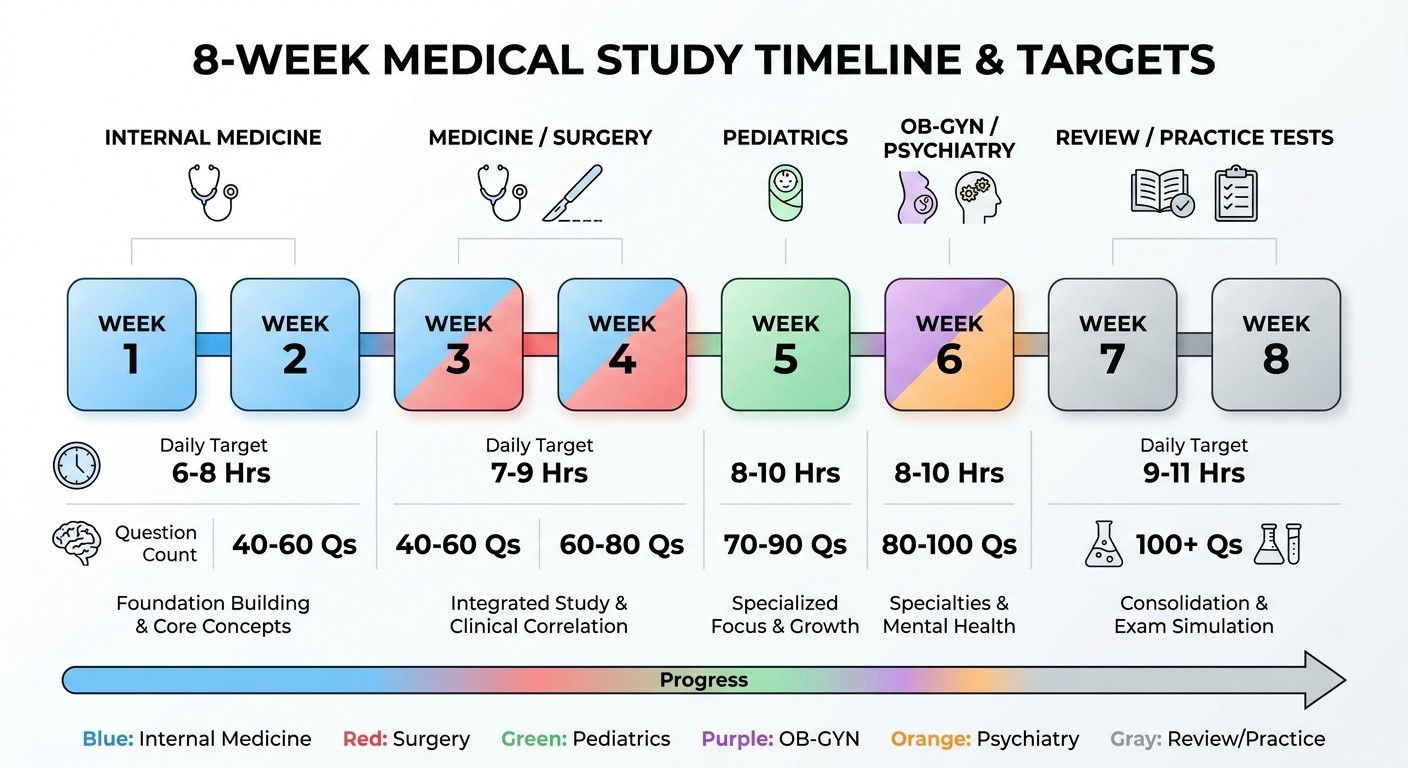
Weeks 1-2: Internal Medicine Foundation
Daily Target: 6-8 hours, 40-60 UWorld questions Focus: Cardiology, Pulmonology, Gastroenterology Week 1 Schedule:
Monday-Wednesday: Cardiology deep dive (chest pain workup, arrhythmias, heart failure)
Thursday-Friday: Pulmonology (COPD/asthma, pneumonia, pulmonary embolism)
Saturday: Mixed practice questions, weak area review
Sunday: Rest or light flashcard review
Daily structure that works: 2 hours content review (videos/reading), 3-4 hours question practice and review, 1 hour clinical reasoning practice with real patient scenarios. The Clinical Rounds game presents daily cases with chief complaints and patient data – perfect for building the diagnostic muscle Step 2 CK tests. Week 2 Schedule:
Monday-Tuesday: Gastroenterology (IBD, liver disease, GI bleeding)
Wednesday-Thursday: Nephrology (AKI/CKD, electrolytes, acid-base)
Friday: Infectious diseases (antibiotics, common infections)
Saturday: Mixed system questions
Sunday: Rest
Weeks 3-4: Surgery and High-Yield Medicine
Daily Target: 7-9 hours, 60-80 UWorld questions Focus: General Surgery, Surgical subspecialties, Endocrinology, Hematology
Instead of manually juggling subject balance across these weeks, Oncourse's Daily Plan automatically generates study sessions based on your available time and weak areas. Set 90-minute blocks, select Surgery and Internal Medicine, and get curated activities that adapt to your performance.
Week 3 Schedule:
Monday-Tuesday: General surgery (appendicitis, hernias, bowel obstruction)
Wednesday: Surgical subspecialties (orthopedics, urology basics)
Thursday-Friday: Endocrinology (diabetes, thyroid, adrenal disorders)
Saturday: Surgery + Endocrine mixed practice
Sunday: Rest
Week 4 Schedule:
Monday-Tuesday: Hematology (anemia workup, bleeding disorders, malignancies)
Wednesday-Thursday: Rheumatology (arthritis, connective tissue diseases)
Friday: Dermatology (skin lesions, rashes, procedures)
Saturday: Full-system practice test (160 questions)
Sunday: Practice test review
Week 5: Pediatrics Deep Dive
Daily Target: 8-9 hours, 80-100 UWorld questions Focus: Growth/Development, Common pediatric conditions, Adolescent medicine
Pediatrics trips up adult medicine-focused students. The key is pattern recognition – fever in a 6-month-old vs 6-year-old requires completely different workups.
Schedule:
Monday: Growth/development, vaccination schedules
Tuesday: Pediatric emergencies (fever, respiratory distress)
Wednesday: Common pediatric conditions (asthma, ADHD, infections)
Thursday: Adolescent medicine, child abuse
Friday: Neonatology basics
Saturday: Pediatric question marathon (100+ questions)
Sunday: Review and weak area targeting
Playing Synapses for 5 minutes daily during this week helps cement pediatric presentation patterns. The game groups related concepts – perfect for linking developmental milestones, vaccine schedules, and age-appropriate presentations.
Week 6: OB-GYN and Psychiatry
Daily Target: 8-9 hours, 80-100 UWorld questions Focus: Pregnancy complications, Gynecologic conditions, Psychiatric disorders Schedule:
Monday-Tuesday: Obstetrics (prenatal care, labor complications, postpartum)
Wednesday: Gynecology (menstrual disorders, contraception, STIs)
Thursday-Friday: Psychiatry (depression, anxiety, psychosis, substance use)
Saturday: OB-GYN + Psychiatry mixed practice
Sunday: Rest or light review
Weeks 7-8: Final Review and Practice Tests
Daily Target: 9-11 hours, 100+ targeted questions Focus: Weak areas, practice tests, rapid review Week 7:
Take 2 full-length practice exams (NBME or UWorld)
Identify remaining weak areas
Targeted question blocks in problem subjects
Ethics and communication skills review
Week 8:
Final weak area review
1-2 more practice tests
High-yield facts and mnemonics
Taper studying 2 days before exam
The 6-Week Intensive USMLE Step 2 CK Plan
Short on time? The 6-week plan requires 9-11 hours daily with higher question volumes. Here's the condensed structure:
Weeks 1-2: Internal Medicine (all major systems, 80-100 questions daily) Week 3: Surgery + High-yield medicine subspecialties (100+ questions) Week 4: Pediatrics + OB-GYN combined (100+ questions) Week 5: Psychiatry + weak area intensive review (120+ questions) Week 6: Practice tests and final review (2-3 full exams)
The 6-week plan leaves zero margin for error. You need a strong baseline (NBME 220+) and the discipline to maintain 100+ questions daily from week 1.
Daily Study Structure That Actually Works
6:00-7:00 AM: Light review, flashcards, coffee 7:00-9:00 AM: Content review (videos, reading) 9:00-12:00 PM: Question block 1 (40 questions) + thorough review 12:00-1:00 PM: Lunch break 1:00-4:00 PM: Question block 2 (40 questions) + review 4:00-4:15 PM: Break 4:15-6:00 PM: Question block 3 + targeted weak area practice 6:00-7:00 PM: Dinner 7:00-8:00 PM: Flashcard review, mnemonics 8:00 PM: Stop studying
The key isnt studying longer – its studying with higher intensity and better tools.
Question Bank Strategy: Beyond Just UWorld
UWorld First Pass (Tutor mode): Focus on learning explanations, not percentages UWorld Second Pass (Timed mode): Simulate exam conditions Targeted weak areas: Use subject-specific question sets
Most students treat question banks like reading assignments. High scorers treat them like clinical case discussions. Read every explanation, even for correct answers. Understand why wrong answers are wrong.
When you spot knowledge gaps during question review, targeted flashcard review reinforces concepts with spaced repetition. The AI adapts which cards you see based on your performance pattern.
Subject-Specific Study Strategies
Internal Medicine: The 50% Foundation
Focus on clinical decision trees, not isolated facts. Step 2 CK tests "next best step" thinking:
Chest pain → EKG → troponins → stress test vs catheterization
Shortness of breath → BNP → echo → management pathway
Abdominal pain → location + character → appropriate imaging
Practice clinical reasoning through daily patient cases that mirror Step 2 CK's presentation format. Real diagnostic thinking beats memorizing algorithms.
Surgery: 25% High-Yield
Surgery questions focus on:
Preoperative clearance and risk assessment
Postoperative complications and management
When surgery is vs isnt indicated
Basic surgical emergencies
Dont memorize surgical techniques. Focus on clinical decision-making around surgical patients.
Pediatrics: Age-Specific Medicine
Pediatrics isnt just small adults. Key differences:
Normal vital signs vary by age
Developmental milestones are testable
Vaccine schedules matter
Child abuse recognition
OB-GYN: Pregnancy Plus Gynecology
High-yield topics:
Prenatal screening and testing
Labor complications and management
Contraception counseling
Abnormal uterine bleeding workup
Psychiatry: DSM Criteria Plus Communication
Focus on:
Major depression and anxiety disorders
Psychosis and bipolar disorder
Substance use disorders
Suicide risk assessment
Communication skills in difficult scenarios
Ethics and Communication: The Hidden 10-15%
Ethics questions arent philosophy. They test practical clinical scenarios:
Informed consent procedures
End-of-life discussions
Confidentiality boundaries
Difficult patient interactions
Practice the communication framework: acknowledge feelings, provide information, explore concerns, collaborate on next steps.
Practice Test Strategy and Score Interpretation
Take practice tests throughout, not just at the end:
Week 2: Baseline NBME (diagnostic) Week 4: UWorld Self-Assessment 1 Week 6: NBME + UWorld Self-Assessment 2 Week 7: 2 more practice tests Final week: Light review only Score Interpretation Guide:
Practice scores typically run 10-20 points below actual Step 2 CK
Focus on trends, not absolute numbers
Use practice tests to identify weak areas, not just ego boosts
Common Study Mistakes That Kill Scores
Passive Reading: Reading First Aid like a novel doesnt work. Active recall beats passive review. Question Hoarding: Saving questions for "when you're ready" wastes your most valuable resource. Start questions from day 1. Perfectionism: Trying to master every detail in every subject. Focus on high-yield, commonly tested concepts. Neglecting Weak Areas: Studying what you already know feels good but doesnt move scores. Attack your weaknesses systematically. Burnout from Overloading: 12+ hour study days backfire. Consistent 8-9 hours beats inconsistent marathon sessions.
How AI Changes Step 2 CK Preparation in 2026
Traditional passive resources (videos, books) teach facts. AI-powered tools teach clinical reasoning – the skill Step 2 CK actually tests.
Smart students now use AI tutors for immediate explanation of complex concepts, adaptive question sets that target individual weak areas, and spaced repetition that prevents forgetting. The key is using AI as a clinical reasoning coach, not a fact-checking service.
Resource Stack: What You Actually Need
Essential (Use These):
UWorld Question Bank (primary resource)
NBME Practice Exams (score prediction)
One review book (First Aid Step 2 CK or Master the Boards)
Helpful But Not Required:
OnlineMedEd (video review for weak areas)
Amboss Question Bank (additional questions)
Anki flashcards (if you're already using them)
Skip These:
Multiple question banks (creates confusion)
Extensive video libraries (too passive)
Social media study accounts (distraction dressed as productivity)
Last-Week Exam Preparation
5 Days Before: Final practice test, identify any remaining gaps 3 Days Before: Light review of high-yield facts, no new content 1 Day Before: Rest, light review of mnemonics, early bedtime Exam Day: Normal routine, arrive early, trust your preparation
Dont cram the night before. Your clinical reasoning skills are built over weeks, not hours.
Frequently Asked Questions
How many UWorld questions should I do per day for Step 2 CK?
Start with 40-60 questions daily in weeks 1-2, building to 80-100 questions by weeks 3-4, and 100+ during intensive review weeks. Quality review matters more than raw quantity – spend 2-3 minutes per explanation.
Is 6 weeks enough to study for Step 2 CK?
Six weeks works if you have a strong baseline (NBME 220+), completed most clerkships with high shelf scores, and can maintain 9-11 hours daily. Most students perform better with 8 weeks for a comfortable margin.
Should I repeat UWorld for Step 2 CK?
Yes, but strategically. First pass in tutor mode for learning, second pass in timed mode for exam simulation. Focus on previously incorrect questions and weak subject areas during the second pass.
What NBME score predicts my actual Step 2 CK score?
NBME practice tests typically run 10-20 points below actual scores, but this varies by individual. UWorld Self-Assessments tend to be more predictive. Take multiple practice tests to establish a trend rather than relying on a single score.
How important is Step 2 CK for residency matching?
Extremely important. With Step 1 now pass/fail, Step 2 CK is often the primary numerical score programs use for screening. A strong Step 2 CK score (240+) significantly improves your chances in competitive specialties.
When should I take Step 2 CK during medical school?
Most students take it after core clerkships but before residency applications (typically spring of MS4 year). Taking it earlier allows time for a retake if needed, but later gives you more clinical knowledge.
---
Prepare smarter with Oncourse AI – adaptive MCQs, spaced repetition, and AI explanations built for USMLE Step 2 CK. Download free on Android and iOS.