Back
UKMLA AKT 2026: Exam Pattern, Passing Criteria, and Study Plan
Complete guide to UKMLA AKT 2026 exam pattern, passing criteria, and proven study strategies. Includes 6-month study plan, practice tips, and success strategies for medical graduates.

UKMLA AKT 2026: Exam Pattern, Passing Criteria, and Study Plan
The UK Medical Licensing Assessment Applied Knowledge Test (UKMLA AKT) represents a crucial milestone for medical graduates seeking to practice medicine in the UK. With over 15,000 candidates taking the exam annually, understanding the 2026 exam pattern, passing criteria, and developing a strategic study plan is essential for success.
This comprehensive guide covers everything you need to know about the UKMLA AKT 2026, from the latest exam format changes to proven study strategies that can significantly improve your chances of passing on the first attempt.
What is the UKMLA AKT?
The UKMLA Applied Knowledge Test is a computer-based assessment developed by the General Medical Council (GMC) to ensure that medical graduates possess the fundamental knowledge required to practice safely in the UK healthcare system. The exam tests theoretical knowledge across five key domains that form the foundation of medical practice.
Introduced as part of the UKMLA framework, the AKT serves as one of two components (alongside the Clinical Skills Assessment) that international medical graduates must pass to obtain GMC registration and practice medicine in the UK.
UKMLA AKT 2026 Exam Pattern and Format
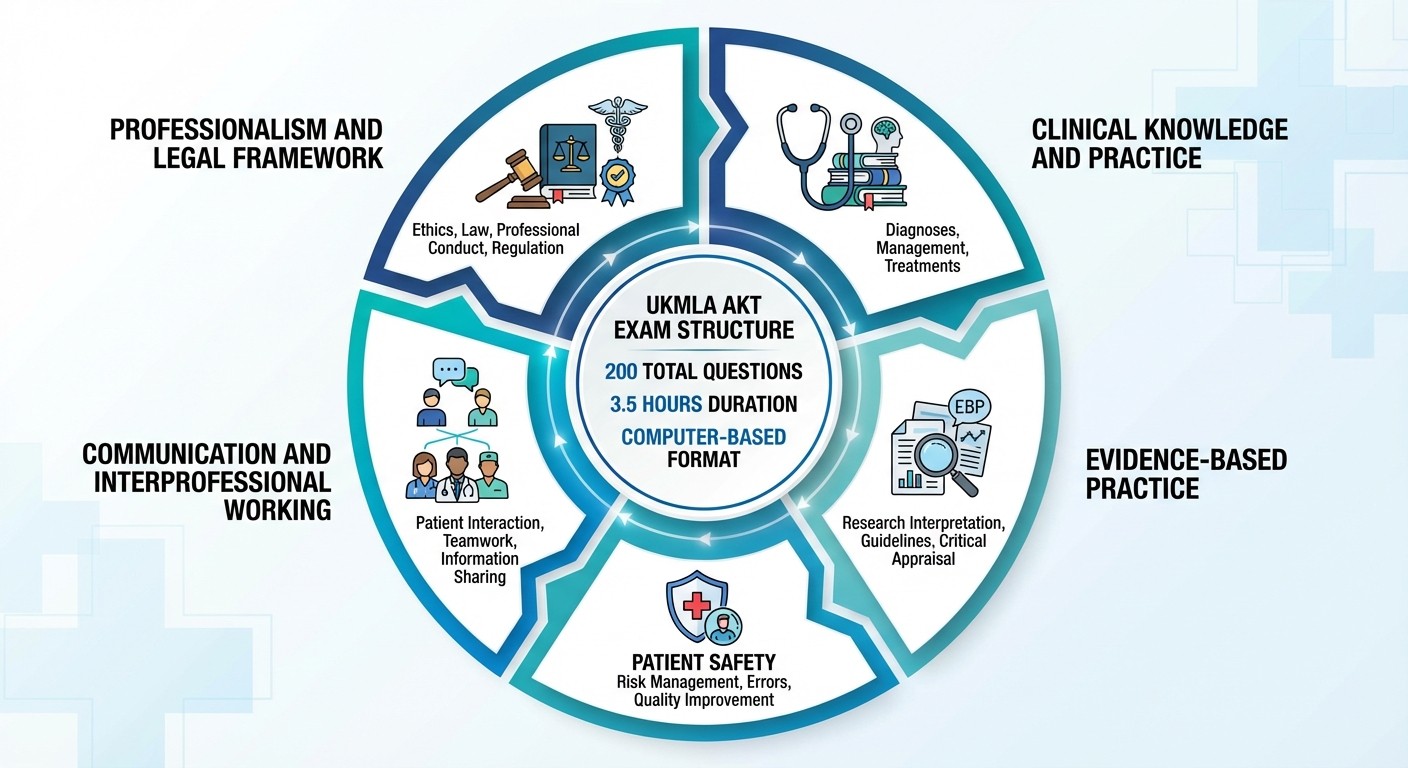
Exam Structure Overview
The UKMLA AKT 2026 maintains the established format while incorporating refined question types and updated content areas:
Exam Component | Details |
|---|---|
Total Questions | 200 multiple-choice questions |
Duration | 3 hours and 30 minutes |
Question Format | Single Best Answer (SBA) format |
Delivery Method | Computer-based test |
Sessions per Day | 2 sessions available |
Break | Optional 15-minute break after 100 questions |
Five Assessment Domains
The UKMLA AKT 2026 evaluates candidates across five interconnected domains:
#### 1. Clinical Knowledge and Practice (60-65% of questions)
Anatomy and Physiology: Foundational knowledge of body systems
Pathophysiology: Disease mechanisms and processes
Clinical Presentations: Symptom recognition and interpretation
Diagnostic Methods: Investigation selection and interpretation
Therapeutic Interventions: Treatment options and management strategies
Pharmacology: Drug mechanisms, interactions, and adverse effects
#### 2. Evidence-Based Practice (10-15% of questions)
Research Methodology: Study design and statistical concepts
Critical Appraisal: Evaluating medical literature
Clinical Guidelines: Understanding and applying evidence-based protocols
Quality Improvement: Healthcare system enhancement strategies
#### 3. Patient Safety (10-15% of questions)
Risk Management: Identifying and mitigating clinical risks
Medication Safety: Prescribing safety and error prevention
Infection Control: Prevention and management strategies
Clinical Governance: Safety reporting and improvement systems
#### 4. Communication and Interprofessional Working (5-10% of questions)
Patient Communication: Effective consultation skills
Colleague Interaction: Professional communication with healthcare teams
Information Sharing: Appropriate disclosure and confidentiality
Conflict Resolution: Managing disagreements professionally
#### 5. Professionalism and Legal Framework (5-10% of questions)
Medical Ethics: Ethical decision-making frameworks
Legal Requirements: Understanding medical law and regulations
Professional Standards: GMC Good Medical Practice guidelines
Consent Procedures: Valid consent processes and documentation
Question Types and Format
All 200 questions follow the Single Best Answer (SBA) format, presenting:
Clinical vignettes with patient scenarios
Five answer options (A through E)
One correct answer that represents the best clinical decision
Distractors designed to test clinical reasoning rather than recall
UKMLA AKT 2026 Passing Criteria
Standard Setting Method
The UKMLA AKT uses the Angoff standard-setting method to determine the pass mark. This approach involves:
1. Expert Panel Review: Experienced clinicians review each question
2. Difficulty Assessment: Experts estimate the percentage of minimally competent candidates who should answer each question correctly
3. Pass Mark Calculation: The cumulative scores determine the overall pass threshold
4. Statistical Validation: Historical performance data validates the standard
2026 Pass Mark Expectations
Based on historical trends and GMC announcements:
Year | Pass Mark Range | Pass Rate |
|---|---|---|
2023 | 472-485/700 | 78-82% |
2024 | 475-488/700 | 76-80% |
2025 | 478-490/700 | 75-79% |
2026 (Projected) | 480-492/700 | 74-78% |
Note: The pass mark typically ranges between 68-70% of the maximum possible score
Scoring System
Total Possible Score: 700 points
Raw Score Conversion: Each correct answer contributes to the raw score, which is then converted to the standardized 700-point scale
No Negative Marking: Incorrect answers do not deduct points
Domain-Specific Performance: While the overall pass mark applies, candidates receive feedback on performance across all five domains
Pass/Fail Determination
Candidates receive their results approximately 6-8 weeks after the exam date:
Pass: Clear notification with domain-specific performance breakdown
Fail: Detailed feedback indicating weak areas and recommended study focus
Borderline Review: Exceptional cases may undergo additional review
Comprehensive UKMLA AKT 2026 Study Plan
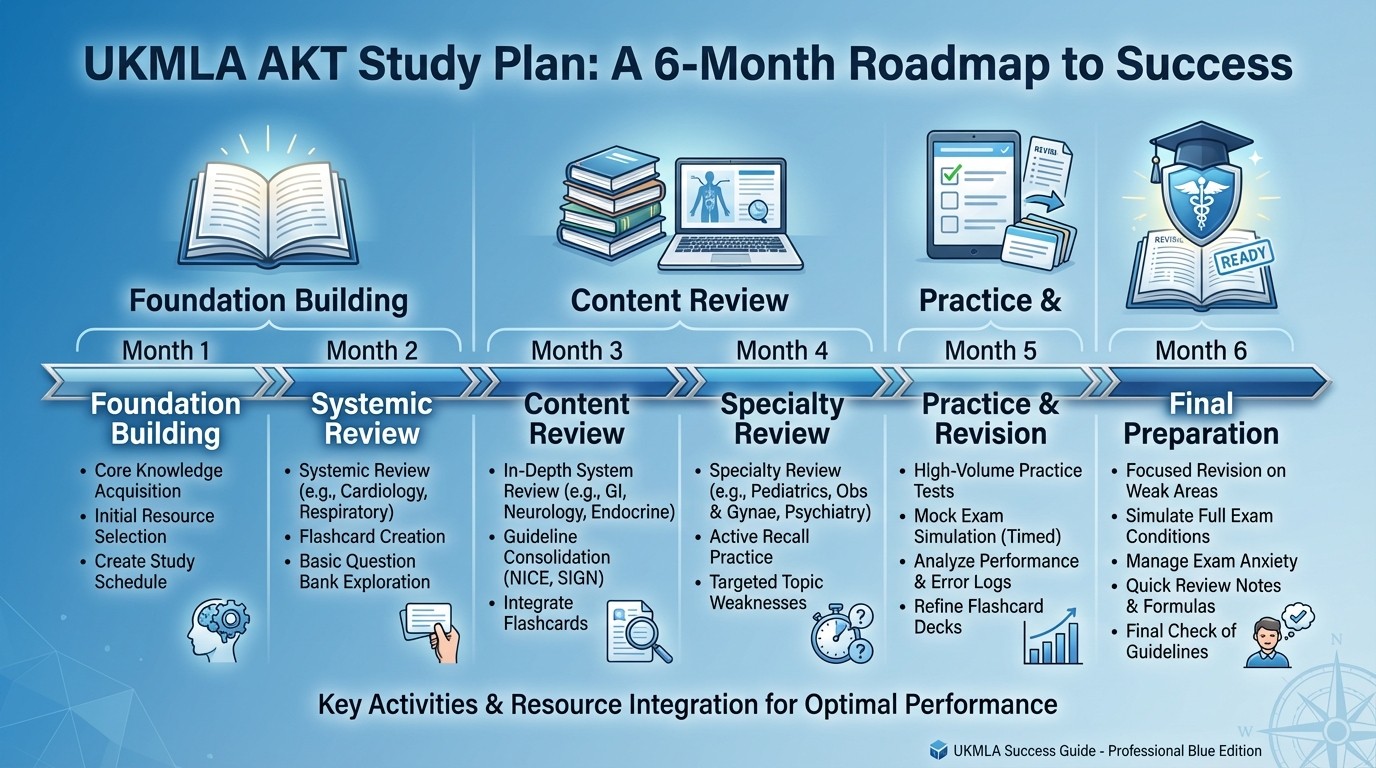
6-Month Strategic Study Plan
#### Phase 1: Foundation Building (Months 1-2)
Week 1-4: Assessment and Planning
Take a diagnostic practice test to identify knowledge gaps
Review the GMC's UKMLA content guide thoroughly
Organize study materials and create a dedicated study space
Explore Oncourse's UKMLA preparation resources for structured learning paths
Week 5-8: Core Knowledge Development
Focus on high-yield topics from clinical knowledge domain
Study anatomy, physiology, and pathophysiology systematically
Use active recall techniques and spaced repetition
Complete 50-75 practice questions weekly to reinforce learning
#### Phase 2: Content Mastery (Months 3-4)
Week 9-12: Clinical Applications
Emphasize clinical presentation patterns and diagnostic reasoning
Study pharmacology with focus on mechanism of action and side effects
Practice evidence-based medicine and research methodology questions
Increase practice questions to 100-125 per week
Week 13-16: Professional Domains
Study patient safety protocols and risk management strategies
Review communication skills and ethical frameworks
Learn legal requirements specific to UK medical practice
Maintain consistent practice question routine
#### Phase 3: Practice and Revision (Month 5)
Week 17-20: Intensive Practice
Complete full-length practice exams under timed conditions
Review incorrect answers thoroughly and understand reasoning
Focus on weak domains identified through practice performance
Join study groups or discussion forums for peer learning
#### Phase 4: Final Preparation (Month 6)
Week 21-24: Exam Readiness
Take 2-3 full practice exams per week
Review high-yield facts and clinical guidelines
Practice time management strategies
Ensure familiarity with computer-based test interface
Week 25-26: Pre-Exam Period
Light review of key concepts and formulas
Maintain physical and mental health routines
Prepare exam day logistics (documents, location, timing)
Avoid learning new material in the final week
Daily Study Schedule Recommendations
Optimal Study Duration: 6-8 hours daily for dedicated preparation
Time Block | Activity | Duration |
|---|---|---|
9:00-11:00 AM | Core content study | 2 hours |
11:30 AM-12:30 PM | Practice questions | 1 hour |
2:00-4:00 PM | Weak area review | 2 hours |
4:30-5:30 PM | Flashcard revision | 1 hour |
7:00-8:00 PM | Mock test/Review | 1 hour |
Study Resources and Materials
#### Essential Textbooks
Kumar and Clark's Clinical Medicine - Comprehensive clinical reference
Oxford Handbook of Clinical Medicine - Quick reference guide
BNF (British National Formulary) - Pharmaceutical reference
GMC Good Medical Practice - Professional standards guide
#### Digital Resources
1. Oncourse UKMLA Platform - AI-powered adaptive learning with personalized study paths
2. Question Banks - High-quality SBA practice questions
3. Video Lectures - Visual learning for complex concepts
4. Mobile Apps - Convenient study tools for revision on-the-go
#### Practice Materials
Official GMC Sample Questions - Authentic question styles
Commercial Question Banks - Extensive practice opportunities
Peer Study Groups - Collaborative learning environments
Spaced Repetition Flashcards - Efficient memorization techniques
High-Yield Study Strategies for UKMLA AKT Success
Active Learning Techniques
1. Case-Based Learning
Study clinical scenarios rather than isolated facts
Practice pattern recognition for common presentations
Understand the reasoning behind diagnostic and treatment decisions
2. Spaced Repetition
Review material at increasing intervals
Use evidence-based flashcard systems for long-term retention
Focus on weak areas more frequently
3. Practice Question Analysis
Don't just identify correct answers
Understand why incorrect options are wrong
Learn from explanation rationales
Track performance trends across domains
Domain-Specific Preparation Tips
#### Clinical Knowledge Mastery
Create disease-focused mind maps linking pathophysiology, presentation, investigation, and management
Practice rapid pattern recognition for common conditions
Memorize key diagnostic criteria and treatment protocols
#### Evidence-Based Practice Excellence
Learn basic statistical concepts and research methodology
Practice interpreting clinical studies and guidelines
Understand hierarchy of evidence and critical appraisal methods
#### Patient Safety Focus
Memorize key safety protocols and checklists
Study medication safety guidelines and common errors
Review incident reporting and quality improvement frameworks
Technology-Enhanced Learning
Modern medical education increasingly relies on adaptive learning technologies. AI-powered study platforms can significantly improve preparation efficiency by:
Personalizing study paths based on individual knowledge gaps
Optimizing review schedules using spaced repetition algorithms
Providing instant feedback on practice questions
Tracking progress across all exam domains
Common Mistakes to Avoid During UKMLA AKT Preparation
Study Planning Errors
1. Insufficient Time Allocation
Starting preparation too late (minimum 4-6 months recommended)
Underestimating the breadth of content coverage
Poor time management during study sessions
2. Imbalanced Domain Focus
Overemphasizing clinical knowledge while neglecting other domains
Ignoring professional and legal framework topics
Insufficient practice with evidence-based medicine questions
Content Study Mistakes
3. Passive Learning Approaches
Reading without active recall or testing
Highlighting without understanding concepts
Memorizing facts without clinical context
4. Practice Question Misuse
Focusing only on correct answers without learning from mistakes
Using low-quality question banks with poor explanations
Not simulating actual exam conditions during practice
Exam Day Preparation Issues
5. Technical Unfamiliarity
Not practicing with computer-based test interfaces
Poor understanding of exam navigation features
Inadequate time management strategies
UKMLA AKT vs Other Medical Licensing Exams
Understanding how the UKMLA AKT compares to other international medical licensing examinations can provide valuable context:
Exam | Questions | Duration | Pass Rate | Key Focus |
|---|---|---|---|---|
UKMLA AKT | 200 SBA | 3.5 hours | 75-80% | UK-specific practice |
USMLE Step 1 | 280 MCQ | 8 hours | 85-90% | Basic sciences |
USMLE Step 2 CK | 318 MCQ | 9 hours | 95-98% | Clinical knowledge |
NEET-PG | 200 MCQ | 3.5 hours | 15-20% | Indian postgraduate entry |
The UKMLA AKT's moderate difficulty level and reasonable pass rates make it achievable for well-prepared candidates, while still maintaining high standards for patient safety.
Updated Registration and Exam Procedures for 2026
Eligibility Requirements
To register for the UKMLA AKT 2026:
Hold a primary medical qualification
Meet GMC's English language requirements
Complete identity verification process
Pay examination fees (approximately £200-250)
Registration Process
1. Create GMC Online Account - Register on the official GMC website
2. Submit Application - Complete all required documentation
3. Identity Verification - Attend approved verification center
4. Fee Payment - Pay examination fees online
5. Exam Booking - Select preferred test center and date
2026 Exam Dates and Locations
The UKMLA AKT is offered multiple times throughout the year at Pearson VUE test centers:
Exam Windows: Approximately every 6-8 weeks
Global Test Centers: Available in major cities worldwide
UK Locations: London, Birmingham, Manchester, Edinburgh, Cardiff
International Centers: Delhi, Mumbai, Lagos, Cairo, Dhaka
Frequently Asked Questions About UKMLA AKT 2026
How many times can I take the UKMLA AKT?
You can attempt the UKMLA AKT up to four times, with mandatory waiting periods between attempts. After four unsuccessful attempts, you must complete additional remedial training before becoming eligible again.
What happens if I fail the UKMLA AKT?
If you don't pass, you'll receive detailed feedback showing your performance in each domain. You can re-register for a future exam window after the mandatory 30-day waiting period.
Can I use a calculator during the exam?
Yes, a basic on-screen calculator is provided for questions requiring mathematical calculations. However, most questions are designed to test clinical reasoning rather than complex computations.
How soon will I receive my results?
Results are typically available 6-8 weeks after your exam date through your GMC online account. You'll receive either a pass notification or detailed feedback on areas needing improvement.
Is the UKMLA AKT the same difficulty worldwide?
Yes, the exam maintains consistent difficulty standards across all test centers globally. The questions and passing criteria are identical regardless of your testing location.
Should I postpone my exam if I don't feel ready?
Only postpone if you're significantly unprepared. Minor nervousness is normal. Use practice scores as your guide - consistently scoring above 75% suggests readiness for the actual exam.
Conclusion: Your Path to UKMLA AKT Success
Successfully passing the UKMLA AKT 2026 requires strategic preparation, consistent practice, and a thorough understanding of the exam format and content domains. The key to success lies in:
Starting early with a structured 6-month study plan
Balancing all five domains rather than focusing solely on clinical knowledge
Practicing extensively with high-quality questions under timed conditions
Using proven study techniques like spaced repetition and active recall
Leveraging technology to optimize your preparation efficiency
Remember that the UKMLA AKT is a competency-based assessment designed to ensure patient safety. Focus on understanding concepts and clinical reasoning rather than memorizing isolated facts. With dedicated preparation and the right resources, including comprehensive study platforms like Oncourse, you can achieve your goal of practicing medicine in the UK.
Your success in the UKMLA AKT 2026 opens the door to a rewarding medical career in one of the world's most respected healthcare systems. Start your preparation today, follow the strategies outlined in this guide, and take the first step toward achieving your professional goals in UK medicine.
Ready to begin your UKMLA AKT preparation journey? Explore personalized study plans and adaptive learning tools designed specifically for international medical graduates pursuing UK medical registration.