Back
Anki vs Oncourse: Best Flashcard App for Medical Exams in 2024
Compare Anki and Oncourse for medical exam prep. Expert analysis of features, pros, cons, and which flashcard app works best for NEET-PG, USMLE, and UKMLA preparation.
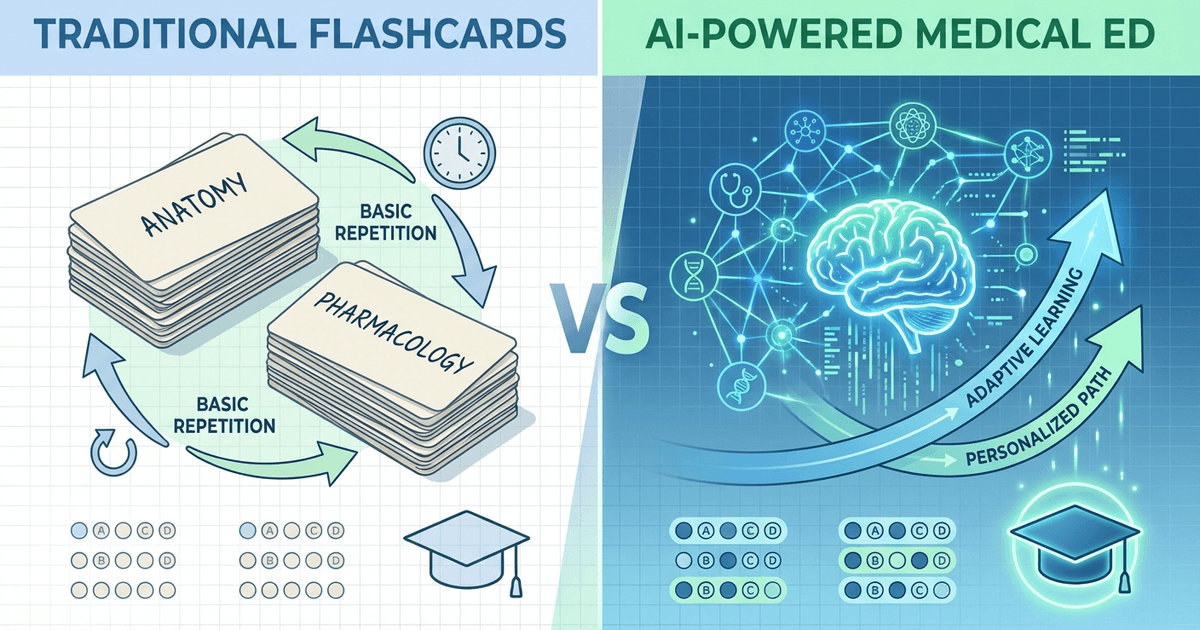
Anki vs Oncourse: Best Flashcard App for Medical Exams in 2024
When preparing for high-stakes medical exams like NEET-PG, USMLE, or UKMLA, choosing the right flashcard app can make or break your preparation strategy. With thousands of concepts to master and limited time, medical students need tools that don't just help them memorize—they need platforms that help them think like doctors.
The flashcard app market is dominated by two distinct approaches: traditional spaced repetition systems like Anki, and AI-powered adaptive learning platforms like Oncourse. While both promise to improve retention and exam performance, they differ dramatically in their methodology, user experience, and effectiveness for medical education.
In this comprehensive comparison, we'll analyze both platforms across key dimensions that matter most to medical students: content quality, learning methodology, exam alignment, user experience, and overall value proposition. Whether you're starting your medical journey or switching from your current study method, this guide will help you make an informed decision.
Quick Comparison Overview
Feature | Oncourse | Anki |
|---|---|---|
Content Creation | AI-generated + Expert-validated | User-created or downloaded |
Learning Method | Adaptive AI + Spaced Repetition | Traditional Spaced Repetition |
Exam Focus | NEET-PG, USMLE, UKMLA specific | Generic (any subject) |
Question Bank | 100k+ medical MCQs integrated | Separate download required |
AI Features | Built-in AI study partner (Rezzy) | None (manual setup only) |
Mobile Experience | Native app optimized | Basic mobile interface |
Pricing | Premium subscription | Free + paid features |
Setup Time | Ready to use immediately | Hours of deck setup/import |
1. Oncourse: AI-Powered Medical Education Platform
Oncourse represents the new generation of medical exam preparation tools, built specifically for modern medical education. Unlike traditional flashcard apps, Oncourse combines adaptive learning technology with medical expertise to create a comprehensive study ecosystem.
Key Features
AI-Powered Content Generation: Oncourse uses a three-model AI system (Generator, Validator, and Adversarial Reviewer) to create and validate medical content. This ensures accuracy while maintaining the clinical reasoning depth required for modern medical exams. Exam-Specific Alignment: The platform is built around actual exam patterns—NEET-PG (60% clinical, 30% application-based, 10% factual), USMLE clinical reasoning focus, and UKMLA integrated approach. Integrated Learning Ecosystem: Beyond flashcards, Oncourse offers:
100k+ medical MCQs with detailed explanations
High-yield notes aligned with exam weightage
Adaptive custom quizzes targeting weak areas
Image-based questions for radiology, pathology, and dermatology
Rezzy AI Study Partner: An AI assistant that can:
Create flowcharts, tables, and mnemonics on demand
Fetch trusted medical videos
Personalize content to match individual learning styles
Provide voice-based study support
Pros
Ready to use immediately - No setup or deck creation required
Medical expert validation - Content reviewed by medical professionals
Adaptive learning - AI adjusts difficulty based on performance
Comprehensive platform - Questions, notes, and flashcards in one place
Mobile-optimized - Smooth experience across devices
Regular updates - Content stays current with medical guidelines
Cons
Premium pricing - Requires subscription for full features
Limited customization - Less flexibility than user-created content
Newer platform - Smaller community compared to established tools
2. Anki: Traditional Spaced Repetition System
Anki has been the gold standard for spaced repetition learning since 2006. Built on cognitive science principles, it uses algorithmic spacing to optimize long-term retention through timed reviews.
Key Features
Powerful Spaced Repetition Algorithm: Anki's SM-2 algorithm adjusts card intervals based on recall difficulty, optimizing review timing for maximum retention. Complete Customization: Users can create cards with:
Text, images, audio, and video
Custom formatting and styling
Advanced card types and templates
Mathematical formulas and diagrams
Extensive Add-on Ecosystem: Thousands of community-created add-ons enhance functionality:
Statistics and analytics
Enhanced editors
Study session timers
Advanced scheduling options
Cross-Platform Synchronization: Cards sync seamlessly across desktop, web, and mobile platforms.
Pros
Free core functionality - Basic features available at no cost
Highly customizable - Unlimited flexibility in card creation
Proven algorithm - Time-tested spaced repetition system
Large community - Extensive shared deck library
Offline capability - Full functionality without internet
Platform agnostic - Works for any subject matter
Cons
Steep learning curve - Requires significant time investment to master
Content quality varies - Shared decks may contain errors or outdated information
No built-in medical content - Requires finding or creating medical-specific materials
Limited mobile experience - Desktop-focused design
Time-intensive setup - Hours needed to configure optimal study environment
Key Differences Analysis
Content Quality and Accuracy
Oncourse employs a three-model AI validation system where content must survive both validator and adversarial reviewer checks. For example, when generating content about atrial fibrillation rate control, the system caught that calling digoxin "first-line" was misleading since it only controls rate at rest, not during exertion—a distinction crucial for exam success. Anki relies on user-generated or community-shared content. While popular medical decks exist (like AnKing for USMLE), quality control depends entirely on the creator's expertise and diligence. Errors can propagate across thousands of users without systematic verification.
Learning Methodology
Oncourse combines traditional spaced repetition with adaptive AI that adjusts content difficulty, question types, and explanations based on individual learning patterns. The system recognizes when a student struggles with clinical reasoning versus factual recall and adapts accordingly. Anki uses pure algorithmic spaced repetition based on user-reported difficulty ratings. While effective for memorization, it lacks intelligence about content relationships or learning context specific to medical education.
Exam Preparation Focus
Oncourse is purpose-built for medical exams, with content structure matching actual exam patterns. For NEET-PG preparation, this means emphasis on clinical scenarios and application-based questions rather than isolated facts. Anki is subject-agnostic, requiring users to structure their own medical study approach. While flexible, this places the burden on students to understand optimal medical education pedagogy.
User Experience and Setup
Oncourse offers immediate usability—students can start productive study sessions within minutes of registration. The mobile app provides a native, touch-optimized experience designed for on-the-go medical study. Anki requires substantial initial setup: finding quality medical decks, configuring settings, installing useful add-ons, and learning the interface. New users often spend their first week just setting up their study environment rather than studying.
Which Platform Should You Choose?
Choose Oncourse If You:
Need immediate study results without time for extensive setup
Prefer expert-curated content over self-created materials
Want integrated exam preparation with questions, notes, and flashcards
Value mobile-first study experience for studying anywhere
Prepare for NEET-PG, USMLE, or UKMLA specifically
Want AI assistance for personalized learning support
Choose Anki If You:
Enjoy customizing your study environment and have time for setup
Want complete control over content creation and formatting
Prefer free tools and don't mind investing time over money
Study multiple subjects beyond medicine using one platform
Have found high-quality medical decks that match your exam needs
Prefer traditional desktop study over mobile-centric learning
Making the Transition
From Anki to Oncourse
Many medical students find the transition smooth since both platforms use spaced repetition principles. The key difference is shifting from content creation to content consumption and trusting AI-powered adaptive learning.
Starting Fresh with Either Platform
If you're beginning your medical exam preparation, consider your study style, available time, and technical comfort level. Students who succeed with traditional study methods often adapt well to Anki, while those preferring guided, structured learning tend to favor Oncourse.
Cost Considerations
Oncourse requires a subscription investment but includes all content, features, and regular updates. For medical students, this represents comprehensive exam preparation in a single platform. Anki offers free core functionality with optional paid features (mobile apps, enhanced sync). However, the time investment for setup and content creation has opportunity cost—hours spent configuring Anki could be spent studying.
The Future of Medical Education Technology
The comparison between Anki and Oncourse reflects a broader shift in educational technology. While traditional tools require students to become system administrators of their own learning, AI-powered platforms focus on learning efficiency and evidence-based pedagogical approaches.
For medical education specifically, the trend toward integrated, adaptive, and expert-validated content aligns with the complexity and stakes of modern medical training. Students need tools that understand not just memorization, but medical reasoning, clinical application, and exam-specific requirements.
According to the National Board of Examinations, modern medical exams increasingly focus on clinical application rather than rote memorization, making AI-powered adaptive learning platforms particularly relevant for current exam patterns.
Conclusion
Both Anki and Oncourse can support successful medical exam preparation, but they serve different student needs and learning styles. Oncourse offers a modern, AI-powered approach optimized specifically for medical education, while Anki provides a proven, customizable foundation for dedicated students willing to invest setup time.
The choice ultimately depends on your priorities: immediate efficiency and expert-guided learning with Oncourse, or complete control and customization with Anki. Many successful medical students have used both approaches—the key is choosing the platform that aligns with your study preferences and sticking with it consistently.
Remember, the best flashcard app is the one you'll actually use consistently. Whether you choose the cutting-edge AI approach of Oncourse or the time-tested flexibility of Anki, success comes from regular, focused study sessions and active engagement with the material.
Ready to supercharge your medical exam preparation? Explore Oncourse's AI-powered medical education platform and experience the future of medical study technology. For more insights on AI-powered medical education tools, discover how technology is transforming medical exam preparation.