Step 2 Percentiles 2026: What Your Score Means for Match Readiness
Decode your Step 2 CK percentile for 2026 residency match readiness. Learn what percentile bands mean for specialty competitiveness, how to convert score gaps into targeted study plans, and avoid common mistakes that tank performance.
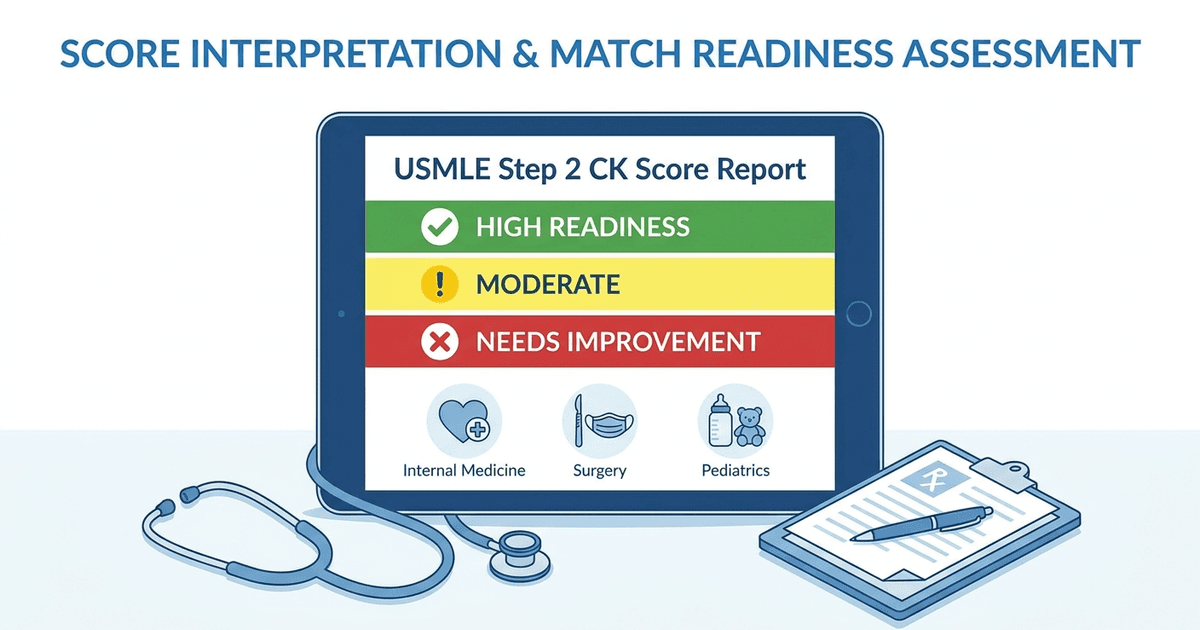
Step 2 Percentiles 2026: What Your Score Means for Match Readiness
You got your Step 2 CK score back. The number sits there on your screen — maybe 247, maybe 238, maybe 261. But what does it actually mean for your residency applications? More importantly, what should you do next?
Step 2 CK percentiles matter more in 2026 than ever before. With Step 1 now pass/fail, your CK score is often the primary objective metric programs use to screen applications and extend interviews. A percentile isnt just a ranking — it's a signal about your clinical readiness and how programs will view your competitiveness.
But here's what most students get wrong: they treat percentiles like verdicts instead of action items. Your percentile band should dictate your next 7 days of studying, not determine your career trajectory. Whether you scored in the 40th percentile or the 85th, theres a specific set of moves that will maximize your readiness for both retakes and residency applications.
This guide breaks down exactly what your Step 2 CK percentile means, which specialty doors it opens or closes, and how to convert any score gap into a targeted weak-area repair plan that actually moves the needle.
Understanding Step 2 CK Percentiles and Scaled Scores
Step 2 CK uses a three-digit scaled score ranging from 1-300, with a current national mean around 248-250. Your percentile rank shows how you performed compared to other first-time test-takers from LCME-accredited medical schools over a three-year period.
The percentile system works differently than Step 1. A 240 on Step 2 CK places you at roughly the 25th percentile — meaning 75% of test-takers scored higher. This isnt a reflection of your clinical abilities; its simply where you landed in the statistical distribution of that particular exam administration.
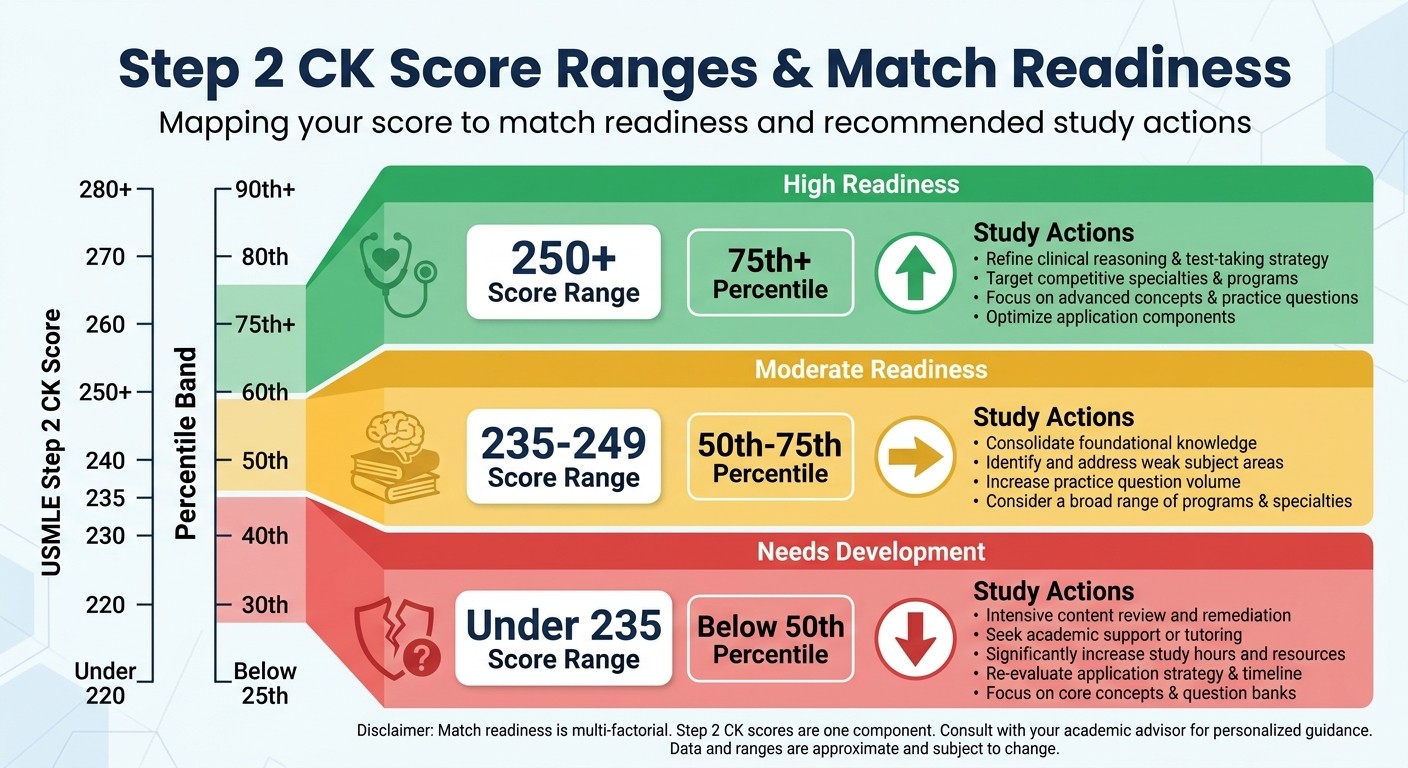
Key percentile benchmarks for 2026:
85th+ percentile (255+ score): Strong competitive position for most specialties
70th-85th percentile (245-254 score): Solid positioning, specialty-dependent competitiveness
50th-70th percentile (235-244 score): Around average, requires strategic specialty selection
30th-50th percentile (225-234 score): Below average, limits competitive specialty options
Below 30th percentile (<225 score): Significant improvement needed for most residency paths
The critical insight: percentiles shift annually based on test-taker performance. A 250 might be 75th percentile one year and 70th the next. Always check the current USMLE norm table rather than relying on outdated percentile conversions.
What Your Percentile Actually Predicts About Match Readiness
Your Step 2 CK percentile serves as a screening tool, not a crystal ball. Programs use percentile cutoffs to manage overwhelming application volumes, but your percentile doesnt determine your residency fate.
High readiness band (75th+ percentile):
This percentile range signals strong clinical knowledge and test-taking ability. You're competitive for most specialties, though highly competitive fields like dermatology, orthopedics, and radiology often expect 85th+ percentile performance. Your score shouldnt be a limiting factor in your applications.
Moderate readiness band (50th-75th percentile):
You have solid clinical knowledge but may face screening cutoffs at some programs. This band requires strategic specialty selection and geography flexibility. Many internal medicine, family medicine, and pediatrics programs remain accessible, but competitive subspecialties become more challenging.
Needs development band (Below 50th percentile):
Your score likely reflects knowledge gaps that need addressing before residency applications. This doesnt mean youre a poor future physician — it means you need targeted preparation. Consider delaying applications for one year while addressing weak areas and potentially retaking Step 2 CK.
Programs interpret percentiles within context. A 60th percentile score paired with strong clinical grades, research, and letters of recommendation can outweigh an 80th percentile score with weaker supporting credentials.
How Self-Assessments Correlate with Actual Performance
Your NBME and UWorld self-assessments provide percentile predictions, but they carry significant error margins. Understanding these correlations helps you interpret practice scores and adjust expectations.
NBME CBSSA correlation:
NBME practice exams show the strongest correlation with actual Step 2 CK performance (r ≈ 0.80-0.87). However, they typically underpredict your score by 2-5 points and have an error range of ±8-10 points. If your latest NBME CBSSA predicts 245, expect your actual score to fall between 240-253.
UWorld Self-Assessments:
UWSA2 correlates well (r ≈ 0.80-0.85) but tends to overpredict by 2-5 points. UWSA1 is less reliable (r ≈ 0.70-0.78) and often overpredicts by 5-10 points. Use UWSA2 as your optimistic anchor and NBME as your conservative estimate.
Free 120 limitations:
The NBME Free 120 shows weaker correlation (r ≈ 0.65-0.75) with actual scores. While rough conversions exist (90% correct ≈ 260, 85% ≈ 250, 80% ≈ 240), the error margin reaches ±12-15 points. Use it for interface familiarity, not score prediction.
Oncourse tracks your predicted score across practice sessions, giving you a running estimate based on your question performance patterns. This helps identify when youre ready for the real exam rather than chasing a specific practice score target.
Interpreting Readiness Signals Without Panic
Low percentiles trigger panic, but they shouldnt derail your entire career timeline. Your percentile is a snapshot, not a life sentence. Here's how to interpret different scenarios without catastrophizing:
Scenario: 35th percentile on first attempt
This signals knowledge gaps, not personal failure. Many successful residents scored similarly on their first attempt. Your move: systematic weak-area identification and targeted repair over 2-3 months before considering a retake.
Scenario: Declining percentile trend on practice exams
If your NBMEs show 65th → 58th → 52nd percentile, you may be burning out or developing test anxiety. Step back, review your study methods, and address fatigue before test day.
Scenario: High practice scores, disappointing actual percentile
This gap often reflects test-day issues: anxiety, pacing problems, or overconfidence. Your clinical knowledge is likely solid — focus on test-taking strategy and stress management for any future attempts.
The key insight: percentiles measure test performance, not clinical potential. Use them as diagnostic tools to identify improvement areas, not as judgments on your future as a physician.
Specialty-Specific Percentile Targets for 2026
Different specialties expect different percentile ranges. Understanding these benchmarks helps you set realistic targets and make strategic application decisions.
Highly competitive specialties (85th+ percentile expected):
Dermatology: Average matched score ~257 (90th+ percentile)
Orthopedic Surgery: Average ~257 (90th+ percentile)
Diagnostic Radiology: Average ~256 (85th+ percentile)
Anesthesiology: Average ~252 (80th+ percentile)
Moderately competitive (70th-85th percentile competitive):
Internal Medicine: Average ~251 (75th+ percentile)
Emergency Medicine: Average ~248 (70th+ percentile)
General Surgery: Average ~249 (70th+ percentile)
Pathology: Average ~245 (60th+ percentile)
Less competitive (50th+ percentile often sufficient):
Family Medicine: Average ~243 (55th+ percentile)
Pediatrics: Average ~247 (65th+ percentile)
Psychiatry: Average ~240 (45th+ percentile)
Physical Medicine: Average ~238 (40th+ percentile)
These averages shift yearly, but the relative rankings remain consistent. If your percentile falls below your target specialty's average, consider broadening your applications geographically or exploring backup specialties.
Converting Percentile Gaps into 7-Day Action Plans
Your percentile identifies the problem; your next week of studying should target the solution. Here's how to convert any percentile gap into concrete action items:
For percentiles below 50th (major knowledge gaps):
Days 1-2: Complete diagnostic assessment using Oncourse's weak topics analysis to identify your bottom 3 subject areas
Days 3-5: Focused review of weakest subject using targeted question blocks (40 questions daily from weak areas)
Days 6-7: Mixed practice incorporating weak areas with timed blocks to test retention
For percentiles 50th-75th (refinement needed):
Days 1-2: Error log review to identify recurring mistake patterns in clinical reasoning
Days 3-4: Targeted practice on specific question types you miss most (next-best-step vs. diagnosis vs. emergency management)
Days 5-7: Full-length timed practice with immediate review using Rezzy's explanation chat for missed concepts
For percentiles 75th+ (optimization phase):
Days 1-3: Focus on high-yield, low-frequency topics that could provide marginal gains
Days 4-5: Test-taking strategy refinement and pacing optimization
Days 6-7: Confidence building with mixed practice and light content review
The key is specificity. Oncourse's weak topics feature automatically identifies your knowledge gaps from practice performance, letting you skip generic study plans and focus on personalized improvement areas.
High-Yield Areas That Drive Percentile Improvements
Certain topics appear frequently on Step 2 CK and offer the highest return on study time investment. Targeting these areas can quickly shift your percentile upward:
Internal Medicine (35% of exam):
Cardiovascular: ACS management, heart failure, arrhythmias, valvular disease
Endocrine: Diabetes complications, thyroid disorders, adrenal emergencies
Infectious Disease: Sepsis protocols, HIV management, antibiotic selection
Renal: AKI/CKD staging, electrolyte emergencies, dialysis indications
For comprehensive internal medicine review, explore our Step 2 CK internal medicine study guide and practice with targeted internal medicine lessons. Surgery (15% of exam):
Emergency procedures: appendicitis, bowel obstruction, trauma protocols
Preoperative risk assessment and optimization
Postoperative complications recognition and management
OB/GYN (15% of exam):
High-risk pregnancy management
Emergency obstetrics: preeclampsia, hemorrhage, fetal distress
Gynecologic emergencies: ectopic pregnancy, ovarian torsion
Pediatrics (15% of exam):
Growth and development milestones
Pediatric emergencies: dehydration, respiratory distress
Vaccination schedules and contraindications
Review high-yield pediatric concepts in our Step 2 CK pediatrics guide. Psychiatry (10% of exam):
Major depression and suicide risk assessment
Substance abuse disorders and withdrawal management
Psychosis and mood disorder differentiation
Ethics/Communication (10% of exam):
Informed consent scenarios
End-of-life care decisions
Patient autonomy vs. beneficence conflicts
When Rezzy explains a missed question from these high-yield areas, dive deeper into related concepts. One cardiology explanation might reveal gaps in heart failure management that extend to multiple question types.
Common Mistakes That Tank Percentiles
Certain study habits consistently lead to underwhelming percentile performance, even when students feel prepared. Avoiding these traps can prevent percentile drops:
Mistake 1: Chasing percentile calculators
Spending time on multiple prediction tools instead of focused studying. Percentile calculators have wide error margins and create anxiety without improving performance.
Mistake 2: Reviewing only correct answers
Many students skip explanation review for questions they got right, missing opportunities to solidify reasoning and catch lucky guesses.
Mistake 3: Ignoring repeated weak topics
Continuing general review instead of drilling down on consistently missed subject areas. If cardiology appears in your weak topics repeatedly, it needs dedicated attention.
Mistake 4: Delaying timed practice
Practicing untimed questions until the final weeks. Time pressure changes decision-making patterns and reveals different knowledge gaps than untimed practice.
Mistake 5: Underestimating ethics and communication
Treating these as "easy points" without understanding the clinical reasoning frameworks behind patient interaction scenarios.
Mistake 6: Content overload without application
Reading extensively without immediate question practice to test understanding and retention.
Mistake 7: Ignoring test-day logistics
Failing to practice with the same timing, break schedule, and mental strategies youll use on exam day.
When you miss questions in practice, use Oncourse's explanation chat to explore not just why the correct answer is right, but why your reasoning led to the wrong choice. This prevents repeating the same thinking errors.
Final 30-Day Readiness Assessment Protocol
Your last month should focus on percentile optimization through strategic practice and gap closure. This protocol helps ensure youre testing at your highest potential percentile:
Weeks 4-3 before exam:
Complete final NBME CBSSA for baseline percentile estimate
Identify and drill 2-3 persistent weak areas daily
Begin timed full-length practice blocks
Track improvement using Oncourse's predicted score feature
Weeks 2-1 before exam:
Take UWSA2 for optimistic percentile range
Focus review on high-yield, commonly tested topics
Practice test-day timing and break schedules
Light content review, heavy question practice
Week of exam:
Complete Free 120 for interface familiarity
Review error log for final pattern identification
Maintain normal sleep schedule
Avoid new content, focus on confidence building
48 hours before exam:
Light review of algorithms and mnemonics
Practice one final 40-question timed block
Plan test-day logistics (route, timing, meals)
Mental preparation and stress management
The goal isnt cramming for percentile points — its ensuring your test-day performance reflects your actual clinical knowledge level without anxiety or pacing issues interfering.
Frequently Asked Questions
How accurate are Step 2 CK percentile predictions from practice exams?
NBME CBSSAs predict within ±8-10 points about 67% of the time, while UWorld assessments have slightly wider error margins. Percentile predictions are more reliable than raw score predictions, but expect variance. Use multiple assessment types for better accuracy.
Should I retake Step 2 CK if Im below the 50th percentile?
It depends on your career timeline and target specialties. Below-50th percentile scores limit options for competitive specialties but dont prevent matching in primary care fields. Consider retaking if you have time to improve and need higher scores for your target programs.
Do international medical graduates need higher percentiles than US students?
Yes, IMGs typically need 70th+ percentile scores (245+) to be competitive for the same residency positions. The average matched IMG scores about 242 overall, but competitive specialties expect higher performance from international applicants.
How much can focused studying improve my percentile?
Targeted weak-area study can improve scores by 10-20 points (roughly 10-20 percentile points) over 2-3 months. The improvement depends on your starting knowledge base and study efficiency. Systematic gap identification and repair consistently produces better results than general review.
Can a high Step 2 CK percentile compensate for a failed Step 1?
A strong Step 2 CK performance (75th+ percentile) can partially offset Step 1 concerns, but youll need exceptional clinical grades and strong letters of recommendation. Programs view Step 1 failures as concerning regardless of subsequent performance.
Should I delay my exam if practice percentiles arent reaching my target?
If practice exams consistently show percentiles 15+ points below your specialty target and you have time flexibility, consider delaying. However, if youre within 10 percentile points of your target, test-day performance variance might get you there.
---
Your Step 2 CK percentile is just one data point in your residency application, but it's an important one. The key is using it strategically — as a diagnostic tool for improvement and a guide for realistic specialty targeting, not as a judgment on your worth as a future physician.
Prepare smarter with Oncourse AI — adaptive MCQs, spaced repetition, and AI explanations built for USMLE Step 2 CK. Download free on Android and iOS.