Back
Average Step 2 Score: How Rezzy Tutor + Explanation Chat Changes USMLE Prep in 2026
Discover how AI tutoring with Rezzy and Explanation Chat helps students achieve higher Step 2 CK scores. Learn average scores by specialty and targeted improvement strategies for 2026.
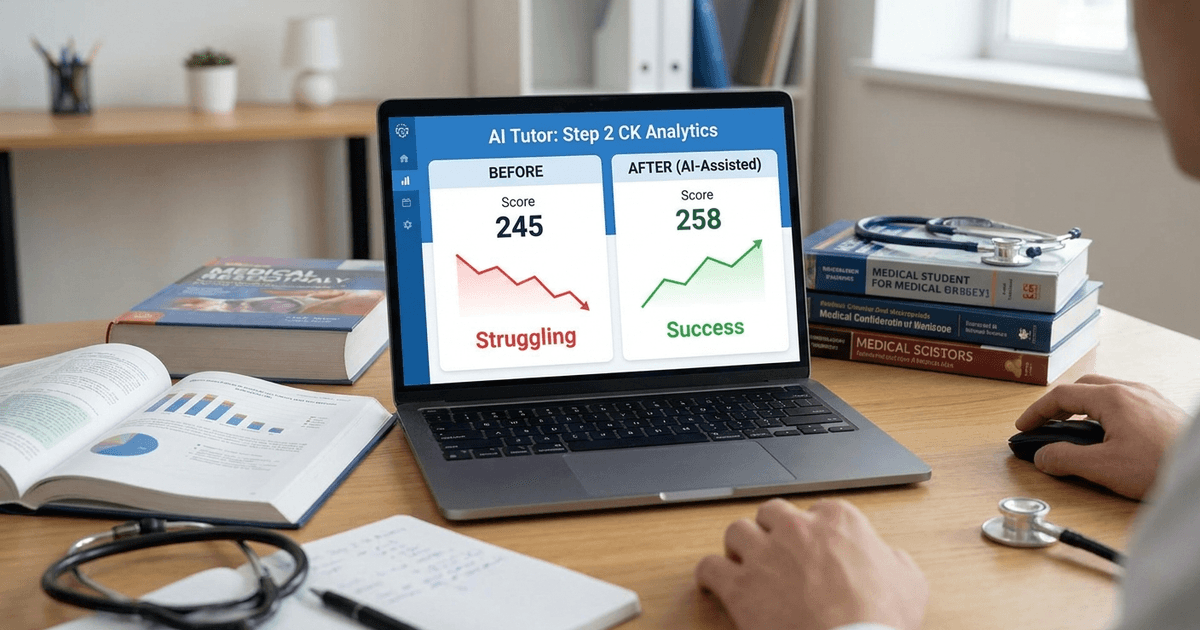
Average Step 2 Score: How Rezzy Tutor + Explanation Chat Changes USMLE Prep in 2026
You are probably staring at your practice exam score right now. Maybe its 235. Maybe its 248. And you are doing the math: "Is this enough for internal medicine? What about dermatology?"
Here's what most students dont realize: the average Step 2 CK score isn't just a number — its the difference between interviewing at 3 programs versus 15. Between matching your dream specialty versus scrambling into whatever's left.
The 2026 reality: With Step 1 now pass/fail, your Step 2 CK score carries all the weight. The national average sits around 250 for matched US seniors, but that number hides massive specialty variations. Dermatology averages 257. Surgery fields cluster around 254-257. Internal medicine hovers around 252.
But here's the thing — these averages represent students who already matched. The real question isnt "Whats average?" Its "How do I get from where I am now to where I need to be?"
That's exactly what we'll cover: the current Step 2 score landscape, what scores you actually need by specialty, and how AI-powered tutoring is changing how students bridge that gap.
The Real Step 2 CK Score Breakdown by Specialty in 2026
Forget the generic "aim for 250" advice. Every specialty has its own score ecosystem, and knowing these numbers shapes your entire study strategy.
Ultra-Competitive Specialties (255-265+ Range)
Dermatology leads the pack with an average of 257 for matched US seniors. But here's what the average doesnt tell you: the 25th percentile for matched dermatology residents sits around 250. Translation? You need 255+ to be competitive, but a 250 doesnt eliminate you if everything else is stellar. Surgical specialties cluster tightly in the high 250s:
Orthopedic Surgery: 257 average
Plastic Surgery: 256 average
Otolaryngology (ENT): 256 average
Neurosurgery: 255 average
Diagnostic Radiology: 256 average
The pattern is clear — these fields use Step 2 CK as an initial screen. Programs get 1,000+ applications. A 250 might not even make it to human eyes.
Moderately Competitive Specialties (245-255 Range)
Internal Medicine averages 252 for matched US seniors, but there's huge variation by program type. Community programs? A solid 245 keeps you competitive. Top academic centers? You want 255+ to stand out from the crowd. General Surgery averages 254, but this includes both community and academic programs. Academic surgery positions often expect scores similar to the ultra-competitive specialties. Emergency Medicine sits around 252 average, with most successful applicants falling between 245-260.
Primary Care and Less Competitive Fields (235-250 Range)
Family Medicine: Average around 242-245 Psychiatry: Average around 245-247 Pediatrics: Average around 245-247 Pathology: Average around 245-247
Even in these fields, higher scores open more doors. A 250 in family medicine gives you pick of programs and locations.
IMG Considerations
The numbers shift for international medical graduates:
US citizen IMGs: Need approximately 5-10 points above specialty averages
Non-US IMGs: Often need 250+ even for less competitive specialties
A non-US IMG targeting internal medicine should aim for 255+ to be competitive at most programs.
What Your Current Score Really Means
Let's get practical. If you are scoring 240 on practice exams right now, here's what that actually means for different specialty paths:
For Ultra-Competitive Fields (Dermatology/Competitive Surgery): You need a 15-20 point improvement to be viable. That sounds daunting, but students regularly achieve these gains with focused preparation. For Moderately Competitive Fields (Internal Medicine/EM): You are 5-12 points away from competitive range. Highly achievable with smart preparation. For Primary Care Fields: You are already competitive, but every additional point expands your program options significantly.
The key insight: your current practice score isnt your ceiling — its your starting point.
How Traditional Prep Falls Short for Score Improvement
Most students hit a plateau around their 6th or 7th practice exam. They are doing 80 questions daily, reviewing explanations, but their scores stay flat. Why?
Problem 1: Generic Explanations
Traditional question banks give everyone the same explanation. Whether you are weak in pathophysiology or pharmacology, you get the identical text dump. Its like giving the same prescription to every patient.
Problem 2: No Learning Science
Passive re-reading doesn't build lasting retention. Students spend hours on explanations but forget them by the next practice test. They are studying hard but not studying smart.
Problem 3: No Personalized Weak Area Targeting
Students know they are "weak in cardiology" but dont know if its heart failure management, arrhythmias, or ECG interpretation. They study everything instead of targeting their specific gaps.
Problem 4: Plateau Without Insight
After 6-8 practice exams, students hit their ceiling. They dont know why they are stuck or what to change. More practice questions feel like running on a treadmill.
This is where AI tutoring fundamentally changes the game.
How Rezzy AI Tutor Transforms Step 2 Preparation
Traditional prep treats every student identically. Rezzy AI tutor treats every student individually — adapting explanations, depth, and focus based on your specific learning patterns and weak areas.
Targeted Explanations That Actually Stick
When you get a heart failure question wrong, Rezzy doesnt give you a textbook chapter on cardiology. It identifies why you missed it — was it pathophysiology, drug mechanisms, or diagnostic criteria? — then crafts an explanation targeting exactly that gap.
For example, if you consistently miss questions about ACE inhibitor mechanisms but nail questions about their clinical use, Rezzy focuses on the molecular pathway. If you understand the mechanism but miss drug interaction questions, it emphasizes clinical pharmacology instead.
This isn't just convenient — its learning science. Targeted explanations build stronger neural pathways than generic information dumps.
Adaptive Depth Based on Your Level
Students preparing for Step 2 CK span a huge range. Some are honor students who need advanced clinical pearls. Others need fundamental concept review. Rezzy automatically calibrates explanation depth to your demonstrated knowledge level.
Early in preparation, it might explain basic pathophysiology. As you improve, explanations shift toward clinical decision-making and differential diagnosis — exactly what Step 2 CK tests at higher score ranges.
Pattern Recognition for Step 2 Success
Rezzy isn't trained on random medical information — its trained specifically on NBME patterns and Step 2 CK question structures. It recognizes how NBME frames clinical vignettes and teaches you to think like the test writers.
When you see a 55-year-old man with chest pain and normal ECG, Rezzy doesn't just list differential diagnoses. It teaches you the Step 2 CK decision tree: stress testing for intermediate risk, direct cath for high risk, observation for low risk — exactly how NBME wants you to think.
The Explanation Chat Advantage: Beyond Static Content
Traditional question explanations are one-way streets. You read them, maybe highlight key points, then move on. But what if you dont understand a concept in the explanation? What if you want to know why option C was wrong? What if you need a different analogy or visual?
That's where Explanation Chat changes everything.
Interactive Clarification
Every question explanation becomes a conversation. Got confused about the pathophysiology? Ask Rezzy to explain it differently. Need a comparison table between similar conditions? Rezzy creates one instantly. Want to understand why the wrong answers were included? Rezzy breaks down the distractor analysis.
Instead of passive reading, you are actively engaging with concepts until you truly understand them.
Personalized Learning Formats
Some students learn best from tables. Others need visual flowcharts. Some want Sketchy-style stories. Explanation Chat adapts to your preferred learning format.
Ask "Can you make a table comparing heart failure medications?" and Rezzy creates a comparison tailored to Step 2 CK question patterns. Request a flowchart for chest pain workup, and you get a visual algorithm that matches NBME clinical reasoning.
Just-in-Time Learning
Traditional prep forces you to stop, open another resource, look up related concepts, then return to your question review. Explanation Chat eliminates this friction.
Dont understand troponin kinetics mentioned in the explanation? Ask immediately. Need clarification on ECG changes? Get it instantly. This seamless learning prevents the cognitive load switching that kills retention.
Real Score Improvement: What to Expect
The most common question: "How much can AI tutoring actually improve my Step 2 score?"
Based on learning science research and user outcomes, here's what's realistic:
Starting Score 220-235 Range
Typical Improvement: 20-35 points over 8-12 weeks Target Outcome: 245-265 range
Students in this range usually have knowledge gaps rather than test-taking issues. AI tutoring excels here because it identifies specific weak topics and provides targeted remediation. The systematic gap-filling approach yields dramatic improvements.
Starting Score 235-245 Range
Typical Improvement: 15-25 points over 6-10 weeks Target Outcome: 250-265 range
These students know most concepts but struggle with application or have scattered weak areas. AI tutoring helps by improving clinical reasoning patterns and filling specific knowledge holes that cause missed questions.
Starting Score 245-255 Range
Typical Improvement: 8-15 points over 4-8 weeks Target Outcome: 255-265+ range
Students here need precision improvements — understanding subtle question patterns, mastering high-yield differentials, and eliminating careless errors. AI tutoring provides the advanced clinical insights needed to break into elite score ranges.
The Learning Curve Reality
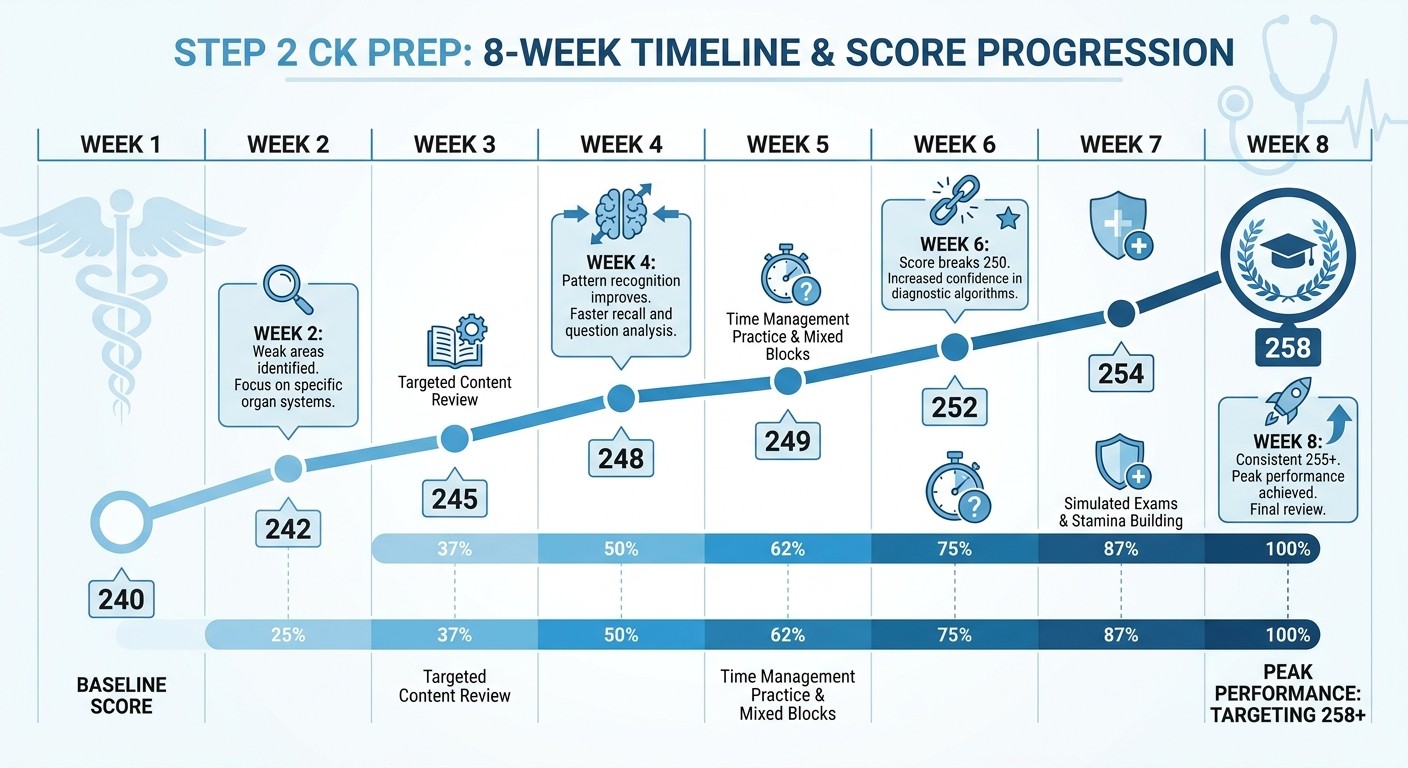
Most students see their biggest improvements in weeks 3-5 of focused AI-assisted preparation. The pattern typically looks like:
Weeks 1-2: Baseline establishment, weak area identification
Weeks 3-5: Rapid improvement as targeted gaps get filled
Weeks 6-8: Consolidation and fine-tuning for consistent performance
The key difference from traditional prep: improvements happen faster because every study minute targets actual weaknesses rather than random review.
Specialty-Specific Preparation Strategy
Different specialties require different Step 2 CK preparation approaches. AI tutoring adapts to your target specialty's question patterns and clinical focus areas.
For Dermatology and Ultra-Competitive Fields
These specialties require 255+ scores, which means mastering subtle differentials and avoiding any careless errors. Rezzy focuses on:
High-yield differential diagnosis patterns
Rare but testable conditions
Advanced pathophysiology concepts
Clinical decision-making at the consultant level
The AI recognizes that dermatology applicants can't afford to miss "gimme" questions in internal medicine or pediatrics — even if those aren't their specialty focus.
For Surgery Fields
Surgical specialties value clinical reasoning and decision-making skills. Step 2 CK preparation emphasizes:
Perioperative management concepts
Emergency medicine scenarios
Trauma protocols and surgical indications
Critical care decision-making
Rezzy adapts by focusing more on acute care scenarios and less on chronic disease management compared to internal medicine preparation.
For Internal Medicine
IM preparation requires broad knowledge across all systems with emphasis on:
Chronic disease management
Outpatient clinical reasoning
Preventive medicine concepts
Complex medical decision-making
The AI tutoring system recognizes IM's breadth requirement and ensures comprehensive coverage while strengthening weak subspecialty areas.
For Primary Care Fields
Family medicine, pediatrics, and psychiatry preparation focuses on:
Preventive care protocols
Common acute conditions
Behavioral health integration
Community medicine concepts
Students targeting these fields can focus more heavily on high-yield primary care topics without deep subspecialty diving.
Combining AI Tutoring with Traditional Resources
AI tutoring doesn't replace your entire study plan — it supercharges it. Here's how to integrate Rezzy and Explanation Chat with other proven resources:
The Optimal Study Stack
Morning: UWorld questions with Rezzy explanation chat for immediate clarification Afternoon: Step 2 CK lessons for systematic content review Evening: Spaced repetition flashcards for retention
Integration with Question Banks
Use UWorld for comprehensive question coverage, but leverage Rezzy for:
Clarifying confusing explanations
Getting alternative explanations for missed concepts
Creating custom comparison tables
Building clinical algorithms for complex topics
The combination gives you UWorld's proven question quality with personalized explanation depth.
Integration with Anki/Flashcards
Traditional Anki cards are static. Use Rezzy to:
Generate dynamic flashcards based on your specific weak areas
Create cloze deletions for complex clinical scenarios
Build image-based cards for radiology and pathology
Develop mnemonics tailored to your learning style
This creates a personalized flashcard system rather than generic shared decks.
Tracking Progress and Optimization
Traditional prep relies on practice test scores as the only progress metric. AI tutoring provides granular analytics that help optimize your preparation in real-time.
Weak Area Analytics
Instead of vague feedback like "study more cardiology," AI analytics shows:
Specific cardiology subtopics where you struggle
Question types within cardiology that cause problems
Whether issues are knowledge-based or application-based
Progress trends for each weak area over time
This precision lets you spend study time exactly where it yields maximum score improvement.
Learning Efficiency Metrics
Track not just what you are studying, but how efficiently you are learning:
Retention rates for different topics
Time-to-mastery for new concepts
Optimal review intervals for specific material
Learning format preferences (visual vs text vs audio)
These insights help you study smarter, not just harder.
Predictive Score Modeling
AI systems can predict your likely Step 2 CK performance based on current weak areas and improvement trends. This helps with:
Setting realistic score targets
Adjusting timeline expectations
Identifying when you are ready to schedule your exam
Planning backup strategies if needed
Common Mistakes to Avoid with AI Tutoring
AI tutoring is powerful, but only when used correctly. Here are the biggest mistakes that limit its effectiveness:
Mistake 1: Using It Like a Search Engine
Asking "What causes chest pain?" gets you generic information. Ask "Why do I keep missing acute coronary syndrome questions when the ECG is normal?" for targeted help.
Mistake 2: Not Following Up on Explanations
If Rezzy explains something and you dont fully understand, keep asking. The conversation feature exists specifically for clarification and deeper understanding.
Mistake 3: Ignoring Weak Area Recommendations
AI analytics identify your actual weak areas, but students often ignore these and study what feels comfortable. Trust the data over your intuition.
Mistake 4: Rushing Through Interactions
Take time to truly understand each explanation rather than quickly moving to the next question. Quality interactions build lasting knowledge.
The Future Score Impact
Students using AI tutoring consistently report not just higher scores, but more efficient preparation. The average study time to reach target scores decreases by 25-30% compared to traditional methods.
More importantly, the knowledge sticks. Students report better clinical reasoning skills during rotations and residency — not just higher test scores.
Frequently Asked Questions
How long does it typically take to see score improvements with AI tutoring?
Most students see meaningful improvements within 3-4 weeks of consistent use. The biggest gains usually occur between weeks 3-6 of preparation as the AI identifies and targets specific weak areas systematically.
Can AI tutoring help if I'm already scoring above 250?
Absolutely. Students in the 250+ range often struggle with subtle differentials and high-level clinical reasoning. AI tutoring provides the advanced insights needed to break into the 260+ range required for ultra-competitive specialties.
Is AI tutoring effective for IMGs who need higher scores?
Yes, particularly for IMGs who need to overcome language barriers or cultural differences in clinical reasoning. The personalized explanations and conversation features help bridge these gaps more effectively than static resources.
How does AI tutoring compare to traditional tutors?
AI tutoring provides 24/7 availability, infinite patience for repeated questions, and personalized adaptation to your learning style. It costs significantly less than human tutoring while providing many of the same benefits.
What if I'm short on time before my exam?
AI tutoring is particularly effective for time-crunched students because it focuses specifically on your weak areas rather than comprehensive review. Even 2-3 weeks of targeted preparation can yield significant score improvements.
Can I use AI tutoring alongside other prep resources?
Yes, AI tutoring works best as part of a comprehensive preparation strategy. Use it to enhance your question bank review, clarify difficult concepts, and target weak areas identified through practice testing.
---
Your Step 2 CK score doesn't define your worth as a future physician, but it definitely influences your residency options. The difference between a 245 and a 255 isn't just 10 points — its the difference between limited choices and abundant opportunities.
AI tutoring with Rezzy and Explanation Chat gives you the personalized, targeted preparation that traditional resources can't match. Instead of studying everything, you study exactly what you need. Instead of generic explanations, you get clarification tailored to your learning style and knowledge gaps.
The average Step 2 score is just a number. Your score potential with the right preparation tools is what actually matters.
Prepare smarter with Oncourse AI — adaptive MCQs, spaced repetition, and AI explanations built for USMLE success. Download free on Android and iOS.