NBME Review Strategy: Turn Every Wrong Answer Into Weak-Area Practice
Master the systematic NBME review workflow that converts every wrong answer into targeted weak-area practice. Learn same-day triage, error classification, and 7-day repair cycles for USMLE Step 1 success.

NBME Review Strategy: Turn Every Wrong Answer Into Weak-Area Practice
You stare at your NBME score. 67%. Not terrible, but not where you need to be. You scroll through the results, check your percentile, maybe feel discouraged for a minute. Then you close the browser and move on with your day.
This is exactly how most Step 1 students waste their NBMEs.
The NBME score is just the starting line. The real value lives in converting every single wrong answer into systematic weak-area practice that changes how you approach similar questions 2 weeks from now. An NBME without a follow-up review plan is just an expensive anxiety trigger.
Here's what actually happens when you nail this process: you start recognizing question patterns faster, your weak subjects become neutral ground instead of score killers, and your confidence builds because you know exactly where you stand and what to fix.
What Is an NBME Review Strategy?
An NBME review strategy goes far beyond checking your score and reading explanations. It's a systematic workflow that turns your worst-performing questions into targeted daily practice sessions.
The strategy has three core components:
1. Same-day error classification - tagging each miss by error type within 4 hours of finishing
2. Weak-area mapping - identifying recurring patterns across subjects and question types
3. Daily practice integration - converting those patterns into focused 7-day repair cycles
Most students treat NBME results like a report card. But Step 1 preparation works differently. Your NBME misses are actually showing you exactly what to study next, in what order, and with what intensity.
The difference between a 220 and a 250 often comes down to how systematically you convert wrong answers into skill improvements.
Why Students Waste NBMEs by Only Checking the Score
Three-digit tunnel vision kills more Step 1 prep plans than content gaps.
When you focus only on your overall score, you miss the diagnostic data that actually drives improvement. Your NBME breaks down performance by subject, shows you which question types trip you up, and reveals timing patterns that cost points.
But most students never dig into this level of detail. They see "67%" and think "I need to study harder" instead of "I missed 4/6 cardiology questions due to misreading ECG strips under time pressure."
The score without the analysis is meaningless. A 65% where you missed random questions across all subjects is very different from a 65% where you bombed pathology but nailed everything else. The first suggests a pacing or test-taking issue. The second points to a clear content gap.
Here's the brutal truth: if you cant explain why you missed each question and what you'll do differently next time, taking another NBME wont help. You'll just repeat the same errors in a different order.
Same-Day Triage After an NBME
Your NBME review needs to happen within 4 hours of finishing, while the reasoning is still fresh in your memory.
Start with rapid error classification. Go through every incorrect and guessed-correct question and tag each one:
Content Gap: You genuinely didn't know the mechanism or fact
Reasoning Error: You knew the content but applied it incorrectly
Timing Error: You rushed and made a careless mistake
Second-Guessing: You changed from right to wrong
This triage takes 20-30 minutes max. You're not doing deep review yet - just sorting your mistakes into actionable categories.
Next, identify your top 3 weak subjects based on percentage correct. If you got 3/8 cardiology questions right, that's your priority target. If you went 7/8 on infectious disease, that stays on maintenance mode.
Create a simple spreadsheet or note with:
Subject areas ranked by weakness (lowest percentage first)
Most common error type across all subjects
Questions that took longer than 2 minutes
This same-day triage prevents the "everything's a blur" problem that happens when you try to review an NBME days later.
How to Separate Content Gaps, Reasoning Errors, Timing Errors, and Second-Guessing
Each error type requires a different fix, so accurate classification matters.
Content Gaps are straightforward - you didn't know the pathophysiology, drug mechanism, or diagnostic criteria. These questions feel impossible because you're missing fundamental knowledge. The fix is targeted content review plus spaced repetition. Reasoning Errors happen when you know the facts but apply them wrong. You might know that beta blockers reduce mortality in heart failure, but choose the wrong beta blocker for the clinical scenario. These questions feel frustrating because you "should have" gotten them right. The fix is pattern recognition practice and algorithm memorization. Timing Errors occur when you rush through questions and miss obvious details. You know hypertrophic cardiomyopathy causes systolic murmurs, but you pick mitral regurgitation because you skimmed the physical exam. These feel like "stupid mistakes." The fix is pacing practice and active reading strategies. Second-Guessing happens when you change a correct answer to wrong during your review pass. You had the right reasoning initially but talked yourself out of it. This signals confidence issues and overthinking patterns. The fix is developing "stop rules" for when to trust your first instinct.
Track these patterns across your NBME. If 60% of your errors are reasoning-based, your study time should emphasize decision algorithms and pattern drilling rather than passive content review.
How to Review Incorrects and Guessed Corrects
Wrong answers get obvious attention, but guessed corrects deserve equal review time.
For each incorrect answer, use this sequence:
1. Restate the question in one sentence without looking at choices
2. Predict the answer category from memory (diagnosis, mechanism, next step, drug class)
3. Write your original wrong logic - what assumption led you astray?
4. Extract the discriminating detail that should have pointed to the right answer
5. Install a corrected decision rule you can recall under time pressure
Here's how this looks in practice:
Question: 45-year-old man with chest pain, elevated troponins, normal coronary angiogram
Your wrong answer: Prinzmetal angina
Correct answer: Takotsubo cardiomyopathy
Restate: Acute chest pain with troponin elevation but clean coronaries
Predict: Diagnosis question, likely non-atherosclerotic cause
Wrong logic: "Chest pain + normal coronaries = vasospasm"
Discriminating detail: Emotional stressor mentioned in history
Corrected rule: "Troponin elevation + clean coronaries + stress trigger = Takotsubo"
For guessed corrects, focus on what made you uncertain. If you narrowed it down to two choices but weren't confident, that's unstable knowledge that becomes a miss under more pressure.
When reviewing guessed corrects, ask: "What would I need to know to be confident here next time?" Then drill that specific knowledge gap.
How to Turn Recurring Misses Into Weak Topics
Pattern recognition separates effective NBME review from random question grinding.
After classifying your errors, look for themes that cross subject boundaries. You might notice:
Missing 4 questions about drug side effects (spans cardio, neuro, psych)
Struggling with "next best step" questions regardless of specialty
Confusing similar-sounding conditions (aortic stenosis vs sclerosis, restrictive vs constrictive)
These cross-cutting patterns become your weak topics for focused practice.
Oncourse's Weak Topics flow automatically identifies these patterns from your practice history. Instead of manually tracking which pathology concepts trip you up, the algorithm surfaces your most problematic areas based on recent performance data. This lets you focus on the specific physiology mechanisms or pathology principles that consistently cost points.
When you identify a recurring weak topic, create a targeted practice block around it. If you keep missing questions about shock pathophysiology, spend 2 days drilling shock-related questions across all specialties - cardiology, emergency medicine, critical care, anesthesia.
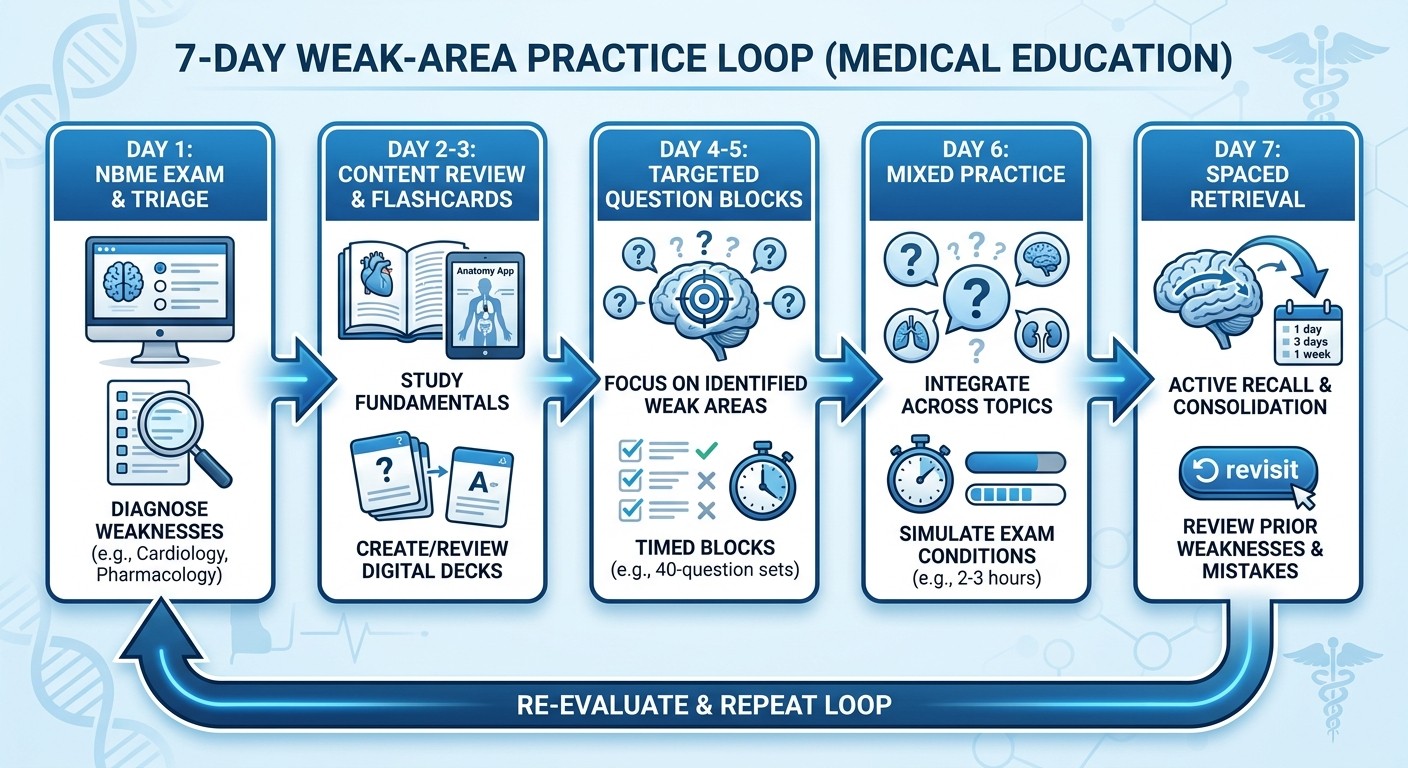
How to Build a 7-Day Weak-Area Practice Loop
Converting NBME insights into daily practice requires structure, not just good intentions.
Here's your post-NBME weekly schedule:
Day 1 (NBME day): Complete exam + same-day triage Day 2-3: Deep review of content gaps + create flashcards for weak topics Day 4-5: Targeted question blocks on your worst-performing subjects Day 6: Mixed practice combining weak areas with maintenance topics Day 7: Spaced retrieval of Day 2-3 flashcards + pattern review
During Days 2-3, use Oncourse's Daily Plan to automatically generate question sets focused on your identified weak areas. Instead of random question selection, you get curated practice that targets your specific gaps from the NBME review.
For each weak subject, aim for 20-30 focused questions per day. If cardiology was your worst area, spend Tuesday doing nothing but cardiology questions, then Wednesday on your second-worst subject.
The key is intensity over breadth. Better to master 2-3 weak areas completely than to superficially review 8 different subjects.
By Day 6, you should notice improved confidence on topics that felt shaky during the NBME. If not, extend the repair cycle for another 3-4 days before moving to new content.
How to Use Explanations Without Passively Rereading
Explanation quality varies wildly, and even good explanations can become passive consumption if you're not strategic.
Before reading any explanation, force yourself to reconstruct the correct reasoning from memory. Write down what you think the answer should be and why. Only then compare to the official explanation.
This retrieval-first approach strengthens memory formation and highlights gaps in your understanding that passive reading might miss.
When the explanation introduces new concepts, don't just read - create active learning outputs:
Turn mechanisms into simple diagrams
Convert drug interactions into if-then rules
Transform diagnostic criteria into mnemonics
For complex physiology explanations, use Rezzy to break down the mechanism step by step. Instead of rereading dense explanations multiple times, ask specific follow-up questions: "Why does this pathway lead to that symptom?" or "What happens if this receptor is blocked instead?"
This approach turns explanations into interactive learning sessions rather than passive information dumps.
What to Do in the Final 30 Days
Your NBME review strategy shifts dramatically in the home stretch.
With 30 days left, you cant afford major content overhauls. Your review focuses on error pattern elimination and confidence building.
Take your final 2 NBMEs with 10-14 days spacing. After each one, spend maximum 2 days on review before returning to mixed practice. You're looking for persistent weak patterns, not trying to learn new topics.
During these final NBME reviews, pay special attention to:
Questions you've seen similar versions of but still miss
Timing issues that emerge under pressure
Second-guessing patterns that cost easy points
If you keep missing cardiac catheterization questions despite reviewing them twice, that's not a content gap anymore - it's a pattern recognition problem that requires targeted drilling.
Use Explanation Chat to quickly clarify confusing concepts without falling into content rabbit holes. Ask specific questions like "What's the one detail that distinguishes this from the similar condition?" rather than requesting comprehensive explanations.
Your final 30 days should feel like fine-tuning, not major repairs.
Common NBME Review Strategy Mistakes
Mistake 1: Reviewing everything equally
Not all misses deserve the same attention. A lucky guess that happened to be right teaches you nothing. A systematic reasoning error that spans multiple subjects is worth 2 hours of focused practice.
Mistake 2: Focusing on explanations over patterns
Reading comprehensive explanations feels productive but doesn't change future performance. Identifying why you made the error and drilling similar questions does.
Mistake 3: Taking too many NBMEs without review
Some students take 6-8 NBMEs thinking quantity improves scores. But without systematic review between each one, you just repeat the same errors more expensively.
Mistake 4: Ignoring timing data
Your NBME shows which questions took longer than average. These time sinks often predict future misses under pressure, even if you got them right.
Mistake 5: Delaying the review
NBME review gets harder every day you wait. Your reasoning fades, and you lose the emotional context that explains why you chose wrong answers.
The most successful Step 1 students treat NBMEs as diagnostic tools that drive systematic practice changes, not as practice tests that build familiarity.
Frequently Asked Questions
How many NBMEs should I take before Step 1?
Take 3-4 NBMEs total, spaced 2-3 weeks apart. More than 4 becomes expensive without adding value, and less than 3 doesn't give you enough trend data. Focus on thorough review of each one rather than quantity.
Should I review questions I got right?
Review any question where you guessed or took longer than 2 minutes, even if correct. These represent unstable knowledge that becomes misses under pressure. Skip questions you answered confidently and quickly.
What if my NBME scores aren't improving despite good review?
Check your error patterns across multiple NBMEs. If you're making the same types of mistakes, your study method needs adjustment, not just more content. Consider whether you need more active practice, better timing strategies, or confidence building.
How long should I spend reviewing each NBME?
Plan 4-6 hours total: 30 minutes for initial triage, 2-3 hours for deep review of misses, 1-2 hours for targeted weak area identification, and 30 minutes planning your next week of practice.
Can I use question banks other than NBMEs for this strategy?
Yes, but prioritize NBME-style questions for pattern recognition. Any comprehensive question bank can provide the volume for weak-area practice once you identify your gaps from NBME review.
When should I stop taking NBMEs?
Take your final NBME 7-14 days before Step 1. You need time to address any issues you discover, but not so much time that you lose momentum. Use the final week for light review and confidence building.
Converting your NBME misses into systematic weak-area practice transforms expensive practice tests into precision-guided study sessions. Each wrong answer becomes a roadmap showing you exactly what to master next.
Prepare smarter with Oncourse AI - adaptive MCQs, spaced repetition, and AI explanations built for USMLE Step 1. Download free on Android and iOS.