Back
Step 2 CK Tutoring: What It Costs, When You Need It, and How AI Prep Compares (2026)
Step 2 CK tutoring costs $150-300/hour. Learn when it's worth it, budget alternatives, and how AI platforms like Oncourse provide personalized guidance at fraction of the cost.

Step 2 CK Tutoring: What It Costs, When You Need It, and How AI Prep Compares (2026)
You are probably staring at your Step 2 CK score target and wondering if you need to shell out hundreds per hour for a tutor. The average private Step 2 CK tutor charges $150-300 per hour. Most students need 20-40 hours of tutoring. Thats $3,000-12,000 before you factor in question banks, review courses, and everything else.
But heres the thing about Step 2 CK tutoring: it works best when you already know what you dont know. The students who benefit most from tutoring arent the ones starting from zero — theyre the ones with specific weak areas who need targeted clinical reasoning practice and strategic guidance on the exam.
So when does Step 2 CK tutoring actually make sense? When should you save the money and study solo? And how do AI-powered prep platforms stack up against traditional one-on-one tutoring?
What Step 2 CK Tutoring Actually Costs in 2026
Private Step 2 CK tutoring rates vary dramatically based on the tutors background and your timeline:
Tutor Type | Hourly Rate | Typical Package |
|---|---|---|
Recent residents/fellows | $100-150/hour | 20-30 hours |
Experienced physicians | $200-300/hour | 15-25 hours |
Premium tutoring companies | $250-400/hour | 10-20 hours |
Group tutoring sessions | $50-100/hour | 30-40 hours |
Most tutoring relationships last 6-12 weeks, with 2-3 sessions per week. The total investment typically ranges from $2,000-8,000 depending on your needs and the tutors expertise level.
Hidden costs that add up:
Initial diagnostic assessment: $150-300
Customized study materials: $200-500
Last-minute cramming sessions: premium rates (often 1.5-2x normal)
Travel time charges from some tutors: $50-100 per session
The economics get trickier for IMGs. Many need more extensive support — both content review and test-taking strategy — which can push tutoring costs toward the higher end of these ranges.
When Step 2 CK Tutoring Makes Sense (And When It Doesnt)
You probably need tutoring if:
Your NBME scores are consistently 15-25 points below your target
You know the content but struggle with clinical reasoning and case analysis
You are an IMG who needs help with American medical culture and practice patterns
You have limited time (under 12 weeks) and need strategic guidance
You consistently miss questions in 2-3 specific systems despite studying them
Skip tutoring if:
Your NBME scores are already within 10 points of your target
You have 4+ months to prepare and strong self-study habits
Your main issue is content gaps (not reasoning or test strategy)
You cannot afford it without financial stress
You prefer learning at your own pace without external pressure
The dirty secret about Step 2 CK tutoring: most students who hire tutors could achieve similar score improvements with structured self-study and the right resources. Tutoring accelerates the process and provides accountability, but it doesnt replace the fundamental work of practice questions and content review.
IMGs face a specific decision point. Traditional tutoring helps with cultural context and American practice patterns that question banks might miss. But at $200+ per hour, many IMGs find better value in comprehensive AI platforms that provide similar personalized guidance for a fraction of the cost.
Traditional Tutoring vs Self-Study vs AI-Powered Prep
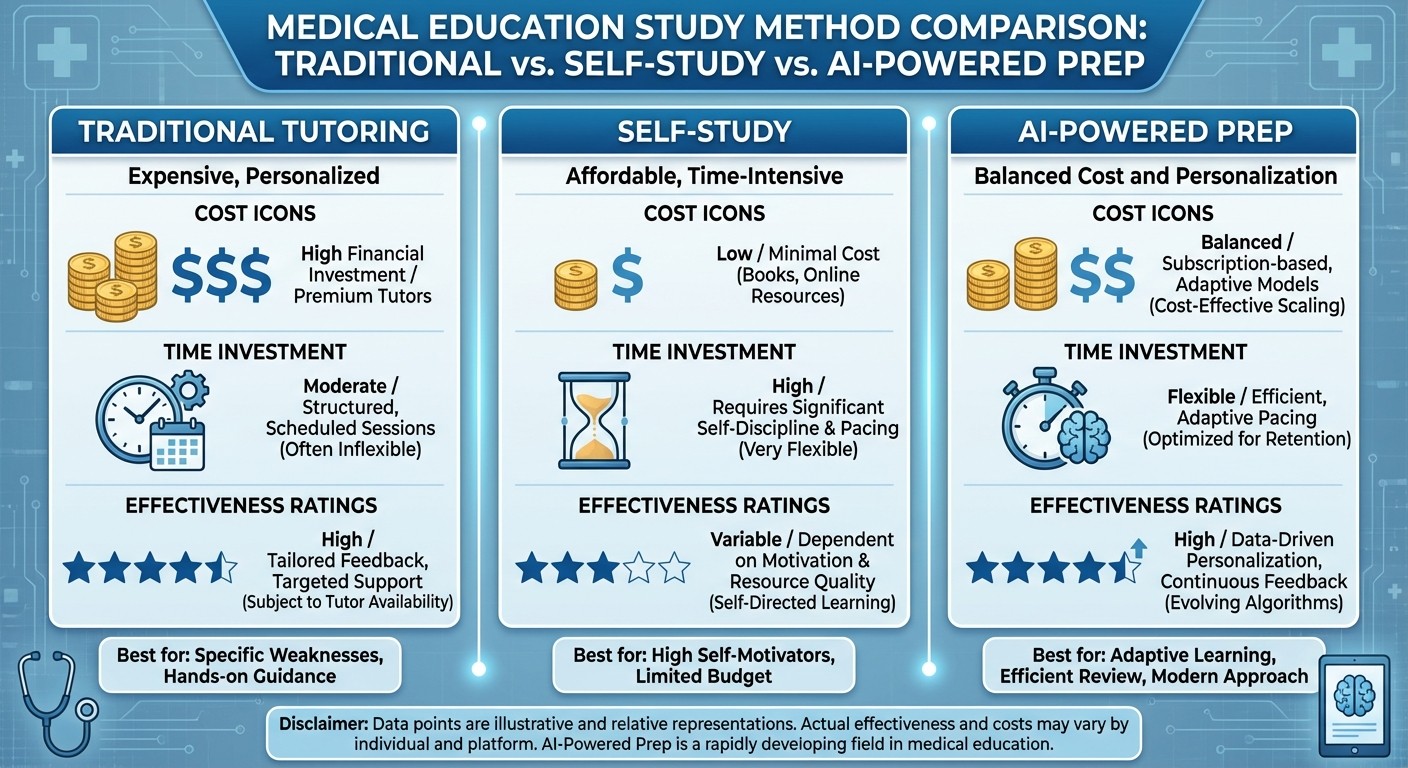
Traditional One-on-One Tutoring
Strengths:
Personalized feedback on clinical reasoning gaps
Real-time strategy adjustments based on practice test performance
Accountability and structured study schedule
Cultural context for IMGs navigating US medical practice
Weaknesses:
High cost ($3,000-12,000 total investment)
Limited availability of quality tutors
Scheduling constraints around tutor availability
Inconsistent quality — tutor expertise varies widely
Best for: Time-crunched students with specific weak areas and budget flexibility.
Self-Study with Question Banks
Strengths:
Most cost-effective approach ($200-500 total)
Complete flexibility over pace and schedule
Forces active learning and problem-solving independence
Access to massive question databases
Weaknesses:
No personalized guidance on weak areas
Easy to waste time on low-yield topics
Limited feedback on clinical reasoning process
Requires strong self-discipline and study planning
Best for: Students with 4+ months, strong study habits, and budget constraints.
AI-Powered Adaptive Platforms
This is where platforms like Oncourse change the equation. AI prep combines the personalization of tutoring with the cost-effectiveness of self-study.
How AI mimics tutoring benefits:
Adaptive difficulty: Oncourse's AI adapts question difficulty in real-time based on your performance, automatically focusing on weak areas the way a tutor would guide your practice sessions
Detailed explanations: Each question includes step-by-step clinical reasoning breakdowns that replicate the "why" explanations a tutor provides, helping you build pattern recognition instead of just memorizing facts
Performance analytics: The dashboard shows exactly where you are losing points by system, topic, and question type, directing your self-study the way a tutor would identify your gaps
The cost difference is dramatic. While private tutoring runs $150-300 per hour, AI platforms typically cost $30-50 per month for unlimited access.
Strengths:
Personalized learning paths at a fraction of tutoring costs
24/7 availability — no scheduling constraints
Immediate feedback on every practice question
Data-driven insights into performance patterns
Weaknesses:
Less cultural context for IMGs compared to human tutors
No emotional support or motivation coaching
Requires some self-direction in study planning
How to Choose Your Step 2 CK Prep Strategy
Start with a diagnostic assessment. Take an NBME or free diagnostic test to establish your baseline. This tells you whether you need content review, test strategy work, or both. If you score 200-220: Focus on content gaps first. Self-study with question banks or AI platforms will be most cost-effective. Save tutoring money for later if needed. If you score 220-240: You are in the strategic improvement zone. AI platforms can provide the personalized guidance you need without the tutoring premium. Use Oncourse's performance analytics to identify which systems need targeted work. If you score 240+: You probably dont need tutoring. Focus on high-yield question practice and maintaining your knowledge base. For IMGs specifically: Consider your English fluency and familiarity with US medical culture. If these are strong, AI platforms offer excellent value. If you need cultural context and communication practice, budget for some tutoring hours.
The AI Advantage: Targeted Practice Without Hourly Rates
Traditional tutoring excels at providing strategic guidance, but most of what students pay for can be replicated with smart technology. Here's how AI platforms deliver tutor-level insights:
When you miss a cardiology question about heart failure management, a tutor would identify this as a pattern and assign more HF questions. Oncourse does the same thing automatically — its adaptive question bank increases cardiology question frequency and difficulty based on your performance data.
When you struggle with diagnostic reasoning, a tutor would walk through the clinical thought process step by step. Oncourse provides detailed explanations with clinical reasoning breakdowns for every question, teaching the same systematic approach.
The key insight: you dont need to pay hourly rates for personalized guidance if the platform can identify your weak areas and adjust your practice accordingly. Students who understand their weak systems via analytics can replace general tutoring with targeted practice sessions on specific topics — cutting prep time and cost.
Red Flags: When to Avoid Expensive Tutoring
Avoid tutoring if the provider:
Guarantees specific score improvements
Requires large upfront payments without trial sessions
Cannot provide references from recent Step 2 CK students
Focuses heavily on content review instead of test strategy
Charges extra for materials that should be included
Warning signs you are overpaying:
Paying for more than 40 hours of tutoring
Hiring multiple tutors simultaneously
Starting tutoring before establishing a content foundation
Using tutoring for basic content review that self-study could handle
Remember: the most expensive tutoring isnt always the most effective. A resident who scored 270 last year might provide better insights than an experienced physician who hasnt taken Step 2 CK in decades.
Budget-Friendly Alternatives That Actually Work
Group tutoring sessions ($50-100/hour) provide some personalized guidance at lower cost. Look for groups of 3-4 students with similar score targets. Peer study groups cost nothing and create accountability. Form groups with students at similar preparation stages. Question bank + AI explanations gives you most tutoring benefits for under $100/month. Focus on platforms with detailed reasoning explanations. Free resources like Step 2 CK study guides and NBME practice tests help establish your foundation before investing in paid resources.
The key is building a foundation first, then adding personalized guidance only where needed.
Frequently Asked Questions
How many hours of Step 2 CK tutoring do most students need?
Most students benefit from 20-30 hours of tutoring spread over 6-8 weeks. Students with strong foundations need fewer hours (15-20), while those with significant content gaps may need 35-40 hours.
Is Step 2 CK tutoring worth it for IMGs?
It depends on your English fluency and familiarity with US medical practice. IMGs who need cultural context and communication practice get good value from tutoring. Those with strong English skills often do just as well with AI platforms and question banks.
Can I improve my Step 2 CK score without tutoring?
Absolutely. Most score improvements come from systematic question practice and content review. Tutoring accelerates the process but isnt necessary for most students. AI platforms provide similar personalized guidance at much lower cost.
When should I start looking for a Step 2 CK tutor?
Start looking 8-10 weeks before your exam date if you decide tutoring is right for you. This gives time to find a good match and complete a full tutoring cycle. Dont start tutoring until youve established your content foundation.
How do I know if my Step 2 CK tutor is effective?
Your NBME scores should improve by 10-15 points every 3-4 weeks of consistent tutoring and practice. If you arent seeing steady improvement after 6-8 sessions, reassess whether the tutoring approach is working.
What questions should I ask potential Step 2 CK tutors?
Ask about their recent Step 2 CK experience, typical student score improvements, study materials they provide, and availability for your timeline. Request references from recent students and ask for a trial session before committing to a full package.
Prepare smarter with Oncourse AI — adaptive MCQs, spaced repetition, and AI explanations built for USMLE Step 2 CK. Download free on Android and iOS.