Step 2 CK Prep Course: How to Pick the Right One and Actually Score High
Learn how to evaluate Step 2 CK prep courses beyond question banks. Discover what separates courses that build clinical reasoning from ones that just test recall, and get a proven study plan framework.
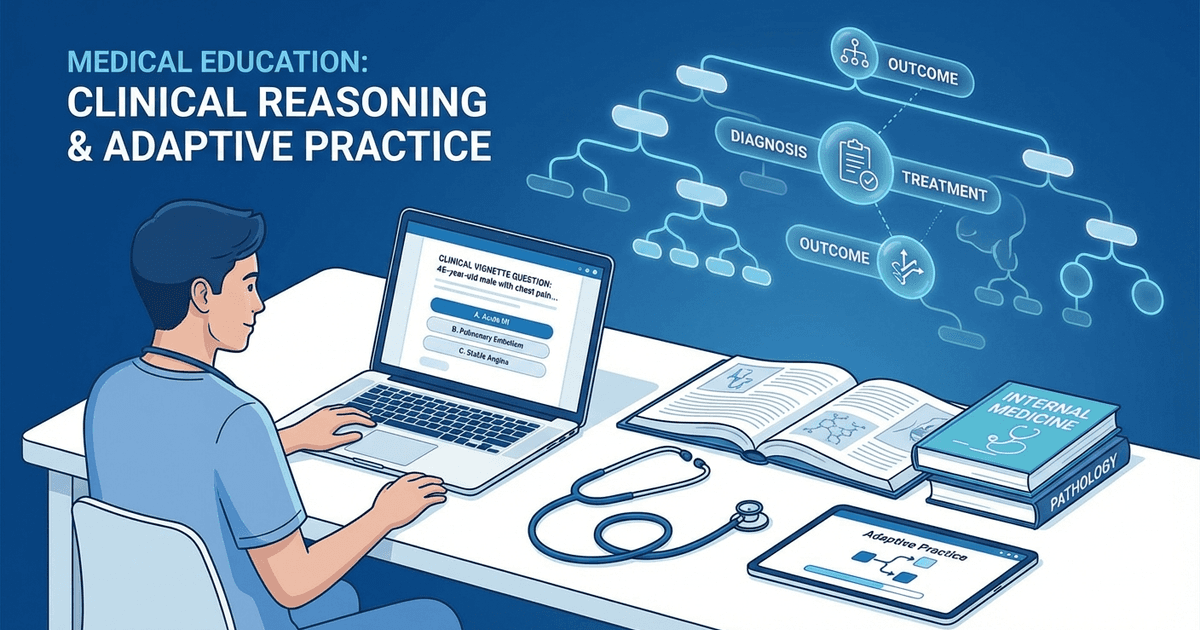
Step 2 CK Prep Course: How to Pick the Right One and Actually Score High
You just finished Step 1. You're staring at a list of Step 2 CK prep courses. Most advice tells you to "pick UWorld and call it done." But here's what nobody mentions: UWorld is a question bank, not a prep course. And the difference matters more than you think.
Step 2 CK isnt about memorizing biochemical pathways anymore. It's about seeing a 45-year-old with chest pain and knowing whether to order a stress test or head straight to the cath lab. It's about reading "next best step" and actually thinking through what comes next in real clinical practice.
Most students fail to score high on Step 2 CK because they treat it like an upgraded Step 1. They do thousands of practice questions but never learn to think clinically. They memorize differential diagnoses but cant apply clinical reasoning when two answer choices both seem right.
If you want to score high on Step 2 CK, you need a prep course that builds clinical reasoning, not just tests recall. One that adapts to your weak areas instead of giving everyone the same content. One that explains WHY you got a question wrong, not just tells you the right answer.
Here's how to evaluate any Step 2 CK prep course for what actually moves your score.
What Makes Step 2 CK Different (And Why Most Prep Fails)
Step 2 CK tests clinical reasoning through long vignettes. The average question takes 2-3 minutes to read and process, not the 60 seconds you had on Step 1. The scenarios mirror real clinical encounters: patient presentations, diagnostic workups, management decisions.
This creates three fundamental differences from Step 1:
Volume doesnt equal mastery. You cant brute-force Step 2 CK by doing 5,000 questions. The clinical reasoning skills that drive high scores develop through deliberate practice with immediate feedback, not passive repetition. Context matters more than facts. Knowing that digoxin causes arrhythmias wont help you when the question asks about managing an 80-year-old with heart failure who's already on optimal medical therapy. You need to think through the clinical scenario. Pattern recognition beats memorization. Step 2 CK rewards students who can recognize when a presentation fits classic patterns (acute coronary syndrome, sepsis, diabetic ketoacidosis) and when it doesnt. This comes from practice with varied clinical vignettes, not flashcard drilling.
Most Step 2 CK prep courses ignore these differences. They focus on content coverage instead of clinical reasoning development. They give you more questions without teaching you how to think through them systematically.
The 3 Things Any Good Step 2 CK Prep Course Must Do
When evaluating Step 2 CK prep courses, look for these three capabilities. If a course doesnt nail all three, it wont move your score significantly.
1. Clinical Reasoning Practice With Long Vignettes
Step 2 CK questions average 150-200 words. Many are longer. The clinical vignettes include patient history, physical exam findings, lab values, and imaging results. You need practice reading through complex scenarios and identifying the key clinical decision points.
Look for courses that offer:
Practice questions with full-length clinical vignettes (not shortened stems)
Timed practice sessions that mirror the 3-minute-per-question pace
Mixed subject blocks that force you to identify the clinical domain before solving
Most question banks give you subject-specific blocks. But Step 2 CK doesnt tell you whether a question is cardiology or infectious disease. You have to figure that out from the clinical presentation. Practice clinical reasoning with our USMLE diagnostic lessons to build this skill systematically.
2. Adaptive Weak-Area Targeting
Step 2 CK covers eight major clinical disciplines: Internal Medicine, Surgery, Obstetrics and Gynecology, Pediatrics, Psychiatry, Family Medicine, Emergency Medicine, and Neurology. Within each discipline, you'll have stronger and weaker areas.
A good prep course identifies your weak areas automatically and adjusts your study plan accordingly. It gives you more Internal Medicine cardiology if that's where you're missing questions. It surfaces more Pediatrics infectious disease if that's your gap.
This is where Oncourse's Daily Plan becomes invaluable for Step 2 CK prep. The adaptive learning system tracks your performance across all clinical subjects and builds personalized study sessions that target your momentum subjects (weakest areas) while rotating through all domains. No planning paralysis — just start each day and know you're hitting the right content in the right proportions.
Red flag: Courses that give everyone the same study schedule regardless of performance patterns.
3. Deep Answer Explanations (Not Just Rationale)
Step 2 CK questions often have two answer choices that could be correct in different clinical contexts. The explanation needs to teach you why one choice is better in this specific scenario.
Standard explanations tell you the correct answer and move on. Deep explanations address:
Why you chose the wrong answer (your clinical reasoning gap)
Why the correct answer is best for this patient scenario
When the other answer choices would be correct (different clinical contexts)
How this connects to broader clinical patterns and differential diagnoses
After every wrong answer, you should understand not just what to do differently, but how to think differently. The Explanation Chat feature in Oncourse does exactly this for Step 2 CK — it analyzes your specific incorrect choice and teaches the clinical reasoning that leads to the right answer, turning each mistake into a deeper understanding of clinical decision-making.
High-Yield Step 2 CK Content Areas To Prioritize
Step 2 CK isnt equally weighted across all topics. Some clinical areas appear more frequently and carry higher point values. Focus your prep course selection on platforms that give adequate coverage to these high-yield domains:
Internal Medicine (35-40% of exam)
Cardiology: Acute coronary syndromes, heart failure management, arrhythmias, hypertension
Pulmonology: COPD exacerbations, pneumonia, asthma, pulmonary embolism
Gastroenterology: GI bleeding, inflammatory bowel disease, liver disease
Endocrinology: Diabetes management, thyroid disorders, adrenal disorders
Nephrology: Acute kidney injury, chronic kidney disease, electrolyte disorders
Surgery (15-20% of exam)
Acute abdomen: Appendicitis, cholecystitis, bowel obstruction, perforation
Trauma: ATLS protocols, shock management, prioritization
Perioperative care: Preoperative risk assessment, postoperative complications
Obstetrics and Gynecology (10-15% of exam)
Antepartum: Prenatal care, high-risk pregnancies, genetic screening
Labor and delivery: Normal delivery, complications, cesarean indications
Gynecology: Abnormal uterine bleeding, contraception, STDs
Pediatrics (10-15% of exam)
Development: Milestones, developmental delays, autism screening
Infectious disease: Vaccination schedules, common pediatric infections
Respiratory: Asthma, bronchiolitis, croup
Psychiatry (10-15% of exam)
DSM-5 criteria: Major depression, anxiety disorders, bipolar disorder
Pharmacotherapy: Antidepressants, antipsychotics, mood stabilizers
Emergency psychiatry: Suicidality, psychosis, substance abuse
Make sure your prep course provides adequate question volume in these areas. A course with 50 cardiology questions wont give you enough exposure to the variety of presentations you'll see on test day.
How To Build a Score-Boosting Step 2 CK Study Plan
The best prep course means nothing without a systematic approach to using it. Here's the framework that consistently produces score improvements:
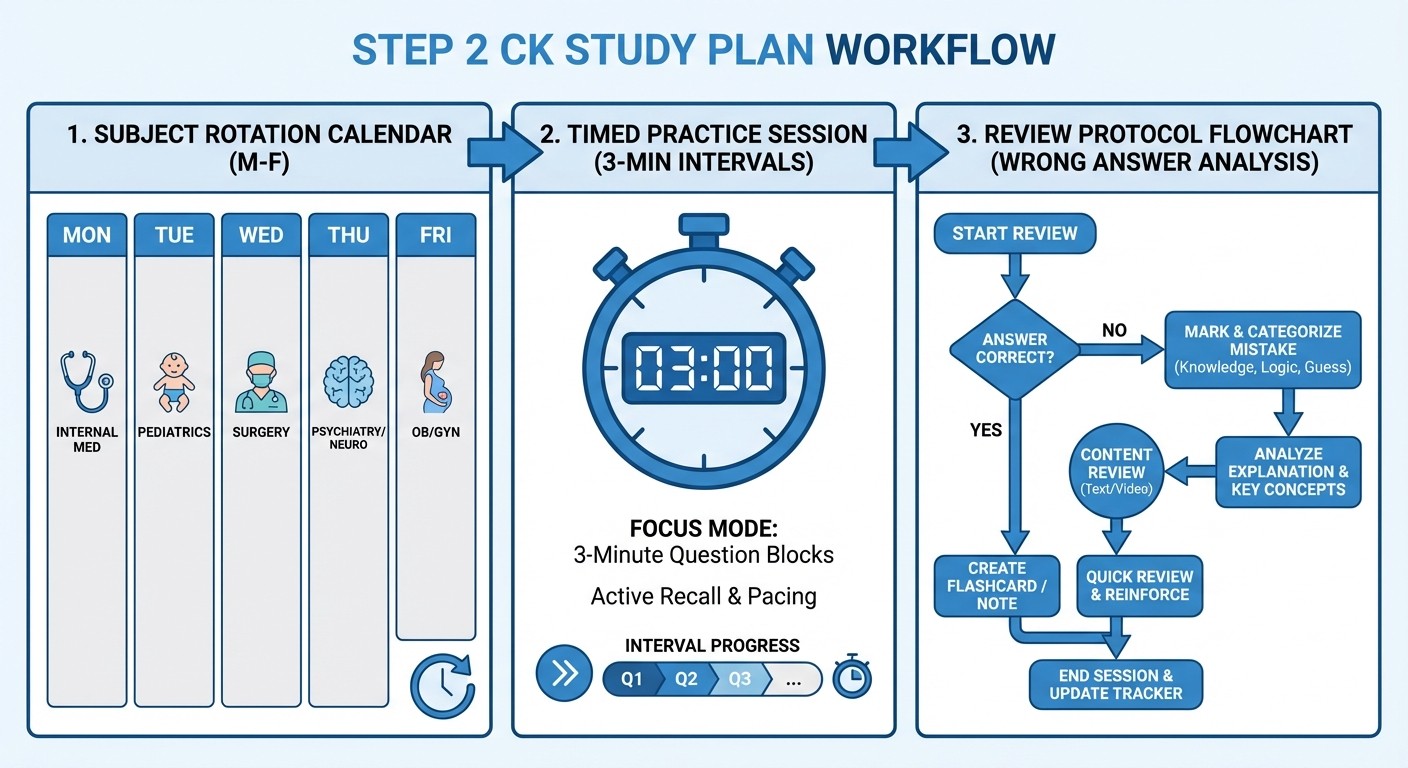
Subject Rotation Strategy
Dedicate specific days to specific subjects, but always include mixed review:
Monday: Internal Medicine focus + mixed review block
Tuesday: Surgery focus + mixed review block
Wednesday: OB-GYN focus + mixed review block
Thursday: Pediatrics focus + mixed review block
Friday: Psychiatry focus + mixed review block
Weekend: Pure mixed blocks + weak area targeting
This prevents the "silo effect" where you can answer cardiology questions when you know they're cardiology questions, but struggle to identify cardiology presentations in mixed blocks.
Timed Practice Sessions
Always practice under timed conditions. Set a timer for 3 minutes per question during focused practice. For mixed blocks, aim for 2.5 minutes per question to simulate test day pressure.
Most students practice untimed and then struggle with pace on test day. Clinical reasoning under time pressure is a separate skill that requires deliberate practice.
Daily Review Protocol
After each practice session:
1. Review all wrong answers immediately with detailed explanations 2. Identify clinical reasoning gaps (missed diagnosis, wrong next step, management error) 3. Note high-yield learning points for spaced repetition review 4. Track weak areas for targeted practice in next sessions
This is where gamified recall practice like Synapses helps cement the high-yield associations Step 2 CK tests repeatedly — drug to adverse effect, symptom to next best step, diagnosis to management. The word-grouping game format makes these clinical connections stick through active retrieval.
Common Step 2 CK Prep Pitfalls That Tank Scores
Passive Question Banking
Doing 3,000 questions without reviewing wrong answers thoroughly. You're practicing the skill of answering questions quickly, not the skill of clinical reasoning. Each wrong answer should teach you something new about how to think through similar clinical scenarios.
Ignoring Mixed Blocks
Studying each subject in isolation. Step 2 CK tests your ability to identify what type of problem you're dealing with before solving it. If you only practice cardiology questions when you know they're cardiology questions, you'll struggle on test day.
Content Coverage Without Clinical Application
Memorizing management algorithms without understanding the clinical reasoning behind them. You need to know not just what to do, but when and why to do it. Practice questions that force you to choose between multiple reasonable options based on patient-specific factors.
Inadequate Timing Practice
Practicing untimed and then expecting to perform under test day pressure. Clinical reasoning under time constraints is a different skill. Build speed through deliberate timed practice, not by rushing through untimed questions.
Red Flags: What To Avoid in Step 2 CK Prep Courses
Courses that promise "comprehensive coverage" without adaptive targeting. Step 2 CK spans eight clinical disciplines with hundreds of subtopics. No student needs equal time on everything. You need more practice in your weak areas. Platforms that focus on question quantity over explanation quality. Having 5,000 questions doesnt matter if the explanations dont teach clinical reasoning. Look for platforms that explain the thought process, not just the facts. One-size-fits-all study schedules. Your Step 1 score, clinical experience, and knowledge gaps are different from other students. Your prep should be too. Limited clinical vignette practice. If most practice questions are short stems, you're not preparing for the actual test format. Step 2 CK tests your ability to process complex clinical scenarios.
How To Evaluate Any Step 2 CK Prep Course
Before committing to a prep course, test it against these criteria:
Question Quality Assessment
Take a sample practice block and evaluate:
Do vignettes match test day length and complexity?
Are answer explanations teaching clinical reasoning or just listing facts?
Do mixed blocks force you to identify the clinical domain?
Are timing constraints realistic for test day pace?
Adaptive Learning Capability
Does the platform identify your weak areas automatically?
Can it adjust future content based on your performance?
Does it cycle through all clinical domains while prioritizing gaps?
Can you see your progress in specific subtopics over time?
Clinical Reasoning Development
Do explanations address why wrong answers are wrong?
Are different clinical scenarios provided for similar diagnoses?
Does the course teach decision-making frameworks for complex cases?
Are there opportunities to practice clinical pattern recognition?
Building Clinical Reasoning Skills Beyond Question Banks
Step 2 CK prep isnt just about answering more questions. You need to develop clinical thinking skills that transfer to any patient scenario.
Practice Clinical Decision Trees
For each clinical presentation, map out the decision tree:
Patient presents with chest pain → Risk stratify → Low risk: outpatient workup → High risk: immediate intervention
Learn to think in clinical algorithms, not isolated facts
Study Real Case Presentations
Review clinical reasoning fundamentals to understand how expert clinicians approach complex cases. Practice both analytical reasoning (step-by-step) and pattern recognition for different clinical scenarios.
Connect Basic Science to Clinical Practice
Step 2 CK questions often test your ability to apply basic science knowledge to clinical scenarios. When you see a pharmacology question, think through the mechanism of action, side effects, and clinical monitoring requirements.
Step 2 CK Timing and Score Goals
Most students need 6-8 weeks of dedicated Step 2 CK preparation if they're using an effective prep course with adaptive targeting. Students using passive question banks often need 10-12 weeks because they're not efficiently targeting their knowledge gaps.
Score goals depend on your specialty choice:
Competitive specialties: Aim for 250+ (90th percentile)
Moderately competitive: Target 240+ (75th percentile)
Less competitive: Goal of 230+ (50th percentile)
The key insight: Step 2 CK scores correlate more strongly with clinical reasoning skills than pure knowledge volume. Students who learn to think through clinical scenarios systematically often see 20-30 point improvements from their baseline.
Frequently Asked Questions
How long should I spend on Step 2 CK prep?
Most students need 6-8 weeks of dedicated preparation with an adaptive prep course. If you're using passive study methods, expect 10-12 weeks. The key is deliberate practice with immediate feedback, not just logging hours.
Can I use the same study strategy as Step 1?
No. Step 1 rewards memorization and factual recall. Step 2 CK tests clinical reasoning and decision-making. You need practice with long clinical vignettes and systematic approaches to complex patient scenarios, not flashcard drilling.
How many practice questions should I do per day?
Quality over quantity. 40-60 timed questions with thorough review is better than 100 questions without deep analysis. Focus on understanding why you got questions wrong and how to think differently.
Should I study subjects separately or do mixed blocks?
Both. Use subject-focused practice to build knowledge in weak areas, but always include mixed blocks to practice clinical domain identification. Step 2 CK doesnt tell you what type of question you're answering.
What if I keep getting questions wrong in the same clinical areas?
This indicates knowledge gaps that need targeted attention. Use focused practice questions in those specific areas, then review the underlying concepts systematically.
How important are the newer clinical disciplines like Emergency Medicine?
Emergency Medicine questions appear throughout Step 2 CK integrated with other specialties. Focus on acute management principles: sepsis protocols, trauma evaluation, cardiac arrest, and emergency procedures.
Prepare smarter with Oncourse AI — adaptive MCQs, spaced repetition, and AI explanations built for USMLE Step 2 CK. Download free on Android and iOS.