Back
How Oncourse AI's Question Bank Works: Adaptive Practice That Knows Your Weak Spots
Discover how Oncourse AI's adaptive question bank uses intelligent algorithms to identify weak areas and personalize practice for NEET PG, USMLE, and UKMLA preparation.
How Oncourse AI's Question Bank Works: Adaptive Practice That Knows Your Weak Spots
You are probably staring at another 100-question practice set wondering if youre actually improving or just going through the motions. Traditional question banks throw random MCQs at you — 50 from medicine, 30 from surgery, 20 from pediatrics — without any logic behind the selection. You answer them, check your score, and move to the next set. Rinse and repeat.
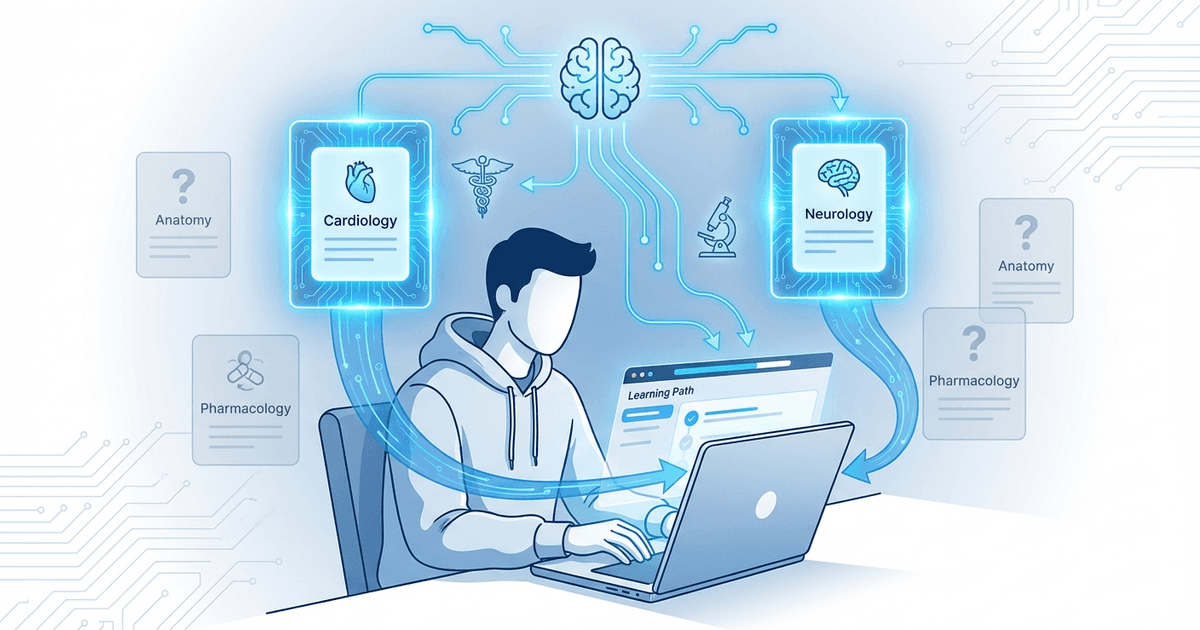
But what if your question bank actually learned from every single answer you gave? What if it tracked exactly which subtopics trip you up and automatically served more questions from those areas? What if it knew that you nail cardiology but struggle with endocrine disorders, then adapted accordingly?
This isnt wishful thinking. This is exactly how Oncourse AI's question bank operates — through adaptive logic that turns every practice session into a personalized learning experience.
What Makes a Question Bank "Adaptive"?
Most medical question banks work like a static library. You pick a subject, select difficulty, and get a random assortment of questions. Whether you scored 40% or 90% on your last cardiology session, the next set looks identical.
An adaptive question bank operates differently. It maintains a detailed profile of your performance across every medical subtopic, difficulty level, and question type. When you consistently miss questions about diabetic ketoacidosis but ace myocardial infarction topics, the system takes note. Your next practice session will include more DKA questions and fewer MI ones.
The goal isnt to make practice harder — its to make it smarter. Instead of spending time on concepts you already know, you focus on genuine knowledge gaps.
How Oncourse AI Tracks Your Learning Patterns
Every question you answer on Oncourse feeds data points into your performance profile. The system tracks:
Subject-level accuracy across all 19 medical specialties
Subtopic performance down to specific conditions and procedures
Difficulty progression from basic recall to complex clinical scenarios
Question type patterns (image-based, case studies, direct recalls)
Response timing to identify concepts that slow you down
When you answer a pharmacology question about beta blockers incorrectly, the system doesnt just mark it wrong. It logs that you struggled with cardiovascular pharmacology, specifically adrenergic antagonists, at an intermediate difficulty level. This granular tracking enables precise targeting.
The adaptive engine uses this response history to identify weak subtopics automatically and route more questions there. Unlike static question banks that rely on you to manually select weak areas, Oncourse's system builds a personalized weak-area drill mode that adapts as your knowledge evolves.
The Performance Dashboard: Your Learning Mirror
Traditional practice gives you a score and moves on. Oncourse's performance dashboard transforms every answered question into visual feedback through an accuracy heatmap that shows improvement over time by subject and difficulty.
The dashboard reveals patterns you might miss otherwise:
Subjects where your accuracy drops with higher difficulty
Topics where you improve quickly vs. those needing more attention
Question types that consistently challenge you
Time trends showing whether gaps are closing or widening
This visual feedback helps you make informed study decisions. If your medicine accuracy has plateaued at 75% while surgery keeps climbing, you know where to focus next.
Spaced Repetition Integration: Practice Meets Retention
Heres where Oncourse gets really smart. Incorrectly answered questions dont just disappear into your practice history. They are automatically scheduled for spaced review, combining practice and retention in one workflow.
The system calculates optimal review intervals based on forgetting curves and your individual retention patterns. A pharmacology question you missed today might resurface in 3 days, then a week later, then a month later — but only if you need the reinforcement.
This integration means you dont need separate apps for practice and review. Every practice session reinforces previous weak areas while introducing new content. You can practice cardiovascular pharmacology questions and trust that missed concepts will return when you need them most.
Smart Question Routing in Action
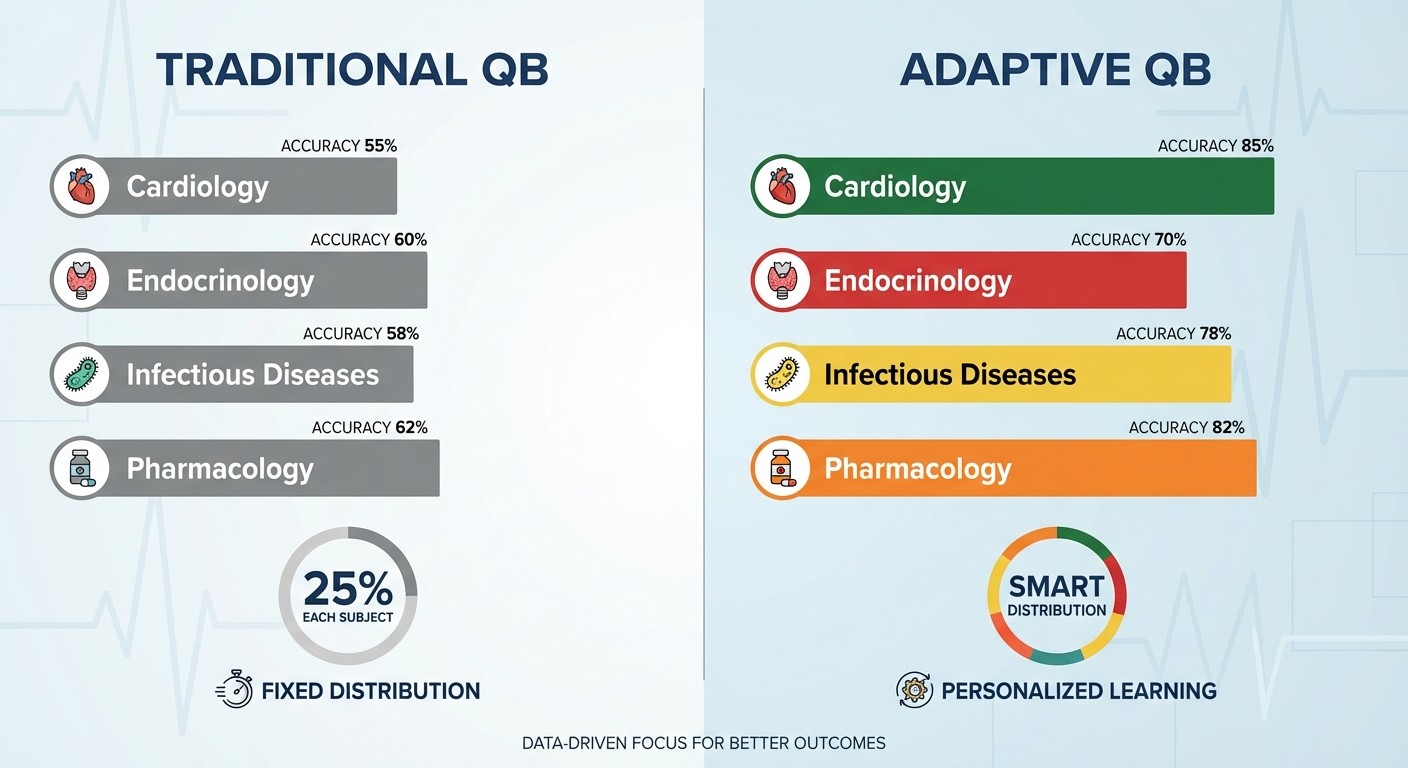
Let me show you how this works with a real example. Say you are preparing for NEET PG and your recent sessions show:
Cardiology accuracy: 85%
Endocrinology accuracy: 62%
Infectious diseases accuracy: 78%
Pharmacology accuracy: 55%
A traditional question bank might give you 25 questions from each area. Oncourse's adaptive engine would serve something like:
Cardiology: 10 questions (maintenance level)
Endocrinology: 40 questions (major weak area)
Infectious diseases: 20 questions (moderate reinforcement)
Pharmacology: 30 questions (significant weak area)
But it gets more specific. Within endocrinology, if you consistently miss diabetes complications but handle thyroid disorders well, more questions will focus on diabetic nephropathy, retinopathy, and ketoacidosis.
The result? You spend practice time where it actually matters instead of repeatedly confirming what you already know.
Beyond Random Practice: Contextual Question Selection
Adaptive systems dont just adjust quantity — they optimize context. Oncourse analyzes not just which questions you miss, but why you might be missing them.
If you struggle with image-based dermatology questions but handle text-based derm cases well, the system will surface more visual questions in that area. If you consistently confuse drug mechanisms within the same class (say, different beta blockers), it will serve comparison questions that force you to distinguish between them.
This contextual awareness means practice sessions target specific gaps rather than broadly covering subjects. You get the exact type of practice you need for your unique learning pattern.
Real-Time Difficulty Calibration
Most question banks sort questions into basic, intermediate, and advanced buckets that never change. Oncourse calibrates difficulty in real-time based on your current performance level.
A cardiology question thats "intermediate" for someone scoring 90% in cardiology might be "basic" for someone at 60%. The system adjusts question difficulty to keep you in the optimal challenge zone — hard enough to promote learning, easy enough to avoid frustration.
This dynamic calibration prevents two common problems:
Getting stuck on questions too hard for your current level
Wasting time on questions too easy to add value
The result is practice sessions that consistently push your knowledge forward without overwhelming you.
Integration with Comprehensive Study Tools
The adaptive question bank doesnt operate in isolation. It connects seamlessly with Oncourse's other learning tools. When you miss questions about specific topics, you can immediately access relevant flashcards or detailed lessons on those concepts.
This integration creates a complete learning loop: identify gaps through adaptive practice, fill gaps with targeted content, then verify improvement through focused follow-up questions.
Measuring Progress Beyond Score Percentages
Traditional metrics — percentage correct, questions answered — dont capture learning velocity or retention depth. Oncourse tracks more meaningful indicators:
Knowledge Stability: How consistently you answer questions correctly over time, not just single-session scores Learning Velocity: How quickly you improve in specific areas after targeted practice Retention Strength: Whether concepts stick after initial mastery or require ongoing reinforcement Cross-Topic Connections: Whether improvement in one area correlates with better performance in related topics
These metrics give you a clearer picture of actual learning rather than superficial performance indicators.
Why Adaptive Practice Matters for High-Stakes Exams
Medical entrance exams like NEET PG, USMLE, and UKMLA test breadth as much as depth. You cannot afford major blind spots in any subject.
Traditional practice might leave gaps undetected until exam day. You might think you understand cardiology because you score well on practice tests, but if those tests never challenged your knowledge of rare arrhythmias or complex drug interactions, youre vulnerable.
Adaptive practice systematically probes every corner of your knowledge. It finds the subtle weak spots that random practice might miss — the specific drug classes you confuse, the pathology mechanisms you oversimplify, the clinical scenarios that trip you up.
By exam day, you have a comprehensive map of your knowledge landscape. You know exactly where you stand on every testable topic, backed by data from hundreds of targeted practice questions.
Common Misconceptions About Adaptive Learning
"It will just give me harder questions until I fail"
Adaptive systems optimize for learning, not failure. The goal is sustained improvement at an appropriate challenge level. If questions become too difficult, the system recalibrates downward.
"I prefer to choose my own practice areas"
You can still manually select subjects when you want focused practice. Adaptation works alongside manual selection, not instead of it. When you choose cardiology practice, the system still adapts within that subject.
"It might focus too much on weak areas and ignore strong ones"
Intelligent adaptation maintains knowledge across all areas while prioritizing gaps. Strong subjects get maintenance-level practice to prevent decay. The system balances remediation with retention.
"I wont know what topics to study without seeing equal practice"
The performance dashboard shows exactly where you stand on every topic. You get better visibility into your knowledge gaps, not less. Equal practice often obscures real performance patterns.
Getting Started with Adaptive Practice
Adaptive systems work better with more data. Your first few practice sessions help the system learn your patterns. Dont worry if initial question selection seems random — the adaptation improves as your response history grows.
For best results:
Answer questions honestly without looking up answers mid-session
Review explanations for both correct and incorrect responses
Use the performance dashboard to track trends over time
Trust the system's question routing even when it feels challenging
The adaptive engine becomes more accurate and helpful the more you use it. After 100-200 questions, you will notice much more precise targeting of your actual weak areas.
Frequently Asked Questions
How long does it take for the adaptive system to learn my weak areas?
The system starts making basic adaptations after 20-30 questions per subject, but becomes highly accurate after 100+ responses. Most students notice meaningful personalization within their first week of consistent practice.
Can I still practice specific topics manually when I want?
Yes. Manual topic selection works alongside adaptive routing. When you choose to practice cardiology, the system still adapts within that subject based on your cardiology-specific weak spots.
Will the system make practice too hard if I have many weak areas?
The adaptive engine balances challenge with success. If you are struggling across multiple areas, it will focus on the most fundamental gaps first while keeping difficulty appropriate for your current level.
How does this help with time management during actual exams?
By identifying exactly which topics slow you down during practice, you can develop time allocation strategies for exam day. You will know which questions deserve extra time and which you can answer quickly.
Does the adaptive system work for different exam formats like USMLE vs NEET PG?
Yes. The system adapts to question patterns and difficulty curves specific to each exam type. USMLE adaptive practice will emphasize clinical reasoning while NEET PG practice focuses on high-yield facts and rapid recall.
What happens if I improve in a weak area — does the system adjust?
Absolutely. As your performance improves, the system reduces emphasis on former weak areas and redirects attention to your current gaps. The adaptation is continuous and responsive to your learning progress.
---
Prepare smarter with Oncourse AI — adaptive MCQs, spaced repetition, and AI explanations built for medical exam success. Download free on Android and iOS.