Back
NEET PG 2026: How to Score 600+ in 3 Months — A Realistic Study Plan
Realistic week-by-week NEET PG study plan to score 600+ in 3 months. Subject prioritization, revision cycles, mock strategy, and daily schedules for NEET PG 2026.

NEET PG 2026: How to Score 600+ in 3 Months — A Realistic Study Plan
You are probably wondering if 600+ in NEET PG is even possible with just 3 months left. The short answer is yes — but only if you drop the fantasy of "covering everything" and commit to a data-driven approach that focuses on what actually gets you marks.
NEET PG 2026 has 200 questions worth 800 marks. To score 600+, you need 75% accuracy — that means getting 150 questions right and having room for 50 mistakes. The students who hit this target dont study harder; they study the right topics in the right sequence with the right feedback loops.
This isnt about cramming 19 subjects in 90 days. Its about identifying the 12-15 high-yield topics that contribute 65-70% of questions, mastering them completely, and having enough time left for strategic revision. The difference between a 450 score and a 600+ score isnt knowledge volume — its precision and speed in your strongest areas.
Heres exactly how to build your 3-month roadmap, week by week, with real numbers and specific targets.
Understanding the NEET PG Scoring Reality
Before diving into the study plan, you need to understand what 600+ actually means in numbers:
Target Score | Questions Correct | Accuracy Required | Room for Error |
|---|---|---|---|
600+ | 150/200 | 75% | 50 questions |
650+ | 163/200 | 81% | 37 questions |
700+ | 175/200 | 87% | 25 questions |
The key insight: you dont need to be perfect. You need to be consistently strong in your chosen subjects and have a strategy for the rest.
Subject-wise question distribution in NEET PG:
Internal Medicine: 40-45 questions
Surgery: 35-40 questions
Obstetrics & Gynecology: 30-35 questions
Pediatrics: 25-30 questions
Pathology: 15-20 questions
Pharmacology: 15-20 questions
Physiology: 10-15 questions
Anatomy: 10-15 questions
Remaining subjects: 20-25 questions
This breakdown tells you where to invest your limited time. Getting 35/40 in Internal Medicine is worth more than perfecting Biochemistry.
The 3-Month Framework: Week-by-Week Breakdown
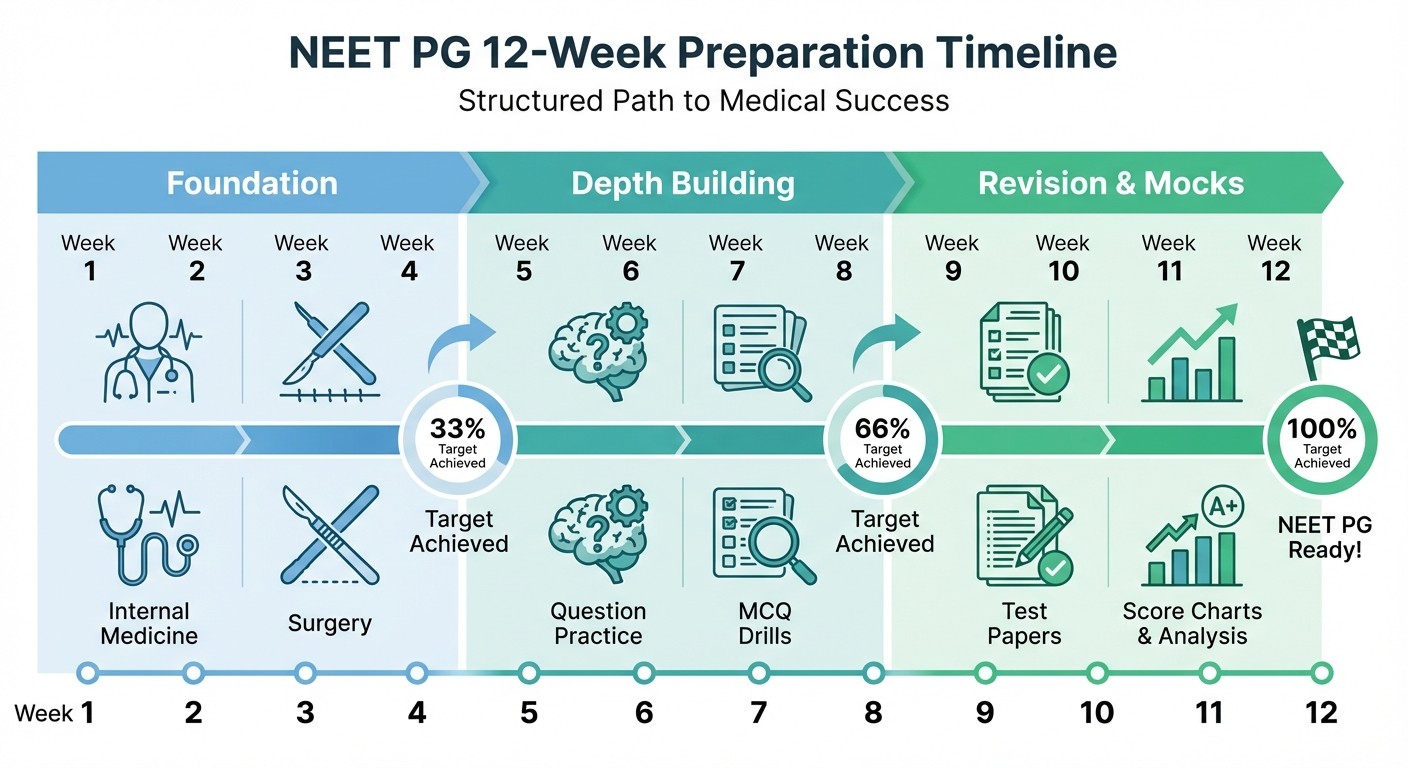
Month 1: Foundation + High-Yield Topics (Weeks 1-4)
Week 1-2 Goal: Establish baseline and cover Internal Medicine + Surgery basics
Start with a diagnostic test to see where you stand. Most students skip this step and waste weeks studying topics they already know. Your Oncourse Performance Dashboard tracks this baseline automatically and shows exactly which subjects need the most attention.
Daily schedule:
6 hours focused study
2 hours active recall (questions/flashcards)
1 hour revision of previous day
Subject priority order:
1. Internal Medicine (Cardiology, Respiratory, GI) - 40% of study time
2. Surgery (General Surgery, Orthopedics) - 30% of study time
3. Obstetrics basics - 20% of study time
4. Quick wins (Pharmacology classifications) - 10% of study time
The adaptive algorithm in Oncourse automatically adjusts your daily schedule based on which subjects are weakest, so you never waste time over-studying strengths. Instead of spending equal time on everything, it unlocks a dynamic roadmap tailored to your baseline score.
Week 3-4 Goal: Complete Pediatrics + Pathology, strengthen Surgery
By week 3, you should have covered the major systems in Internal Medicine and Surgery. Now add:
Pediatrics (Growth, Development, Immunization, Common conditions)
Pathology (General Pathology, Cancer basics, Inflammation)
Start mixing older topics into daily revision. This is where spaced repetition becomes critical — reviewing Cardiology while learning Pediatrics prevents forgetting.
Month 2: Depth + Speed Building (Weeks 5-8)
Week 5-6 Goal: Deep dive into weak areas identified in Month 1
By now, your mock tests should show clear patterns. Maybe youre strong in Medicine but weak in Surgery MCQs, or you know Pathology concepts but struggle with application questions.
This is when Oncourse Question Bank becomes essential — 10,000+ NEET PG questions sorted by subject and difficulty. The adaptive engine surfaces high-yield weak-area questions first, so your revision is efficient, not exhaustive. Instead of random practice, you get targeted questions for your specific gaps.
Daily schedule shifts:
4 hours new content (finishing remaining subjects)
3 hours targeted practice (weak area questions)
1 hour speed drilling (timed question sets)
Week 7-8 Goal: Complete all subjects, start integration
Finish covering:
Remaining Gynecology topics
Anatomy high-yield areas
Physiology applications
Pharmacology mechanisms
Start cross-subject integration. NEET PG loves questions that combine Pathology + Pharmacology, or Surgery + Anatomy. Practice these mixed topic sets.
Month 3: Revision + Mock Strategy (Weeks 9-12)
Week 9-10 Goal: Systematic revision of all covered topics
No new topics. Pure revision and mock tests. This is where most students panic and try to add more subjects. Dont. Your job is to go from 70% accuracy to 80% accuracy in your strong subjects.
Daily schedule:
3 hours targeted revision (weakest topics first)
2 hours mock tests
2 hours mock analysis and doubt clearing
1 hour speed practice
Your Performance Dashboard tracks mock scores, subject-wise accuracy, and predicted exam readiness in real time. It shows exactly where you stand vs the 600 target week by week, so you can adjust strategy instead of hoping for the best.
Week 11-12 Goal: Peak performance and exam readiness
Final 2 weeks focus on:
Maintaining accuracy in strong subjects
Speed optimization (finishing in 180 minutes, not 200)
Stress management and exam-day strategy
Light revision (no heavy learning)
Subject Prioritization Strategy: The 80/20 Approach
Not all subjects are created equal in NEET PG. Here's how to allocate your study time based on question weightage and scoring probability:
Tier 1 Subjects (60% of study time, 70% of marks)
Internal Medicine: 40-45 questions
Surgery: 35-40 questions
Obstetrics & Gynecology: 30-35 questions
These three subjects alone give you 105-120 questions. Master these and youre already at 420-480 marks.
Tier 2 Subjects (30% of study time, 20% of marks)
Pediatrics: 25-30 questions
Pathology: 15-20 questions
Pharmacology: 15-20 questions
Focus on high-yield topics only. In Pediatrics, prioritize Growth & Development, Immunization, and common childhood illnesses. Skip rare genetic disorders.
Tier 3 Subjects (10% of study time, 10% of marks)
Physiology, Anatomy, Biochemistry: 10-15 questions each
Remaining subjects: 20-25 questions total
For these, focus on previous year repeats and basic concepts. Dont go deep — aim for 50-60% accuracy, not perfection.
Mock Test Strategy: Beyond Just Practice
Most students treat mocks as practice tests. Wrong approach. Mocks are data collection tools that tell you exactly where to invest your remaining study time.
Mock Test Timeline
Weeks 1-4: One mock per week (baseline measurement) Weeks 5-8: Two mocks per week (progress tracking) Weeks 9-12: One mock every 2 days (peak performance)
Mock Analysis Framework
After every mock, spend 2 hours on analysis:
1. Subject-wise breakdown: Which subjects pulled your score down?
2. Question type analysis: Factual recall vs application vs clinical reasoning
3. Time management: Did you finish? Where did you spend too long?
4. Silly mistakes: Pattern recognition (always misread "not" in questions?)
Your Performance Dashboard automates most of this analysis, showing trends you might miss manually. It tracks which question types you consistently miss and adjusts future practice accordingly.
Target Mock Scores by Week
Week | Target Score | Focus |
|---|---|---|
1-2 | 350-400 | Baseline establishment |
3-4 | 420-450 | Foundation strengthening |
5-6 | 480-520 | Weak area improvement |
7-8 | 520-550 | Integration and speed |
9-10 | 550-580 | Consistency building |
11-12 | 600+ | Peak performance |
If youre consistently scoring 580+ by Week 10, youre on track. If not, reassess subject allocation.
Daily Study Routine: Hour-by-Hour Breakdown
Phase 1 (Weeks 1-4): Foundation Building
6 AM - 8 AM: Fresh mind subjects (Internal Medicine/Surgery new topics) 8 AM - 9 AM: Breakfast and light revision 9 AM - 11 AM: Continued new content 11 AM - 12 PM: Active recall (questions on yesterday's topics) 12 PM - 1 PM: Lunch break 1 PM - 3 PM: Second priority subject (OBG/Pediatrics) 3 PM - 4 PM: Quick revision (flashcards/notes) 4 PM - 5 PM: Question practice (mixed topics) 5 PM - 6 PM: Exercise/break 6 PM - 8 PM: Review and plan next day 8 PM - 10 PM: Light reading/revision
Phase 2 (Weeks 5-8): Depth + Speed
6 AM - 8 AM: Weak area focus (identified from mocks) 8 AM - 9 AM: Breakfast and revision 9 AM - 11 AM: New content (finishing syllabus) 11 AM - 12 PM: Speed drilling (timed question sets) 12 PM - 1 PM: Lunch break 1 PM - 3 PM: Mock test or intensive practice 3 PM - 4 PM: Mock analysis 4 PM - 5 PM: Doubt clearing 5 PM - 6 PM: Break 6 PM - 8 PM: Review difficult topics 8 PM - 10 PM: Light revision
Phase 3 (Weeks 9-12): Peak Performance
6 AM - 8 AM: High-yield topic revision 8 AM - 9 AM: Breakfast and current affairs 9 AM - 12 PM: Mock test (every alternate day) 12 PM - 1 PM: Lunch break 1 PM - 3 PM: Mock analysis or targeted practice 3 PM - 4 PM: Speed practice 4 PM - 5 PM: Weak area drilling 5 PM - 6 PM: Break 6 PM - 8 PM: Light revision 8 PM - 9 PM: Relaxation/exercise
Revision Cycles: The Science of Not Forgetting
Memory follows predictable decay patterns. Without reinforcement, you lose 50% of new information within 24 hours and 90% within a week. The solution isnt more study time — its smarter revision timing.
The 1-3-7-21 Rule
When you learn a topic:
Day 1: Review after 1 day
Day 3: Review after 3 days
Day 7: Review after 1 week
Day 21: Review after 3 weeks
This spacing optimizes retention while minimizing time investment. Instead of cramming the same topic repeatedly, you build long-term memory efficiently.
Oncourse flashcards automate this timing with spaced repetition algorithms. Cards you struggle with appear more frequently; mastered topics surface just before you would forget them. With 20k+ high-yield flashcards, this system ensures efficient retention without manual tracking.
Subject-Specific Revision Strategy
Internal Medicine: Focus on diagnostic criteria and treatment algorithms. Create mental flowcharts for common presentations. Surgery: Prioritize indications, contraindications, and complications. Visual memory works better here — use image-based flashcards. OBG: Memorize normal values and danger signs. Most questions test recognition of abnormal patterns. Pediatrics: Age-based milestones and vaccination schedules need rote memorization. Use acronyms and mnemonics liberally. Pathology: Understanding mechanisms matters more than memorizing facts. Focus on cancer staging and inflammatory pathways.
Weekly Progress Checkpoints
Every week, assess progress using these metrics:
Week 1-4 Checkpoints
Coverage target: 60% of high-yield topics completed
Mock score: Consistent 50+ improvement week-over-week
Speed target: Completing 200 questions in 200 minutes
Accuracy target: 65% in covered subjects
Week 5-8 Checkpoints
Coverage target: 90% syllabus completion
Mock score: Breaking 500 consistently
Speed target: Completing 200 questions in 190 minutes
Accuracy target: 70% overall, 80% in strong subjects
Week 9-12 Checkpoints
Mock score: 580+ consistently, touching 600+ occasionally
Speed target: Finishing with 10-15 minutes to spare
Accuracy target: 75% overall with minimal silly mistakes
Stress management: Maintaining performance under pressure
If youre behind on any metric, adjust the following week's schedule. The dashboard gives real-time feedback on whether youre tracking toward your 600+ goal or need course correction.
Common 3-Month Preparation Mistakes
Mistake 1: Trying to Cover Everything
Students panic and attempt to read 19 subjects superficially. Result: 45-50% accuracy across all subjects and a final score of 400-450. Better approach: 80% accuracy in 12 subjects and strategic guessing for the rest.
Mistake 2: Mock Overload Without Analysis
Taking 50 mocks but spending zero time understanding why answers were wrong. Each mock teaches you something — but only if you invest time in analysis.
Mistake 3: Last-Week Panic Studying
Adding new topics in the final week destroys confidence and clutters working memory. The last week should be pure revision and stress management.
Mistake 4: Ignoring Speed Training
Knowing the answer but taking 120 seconds per question guarantees failure. Speed comes from practice, not knowledge. Drill timed question sets daily.
Mistake 5: Perfectionist Revision
Spending 3 days on one Anatomy chapter because "it doesnt feel complete." Perfect is the enemy of good. 70% mastery of 15 subjects beats 95% mastery of 8 subjects.
Stress Management and Peak Performance
Sleep and Recovery Strategy
7-8 hours sleep: Non-negotiable. Your brain consolidates memories during deep sleep.
Power naps: 20-minute naps after lunch boost afternoon productivity.
Exercise: 30 minutes daily. Physical activity improves memory retention and reduces cortisol.
Nutrition for Cognitive Performance
Breakfast: Protein + complex carbs (eggs with whole grain toast)
Lunch: Balanced meal with minimal processed food
Snacks: Nuts, fruits, dark chocolate (small amounts)
Hydration: 2-3 liters water daily. Even mild dehydration impairs focus.
Handling Exam Anxiety
Breathing exercises: 4-7-8 technique (inhale 4, hold 7, exhale 8)
Visualization: Mentally rehearse exam day success
Positive self-talk: Replace "I dont know enough" with "I know the high-yield topics well"
Most importantly, remember that NEET PG tests your ability to recognize patterns and apply knowledge under time pressure. Its not testing your ability to recall every detail from Harrison's Internal Medicine.
Frequently Asked Questions
Is 600+ realistic with just 3 months of preparation?
Yes, if you focus on high-yield topics and maintain 75% accuracy in major subjects. Students who score 600+ typically master 12-15 subjects well rather than studying all 19 superficially.
How many hours should I study daily in the last 3 months?
8-10 hours of focused study, including mock tests and revision. Quality matters more than quantity — 6 hours of active learning beats 12 hours of passive reading.
Should I join a coaching institute with only 3 months left?
Not recommended. Coaching institutes follow semester-long curricula. With 3 months, self-study with targeted resources and mock analysis is more effective.
How many mock tests should I take in 3 months?
30-35 mocks total. One mock per week initially, building to one every alternate day in the final month. Spend 2 hours analyzing each mock.
What if I'm consistently scoring below 500 in mocks?
Reassess your subject prioritization. Focus on fewer subjects but aim for higher accuracy. 80% in 10 subjects scores better than 60% across 15 subjects.
Can I clear NEET PG without attending classes during final year?
Yes, but requires disciplined self-study. Many successful candidates balance final year classes with focused NEET PG prep using efficient study methods and targeted practice.
---
Scoring 600+ in NEET PG 2026 with 3 months of preparation requires strategy over heroics. Focus on high-yield subjects, maintain consistent mock analysis, and trust the process. The goal isnt to know everything — its to master what matters most.
Prepare smarter with Oncourse AI — adaptive MCQs, spaced repetition, and AI explanations built for NEET PG. Download free on Android and iOS.