Back
NEET PG 2026: How to Score 600+ in 3 Months — A Realistic Study Plan
Master NEET PG 2026 with this proven 3-month study plan to score 600+. Week-by-week breakdown, subject prioritization, mock test strategy, and daily schedules for success.

NEET PG 2026: How to Score 600+ in 3 Months — A Realistic Study Plan
You probably have exactly 3 months left and you are calculating if its possible. NEET PG 2026 has 200 questions worth 800 marks total. To score 600+, you need 75% accuracy. That means missing only 50 questions out of 200.
Here's what the data shows: students who score 600+ in 3 months dont spread their time equally across 19 subjects. They attack high-yield topics first, solve questions strategically, and track performance obsessively. They know that scoring 600 isnt about perfection — its about precision.
This plan gives you that precision. Week-by-week targets. Subject weightage based on actual NEET PG patterns. Mock test schedules that predict your readiness. And most importantly — a realistic path from wherever you are today to 600+ on exam day.
Understanding the 600+ Score Reality
The NEET PG cutoff for All India Quota hovers around 50th percentile, but 600+ puts you in the 85th-90th percentile range. This score opens doors to most specialties in government colleges across India.
Breaking down 600 marks across subjects:
High-yield clinical subjects (Medicine, Surgery, OBG, Pediatrics): 400+ marks
Pathology & Pharmacology: 120+ marks
Basic sciences & others: 80+ marks
The math is simple: nail the clinical subjects and you are already at 520. Add decent pathology/pharmacology scores and you cross 600.
Subject Priority Matrix for 600+ Scoring
Subject | Expected Questions | Target Score | Study Hours/Week |
|---|---|---|---|
Internal Medicine | 35-40 | 280+ | 12 |
Surgery | 30-35 | 240+ | 10 |
OBG | 25-30 | 200+ | 8 |
Pediatrics | 25-30 | 200+ | 8 |
Pathology | 15-20 | 100+ | 6 |
Pharmacology | 15-20 | 100+ | 6 |
Others | 40-45 | 80+ | 4 |
This distribution assumes 54 study hours per week — aggressive but achievable over 3 months.
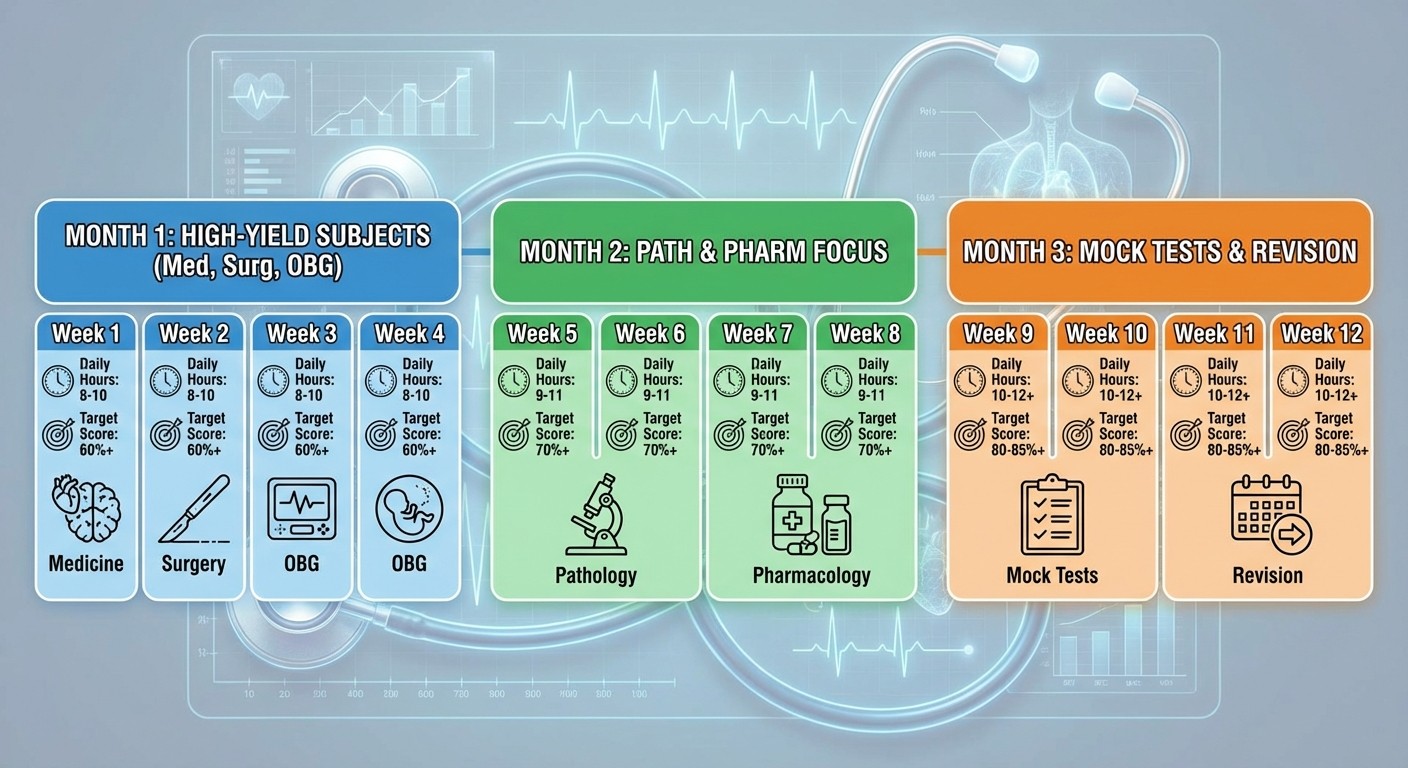
Month 1: Foundation Sprint (Weeks 1-4)
Week 1-2: Clinical Heavy Lifting
Daily structure: 8 hours active study + 2 hours MCQ practice Primary focus: Internal Medicine
Days 1-3: Cardiology (MI, heart failure, ECG interpretation)
Days 4-6: Pulmonology (asthma, COPD, TB patterns)
Days 7-9: Gastroenterology (IBD, liver diseases)
Days 10-12: Endocrinology (diabetes, thyroid)
Days 13-14: Nephrology basics + Medicine revision
During cardiology study, memorizing drug mechanisms becomes easier when you use spaced repetition. The key drugs for heart failure (ACE inhibitors, beta-blockers, diuretics) stick better when reviewed through spaced repetition flashcards rather than passive rereading. MCQ Target: 80-100 questions daily (60% Medicine, 40% mixed)
Week 3-4: Surgery Fundamentals
Primary focus: General Surgery + Subspecialties
Days 15-17: GI Surgery (appendicitis, intestinal obstruction, hernias)
Days 18-20: Hepatobiliary surgery
Days 21-23: Trauma surgery protocols
Days 24-26: Orthopedics (fractures, dislocations)
Days 27-28: Surgery revision + mock test
For surgical procedures, understanding the steps matters more than memorizing every detail. During hepatobiliary surgery prep, practice questions help you recognize question patterns rather than getting lost in operative details. Week 1-4 Target: Complete 70% of Medicine and 70% of Surgery syllabus
Month 2: Clinical Completion + Memory Subjects (Weeks 5-8)
Week 5-6: OBG + Pediatrics
Daily structure: 7 hours active study + 3 hours MCQ practice OBG focus:
High-risk pregnancy management
Labor complications (shoulder dystocia, cord prolapse)
Gynecological emergencies (ectopic pregnancy, ovarian torsion)
Contraception methods
Pediatrics focus:
Developmental milestones (never skip these — easy 4-5 marks)
Vaccination schedules (IAP 2022 guidelines)
Pediatric emergencies (seizures, respiratory distress)
Growth charts interpretation
During pediatric milestone study, creating quick mnemonics helps. "Social smile at 6 weeks, sits without support at 6 months" — but instead of making your own mnemonics, Oncourse's adaptive learning system provides pre-tested memory techniques that actually work in the exam hall.
Week 7-8: Pathology + Pharmacology Deep Dive
Pathology strategy:
Focus on gross pathology images (high-yield for NEET PG)
Microscopy patterns for common diseases
Laboratory values and interpretations
Pharmacology approach:
Drug mechanisms by system
Side effects (especially severe/life-threatening ones)
Drug interactions and contraindications
The beauty of pharmacology is pattern recognition. Beta-blockers all end in "-olol", ACE inhibitors in "-pril". But beyond naming patterns, understanding when NOT to prescribe becomes crucial. Beta-blockers in asthma patients isnt just wrong — it can kill the patient in your clinical scenario.
Week 5-8 Target: Complete OBG, Pediatrics, lock in Pathology/Pharmacology
Month 3: Mock Tests + Precision Revision (Weeks 9-12)
Week 9-10: Mock Test Intensive
Daily structure: 4 hours targeted study + 1 full mock test
Take a full 200-question mock every day. This sounds brutal, but its the only way to build exam stamina and identify weak spots with enough time to fix them.
Mock test schedule:
Day 1: Baseline mock (dont panic at the score)
Day 2: Analyze + revise weak topics
Day 3-4: Subject-specific mocks (Medicine, Surgery)
Day 5: Mixed mock test
Day 6-7: OBG + Pediatrics focused tests
After each mock test, your performance data shows exactly where marks are bleeding. Maybe you are getting cardiology right but missing respiratory questions. Maybe you know the drugs but mess up dosages. The performance dashboard tracks this granularly — accuracy by subject, time per question, improvement trends — so revision becomes surgical, not scattered.
Week 11-12: Final Sprint
Week 11: Last-minute high-yield cramming
Previous year questions (last 5 years minimum)
Image-based questions practice
Clinical scenarios and case-based MCQs
Week 12: Peak performance preparation
Light revision only (2-3 hours daily)
Daily mock tests (maintain exam rhythm)
Rest and mental preparation
During this final week, the goal isnt learning new concepts — its maintaining peak mental state. Your question bank practice should focus on confidence-building rather than discovering weak areas.
The Daily 600+ Routine
Month 1-2 Daily Schedule:
6:00 AM - 8:00 AM: Clinical subject theory
8:00 AM - 9:00 AM: MCQ practice (previous day's topics)
9:00 AM - 11:00 AM: Clinical subject continuation
11:00 AM - 12:00 PM: MCQ practice + review
2:00 PM - 4:00 PM: Memory subjects (Pathology/Pharmacology)
4:00 PM - 5:00 PM: Spaced repetition review
7:00 PM - 9:00 PM: Weak area targeted practice
9:00 PM - 10:00 PM: Next day planning
Month 3 Daily Schedule:
6:00 AM - 9:00 AM: Full mock test
9:00 AM - 11:00 AM: Mock analysis + weak area revision
2:00 PM - 4:00 PM: High-yield topic review
4:00 PM - 5:00 PM: Image-based question practice
7:00 PM - 8:00 PM: Light revision
8:00 PM - 9:00 PM: Mental preparation/relaxation
Weekly Performance Targets
Week | Mock Score Target | Study Hours | MCQs Solved |
|---|---|---|---|
1-2 | Baseline (dont focus on score) | 70 | 600 |
3-4 | 350-400 | 68 | 650 |
5-6 | 450-500 | 66 | 700 |
7-8 | 500-550 | 64 | 750 |
9-10 | 550-600 | 60 | 800 |
11-12 | 600+ consistently | 50 | 600 |
The score progression isnt linear — expect dips during new subject introduction. But by Week 10, your scores should stabilize above 550.
Subject-Specific Quick Wins for 600+
Medicine (Target: 280+/320)
ECG interpretation: Practice 20 ECGs daily in Week 1
Drug dosages: Create quick reference cards for emergency drugs
Clinical presentations: Focus on differential diagnosis approaches
Surgery (Target: 240+/280)
Anatomy relations: High-yield for surgery questions
Emergency protocols: ATLS guidelines, surgical priorities
Postoperative complications: Most predictable question pattern
OBG (Target: 200+/240)
Fetal monitoring: CTG interpretation patterns
High-risk pregnancies: Know management protocols cold
Contraception: Method-specific contraindications
Pediatrics (Target: 200+/240)
Normal values: Weight, height, head circumference charts
Vaccination: Current IAP schedule (not outdated ones)
Developmental milestones: Memorize precisely, not approximately
Common 3-Month Preparation Mistakes
1. Studying everything equally: High-yield subjects deserve more time
2. Starting mocks too late: Begin by Week 6, not Week 10
3. Perfectionism in basic sciences: Focus on clinical application
4. Ignoring previous year patterns: 70% questions follow predictable patterns
5. Burning out in Month 3: Reduce study hours, maintain consistency
Mental Framework for 600+ Success
Week 1-4: Build confidence through completions. Finish what you start. Week 5-8: Embrace the grind. This is where average students quit. Week 9-12: Trust the process. Your scores will fluctuate — focus on learning from mistakes.
Remember: 600+ isnt about being brilliant. Its about being systematic. Every high scorer follows a plan, tracks progress, and adjusts based on data. You are not special — but your preparation can be.
Frequently Asked Questions
Can I really score 600+ with just 3 months preparation?
Yes, if you start with a decent MBBS foundation and stick to high-yield subjects. Students with weak basics need 4-6 months minimum.
How many mock tests should I take in 3 months?
Minimum 30 full mocks. Take them throughout preparation, not just in the final month. Start with 2 per week from Month 1, increase to daily mocks in Month 3.
Is it possible to study 54 hours per week sustainably?
For 3 months, yes. Include breaks, light revision days, and mental health time. Beyond 3 months, this pace leads to burnout.
Should I focus on NEET PG question banks or textbooks?
Question banks for the final 3 months. Textbooks are for concept building in 6+ month preparation. Your time is better spent on targeted MCQ practice than reading theory.
What if my mock scores dont reach 600 even in Week 11?
Dont panic. Focus on improving by 20-30 marks each week. Consistency matters more than peak scores. Many students score higher in the actual exam due to reduced anxiety.
How do I avoid burnout during intense 3-month preparation?
Take one full day off per week. Sleep 6-7 hours minimum. Exercise for 20 minutes daily. Connect with other NEET PG aspirants for motivation and support.
Prepare smarter with Oncourse AI — adaptive MCQs, spaced repetition, and AI explanations built for NEET PG. Download free on Android and iOS.