Back
Neurosurgery Residency: How Competitive Is It? Step 2 Scores & NRMP Data 2026
Neurosurgery residency programs are the most competitive specialty in 2026. Get NRMP data, Step 2 CK score targets (255-265), research requirements, and match strategies.
Neurosurgery Residency: How Competitive Is It? Step 2 Scores & NRMP Data 2026
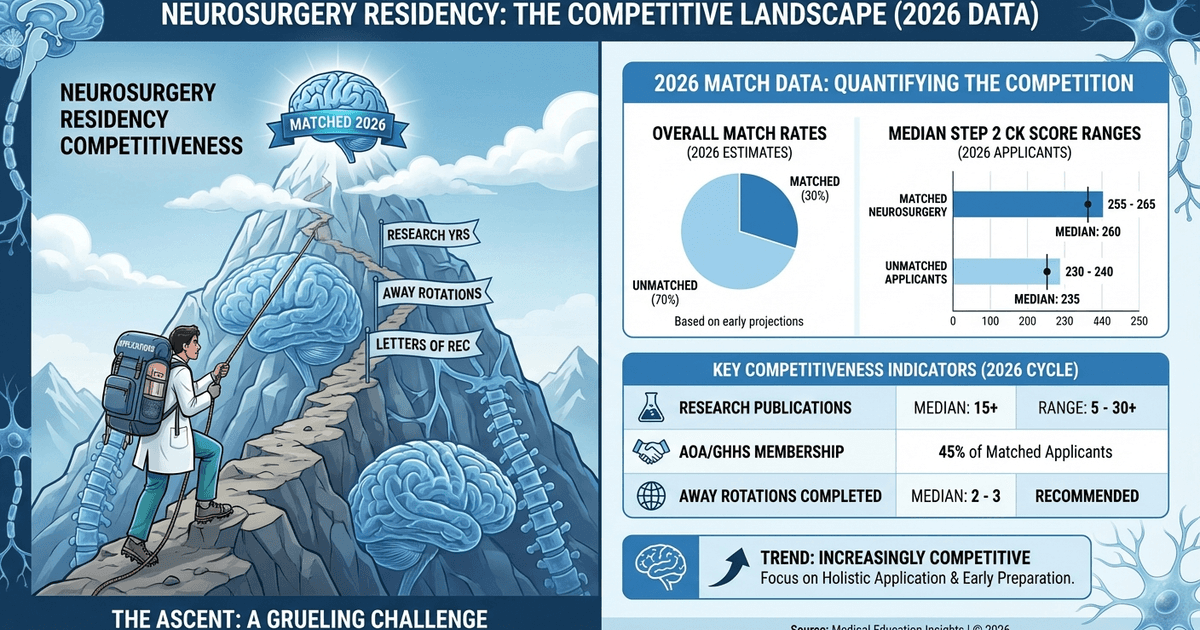
You are probably staring at neurosurgery as your dream specialty, wondering if your stats are even close to competitive. Neurosurgery residency programs accepted just 232 applicants in 2026 — from over 900 who applied. That is a 25.8% match rate, making it officially the most competitive specialty in American medicine.
Your Step 2 CK score needs to hit 255-265 minimum. Your research portfolio needs 15+ publications. Your 7-year commitment starts before you even match. This isnt a specialty you stumble into — its a calculated assault on the highest mountain in residency matching.
The numbers are brutal, but they tell a clear story about what it takes.
Why Neurosurgery Is the Hardest Specialty to Match
Neurosurgery consistently ranks as the most competitive residency for three reasons: limited spots, extreme selectivity, and the demanding nature of the field itself.
The Numbers Game Only 232 positions were available across all neurosurgery programs in 2026, compared to 8,700+ in internal medicine. With roughly 900 applicants competing for those spots, you are fighting 3-4 other candidates for every position. The National Resident Matching Program data shows neurosurgery has maintained this sub-30% match rate for over a decade. Academic Excellence Required
The average matched applicant scored 261 on Step 2 CK in 2026, with most successful candidates falling between 255-275. Unlike other specialties where a 240+ opens doors, neurosurgery demands near-perfect academic performance from day one of medical school.
Research Intensity
Successful neurosurgery candidates averaged 22 research experiences, including 8 first-author publications. This isnt just checking boxes — programs expect meaningful contributions to neurosurgical literature, often spanning 2-3 years of dedicated research time.
The American Association of Neurological Surgeons emphasizes that programs seek candidates who demonstrate both intellectual capacity and the resilience to handle the physical and emotional demands of neurosurgical training.
Step 2 CK Score Targets for Neurosurgery 2026
Your Step 2 CK score is your academic calling card for neurosurgery programs. The data shows exactly where you need to land.
Score Breakdown by Match Success
Step 2 CK Score Range | Match Rate | Interpretation |
|---|---|---|
270+ | 85% | Highly competitive |
260-269 | 68% | Competitive |
250-259 | 42% | Below average |
240-249 | 18% | Significant challenge |
<240 | 5% | Extremely difficult |
Target Score: 255-265
This range represents the realistic minimum for a competitive application. Scoring 255 puts you at the 25th percentile of matched candidates, while 265 reaches the 75th percentile. Most successful applicants cluster between 258-268.
The 270+ Advantage
Candidates scoring 270 or higher match at an 85% rate — nearly guaranteeing success when combined with strong research and clinical grades. These scores signal you can handle the intellectual demands of neurosurgery residency.
Recovery Strategies for Lower Scores If your Step 2 CK falls below 250, your path becomes significantly harder but not impossible. Focus on exceptional research productivity (25+ publications), outstanding clinical rotations in neurosurgery, and strong away rotations at target programs. Combined neurology-neurosurgery experiences can help, using comprehensive neurology preparation to strengthen your clinical foundation. International Medical Graduates (IMGs)
IMG candidates need Step 2 CK scores of 265+ to be competitive, with most successful IMG matches scoring 270+. The bar is higher due to visa considerations and program preferences for US graduates.
2026 NRMP Match Data Breakdown
The latest NRMP data reveals the stark realities of neurosurgery matching in 2026.
Application Statistics
Total applicants: 894
Positions available: 232
Overall match rate: 25.8%
US MD seniors match rate: 78.2%
US DO seniors match rate: 45.6%
IMG match rate: 8.4%
Competitive Metrics for Matched Applicants
Step Scores (Matched Candidates)
Step 1 (when numeric): 248 average
Step 2 CK: 261 average
Step 2 CS: Pass (required)
Research Productivity
Research experiences: 22 average
Peer-reviewed publications: 15 average
First-author publications: 8 average
Presentations: 28 average
Clinical Performance
Honor grades in core clerkships: 85% of candidates
Neurosurgery rotation grade: Honors required
Away rotations completed: 3.2 average
Geographic and Program Trends
Most Competitive Programs
The top-tier neurosurgery programs (Mayo Clinic, Johns Hopkins, UCSF) see match rates below 5%. These programs receive 200+ applications for 1-2 spots and typically match candidates with 275+ Step 2 CK scores and 30+ publications.
Regional Variations
Northeast programs: Most competitive (15-20% match rates)
West Coast: Highly competitive (20-25% match rates)
Southeast: Competitive (25-30% match rates)
Midwest: Moderately competitive (30-35% match rates)
The ACGME neurosurgery programs data shows new programs opening slowly — only 2-3 new positions added annually, while applicant numbers grow by 4-5% yearly.
Research Requirements and Timeline
Neurosurgery demands the most extensive research portfolio of any specialty. Your research timeline needs to start in first year and continue through residency applications.
Research Productivity Benchmarks
Minimum Competitive Portfolio
15+ peer-reviewed publications
5+ first-author papers
25+ conference presentations
2+ years dedicated research time
1+ grant or award
Highly Competitive Portfolio
25+ publications
10+ first-author papers
40+ presentations
3+ years research experience
Multiple grants and awards
Research Timeline Strategy
Years 1-2: Foundation Building
Start basic science research in neuroscience, neurology, or related fields. Focus on learning research methodology and building relationships with faculty mentors. Target 2-3 poster presentations by end of second year.
Year 3: Clinical Research Integration Begin neurosurgery-specific research during your surgery clerkship. Identify neurosurgery faculty mentors and join ongoing clinical studies. Master neurosurgical anatomy and pathology to contribute meaningfully to research discussions. Year 4: Research Year (Recommended)
Take a dedicated research year between third and fourth year. This allows uninterrupted focus on major projects and typically yields 5-8 additional publications. Many successful candidates complete research fellowships at top neurosurgery programs.
Fourth Year: Manuscript Completion
Focus on publishing ongoing work while completing clinical rotations. Submit manuscripts before ERAS applications open in September.
Research Focus Areas
High-Impact Topics
Minimally invasive techniques
Brain tumor genetics and immunotherapy
Cerebrovascular surgery outcomes
Spine biomechanics and fusion technology
Pediatric neurosurgery innovations
Collaborative Opportunities
Work with neurology, oncology, and radiology departments on interdisciplinary projects. Cross-specialty research demonstrates breadth and often leads to higher-impact publications.
The Congress of Neurological Surgeons offers research grants specifically for medical students pursuing neurosurgery careers.
The 7-Year Training Commitment
Neurosurgery residency is a 7-year marathon that tests every aspect of your personal and professional life. Understanding this commitment upfront is crucial for realistic planning.
Training Structure
Years 1-2: Foundation (PGY-1 to PGY-2)
General surgery rotations (6 months)
Internal medicine (3 months)
Neurology (3 months)
Critical care (3 months)
Research (9 months typically)
Call frequency: Every 4th night
Work hours: 80+ per week
Years 3-5: Core Neurosurgery (PGY-3 to PGY-5)
Operating room focus increases progressively
Subspecialty rotations: pediatric, vascular, spine, tumor
Increasing operative responsibility
Call frequency: Every 3rd-4th night
Work hours: 80-100 per week
Years 6-7: Senior Resident (PGY-6 to PGY-7)
Primary surgeon on many cases
Teaching junior residents and medical students
Research project completion
Fellowship preparation
Call frequency: Every 3rd night
Work hours: 90-110 per week
Lifestyle Considerations
Work-Life Balance Reality
Neurosurgery residents work the longest hours of any specialty. Expect minimal personal time during years 3-5. Many residents describe the experience as "postponing life" for the duration of training.
Financial Impact
Seven years of resident salary ($55,000-65,000) while carrying medical school debt creates significant financial strain. Factor in the opportunity cost compared to shorter residencies when making your decision.
Relationship Challenges
The demanding schedule strains relationships. Many successful neurosurgery residents have supportive partners who understand the temporary nature of the intense commitment.
Physical and Mental Health
Long hours and high stress require exceptional self-care strategies. Programs increasingly focus on wellness, but the fundamental demands remain extreme.
Building consistency early is crucial for the long-term preparation neurosurgery demands — tracking your daily study habits helps maintain momentum over the extended timeline required.
How to Build a Competitive Application
Creating a neurosurgery-competitive application requires strategic planning across multiple domains simultaneously.
Academic Excellence Foundation
Medical School Performance
Honor grades in all core clerkships (mandatory)
Top 10% class rank (strongly preferred)
Alpha Omega Alpha (AOA) membership (75% of matched candidates)
Gold Humanism Honor Society membership (valuable)
Step Performance Strategy Target Step 2 CK scores of 260+ through dedicated high-yield preparation. Focus on surgical decision-making questions that mirror neurosurgery clinical reasoning. The emphasis on Step 2 CK has increased significantly since Step 1 became pass/fail.
Clinical Experience Building
Early Neurosurgery Exposure
Shadow neurosurgeons starting second year
Complete neurosurgery electives during third year
Arrange sub-internships at target programs
Seek international neurosurgery experiences if available
Away Rotation Strategy
Complete 3-4 away rotations at programs where you want to match. These serve as extended interviews and relationship-building opportunities. Apply early — spots fill quickly at competitive programs.
Letters of Recommendation
Secure letters from neurosurgery faculty who know your work well. One letter from your research mentor, one from a clinical attending, and one from the department chair create an ideal combination.
Research Portfolio Development
Publication Strategy
Focus on first-author publications in neurosurgery journals. Case reports and retrospective reviews are acceptable starting points, but aim for original research and systematic reviews for maximum impact.
Conference Presentations
Present research at the American Association of Neurological Surgeons (AANS) annual meeting and Congress of Neurological Surgeons (CNS) annual meeting. These presentations often lead to networking opportunities and potential collaborations.
Leadership and Service
Medical School Leadership
Serve in student government, research organizations, or specialty interest groups. Leadership in neurosurgery interest groups is particularly valuable.
Community Service
Engage in medically-related community service, particularly activities involving neurological conditions or surgical outreach.
Teaching Experience
Tutor younger students in anatomy, physiology, or clinical skills. Teaching ability is valued in academic neurosurgery programs.
The combined approach of surgical knowledge and clinical reasoning becomes essential when preparing comprehensive case presentations during interviews.
Alternative Pathways and Backup Plans
Even exceptional candidates should develop backup plans given neurosurgery's low match rate.
Direct Alternative Specialties
Neurology
Many neurosurgery hopefuls successfully transition to neurology, particularly interventional neurology subspecialties. The neurological foundation translates well, and the lifestyle is more manageable.
Orthopedic Surgery
Another highly competitive surgical specialty with similar research requirements. The operative focus and competitive nature attract similar candidate profiles.
Radiation Oncology
High Step score requirements and research focus make this an appropriate backup for academically strong neurosurgery candidates.
Reapplication Strategies
Research Fellowship Route
Complete a 1-2 year research fellowship at a neurosurgery program. This demonstrates continued commitment and often leads to successful matching the following year.
Preliminary Surgery Year
Match into a preliminary surgery position and reapply during PGY-1 year. This shows clinical commitment and provides additional surgical experience.
International Training
Some candidates complete neurosurgery training internationally and then return for US fellowship opportunities.
Long-Term Career Considerations
Fellowship Subspecialization
Even after matching neurosurgery, most graduates complete 1-year fellowships in subspecialties like pediatric neurosurgery, spine surgery, or cerebrovascular surgery.
Academic vs. Private Practice
Consider whether your career goals align with academic medicine (research, teaching) or private practice (clinical focus, lifestyle). This influences program selection and fellowship choices.
Geographic Flexibility
Remain flexible about location, especially for your first choice programs. Many successful neurosurgeons train far from their preferred geographic area and relocate after residency.
Using comprehensive flashcard review helps maintain long-term retention of neurosurgical concepts throughout the extended preparation period.
Timeline for Neurosurgery Match Success
Success in neurosurgery matching requires strategic planning that begins freshman year of medical school.
Pre-Medical School
Shadow neurosurgeons to confirm career interest
Complete research in neuroscience or related fields
Excel in MCAT (520+ strongly recommended)
Choose medical schools with strong neurosurgery programs
Medical School Years 1-2
Year 1:
Excel academically (top 10% class rank target)
Join neurosurgery interest groups
Begin basic science research
Shadow neurosurgeons monthly
Year 2:
Continue research momentum
Complete anatomy with distinction
Network with neurosurgery faculty
Plan research year if considering this option
Medical School Years 3-4
Year 3:
Honor all core clerkships
Complete neurosurgery elective
Identify research mentors
Submit first manuscripts
Year 4:
Complete away rotations
Finalize research publications
Take Step 2 CK (target 260+)
Submit ERAS applications
Interview season preparation
Application Timeline (Year 4)
January-March: Finalize research projects
April-June: Complete away rotation applications
July-August: Complete ERAS application
September: ERAS submission opens
October-February: Interview season
March: Match Day
Frequently Asked Questions
What Step 2 CK score do I need for neurosurgery?
Target 255-265 minimum for US medical graduates. IMG candidates need 265+ to be competitive. Scores below 250 make matching extremely difficult regardless of other credentials.
How many research publications are required?
Successful candidates average 15+ peer-reviewed publications with 5+ first-author papers. Quality matters more than quantity, but neurosurgery expects both substantial research output and meaningful contributions.
Should I take a research year?
Yes, most competitive candidates take 1-2 dedicated research years. This allows focused time for significant research contributions and often yields 5-8 additional publications essential for matching.
What if I dont match neurosurgery?
Have backup plans ready. Consider neurology, orthopedic surgery, or radiation oncology as alternatives. You can also complete a research fellowship and reapply, which has a higher success rate.
How important are away rotations?
Critical. Most matched candidates complete 3-4 away rotations at target programs. These serve as extended interviews and relationship-building opportunities with faculty.
Can international medical graduates match neurosurgery?
Yes, but its extremely difficult. IMG match rate is approximately 8-10%. You need exceptional Step scores (270+), extensive research (25+ publications), and often additional clinical experience in the US.
Prepare smarter with Oncourse AI — adaptive MCQs, spaced repetition, and AI explanations built for USMLE success. Download free on Android and iOS.