USMLE Step 2 CK for IMGs: Complete Preparation Checklist, Target Scores, and Best Resources to Match in 2026
Complete USMLE Step 2 CK preparation guide for IMGs in 2026. Target scores, 6-month study timeline, best resources, and strategies to match in competitive residency programs.

USMLE Step 2 CK for IMGs: Complete Preparation Checklist, Target Scores, and Best Resources to Match in 2026
You are probably staring at your USMLE timeline wondering if 4-6 months is enough for Step 2 CK. As an IMG, the pressure feels different — you need higher scores, perfect timing, and zero mistakes. Step 2 CK has 318 questions across 8 blocks. You get 9 hours total, which means roughly 102 seconds per question. Not much room for second-guessing.
The good news? Step 2 CK is the most predictable USMLE exam. Unlike Step 1's random factoids or Step 3's case simulations, Step 2 CK tests clinical reasoning you can train. The patterns repeat. The high-yield topics stay consistent. Most importantly, it rewards systematic preparation over cramming.
This guide covers everything you need to match in 2026: target scores, month-by-month timelines, resource comparisons, and the specific strategies that work for IMGs. No fluff — just the preparation checklist that gets results.
Target Scores for IMGs in 2026
Step 2 CK scores matter more for IMGs than any other USMLE exam. While US medical graduates can match with scores around 240-250, IMGs need significantly higher numbers to compete.
Minimum Competitive Scores by Specialty
Specialty Category | Target Score Range | Safe Score | Notes |
|---|---|---|---|
Primary Care (FM, IM, Peds) | 245-255 | 260+ | Most IMG-friendly specialties |
Competitive Specialties (Radiology, Anesthesia) | 255-265 | 270+ | Strong Step 1 also required |
Highly Competitive (Surgery, Emergency) | 265-275 | 280+ | Multiple high scores needed |
The passing score for Step 2 CK remains 214, but passing doesn't mean competitive. A score below 240 significantly limits your specialty options as an IMG. The sweet spot is 260+ — this opens doors to most residency programs and demonstrates the clinical competency program directors expect.
Score Timeline Reality Check
Most IMGs take Step 2 CK 6-12 months after Step 1. If your Step 1 score was below 240, you need Step 2 CK to be 20-30 points higher to maintain competitiveness. If Step 1 was strong (250+), Step 2 CK should match or exceed that score.
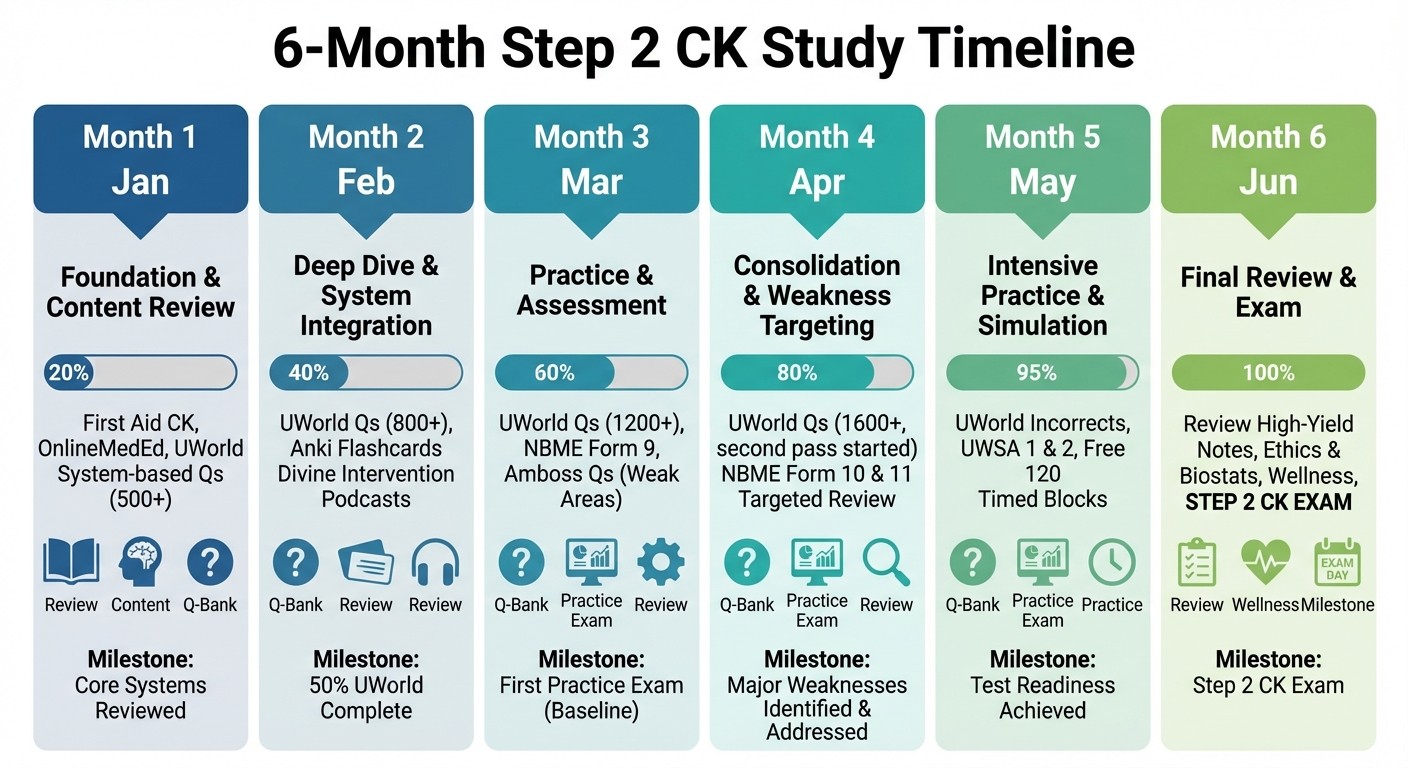
6-Month Preparation Timeline
Step 2 CK preparation works best with dedicated study blocks. Here's the month-by-month breakdown that consistently produces high scores:
Months 1-2: Foundation Building
Daily Time Commitment: 6-8 hours Focus: Core knowledge and pattern recognition
Week 1-2: Read through UWorld explanations for 1-2 systems (start with high-yield: cardiology, infectious diseases)
Week 3-4: Complete your first pass of questions in these systems (40-50 questions daily)
Week 5-6: Add internal medicine and surgery basics
Week 7-8: Incorporate pediatrics and obstetrics fundamentals
During this phase, accuracy doesn't matter. You are building clinical reasoning patterns. When reviewing USMLE internal medicine lessons, focus on diagnostic algorithms rather than memorizing every detail.
Months 3-4: Active Recall and Pattern Recognition
Daily Time Commitment: 8-10 hours Focus: Question-based learning and high-yield review
Daily Routine: 80-100 UWorld questions + thorough review
Weekly Goals: Complete 500-600 questions per week
Knowledge Gaps: Use spaced repetition for weak areas
This is where USMLE practice questions become crucial for reinforcing clinical reasoning. The AI explanations help you understand not just why an answer is correct, but why the other options are wrong.
Months 5-6: Practice Tests and Final Review
Daily Time Commitment: 10-12 hours Focus: Simulated testing and score optimization
Week 17-20: Complete NBME practice exams (aim for 250+ consistently)
Week 21-22: UWorld Self-Assessment exams
Week 23-24: Final review of incorrects and high-yield facts
High-Yield Topics That Appear Most Frequently
Step 2 CK isn't random. Certain topics appear in 60-70% of exams. Focus your energy here:
Internal Medicine (40% of exam)
Cardiology: Heart failure management, MI treatment protocols, arrhythmia interpretation
Infectious Diseases: Antibiotic selection, opportunistic infections, sepsis management
Endocrinology: Diabetes management, thyroid disorders, adrenal conditions
Gastroenterology: IBD treatment, liver disease staging, GI bleeding protocols
Surgery (25% of exam)
General Surgery: Acute abdomen workup, trauma protocols, post-op complications
Orthopedics: Fracture management, joint disorders, sports injuries
Emergency Medicine: Shock management, poisoning protocols, trauma assessment
Obstetrics & Gynecology (15% of exam)
High-risk pregnancy: Gestational diabetes, preeclampsia management
Labor complications: Shoulder dystocia, cord prolapse, fetal distress
Gynecology: Abnormal bleeding, contraception, menopause
Pediatrics (15% of exam)
Well-child care: Vaccination schedules, developmental milestones
Common conditions: Asthma management, failure to thrive, infectious diseases
Emergency pediatrics: Fever protocols, respiratory distress, trauma
The key insight: Step 2 CK tests management decisions more than diagnosis. When practicing with USMLE biostatistics questions, focus on interpreting study results for clinical decision-making rather than memorizing statistical formulas.
Best Study Resources for IMGs
Question Banks (Essential)
UWorld Step 2 CK: The gold standard. 2,500+ questions with detailed explanations. Complete it twice — first pass for learning, second pass for retention. Aim for 70%+ accuracy by your second pass. AMBOSS: Excellent for knowledge gaps and weak areas. Their 5-hammer questions match exam difficulty. Use it to supplement UWorld, not replace it.
Practice Exams (Critical for Score Prediction)
NBME Practice Exams: Take all available forms (NBME 9-12). These predict your actual score within 10-15 points. Schedule one every 2-3 weeks during months 4-6. UWorld Self-Assessments: UWSA1 and UWSA2 are essential. Take UWSA2 one week before your exam — it's the most accurate predictor.
Review Books (Use Selectively)
First Aid Step 2 CK: Good for quick review, but dont rely on it as your primary source. Use it during the final 2-3 weeks for rapid revision. Master the Boards: More detailed than First Aid. Helpful for surgical topics and emergency medicine protocols.
Digital Tools for Active Learning
When you hit a knowledge gap during question review, Rezzy AI can provide instant explanations tailored to USMLE Step 2 CK format. Instead of scrolling through textbooks, ask specific questions about management protocols or diagnostic criteria.
For memorizing drug mechanisms and treatment algorithms, spaced repetition works better than passive reading. The key is consistency — 20-30 minutes daily beats 3-hour weekend cramming sessions.
Study Schedule and Daily Routine
Consistency beats intensity for Step 2 CK. A structured daily routine prevents burnout and ensures comprehensive coverage.
Optimal Daily Schedule (Months 3-5)
9:00 AM - 12:00 PM: Fresh mind question blocks (40 questions) 12:00 PM - 1:00 PM: Lunch break 1:00 PM - 4:00 PM: Review incorrect answers and explanations 4:00 PM - 4:30 PM: Break 4:30 PM - 6:30 PM: Second question block (40 questions) 6:30 PM - 8:00 PM: Dinner break 8:00 PM - 10:00 PM: Review and flashcard revision
Weekly Targets
Questions completed: 500-600 per week
Review time: 2 hours per question block
Practice exam: Every 2-3 weeks
Rest day: One full day off per week (crucial for retention)
The mistake most IMGs make is doing too many questions without proper review. Each incorrect answer represents a knowledge gap. Spend 3-4 minutes understanding why you got it wrong, not just what the right answer is.
Common Mistakes IMGs Make
Mistake 1: Starting Too Late
Many IMGs underestimate Step 2 CK because they assume clinical knowledge from medical school transfers directly. US clinical guidelines, drug names, and treatment protocols differ significantly from most international curricula. Give yourself 6+ months, not 3-4.
Mistake 2: Focusing Only on Knowledge
Step 2 CK tests decision-making under time pressure. You need to recognize patterns quickly and eliminate wrong answers efficiently. Practice timing from day one — 102 seconds per question is non-negotiable.
Mistake 3: Ignoring Practice Exam Scores
If your NBME scores plateau below your target, don't just hope the real exam will be different. Identify specific weak areas and dedicate 2-3 weeks to improvement before rescheduling.
Mistake 4: Memorizing vs Understanding
Step 2 CK questions test application, not recall. When studying hypertension management, don't just memorize JNC guidelines — understand when to use ACE inhibitors vs ARBs vs calcium channel blockers based on patient characteristics.
Target Score Strategies
For 240-250 Range (Competitive for Primary Care)
Complete UWorld once with 65%+ accuracy
Score 240+ on 2-3 NBME exams consistently
Master high-yield internal medicine topics
Focus on time management and pattern recognition
For 250-260 Range (Competitive for Most Specialties)
Complete UWorld 1.5 times with 70%+ accuracy
Add AMBOSS for additional question practice
Score 250+ on all NBMEs
Master surgical and emergency medicine topics
For 260+ Range (Highly Competitive Specialties)
Complete UWorld twice with 75%+ accuracy
Use multiple question banks (UWorld + AMBOSS)
Score 260+ consistently on practice exams
Master ethics, patient communication, and complex multi-system cases
Managing Test Anxiety and Exam Day
Step 2 CK spans 9 hours across 8 blocks. Mental stamina matters as much as knowledge.
Pre-Exam Week Routine
7 days before: Complete final practice exam and review performance
3-4 days before: Light review of high-yield facts only
2 days before: Rest day with minimal studying
1 day before: Review common drug interactions and normal lab values
Exam Day Strategy
Block 1-3: Start conservatively, build confidence Block 4: Lunch break — eat protein, avoid heavy meals Block 5-6: Peak performance window Block 7-8: Mental fatigue hits — stick to first instinct on difficult questions
Time Management Per Block
Questions 1-20: 1.5 minutes each (allow extra time for long stems)
Questions 21-35: 1.7 minutes each (maintain pace)
Questions 36-40: 2 minutes each (use remaining time for review)
Final 5 minutes: Check marked questions only
When practicing clinical reasoning during preparation, tools like the Image Rush game can help you quickly identify pathognomonic findings under time pressure — a skill that directly translates to faster question recognition on exam day.
Post-Exam: Score Reporting and Next Steps
Step 2 CK scores release 2-4 weeks after testing. Plan your next moves while waiting:
If You Scored Your Target
Begin ERAS application preparation immediately
Schedule Step 3 if required for your specialty
Focus on research and clinical experience
If You Scored Below Target
Analyze score report for specific weak areas
Consider retaking only if below 240 or significantly under specialty requirements
Remember: retakes show on transcripts, so improve substantially (20+ points)
Timeline for Residency Applications
ERAS opens: May 1, 2026
Application submission: September 1, 2026
Interview season: October 2026 - January 2027
Match Day: March 2027
Your Step 2 CK score needs to be available before ERAS submission. Plan accordingly.
Frequently Asked Questions
How long should I study for Step 2 CK as an IMG?
Most successful IMGs study 4-6 months with dedicated time. If you have strong clinical background, 4 months might suffice. If you need to learn US clinical guidelines from scratch, plan for 6+ months.
Is 240 enough for IMGs to match?
240 is the minimum competitive score, but 250+ significantly improves your chances. For primary care, 240-250 works. For competitive specialties, aim for 260+.
Should I take Step 2 CK before or after Step 3?
Take Step 2 CK first. Most residency programs require it for ERAS applications. Step 3 can wait until after matching.
How many times can I retake Step 2 CK?
You can attempt each USMLE step up to 6 times. However, multiple attempts appear on your transcript. Only retake if you scored significantly below your target.
What percentage of UWorld should I aim for?
First pass: 55-65% is normal. Second pass: 70-75% indicates readiness for 240-250 range. 75%+ suggests potential for 260+ scores.
When should I schedule my exam date?
Schedule 2-3 months in advance. Peak testing periods (June-August) fill quickly. Avoid scheduling during Ramadan or major holidays if they affect your performance.
Prepare smarter with Oncourse AI — adaptive MCQs, spaced repetition, and AI explanations built for USMLE Step 2 CK. Download free on Android and iOS.