
Brain tumor classification and management — MCQs

A 45-year-old female is admitted to the hospital after worsening headaches for the past month. She has noticed that the headaches are usually generalized, and frequently occur during sleep. She does not have a history of migraines or other types of headaches. Her past medical history is significant for breast cancer, which was diagnosed a year ago and treated with mastectomy. She recovered fully and returned to work shortly thereafter. CT scan of the brain now shows a solitary cortical 5cm mass surrounded by edema in the left hemisphere of the brain at the grey-white matter junction. She is admitted to the hospital for further management. What is the most appropriate next step in management for this patient?
A 13-year-old boy is brought to the physician because of a 4-month history of worsening dizziness, nausea, and feeling clumsy. An MRI of the brain shows a well-demarcated, 4-cm cystic mass in the posterior fossa. The patient undergoes complete surgical resection of the mass. Pathologic examination of the surgical specimen shows parallel bundles of cells with eosinophilic, corkscrew-like processes. Which of the following is the most likely diagnosis?
A 57-year-old man is brought to the emergency department by his wife 20 minutes after having had a seizure. He has had recurrent headaches and dizziness for the past 2 weeks. An MRI of the brain shows multiple, round, well-demarcated lesions in the brain parenchyma at the junction between gray and white matter. This patient's brain lesions are most likely comprised of cells that originate from which of the following organs?
A 60-year-old male is admitted to the ICU for severe hypertension complicated by a headache. The patient has a past medical history of insulin-controlled diabetes, hypertension, and hyperlipidemia. He smokes 2 packs of cigarettes per day. He states that he forgot to take his medications yesterday and started getting a headache about one hour ago. His vitals on admission are the following: blood pressure of 160/110 mmHg, pulse 95/min, temperature 98.6 deg F (37.2 deg C), and respirations 20/min. On exam, the patient has an audible abdominal bruit. After administration of antihypertensive medications, the patient has a blood pressure of 178/120 mmHg. The patient reports his headache has increased to a 10/10 pain level, that he has trouble seeing, and he can't move his extremities. After stabilizing the patient, what is the best next step to diagnose the patient's condition?
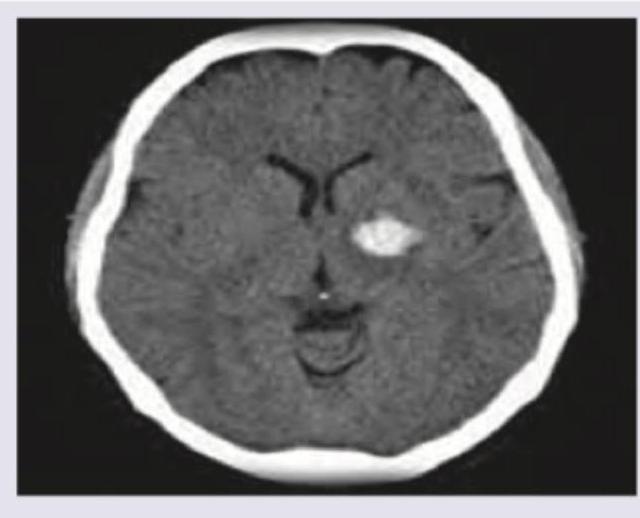
A 53-year-old man is brought to the emergency department for confusion. He was in his usual state of health until about 3 hours ago when he tried to use his sandwich to turn off the TV. He also complained to his wife that he had a severe headache. Past medical history is notable for hypertension, which has been difficult to control on multiple medications. His temperature is 36.7°C (98°F), the pulse is 70/min, and the blood pressure is 206/132 mm Hg. On physical exam he is alert and oriented only to himself, repeating over and over that his head hurts. The physical exam is otherwise unremarkable and his neurologic exam is nonfocal. The noncontrast CT scan of the patient's head is shown and reveals an acute intraparenchymal hemorrhage in the basal ganglia. Which of the following diagnostic tests would be most helpful in determining the underlying cause of this patient's hemorrhage?
A 57-year-old man was brought into the emergency department unconscious 2 days ago. His friends who were with him at that time say he collapsed on the street. Upon arrival to the ED, he had a generalized tonic seizure. At that time, he was intubated and is being treated with diazepam and phenytoin. A noncontrast head CT revealed hemorrhages within the pons and cerebellum with a mass effect and tonsillar herniation. Today, his blood pressure is 110/65 mm Hg, heart rate is 65/min, respiratory rate is 12/min (intubated, ventilator settings: tidal volume (TV) 600 ml, positive end-expiratory pressure (PEEP) 5 cm H2O, and FiO2 40%), and temperature is 37.0°C (98.6°F). On physical examination, the patient is in a comatose state. Pupils are 4 mm bilaterally and unresponsive to light. Cornea reflexes are absent. Gag reflex and cough reflex are also absent. Which of the following is the next best step in the management of this patient?
A 72-year-old woman comes to the emergency department 4 hours after the sudden onset of a diffuse, dull, throbbing headache. During this time, she also reports blurred vision, nausea, and one episode of vomiting. She has a history of hypertension and type 2 diabetes mellitus. Her medications include hydrochlorothiazide, lisinopril, atorvastatin, and metformin. She has smoked 1 pack of cigarettes daily for the past 30 years and drinks 1–2 glasses of wine per day. Her temperature is 36.6 °C (97.9 °F), pulse is 90/min, respirations are 14/min, and blood pressure is 185/110 mm Hg. Fundoscopic examination shows bilateral blurring of the optic disc margins. Physical and neurologic examinations show no other abnormalities. A complete blood count and serum concentrations of electrolytes, urea nitrogen, and creatinine are within the reference range. Urinalysis shows 2+ protein but no WBCs or RBCs. Which of the following is the most likely diagnosis?
A 31-year-old woman comes to the physician because of headaches and nausea for 2 weeks. The headaches are worse on awakening and she describes them as 7 out of 10 in intensity. During this period, she has noticed brief episodes of visual loss in both eyes lasting several seconds, especially when she suddenly stands up or bends over. She is 165 cm (5 ft 5 in) tall and weighs 98 kg (216 lb); BMI is 36 kg/m2. Vital signs are within normal limits. Examination shows a visual acuity of 20/20 in both eyes with mild peripheral vision loss. Fundoscopic examination shows bilateral optic disc swelling. An MRI of the brain shows no abnormalities. A lumbar puncture is performed; opening pressure is 310 mm H2O. Cerebrospinal fluid analysis shows a leukocyte count of 4/mm3 (75% lymphocytes), a protein concentration of 35 mg/dL, and a glucose concentration of 45 mg/dL. Which of the following is the most appropriate next step in management?
A 28-year-old woman presents with a 12-month history of headache, tinnitus, retrobulbar pain, and photopsias. She says the headaches are mild to moderate, intermittent, diffusely localized, and refractory to nonsteroidal anti-inflammatory drugs (NSAIDs). In addition, this past week, she began to have associated dizziness and photopsia with the headaches. Physical examination reveals a body temperature of 36.5°C (97.7°F), blood pressure of 140/80 mm Hg, and a respiratory rate of 13/min and regular. BMI is 29 kg/m2. Neurological examination is significant for peripheral visual field loss in the inferior nasal quadrant, diplopia, bilateral abducens nerve palsy, and papilledema. A T1/T2 MRI of the brain did not identify extra-axial or intra-axial masses or interstitial edema, and a lumbar puncture showed an opening pressure of 27 cm H2O, with a cerebrospinal fluid analysis within the normal range. Which of the following best describes the pathogenic mechanism underlying these findings?
A 67-year-old man comes to the emergency department because of decreased vision and black spots in front of his left eye for the past 24 hours. He states that it feels as if 'a curtain is hanging over his eye.' He sees flashes of light intermittently. He has no pain or diplopia. He underwent cataract surgery on the left eye 2 weeks ago. He has hypertension and type 2 diabetes mellitus. His sister has open-angle glaucoma. Current medications include metformin, linagliptin, ramipril, and hydrochlorothiazide. Vital signs are within normal limits. Examination shows a visual acuity in the right eye of 20/25 and the ability to count fingers at 3 feet in the left eye. The pupils are equal and reactive. The corneal reflex is present. The anterior chamber shows no abnormalities. The confrontation test is normal on the right side and shows nasal and inferior defects on the left side. Cardiopulmonary examination shows no abnormalities. The patient is awaiting dilation for fundus examination. Which of the following is the most likely diagnosis?
Want unlimited practice?
Get full access to all questions, explanations, and performance tracking.
Scan to download app