Back
Interleaving Practice for Medical Students: The Science Behind Mixing Subjects to Score Higher on USMLE and NEET PG (2026)
Master interleaving practice to boost NEET PG and USMLE scores. Learn why mixing subjects beats blocked study, backed by cognitive science research and practical implementation tips.
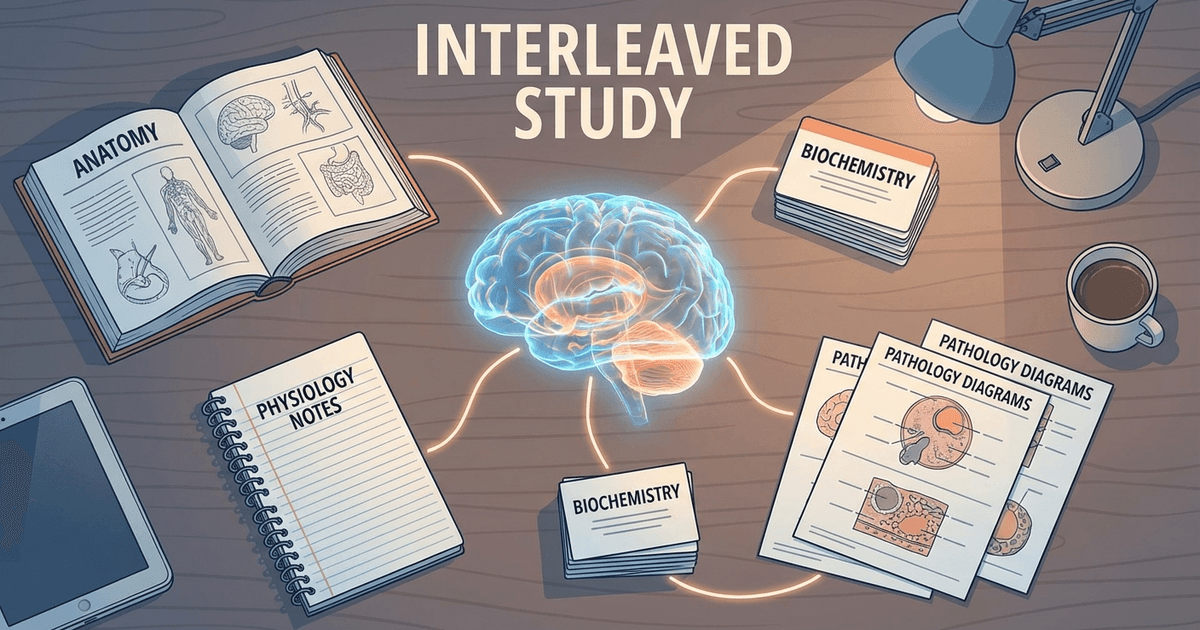
Interleaving Practice for Medical Students: The Science Behind Mixing Subjects to Score Higher on USMLE and NEET PG (2026)
You are probably studying anatomy for 3 hours straight, then switching to physiology tomorrow, then biochemistry the day after. This feels productive. You are making progress through each subject methodically. But here is the problem: your brain is optimizing for short-term fluency, not long-term retention.
NEET PG has 200 questions across 19 subjects in 3.5 hours. USMLE Step 1 tests integrated knowledge across basic sciences. These exams dont test your ability to recall anatomy facts after studying anatomy all morning. They test whether you can discriminate between anatomical, physiological, and pathological concepts when they are mixed together — exactly what interleaving practice trains.
Research from cognitive psychology shows that interleaving — mixing different subjects or problem types within a single study session — improves long-term retention by 43% compared to blocked practice. Yet 90% of medical students still use blocked schedules because interleaving feels harder. That difficulty is exactly why it works.
What Is Interleaving Practice?
Interleaving practice means mixing different subjects, topics, or problem types within a single study session rather than completing one subject before moving to the next. Instead of studying anatomy for 2 hours, then physiology for 2 hours, you alternate: 30 minutes anatomy, 30 minutes physiology, 30 minutes biochemistry, then repeat.
The key is forcing your brain to constantly switch between different types of problems and knowledge domains. Each switch requires your brain to "reload" the relevant concepts, strengthening the neural pathways and improving discrimination between similar concepts.
Blocked vs Interleaved Practice
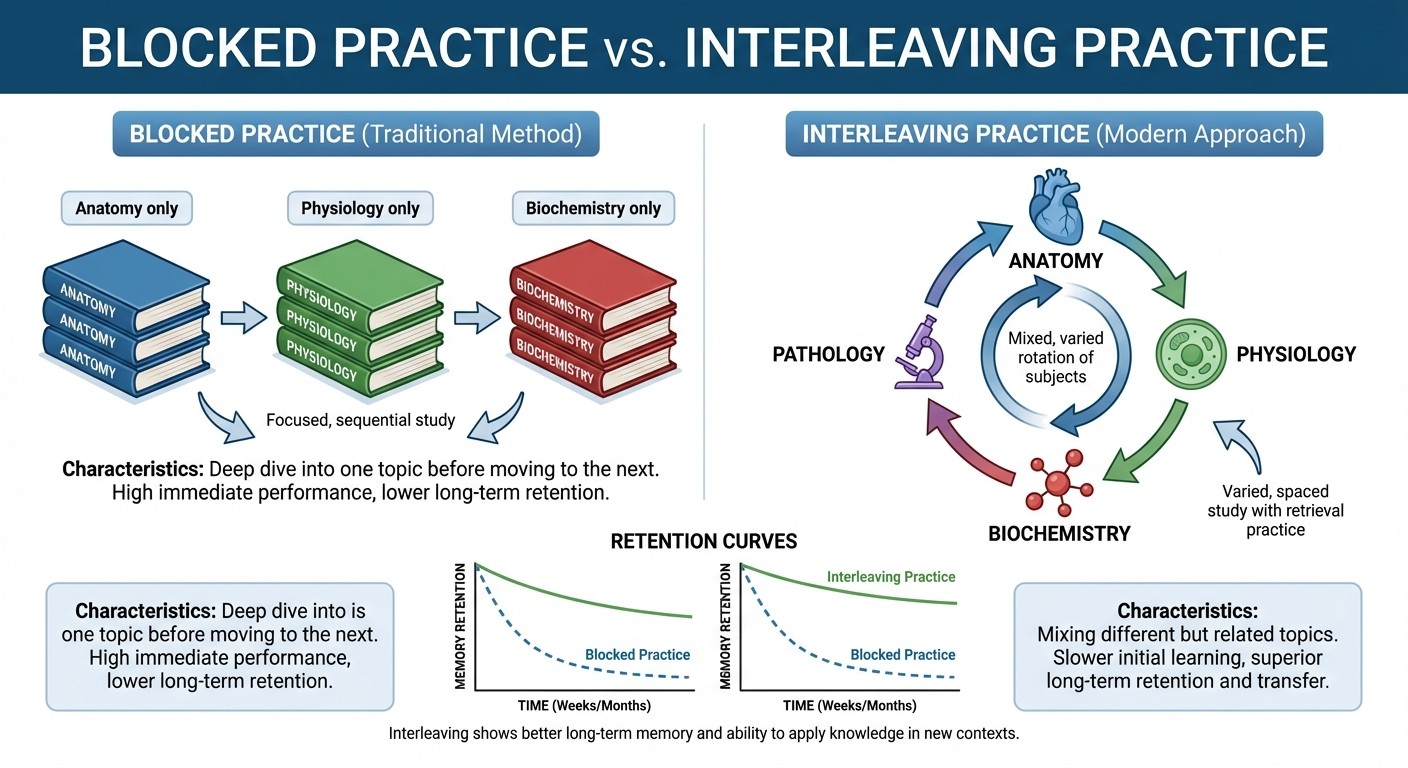
Blocked Practice (Traditional):
Monday: Anatomy (4 hours)
Tuesday: Physiology (4 hours)
Wednesday: Biochemistry (4 hours)
Thursday: Pathology (4 hours)
Interleaved Practice:
Every day: Anatomy (1 hour) → Physiology (1 hour) → Biochemistry (1 hour) → Pathology (1 hour)
The traditional approach feels more organized and produces faster initial learning. You see immediate improvement within each subject block. But when tested weeks later on mixed questions — like NEET PG or USMLE format — blocked learners forget more and struggle to apply concepts correctly.
The Science Behind Why Interleaving Works
Cognitive Load and Desirable Difficulty
Interleaving works because it introduces "desirable difficulty" — cognitive effort that feels harder but strengthens learning. When you switch from anatomy to physiology, your brain cant rely on the warm-up effect from the previous anatomy problems. You have to actively reconstruct the physiological knowledge from scratch.
This reconstruction process, called elaborative retrieval, creates stronger memory traces than simply continuing with similar problems. Research by Rohrer and Taylor (2007) found that students who used interleaved practice scored 63% higher on delayed tests compared to blocked practice, even though they scored lower during initial learning.
Discrimination and Context Switching
Medical exams test your ability to discriminate between similar concepts under time pressure. Is this chest pain cardiac, pulmonary, or musculoskeletal? Interleaving forces constant discrimination practice.
When you study anatomy blocks, your brain knows every question is anatomical. It doesnt practice the crucial skill of pattern recognition — figuring out which type of problem this is before solving it. Interleaving provides this discrimination practice naturally. You approach a question and must first determine: is this asking about anatomical relations, physiological mechanisms, or biochemical pathways?
Spacing Effect Synergy
Interleaving works synergistically with spaced repetition. When you return to anatomy after studying physiology and biochemistry, you are naturally spacing your anatomy review. This spacing prevents the forgetting curve and strengthens long-term retention.
The combination is powerful: spacing prevents forgetting, while interleaving improves discrimination and transfer. Oncourse's Adaptive Daily Plan automatically builds this spacing into your interleaved rotations, ensuring optimal review intervals across subjects.
Why Interleaving Feels Harder (But Works Better)
The Fluency Illusion
Blocked practice creates a fluency illusion. When you study anatomy for 3 hours, you get progressively faster and more confident with anatomical reasoning. This feels like effective learning. You are in the "flow state" and making visible progress.
Interleaving disrupts this fluency. Every subject switch forces you to reload different concepts and reasoning patterns. You feel slower, less confident. This discomfort makes most students abandon interleaving prematurely.
But research consistently shows that this difficulty is precisely what drives better learning. The effort required to switch contexts strengthens memory consolidation and improves transfer to new situations — exactly what medical exams test.
Performance vs Learning
Blocked practice optimizes for immediate performance. Interleaving optimizes for learning. During blocked sessions, you perform better on practice questions because concepts are fresh and reasoning patterns are warmed up. During interleaved sessions, you make more errors and feel less confident.
The key insight: performance during practice doesnt predict performance on exams. Students who struggled more during interleaved practice consistently outperformed blocked learners on delayed tests that mixed different question types — the format of every major medical exam.
Practical Interleaving Schedules for Medical Students
Basic Subject Rotation (Daily)
For NEET PG students covering 19 subjects:
Morning Session (3 hours):
45 minutes: Anatomy
45 minutes: Physiology
45 minutes: Biochemistry
45 minutes: Pathology
Evening Session (3 hours):
45 minutes: Pharmacology
45 minutes: Microbiology
45 minutes: Medicine
45 minutes: Surgery
This ensures daily exposure to core subjects while preventing the forgetting curve. Oncourse's Smart Question Practice serves mixed-subject question sets, so within each 45-minute block, you encounter different subtopics and question formats.
Advanced Interleaving (Topic Level)
Within each subject block, interleave different topics:
Anatomy Block (45 minutes):
15 minutes: Cardiovascular anatomy
15 minutes: Respiratory anatomy
15 minutes: Nervous system anatomy
This prevents topic-level blocking while maintaining subject coherence. You still benefit from anatomical reasoning warmup while practicing discrimination between anatomical systems.
Question-Based Interleaving
For active recall practice, create mixed question sessions:
Sample Question Rotation:
1. Anatomy question (cardiovascular)
2. Physiology question (respiratory)
3. Biochemistry question (metabolism)
4. Pathology question (infectious disease)
5. Pharmacology question (cardiovascular)
6. Repeat rotation with different subtopics
This mirrors the actual exam experience where questions jump between subjects and topics randomly. Your brain learns to switch contexts rapidly — a crucial exam skill.
Common Interleaving Mistakes Medical Students Make
Mistake 1: Switching Too Frequently
Some students interpret interleaving as switching every 10-15 minutes. This creates cognitive whiplash without allowing sufficient depth in any subject. The optimal switching interval for medical subjects is 30-45 minutes — enough time to engage with complex concepts but frequent enough to maintain difficulty.
Mistake 2: Abandoning Due to Initial Discomfort
The first week of interleaving feels terrible. You make more mistakes, take longer to answer questions, and feel less confident. Most students quit here and return to comfortable blocked practice. Push through the discomfort for at least 2 weeks to experience the benefits.
Mistake 3: Interleaving Only Easy Subjects
Students often interleave subjects they find easy (anatomy and physiology) while blocking difficult subjects (biochemistry and pathology). This defeats the purpose. Interleaving works best when applied to your weakest subjects where discrimination is most challenging.
Mistake 4: No Performance Tracking
Without tracking accuracy by subject, you cant optimize your interleaved rotations. Oncourse's Performance Analytics shows accuracy breakdowns by subject and topic after each mixed session, revealing which combinations need more attention.
Mistake 5: Pure Interleaving Without Strategy
Random subject switching isnt optimal. Strategic interleaving considers conceptual relationships. Pairing anatomy with physiology creates productive interference because anatomical structures relate to physiological functions. Pairing biochemistry with pathology works because metabolic pathways connect to disease mechanisms.
How to Start Interleaving Today
Week 1: Basic Subject Rotation
Start with simple 4-subject rotation using your strongest subjects:
Subject A (30 minutes)
Subject B (30 minutes)
Subject C (30 minutes)
Subject D (30 minutes)
Track your comfort level and accuracy. Expect both to drop initially.
Week 2: Add Weaker Subjects
Include 1-2 subjects you find challenging. The difficulty will increase, but this is where interleaving provides maximum benefit.
Week 3: Topic-Level Interleaving
Within each subject block, start mixing different topics. This adds another layer of beneficial difficulty.
Week 4: Full Integration
Implement complete interleaved schedule across all subjects with both subject and topic level mixing.
The progression is crucial. Starting with full interleaving overwhelms most students and leads to abandonment. Gradual implementation allows adaptation while building confidence in the method.
Integrating Interleaving with Other Learning Sciences
Interleaving + Spaced Repetition
Spaced repetition and interleaving are complementary. Spaced repetition optimizes review timing while interleaving optimizes practice variety. Combined, they create a powerful learning system.
Use spaced intervals to determine when to review each subject, then interleave during review sessions. If anatomy is due for review today along with physiology and pathology, study them in interleaved blocks rather than sequentially.
Interleaving + Active Recall
Pure interleaving without active recall is suboptimal. The switching between subjects should involve active retrieval — testing yourself rather than passive review.
Create interleaved question sessions, flashcard reviews, or practice tests. The combination of retrieval practice with subject switching maximizes both retention and discrimination benefits.
Technology Support for Interleaving Practice
Automated Schedule Building
Manual interleaving requires significant planning overhead. Which subjects to rotate? Which topics within subjects? How to track performance across mixed sessions? Oncourse's Adaptive Daily Plan handles this complexity automatically, building evidence-based interleaved schedules across anatomy, biochemistry, and other medical subjects.
Mixed Question Practice
Creating interleaved question sets manually is time-intensive. You need to source questions across multiple subjects, ensure appropriate difficulty distribution, and avoid unintentional clustering. Oncourse's Smart Question Practice automatically serves mixed-subject questions in each session, maintaining optimal variety without planning overhead.
Performance Optimization
Effective interleaving requires data. Which subject combinations are most challenging? Where is discrimination weakest? Which rotation patterns optimize your specific learning? Oncourse's Performance Analytics provides subject-wise accuracy tracking, showing exactly how your interleaved practice translates to improved discrimination and retention.
Research Evidence for Interleaving in Medical Education
Cognitive Science Foundation
The interleaving effect was first documented by Battig (1966) and has been replicated across diverse learning domains. Rohrer and Taylor (2006) showed 43% improvement in mathematical problem-solving. Kornell and Bjork (2008) demonstrated similar effects in categorization tasks — highly relevant to medical diagnosis.
Medical Education Applications
Taylor and Rohrer (2010) specifically tested interleaving in medical education using radiology image interpretation. Students who practiced mixed cases (chest X-rays, CT scans, MRIs interleaved) outperformed blocked learners by 32% on transfer tests.
Helsdingen et al. (2011) studied interleaving in clinical reasoning tasks. Medical students who practiced mixed patient presentations showed superior diagnostic accuracy compared to blocked case presentations, particularly for complex cases requiring discrimination between similar conditions.
Long-Term Retention Studies
The most compelling evidence comes from long-term retention studies. Rohrer and Taylor (2007) tested students immediately after practice (blocked learners performed better) and again after one week delay (interleaved learners performed 63% better).
For medical students preparing for exams months away, this delayed testing advantage is crucial. Your NEET PG or USMLE preparation happens over 6-18 months. Optimization for long-term retention matters more than immediate fluency.
Frequently Asked Questions
How long should each subject block be in an interleaved schedule?
The optimal block length for medical subjects is 30-45 minutes. This provides enough time to engage deeply with complex concepts while maintaining beneficial switching difficulty. Shorter blocks (10-15 minutes) create cognitive whiplash, while longer blocks (60+ minutes) approach blocked practice.
Should I interleave during initial learning or only during review?
Interleaving works best during review and practice phases, not initial concept introduction. When learning completely new material, some blocking helps establish basic understanding. Once you have fundamental knowledge, switch to interleaved practice for retention and discrimination building.
What if interleaving makes me perform worse on practice tests?
This is expected and normal. Interleaving reduces immediate performance while improving long-term learning. If your practice test scores drop initially, you are likely doing it correctly. The benefit appears on delayed tests that mirror actual exam conditions.
How do I know if my interleaving schedule is working?
Track two metrics: immediate accuracy (which may drop) and delayed retention (which should improve). Test yourself on mixed questions from previous days' subjects. If you maintain or improve accuracy on delayed mixed questions, your interleaving is effective.
Can I interleave within subjects or only between subjects?
Both work. Between-subject interleaving (anatomy → physiology → biochemistry) provides maximum benefit but requires more cognitive effort. Within-subject interleaving (cardiovascular anatomy → nervous system anatomy → musculoskeletal anatomy) offers moderate benefit with less difficulty. Start within-subject and progress to between-subject.
Should I interleave all subjects or focus on my weakest areas?
Focus interleaving on subjects where discrimination is most challenging — typically your weakest areas. Strong subjects benefit less from interleaving because you already discriminate well. Use your limited cognitive resources where interleaving provides maximum advantage.
Prepare smarter with Oncourse AI — adaptive MCQs, spaced repetition, and AI explanations built for NEET PG. Download free on Android and iOS.