Most Competitive Residency Specialties in 2026: NRMP Match Data, Step 2 CK Benchmarks and What IMGs Need to Know
Complete 2026 guide to competitive medical specialties: dermatology, plastic surgery, neurosurgery match rates, Step 2 CK score benchmarks, and IMG success strategies for NRMP Match.
Most Competitive Residency Specialties in 2026: NRMP Match Data, Step 2 CK Benchmarks and What IMGs Need to Know
You are staring at the NRMP Match statistics, trying to decode which specialty gives you the best shot at matching. The numbers tell a brutal story: dermatology matched only 67% of applicants in 2025. Plastic surgery? Even worse at 63%. You need 260+ on Step 2 CK just to be considered competitive for derm.
The 2026 match cycle brings new challenges for both US medical graduates and international medical graduates (IMGs). With Step 1 now pass/fail, Step 2 CK scores carry unprecedented weight in determining your match destiny. Every point matters when you're fighting for spots in neurosurgery, orthopedics, or radiology.
This data-driven analysis breaks down the five most competitive specialties based on 2025 NRMP results, projects 2026 trends, and reveals exactly what Step 2 CK scores you need to be competitive. Whether you're an IMG or US graduate, these benchmarks will shape your specialty choice and preparation strategy.
The Big 5: Most Competitive Specialties by Match Rates
1. Plastic Surgery (Integrated)
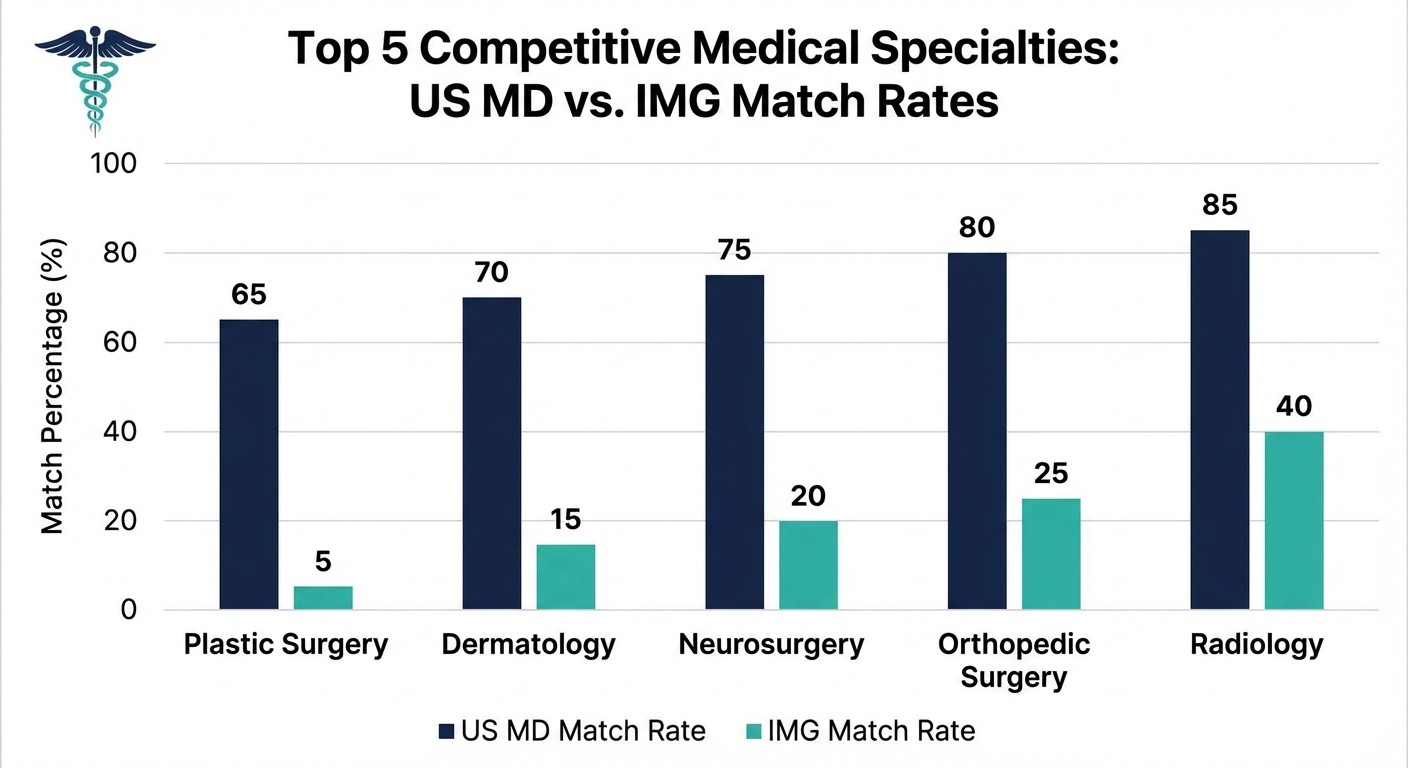
2025 Match Rate: 63% overall, 12% for IMGs Projected 2026: Slight improvement to 65% overall
Plastic surgery remains the most competitive specialty in American medicine. The integrated programs (PGY-1 start) matched just 184 residents out of 291 applicants in 2025. For IMGs, the reality is even harsher — only 8 out of 67 non-US IMG applicants matched.
What makes it brutal: Research publications average 15-20 per matched applicant. Most successful candidates have dedicated research years, often with plastic surgery faculty. The specialty demands both surgical skill demonstration and aesthetic sensibility. Step 2 CK benchmark: 255+ minimum, 265+ competitive. Oncourse's adaptive engine has identified wound management and reconstructive anatomy as high-yield topics that mirror the clinical reasoning tested in plastic surgery interviews.
2. Dermatology
2025 Match Rate: 67% overall, 9% for IMGs Projected 2026: Stable at 67-68%
Dermatology matched 416 residents from 622 applicants in 2025. The numbers haven't improved significantly over five years, making it consistently competitive. Only 11 out of 122 non-US IMG applicants matched — a 9% rate that reflects the specialty's preference for research-heavy US candidates.
Research requirements: Average 12-15 publications, with dermatopathology research particularly valued. Many matched applicants complete dedicated research years or master's degrees. Step 2 CK benchmark: 260+ minimum, 270+ competitive. Performance analytics show dermatopathology and immunology concepts need focused review — Oncourse tracks your percentile performance across these subtopics to identify gaps before application season.
3. Neurosurgery
2025 Match Rate: 75% overall, 15% for IMGs Projected 2026: 76-77% with slight growth
Neurosurgery matched 244 residents from 326 applicants. While more IMG-friendly than dermatology or plastics, the research bar remains sky-high. Successful candidates average 20+ publications and demonstrate commitment through neuroscience research tracks.
IMG advantage: Neurosurgery programs value international perspectives and research experience. Strong clinical performance in neurology rotations can offset geographic barriers. Step 2 CK benchmark: 250+ minimum, 260+ competitive. Neuroanatomy and neurosurgical emergencies require long-term retention — Oncourse's spaced repetition system schedules review of high-yield neurosurg anatomy concepts at optimal intervals months before application deadlines.
4. Orthopedic Surgery
2025 Match Rate: 80% overall, 18% for IMGs Projected 2026: Stable at 80-81%
Orthopedic surgery matched 776 residents from 968 applicants, making it more accessible than the top three but still highly competitive. IMG match rates improved slightly in 2025, reflecting growing international recruitment.
Research focus: Trauma, sports medicine, and biomechanics research dominate successful applications. Clinical research with quantifiable patient outcomes performs better than basic science. Step 2 CK benchmark: 250+ minimum, 258+ competitive. Orthopedic trauma scenarios and musculoskeletal pathology are frequently tested — adaptive question banks help identify these high-yield clinical vignettes.
5. Radiology
2025 Match Rate: 85% overall, 32% for IMGs Projected 2026: 86% overall, 35% for IMGs
Radiology offers the best IMG prospects among highly competitive specialties. The field matched 1,086 residents from 1,277 applicants, with 173 out of 542 IMG applicants successfully matching.
Why IMG-friendly: Radiology values pattern recognition and systematic analysis skills that many international graduates excel at. Research requirements are moderate (5-8 publications typical). Step 2 CK benchmark: 245+ minimum, 255+ competitive. Cross-sectional anatomy and imaging interpretation correlate directly with radiology success.
Step 2 CK Score Analysis: What Competitive Really Means
Score Distribution Reality Check
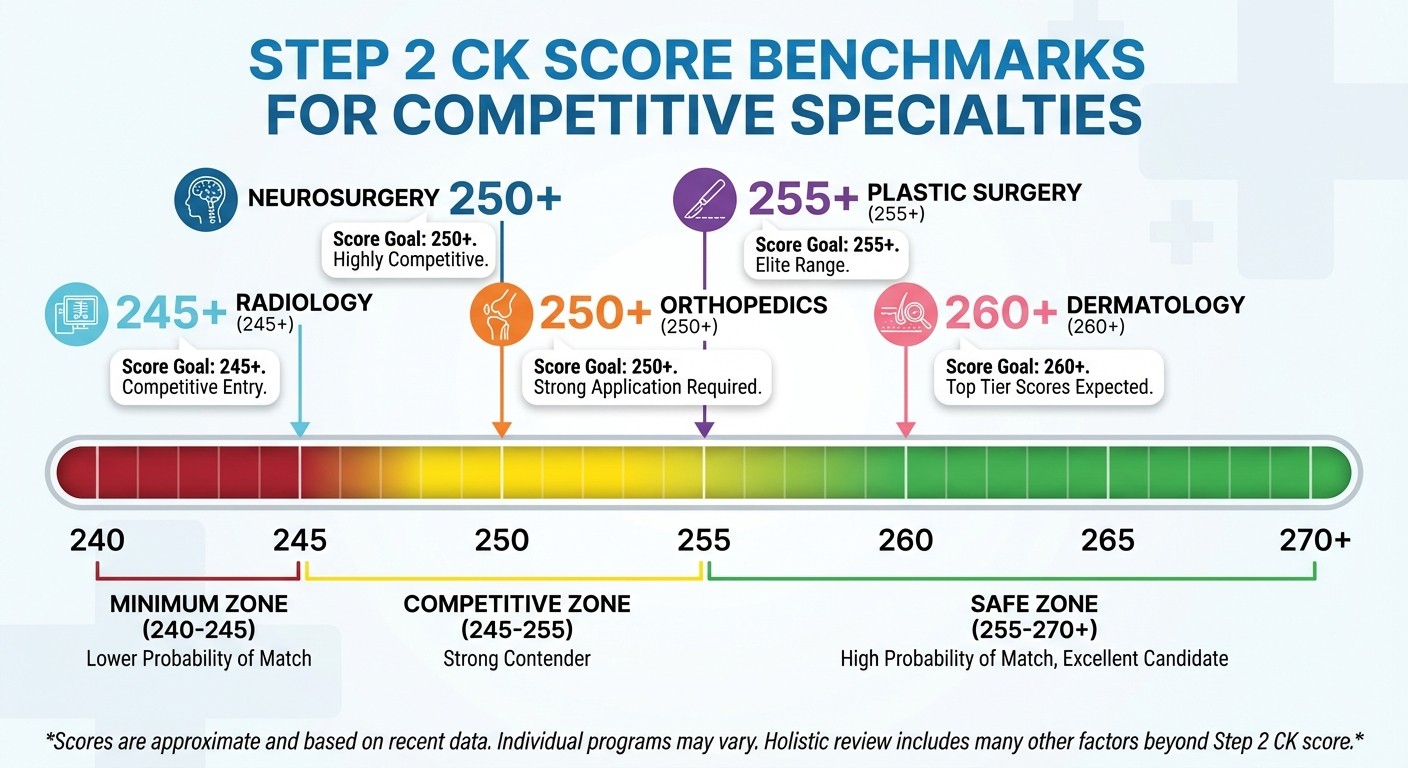
The 2025 NRMP data reveals dramatic Step 2 CK score requirements for competitive specialties:
Specialty | Minimum Score | 50th Percentile | 75th Percentile |
|---|---|---|---|
Dermatology | 260 | 268 | 275 |
Plastic Surgery | 255 | 265 | 272 |
Neurosurgery | 250 | 260 | 268 |
Orthopedic Surgery | 250 | 258 | 266 |
Radiology | 245 | 255 | 263 |
Key insight: "Minimum" scores represent the 10th percentile of matched applicants. Scoring at these levels gives you a chance but doesn't guarantee competitiveness.
IMG Score Premium
IMGs need to score 5-10 points higher than US graduates to be equally competitive:
Dermatology IMGs: 270+ to be competitive
Plastic Surgery IMGs: 265+ minimum consideration
Neurosurgery IMGs: 260+ for serious consideration
Orthopedics IMGs: 258+ competitive range
Radiology IMGs: 255+ strong position
This "IMG tax" reflects the additional scrutiny international graduates face in competitive specialties.
Research and Experience Benchmarks by Specialty
Publications That Matter
Dermatology: 12-15 publications minimum, with dermatopathology and immunodermatology research preferred. Case reports count but carry less weight than original research. Plastic Surgery: 15-20 publications, emphasizing reconstructive outcomes and aesthetic research. Biomechanics and tissue engineering studies demonstrate scientific rigor. Neurosurgery: 18-25 publications typical, with neuroscience research essential. Basic science publications in neurobiology or computational neuroscience highly valued. Orthopedic Surgery: 10-15 publications, focusing on trauma, sports medicine, or biomechanics. Clinical outcomes research with statistical analysis preferred. Radiology: 5-10 publications sufficient, with imaging research or artificial intelligence applications increasingly valued.
Clinical Experience Expectations
US Clinical Experience (UCEs): All competitive specialties expect 6+ months of US clinical rotations, with at least 2 months in the target specialty. Letters of Recommendation: 3-4 letters from specialty faculty required. Away rotations at target programs essential for securing strong letters. USCE Strategy: Focus rotations at academic medical centers with residency programs. Community hospital rotations carry less weight for competitive specialties.
IMG-Specific Success Strategies
Timeline for 2026 Match
January 2026: Complete Step 2 CK if aiming for September 2026 match. Scores need 3-6 months to process and be evaluated. March-June 2026: Secure away rotations for fall. Popular programs book 6+ months in advance. July-August 2026: Complete specialty rotations and secure letters of recommendation. September 2026: Submit ERAS applications with completed USCE and strong LORs.
Geographic Strategy
IMG-friendly regions: Midwest and Southeast programs show higher IMG match rates. Northeast and West Coast programs remain highly competitive for international graduates. Program size correlation: Larger programs (8+ residents per year) match more IMGs than smaller, boutique programs.
Backup Planning
IMG backup specialties: Internal medicine, family medicine, and psychiatry offer much higher match rates (70-85% for IMGs) while maintaining competitive fellowship pathways. Preliminary year strategy: Securing a preliminary surgery or medicine year provides US clinical experience for reapplication to competitive specialties.
Application Strategy: What Programs Actually Want
The Competitive Applicant Profile
Successful candidates in competitive specialties share common characteristics beyond high scores:
Research consistency: 2+ years of sustained research in the target specialty, not scattered publications across multiple fields. Clinical excellence: Honors grades in required rotations, particularly surgery for surgical specialties. Networking effectiveness: Meaningful relationships with faculty who can advocate during selection committees.
Red Flags That Kill Applications
Score timing: Late Step 2 CK scores (after August for September match) signal poor planning. Geographic mismatch: Applying broadly without understanding regional preferences wastes interview slots. Generic applications: Identical personal statements across specialties reveal lack of commitment.
2026 Trends Affecting Competitiveness
Increasing IMG Applications
International medical graduate applications to competitive specialties increased 15% in 2025, driven by improved USCE access post-COVID and growing global medical education quality.
Step 1 Pass/Fail Impact
With Step 1 scores removed, Step 2 CK carries 60-70% of standardized test weight. Programs use Step 2 scores for initial screening more aggressively.
Research Inflation
Publication requirements continue rising. The median number of publications for matched dermatology applicants increased from 8 in 2020 to 12 in 2025.
Geographic Concentration
Competitive programs increasingly cluster applications around major academic centers, creating regional disparities in match difficulty.
Score Improvement Strategies for Competitive Specialties
Adaptive Preparation Approach
IMGs targeting competitive specialties need elite Step 2 CK performance. Traditional question banks often miss the mark by using generic difficulty algorithms. Oncourse's adaptive engine identifies weak clinical domains specific to your target specialty — surgery-heavy scenarios for orthopedics candidates, immunology cases for dermatology aspirants.
The system prioritizes high-yield clinical vignettes that mirror the question complexity required for 260+ scores, automatically adjusting difficulty based on your performance patterns.
Performance Analytics for Precision Study
For IMGs targeting derm or plastics, broad preparation isn't enough. You need granular insight into exactly which subtopics need work before the match deadline. Oncourse's performance analytics track your percentile performance across Step 2 CK domains in real time, showing whether your dermatopathology knowledge ranks in the 90th percentile or needs focused review.
This benchmarking against top-matcher score distributions reveals hidden weak spots that could cost you crucial points on test day.
Long-term Retention for High-stakes Specialties
Competitive specialties require perfect recall of clinical facts months after initial learning. Generic review schedules don't account for the forgetting curves specific to high-yield medical concepts.
Oncourse's spaced repetition system schedules review of specialty-relevant concepts — orthopedic trauma classifications, neurosurgical anatomy landmarks — at scientifically-optimized intervals. This locks in knowledge 6+ months before application season when you're focused on rotations and research rather than content review.
Frequently Asked Questions
Can IMGs realistically match into dermatology or plastic surgery?
The numbers are brutal but not impossible. In 2025, 9% of IMG dermatology applicants and 12% of IMG plastic surgery applicants matched. Success requires exceptional Step 2 CK scores (270+ for derm, 265+ for plastics), extensive research experience, and strategic geographic targeting.
How much do Step 2 CK scores matter compared to research?
For initial screening, Step 2 CK scores carry 60-70% weight since Step 1 went pass/fail. However, research publications become decisive in final ranking decisions. You need both — high scores to pass initial cuts and strong research to rank favorably.
Should IMGs apply to multiple competitive specialties?
No. Competitive specialties require 2+ years of sustained research and specialty-specific clinical experience. Programs can spot scattered applications immediately. Choose one competitive specialty and one backup pathway.
What Step 2 CK score guarantees consideration for competitive specialties?
No score guarantees anything, but 270+ for dermatology, 265+ for plastic surgery, and 260+ for neurosurgery put you in seriously competitive ranges for IMGs. These scores place you above the 75th percentile of matched applicants.
How important are away rotations for competitive specialties?
Away rotations are essential — 90%+ of matched applicants complete rotations at their matched programs. They provide opportunities for strong letters of recommendation and demonstrate serious interest. Book rotations 6+ months in advance.
Can research make up for lower Step 2 CK scores?
Research can help but cannot fully compensate for significantly low scores. Programs use Step 2 CK for initial screening — exceptional research won't help if your application is filtered out before review. Aim for minimum competitive scores first, then leverage research for final ranking.
Prepare smarter with Oncourse AI — adaptive MCQs, spaced repetition, and AI explanations built for USMLE success. Download free on Android and iOS.